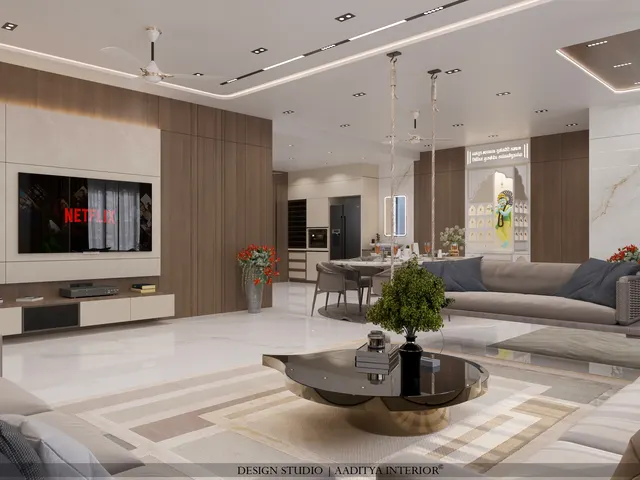
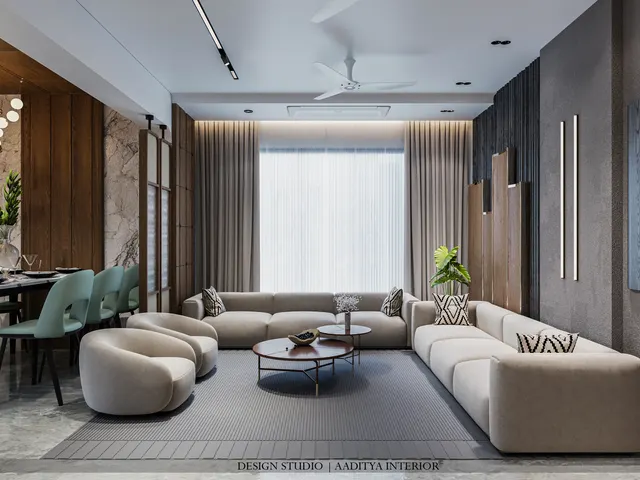
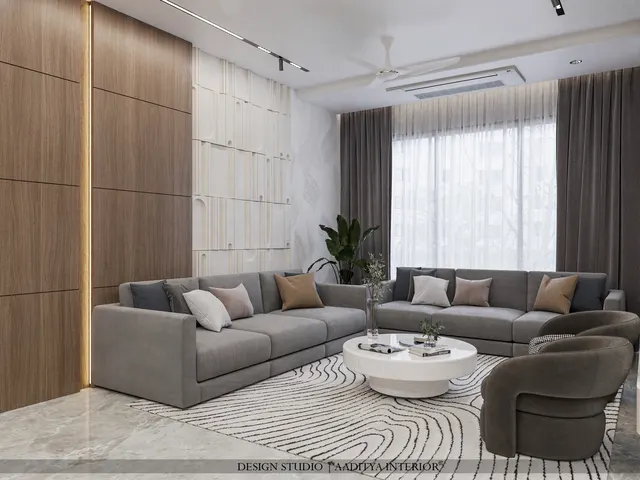
A 3D wall panel is a simple idea with a strong effect: instead of a flat painted wall, a repeating sculpted relief catches light and shadow and turns the whole surface into texture. On a television wall, behind a bed or in a reception area, a well-chosen 3D panel does in one move what a painting, a light and a texture coat together might attempt. The idea has spread fast across Indian homes and offices because it photographs beautifully and installs quickly — but that speed hides a decision most buyers never make properly, which is the choice of material.
The three materials sold as 3D wall panels — PVC, gypsum and MDF — look similar in a showroom photograph and behave completely differently on a wall. PVC is a light, hollow plastic sheet that is cheap and waterproof but can look plasticky and dents easily. Gypsum is a cast plaster tile that gives a seamless, paintable surface but is heavy, brittle and vulnerable to water. MDF, routed on a CNC machine, gives the crispest, deepest and most premium relief of the three, paints to a flawless finish, but swells if it ever gets wet. Buying the wrong one for the room is the single most common mistake, and it is the thing this article is written to prevent.
What follows compares the three honestly on the things that actually matter — the quality of the look, resistance to moisture and fire, weight and fixing, repairability and cost — and then sets out panel sizes, fixing details and the rooms each material suits. Prices are indicative October 2026 ranges and vary with design, depth and brand; a local supplier should confirm them before any order.
From moulded plaster to the CNC router: a short history
Relief on walls is not new. Classical and traditional interiors carried sculpted plaster — cornices, ceiling roses and moulded panels — cast by hand in gypsum or lime and fixed to the wall. What is new is the industrial, repeatable 3D panel: a modular tile, made in a factory, that a fitter can install across a whole wall in an afternoon. Two developments made it possible. First, cheap plastic extrusion and vacuum-forming made hollow PVC panels that are light enough to stick up with adhesive. Second, and more importantly for quality, the CNC router let designers carve any relief they liked into MDF, so the carved look that once needed a craftsman could be cut by a machine from a drawing.
Gypsum sits between the two traditions: it is the old cast-plaster idea made modular, poured into silicone moulds as square tiles that are then jointed and painted on site to read as one seamless sculpted wall. Each of the three materials therefore carries its history into its behaviour — PVC is a plastic product and behaves like one, gypsum is cast plaster and behaves like one, and MDF is a routed board and behaves like one. Understanding that is most of the way to choosing correctly.
The three materials, compared honestly
The look is where buyers are most often fooled by a photograph. PVC panels, being vacuum-formed from thin plastic, have soft, rounded relief and a faint plastic sheen; from a distance they read well, but up close and in daylight they can look exactly like what they are. Gypsum gives a soft, matte, paintable surface with crisp cast detail, and because the joints are filled and painted over, a gypsum wall can read as one continuous sculpted plane — its great advantage. MDF, routed and then painted or laminated, gives the sharpest edges and the deepest, most controlled relief of the three, and because the pattern is cut rather than moulded it can be any design at any scale.
Moisture is the clearest divider. PVC is genuinely waterproof and can go in bathrooms, balconies and kitchens without worry. Gypsum resists ordinary humidity but will soften and stain if it gets properly wet, so it belongs on dry internal walls. MDF is the most moisture-sensitive of all: it swells irreversibly if water reaches the board, so it must stay in dry, air-conditioned or well-ventilated rooms and never go near a wet wall. Fire behaviour follows a similar logic — gypsum is the most naturally fire-resistant, PVC melts and can emit smoke, and MDF is combustible — which matters in commercial and high-rise settings where fire norms apply.
| Property | PVC panel | Gypsum panel | MDF (CNC routed) |
|---|---|---|---|
| Typical look | Soft relief, slight plastic sheen | Seamless, matte, paintable | Sharpest, deepest, most premium |
| Moisture | Waterproof — any room | Humidity-tolerant, not wet | Dry rooms only — swells if wet |
| Fire | Melts, can emit smoke | Most fire-resistant | Combustible |
| Weight | Very light | Heavy | Medium |
| Joints | Visible unless well-fitted | Filled and painted — seamless | Visible module lines (often by design) |
| Repair | Replace a panel | Patch and repaint | Replace a panel |
| Finish | Pre-finished colour / film | Painted on site | Paint, PU or laminate |
Sizes, depth and how a panel wall reads
Panel sizes follow the material. PVC 3D panels are commonly made in squares of about 500 × 500 mm or 600 × 600 mm; gypsum tiles are similar, often 300 × 300 to 600 × 600 mm; MDF panels are cut from standard 2440 × 1220 mm boards, so an MDF feature wall is usually planned as a set of large panels sized to the wall rather than small repeating tiles. The module size changes how the wall reads: small tiles give a dense, all-over texture with many joints, while large MDF panels give a few bold shadow lines and a calmer, more architectural result.
Relief depth is the other lever. A shallow relief of a few millimetres reads as gentle texture; a deep relief of 20 mm or more throws strong shadows and reads as sculpture, but it also casts hard shadow lines across every joint and every bump in the wall behind. That is why the wall preparation matters as much as the panel: a deep-relief panel on an uneven wall will show every undulation in raking light. Designers choose shallow relief for busy, lit walls and deep relief for a single dramatic feature on a wall that has been made flat first.
Fixing: adhesive or mechanical
There are two ways to fix 3D panels, and the right one depends on the material and the wall. Light panels — PVC and small gypsum tiles — are usually stuck directly to a sound, flat, dry wall with a construction adhesive, sometimes with a few mechanical fixings for safety on larger pieces. Heavier gypsum and all MDF panels are better fixed mechanically: battens are fixed to the wall, and the panels are screwed or pinned to the battens, which both carries the weight safely and lets the fitter pack out an uneven wall to a true plane. The batten method also leaves a cavity that can hide wiring for lighting.
Whatever the method, two preparations decide success. The wall behind must be flat and dry: adhesive will not hold on a damp or dusty wall, and deep relief will advertise every hump in a wall that has not been made true. And the setting-out must start from the centre of the wall so that any cut panels fall equally at both ends, rather than leaving a thin sliver on one side. On an MDF wall, any lighting — a cove, an edge strip, a backlight behind the panel — must be wired before the panels close the wall, because opening a finished panel wall to add a cable later is destructive.
| Fixing method | Best for | Needs | Benefit |
|---|---|---|---|
| Direct adhesive | PVC, small gypsum tiles | Flat, dry, sound wall | Fast, thin build-up |
| Battens + screws/pins | Heavy gypsum, all MDF | Battens fixed to wall | Carries weight, trues an uneven wall |
| Adhesive + mechanical | Large panels for safety | Both, on sound wall | Security against panels dropping |
| Concealed clip / groove | Premium MDF systems | Precise setting-out | Hidden fixings, crisp joints |
Finishing and durability
Finish is part of the material choice, especially for MDF. A routed MDF panel can be painted in any colour, sprayed in PU for a seamless premium surface, or faced in laminate for toughness, and the finish changes both the look and the price — a PU-finished MDF panel reads as solid lacquered joinery, while a laminated one shrugs off knocks in a busy room. Gypsum takes ordinary wall paint, which is its great convenience: the jointed tiles are filled, sanded and painted in the room's wall colour so the relief reads as sculpted plaster rather than applied tiles. PVC comes pre-finished in a colour or film, which is why its finish is the hardest of the three to make look genuinely expensive.
Durability follows the material and the finish. MDF with a laminate or PU face is the toughest of the three against knocks and cleaning and suits busy family and commercial walls; painted gypsum is easily marked but just as easily patched and repainted; PVC resists water and cleaning but dents under a knock and cannot be repaired, only replaced. None of the three is a hardwearing surface at low level in a high-traffic route, so in corridors and stairwells a 3D panel is best kept above the zone where shoulders, trolleys and children reach.
A sculpted panel wall also does a little for sound. The broken, three-dimensional surface scatters reflections rather than bouncing them straight back, which softens the hard echo of a bare plastered wall — most noticeable in a large living room or a reception. The effect is modest and should not be oversold as acoustic treatment, but combined with soft furnishings it helps a room sound calmer, and it is a quiet bonus on top of the visual reason the panel was chosen.
Which material for which room
The choice becomes simple once the room is known. In a bathroom, a balcony, a kitchen splash zone or any damp wall, only PVC is safe. On a dry internal feature wall where a seamless, painted, sculptural plane is wanted — a living-room or bedroom accent — gypsum is the natural choice, with its joints filled to read as one surface. Where the brief calls for a crisp, premium, designed relief with sharp edges, a specific pattern or a laminate or PU finish — a television wall, a headboard wall, a reception desk back — MDF is the material, provided the room stays dry. In short: PVC where it is wet, gypsum where it should be seamless, MDF where it should be sharp and premium.
Budget usually reinforces the same decision rather than fighting it, because the three materials sit at different price points that happen to match their looks. A small list of questions settles most projects: Is the wall ever damp? Should the relief read as one seamless plane or as crisp designed panels? And how much depth and sharpness does the design need? The answers point at one material almost every time.
| Room / wall | Recommended material | Why |
|---|---|---|
| Bathroom, balcony, kitchen splash | PVC | The only genuinely waterproof option |
| Living or bedroom feature wall (seamless) | Gypsum | Joints fill to one painted plane |
| TV wall, headboard, reception back | MDF (CNC routed) | Crisp, deep, premium relief |
| High-traffic corridor, low level | Avoid a 3D panel low down | None is hardwearing at shoulder height |
| Commercial wall where fire matters | Gypsum | Most fire-resistant of the three |
What 3D wall panels cost
The figures below are indicative October 2026 installed ranges per square foot, excluding GST, covering material, adhesive or battens and fixing, but not lighting or the paint or laminate finish where that is separate. They vary with relief depth, design complexity, brand and city, and should be confirmed with a local supplier. As a point of reference, a typical 3600 × 2700 mm television wall is about 105 square feet of panel work, so multiplying the rate by roughly a hundred gives a quick sense of the wall's cost.
| Material | Indicative installed cost (₹/sq ft) | Finish included? | Best used for |
|---|---|---|---|
| PVC 3D panel | ₹80 – ₹200 | Pre-finished colour / film | Bathrooms, balconies, budget feature walls |
| Gypsum 3D panel | ₹150 – ₹350 | Paint extra (site-painted) | Seamless dry-room feature walls |
| MDF (CNC routed), painted | ₹350 – ₹700 | PU / paint extra on complex work | Premium TV walls, headboards, receptions |
| MDF (CNC routed), laminate | ₹500 – ₹900 | Laminate included | Durable premium panels, commercial |
Where 3D wall panels are going
Two trends are shaping the next generation of panels. The first is parametric design: CNC routing means any relief a designer can draw can be cut, so panels are moving away from a handful of catalogue patterns towards custom reliefs designed for a specific wall, sometimes flowing across several panels as one continuous landscape. The second is better materials — more convincing finishes on PVC, more moisture-tolerant boards, and fluted and slatted systems that blur the line between a 3D panel and timber cladding. The underlying appeal will not change: a wall that is sculpted rather than flat, made alive by light. The craft is in matching the material to the room and the light to the relief.
Eight rules for specifying 3D wall panels
- Match the material to moisture: PVC where it is ever damp, gypsum and MDF only on dry walls.
- Choose gypsum when the wall should read as one seamless painted plane; choose MDF when it should be crisp and premium.
- Make the wall flat and dry first — deep relief shows every hump in raking light.
- Set out from the centre so cut panels fall equally at both ends.
- Fix heavy gypsum and all MDF to battens, not adhesive alone, to carry weight and true the wall.
- Match relief depth to the light: shallow for busy lit walls, deep for a single prepared feature.
- Wire all lighting before the panels close the wall, especially on MDF.
- Respect fire norms in commercial and high-rise work — gypsum resists fire, PVC and MDF do not.
Frequently asked questions
Which 3D wall panel is best — PVC, gypsum or MDF?
There is no single best; each wins in its place. PVC is best where the wall can get wet and the budget is tight. Gypsum is best for a seamless, painted, sculptural dry-room wall. MDF is best for a crisp, deep, premium relief with a paint, PU or laminate finish, as long as the room stays dry. Choose by moisture first, then by the look you want.
Can 3D wall panels be used in a bathroom?
Only PVC panels should go in a bathroom or any wet wall, because PVC is genuinely waterproof. Gypsum tolerates humidity but not real water, and MDF swells irreversibly if it gets wet, so neither belongs in a shower or splash zone. For a dry bathroom wall away from water, gypsum can work, but PVC is the safe default where moisture is present.
Do 3D wall panels need a flat wall behind them?
Yes — the flatter the better, especially for deep relief. Grazing light across a sculpted panel will reveal every hump and dip in the wall behind it. Light panels are stuck to a flat, dry wall; heavier and MDF panels are screwed to battens, which both carries the weight and lets the fitter pack the panels out to a true plane over an uneven wall.
How are 3D wall panels fixed?
Light PVC and small gypsum tiles are usually stuck to a sound, flat, dry wall with construction adhesive. Heavier gypsum and all MDF panels are fixed to battens with screws or pins, which carries the weight safely, allows an uneven wall to be trued, and leaves a cavity for wiring. Large panels often get both adhesive and mechanical fixings for security.
How much do 3D wall panels cost in India?
Indicative October 2026 installed ranges are about ₹80-200 per square foot for PVC, ₹150-350 for gypsum (paint extra), and ₹350-900 for CNC-routed MDF depending on whether it is painted or laminated, excluding GST. A typical television wall of roughly 105 square feet therefore ranges widely with the material, so the material choice drives the budget as much as the design.
Sources & standards
- Bureau of Indian Standards — IS 2095 (gypsum plaster boards) and IS 12406 (medium density fibreboard)
- National Building Code of India 2016, Part 4 (Fire and Life Safety) — surface finish and fire behaviour of wall linings
- Neufert, Architects' Data — wall finishes, panelling and setting-out of modular cladding
- Time-Saver Standards for Building Types — interior finishes and feature walls
- Gypsum and PVC panel manufacturers' standard technical data (panel sizes, thickness and fixing), described generically
- Price ranges: indicative October 2026 estimates — confirm locally before budgeting