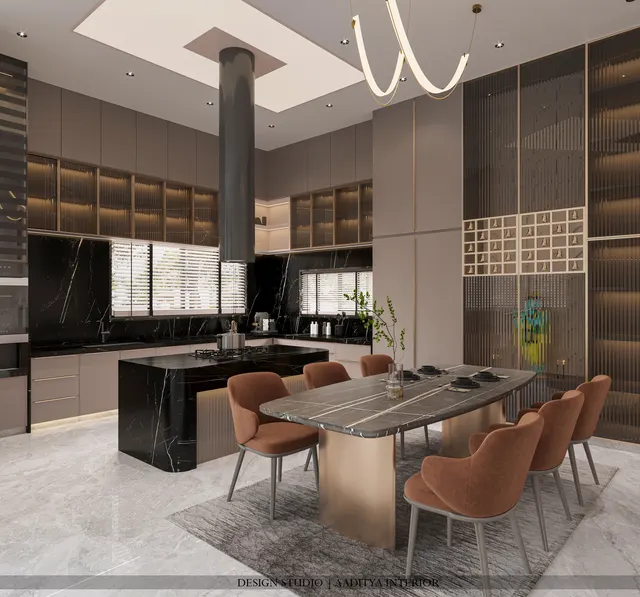
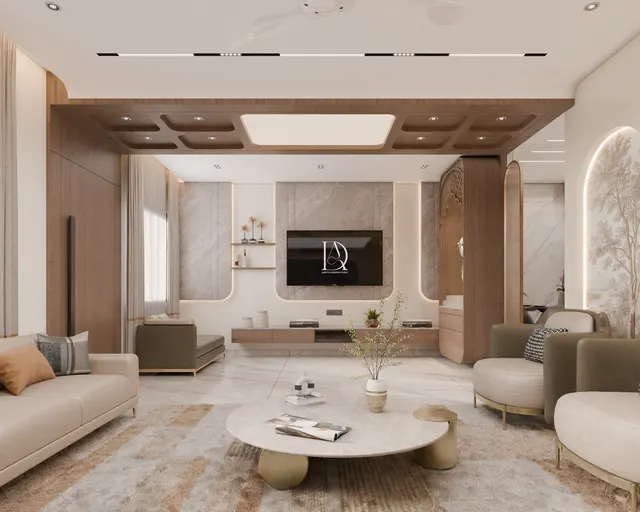
In the last few years one finish has spread across Indian homes faster than almost any before it: the charcoal fluted panel. It appears on television walls, behind beds, in entrance lobbies, on reception desks, around pillars and down passage walls — a dark, ribbed, slatted surface that reads as warm wooden battens from across a room. It is cheap, it goes up in a day, it hides an uneven wall, and it photographs beautifully, which is why it has become the default feature-wall material for budget and mid-range interiors alike. It is also widely misunderstood, often oversold, and frequently fixed in the wrong place with the wrong method.
The confusion starts with the name. "Charcoal" here is not charcoal at all; it is a colour and a loose label for a family of extruded polymer and wood-polymer panels, usually dark grey or black with a wood-grain film, moulded with vertical ribs or flutes on the front. They are sold under many trade names and vary enormously: some are hollow PVC with a thin printed skin that dents and fades; others are denser wood-plastic composite that feels almost like board. Buyers rarely know which they are getting, and the gap between the best and worst products is wide — in durability, in how they take sunlight, and in how they behave in a fire.
This article explains what charcoal fluted louver panels actually are, how the main types differ, what sizes they come in and how to set them out, how they are fixed and where each method suits, where they work well and where they fail, and what they cost. The aim is to let a homeowner or designer specify them deliberately — choosing the right type for the location and fixing it to last — rather than buying the cheapest panel in the showroom and hoping.
What charcoal fluted panels actually are
A fluted panel is simply a board with a repeating profile of vertical ribs — flutes — on its face, so that light catches the ridges and throws soft shadows between them, giving the look of a run of slim wooden slats without the cost and weight of real timber battens. The "charcoal" versions are dark-toned, usually a deep grey or near-black, often with a wood-grain or matt finish printed or laminated onto the surface. Almost all of the panels sold under this name in India are extruded from polymer: either hollow or solid PVC, or a wood-plastic composite (WPC) that blends wood flour with plastic for a denser, more board-like feel. Some premium fluted panels are instead made of MDF or laminate for interiors, which is a different and generally better-quality product covered separately in this blog's panelling guides.
Where fluted panels came from
Decorative wall cladding in plastic is not new — PVC panelling has been used for budget ceilings and bathroom walls in India for years — but the charcoal fluted look is a recent arrival, part of a global wave of wood-plastic composite wall panels that spread from East Asian manufacturing into Indian interiors through the 2010s and exploded in popularity in the 2020s. The appeal was obvious: the fluted, slatted aesthetic was fashionable in high-end architecture, where it was executed in solid timber battens at considerable cost, and the extruded polymer panel delivered a convincing version of the same look for a fraction of the price and effort. As supply grew and prices fell, the panels moved from feature walls in showrooms into ordinary homes, and the charcoal shade became the signature colour of the trend.
That rapid spread is both the strength and the weakness of the material. It democratised a desirable look, letting modest budgets get a rich, textured feature wall. But it also flooded the market with products of wildly varying quality, sold on price with little information about what they are made of or how they will last. A panel that looks identical in the showroom may be dense WPC that lasts for years or thin hollow PVC that dents and fades within months. The sections below separate the types so a buyer can tell them apart.
| Type | Make-up | Feel and durability | Sunlight | Best use |
|---|---|---|---|---|
| Hollow PVC fluted | Extruded PVC with hollow ribs, printed film | Lightest, cheapest; dents, film can peel | Fades and can warp in strong sun | Budget dry interior feature walls |
| Solid / foamed PVC fluted | Denser PVC, printed or matt skin | Firmer than hollow; still a plastic | Better than hollow but still indoor | Dry interiors, better durability |
| WPC fluted | Wood flour and plastic composite | Densest, most board-like; holds fixings | More stable; some grades semi-outdoor | Feature walls, semi-outdoor shaded areas |
| WPC louvers (deep battens) | Heavier WPC profiles, wider spacing | Stronger, more three-dimensional | Some grades rated for shaded exteriors | Facades (shaded), partitions, ceilings |
| MDF / laminate fluted (reference) | Routed MDF with laminate or paint | Smoothest, premium; dry only | Indoor only | Premium dry interiors (see panelling guide) |
Sizes and setting out
Charcoal fluted panels are sold as long strips, which controls how they are planned on a wall. A very common size is a strip roughly 2900–3000 mm long and about 160 mm wide, with the flutes running along the length, so that each strip covers a tall vertical band and several strips butt together side by side to clad a wall. Other widths and lengths exist, and WPC louver profiles come in heavier, wider sections. Because the strips are long and narrow, the setting-out question is where the vertical joints between strips fall and how the flute rhythm continues across them: a good installer plans the layout so the joint lines are either invisible in the flute valleys or deliberately placed, and so that part-width strips at the ends are balanced rather than leaving a thin sliver on one side.
| Property | Typical value | Note |
|---|---|---|
| Strip length | 2900 – 3000 mm (common) | Covers most Indian floor-to-ceiling walls |
| Strip width | About 160 mm (common) | Several strips butt to clad a wall; other widths exist |
| Panel thickness | 12 – 22 mm (flute depth varies) | Deeper flutes read more strongly |
| Flute pitch | 40 – 60 mm | Rib-to-rib spacing; sets the slat rhythm |
| WPC louver profiles | Wider, heavier sections | For deeper, more three-dimensional battens |
| Coverage per strip | Roughly 0.45 – 0.5 sq m | Buy 5–10 % extra for cuts and wastage |
Fixing methods and where each suits
How a fluted panel is fixed decides whether it stays flat, stays up and can ever be removed. There are four common methods. Direct adhesive — bonding the panel to the wall with construction adhesive — is the fastest and cheapest and suits a flat, sound, dry wall, but it is permanent and only as good as the wall surface behind. Pin or screw fixing through the panel into the wall, with the heads hidden in the flute valleys or filled, is more secure and suits slightly uneven walls. Batten fixing — screwing timber or WPC battens to the wall first and then fixing the panels to the battens — is the most robust, lets air move behind the panel, copes with uneven walls, and is the right method for taller or heavier installations and for anything semi-outdoor. Clip or spline systems, where panels lock onto a track or into each other, allow neat joints and some removability. The table matches method to situation.
| Fixing method | Best for | Pros | Watch out for |
|---|---|---|---|
| Direct adhesive | Flat, sound, dry walls | Fast, cheap, no battens | Permanent; only as good as the wall; not for wet areas |
| Pin / screw | Slightly uneven dry walls | More secure than glue alone | Heads must hide in valleys or be filled neatly |
| Batten (framed) | Tall, heavy or semi-outdoor | Robust; air gap; copes with uneven walls | Adds thickness; needs rust-proof fixings outdoors |
| Clip / spline | Neat joints, some removability | Tidy, demountable | System-specific; fewer panel choices |
Where fluted panels work and where they fail
Charcoal fluted panels are at their best on a dry interior feature wall out of direct sunlight: a television wall, a bed back, a passage, a reception or a lobby, where they add warmth and texture cheaply and hide an imperfect wall. They fail, sometimes quickly, in three situations. In strong direct sunlight — a west wall, a sun-struck balcony, a bright window-facing wall — many PVC panels fade and some warp, because the polymer and the printed film are not UV-stable unless specifically rated. In wet areas — bathrooms, open balconies, anywhere water sits behind or on them — panels that are not genuinely exterior-grade trap moisture and the fixings and any timber battens behind them suffer. And on fire-sensitive walls — escape routes, around cooking, in commercial premises — ordinary polymer panels can be a concern, because many have poor surface-spread-of-flame performance, so for such locations the fire rating of the specific product must be checked against the National Building Code's requirements rather than assumed. Matching the panel grade to the location is the whole discipline.
| Location | Suitable? | Condition |
|---|---|---|
| Dry interior feature wall, shaded | Yes | Any good-quality panel; the ideal use |
| West or sun-struck wall | Caution | Only UV-stable grades; cheaper PVC fades and warps |
| Bathroom / wet area | Mostly no | Only genuinely exterior/water-grade WPC, detailed to shed water |
| Open balcony / exterior | Caution | Exterior-rated WPC louvers only, battened with rust-proof fixings |
| Escape route / commercial | Check fire rating | Verify surface-spread-of-flame against NBC Part 4 |
| Kitchen near cooking | Caution | Away from direct heat and grease; check fire performance |
What they cost
Charcoal fluted panels are popular partly because they are cheap, but the range is wide and reflects the quality gap. Hollow PVC panels are the budget end; denser WPC panels and deeper louver profiles cost more; and premium MDF or laminate fluted panels, a different product, cost more again. The figures below are indicative October 2026 ranges for supply and installation per square foot in metro and tier-2 cities, excluding GST and electrical work, and are consistent with this blog's other panelling and cladding guides. Installation adds to the material cost, and battened or semi-outdoor fixing costs more than direct adhesive.
| Panel | Indicative October 2026 (₹/sq ft) | Note |
|---|---|---|
| Hollow PVC fluted (supply) | ₹130 – ₹250 | Budget; material only, before fixing |
| PVC fluted, installed | ₹250 – ₹400 | Direct adhesive on a sound dry wall |
| WPC fluted / louvers, installed | ₹300 – ₹500 | Denser, more durable; battened costs more |
| Fluted laminate / MDF (reference) | ₹350 – ₹850 | Premium dry-interior product; see panelling guide |
| Battened fixing (extra) | Adds to the above | Battens, air gap, labour; needed for tall/semi-outdoor |
For a typical television wall of about 3600 × 2700 mm — roughly 105 sq ft — charcoal PVC fluted panels installed at ₹250–400 per sq ft work out to roughly ₹26,000–42,000, and a denser WPC installation higher. That is a fraction of the cost of the same wall in solid timber battens, which is the trade the material makes: a convincing version of an expensive look, for far less, at the price of being a polymer that will not last or refinish like real wood. Aaditya Interior's usual advice is to use fluted panels where their speed and economy genuinely help — a quick, warm feature wall in a dry, shaded spot — and to spend on solid timber or MDF where the wall is seen and touched up close every day.
Where the trend is going
The fluted look is maturing rather than fading. As the first wave of cheap panels ages and some disappoint, buyers are becoming more discriminating about grade, UV stability and fire performance, and manufacturers are responding with better WPC formulations, genuinely exterior-rated louver systems and clearer specifications. The palette is broadening beyond charcoal into warmer woods, lighter greys and painted MDF flutes, and designers are using the texture more sparingly — one considered feature wall rather than every surface in the home. The sensible direction for a homeowner is the same as the direction of the market: treat fluted panels as one useful, affordable finish among many, specify the right grade for the location, fix it properly, and avoid the temptation to wrap a whole house in a trend that will date.
Rules for specifying charcoal fluted louver panels
- Know what you are buying — ask whether the panel is hollow PVC, solid PVC or WPC, because durability depends on it.
- Use them where they shine: dry, shaded interior feature walls — television walls, bed backs, lobbies, passages.
- Keep ordinary PVC panels out of strong direct sun; use only UV-stable or WPC grades on sun-struck walls.
- Do not use non-exterior panels in bathrooms or open balconies; only genuinely water-grade WPC, detailed to shed water.
- Check the fire rating against NBC Part 4 for escape routes, commercial premises and walls near cooking.
- Fix tall, heavy or semi-outdoor panels on battens with an air gap and rust-proof fixings, not glue alone.
- Start plumb and true and plan joints to fall in a flute valley — vertical ribs expose every lean and gap.
- Buy 5–10 per cent extra for cuts and wastage, and keep a spare strip for future repairs, as colours change between batches.
Frequently asked questions
Are charcoal fluted panels made of real wood?
No. Despite the wood-grain look, almost all charcoal fluted panels sold in India are extruded polymer — hollow or solid PVC, or a wood-plastic composite (WPC) that mixes wood flour with plastic. The grain is a printed or laminated film. Genuine timber fluted battens and routed MDF fluted panels exist and are a different, generally better-quality and more expensive product covered in this blog's panelling guides.
Can fluted panels be used in a bathroom or outdoors?
Only if the panel is genuinely exterior or water grade — most charcoal fluted panels are not. Ordinary PVC and interior WPC panels trap moisture in wet areas and fade or warp in strong sun, and the battens and fixings behind them suffer. For bathrooms, open balconies or exteriors, use only panels the manufacturer rates for that exposure, fixed on battens with rust-proof fixings and detailed to shed water, or choose a different material.
How are charcoal fluted panels fixed to the wall?
By one of four methods: direct construction adhesive on a flat, sound, dry wall; pins or screws into a slightly uneven wall, with the heads hidden in the flute valleys; battens screwed to the wall with the panels fixed to them, which is the most robust and the right choice for tall, heavy or semi-outdoor work; or a clip and spline system for neat, demountable joints. Whichever method, the installation must start plumb and true because the vertical ribs expose any lean.
How much do charcoal fluted panels cost?
Indicatively in October 2026, PVC fluted panels cost about ₹130–250 per sq ft as material and ₹250–400 per sq ft installed, while denser WPC fluted panels and louvers run about ₹300–500 per sq ft installed. Premium MDF or laminate fluted panels, a different product, cost about ₹350–850 per sq ft. A 105 sq ft television wall in PVC fluted panels is therefore roughly ₹26,000–42,000 installed, a fraction of the same wall in solid timber battens.
Do charcoal fluted panels fade or last?
It depends entirely on the grade and the location. A good WPC panel on a dry, shaded interior wall lasts for years with little change. A cheap hollow PVC panel in strong direct sun can fade, discolour and even warp within months, because its polymer and printed film are not UV-stable. The way to avoid disappointment is to match the panel grade to the exposure, keep ordinary panels out of direct sun and wet areas, and buy from a supplier who can say what the panel is made of.
Sources & standards
- National Building Code of India 2016, Part 4 (Fire and Life Safety) — surface spread of flame and finish requirements for walls and escape routes
- Bureau of Indian Standards — IS codes for unplasticised PVC and wood-plastic composite building products and their performance (described generically)
- Energy Conservation Building Code (ECBC) and IGBC/GRIHA guidance — material and finish selection for durability and indoor environment
- Neufert, Architects' Data, and Time-Saver Standards for Building Types — wall finishes, cladding and battened linings
- Wood-plastic composite and PVC panel manufacturers' generic specifications — strip sizes, flute profiles, UV and exterior ratings (described generically)
- Price ranges: indicative October 2026 estimates — confirm locally before budgeting