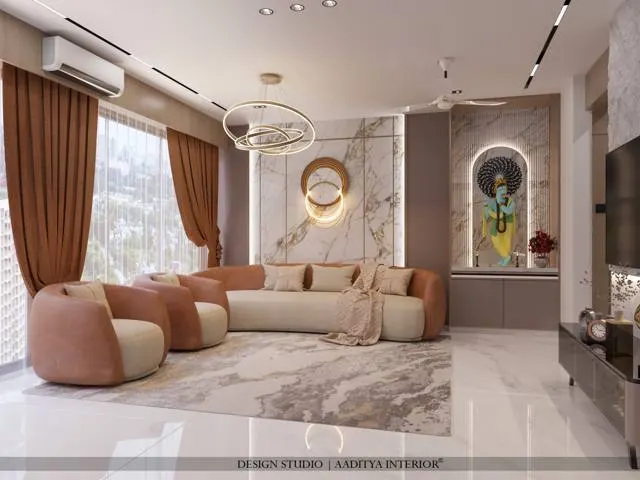
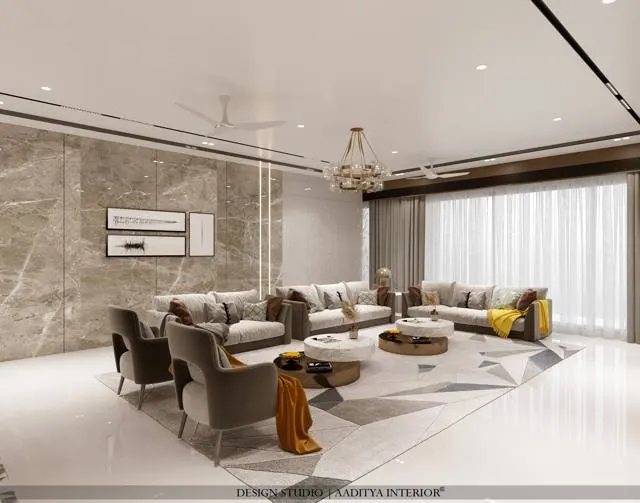
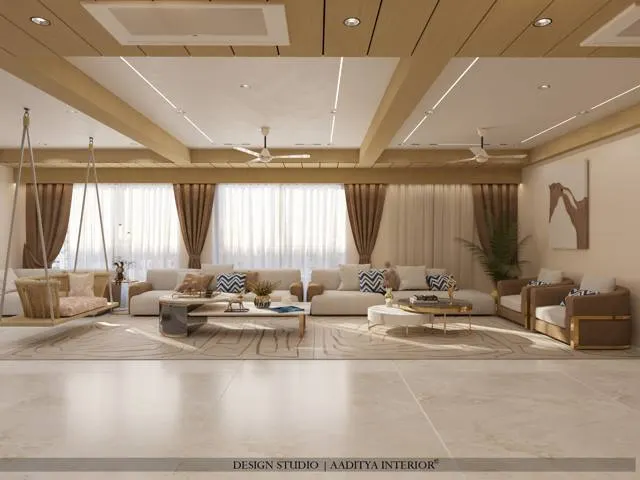
In most Indian living rooms the coffee table — often called the centre table — is the one piece of furniture that every person in the room uses, and the one piece most often bought by eye. It holds the tea tray when guests arrive, the remote, the newspaper, the bowl of dry fruit at Diwali, the children's homework on a Sunday and, increasingly, a laptop. Because it sits in the middle of the room, it also decides how people move: get its size wrong and every trip from the sofa to the balcony becomes a sideways shuffle past someone's knees.
The common mistakes are predictable. Tables bought from a showroom floor look modest beside a large display sofa, then dominate a 12 × 14 ft living room at home. Tables are chosen too low for a deep, high-seated Indian sofa, so lifting a cup means leaning forward. Glass tops with sharp corners are placed in homes with toddlers and elderly parents. Marble tops are ordered on legs too slender to carry them. And a table with storage drawers ends up so close to the sofa that the drawers cannot open.
This guide sets out the numbers that prevent those mistakes: the height relationship to the sofa seat, the length and width relationship to the sofa, the clearances around the table, how shape changes with layout, what different materials weigh and cost, and how the coffee table is evolving in smaller, multi-use Indian homes. Dimensions are given in millimetres with approximate inches and feet where furniture is commonly sold that way.
Where the coffee table came from
The low table placed in front of seating is an old idea in many cultures. Across Asia, people sitting on the floor or on low platforms used low tables for food and tea; the Indian baithak, with its gaddis and bolsters, used low wooden chowkis and trays at a height that suited people seated on the floor. In Europe, by contrast, the long, low table in front of a sofa became common only in the late nineteenth and early twentieth centuries, as upholstered sofas spread into middle-class drawing rooms and the habit of taking tea in the sitting room grew. Furniture historians generally describe the coffee table as a relatively modern form for that reason.
The twentieth century gave the coffee table most of the shapes we still buy. Modernist designers treated it as a sculptural object at the centre of an open living room: glass tops on chrome or timber bases, free-form biomorphic tops, low slab tables in solid wood. Mid-century designs, many still produced under licence today, set the expectation that a coffee table should look light and should not block the view across a room. In Indian homes, the shift from floor seating to sofas through the second half of the century turned the chowki into the centre table, and carpenter-built tables in teak and sheesham — often with a glass insert over a carved panel — became a standard part of the living-room set.
Today the coffee table has to do more than its ancestors did. Living rooms in city flats are smaller; the same room is a television room, a guest room, a study and a dining overflow. That is why storage tables, lift-tops, nesting pairs and ottomans have grown in popularity, and why the dimensions below matter more, not less, than they did when living rooms were larger.
How high should a coffee table be?
Coffee table height is set by the sofa, not by the table catalogue. The working rule used by designers is that the tabletop should be level with the top of the seat cushion or slightly below it — typically 25–50 mm lower. At that height a seated person can put down and pick up a cup with a short reach, the table does not block the view of the television, and the eye reads the sofa and table as one low composition. A table higher than the seat feels like a barrier; one much lower than the seat forces people to bend forward, which is uncomfortable for elders and for anyone holding a hot cup.
Most Indian sofas have a finished seat height of about 430–470 mm, which is why the standard coffee table is 400–450 mm high — the same figure this site's sofa, living-room and Vastu layout guides use. Deep lounge sofas and low modular sofas sit lower, around 380–420 mm, and pair with a 350–400 mm table. Upright sofas for older users, or formal sofas with firm seats, may reach 480–500 mm and can take a 450–480 mm table. Always measure the seat with the cushion compressed by a seated adult, because a soft cushion can sink 30–50 mm.
| Sofa type | Typical seat height (compressed) | Recommended coffee table height | Notes |
|---|---|---|---|
| Low lounge or modular sofa | 380–420 mm | 350–400 mm | Deep seats; a taller table looks heavy and blocks the TV |
| Standard Indian 3-seater | 430–470 mm | 400–450 mm | The common case; most ready tables are 400–450 |
| Firm formal sofa or sofa for elders | 460–500 mm | 430–480 mm | Higher table reduces bending for people with knee or back pain |
| Floor seating, baithak or diwan | 150–300 mm | 300–380 mm (chowki) | Table slightly above cushion height for floor sitting |
| Recliner sofa | 450–500 mm | Side tables preferred | Reclining footrests need 450–600 mm clear in front |
| Lift-top coffee table (top raised) | 430–470 mm | Closed 400–450; raised 550–650 | Raised top suits laptop work and casual meals |
How big should a coffee table be?
Length follows the sofa. The guideline used across most design references is that a coffee table should be roughly half to two-thirds the length of the sofa it serves. Less than half and the table looks lost and people at the ends of the sofa cannot reach it; more than two-thirds and the table blocks the path in and out of the seat. For the standard 3-seater sofa of about 2130–2290 mm, that gives a table of about 1100–1500 mm long. For a 2-seater or loveseat of 1520–1830 mm, it gives about 760–1200 mm. For an L-shaped sofa, size the table to the longer arm but keep it short enough to leave the corner seat a way out.
Width, or depth, is limited by reach and by circulation. Anything narrower than about 450 mm looks like a bench and cannot hold a tray with cups on both sides; anything deeper than about 750–800 mm in a typical flat starts to cut into the walkway and becomes hard to reach across. Most rectangular coffee tables in Indian homes therefore fall in the 500–750 mm range, with 600 mm the safe default. Square tables, which suit sectional sofas and two sofas facing each other, are usually 800–1100 mm on each side; round tables 800–1100 mm in diameter.
| Sofa or layout | Sofa length | Coffee table length | Coffee table depth or diameter | Notes |
|---|---|---|---|---|
| 2-seater / loveseat | 1520–1830 mm | 760–1200 mm | 450–600 mm | A round table of 600–800 mm also suits |
| Standard 3-seater | 2130–2290 mm | 1100–1500 mm | 550–750 mm | 1200 × 600 is the safest single size |
| Large 4-seater | 2400–2700 mm | 1300–1700 mm | 600–800 mm | Or two square tables side by side |
| L-shaped sofa (long arm 2400–2800) | Long arm | 1000–1400 mm | 600–900 mm, or square 900–1100 | Leave the corner seat a 450 mm way out |
| Two sofas facing each other | Each 1800–2200 mm | 1000–1400 mm | 600–800 mm | Gap 400–450 mm on both sides |
| Sofa plus two armchairs | 2130–2290 mm | Round 900–1100 mm dia. | — | Round reaches all seats equally |
| Compact 1BHK sofa-cum-bed | 1800–2000 mm | 800–1000 mm | 450–550 mm | Must move aside when the bed opens |
The plan in Fig. 2 shows how these numbers come together in a comfortable 12 × 16 ft (about 3600 × 4800 mm) living room. The 2200 mm sofa sits against the long wall; a 1200 × 600 mm table stands 450 mm in front of it; the television console is 1450 mm beyond the table edge; and the walk from the entrance to the balcony passes the end of the table with 900 mm to spare. Change any one number — a 1500 mm table, a 750 mm deep table, a 300 mm gap — and something else has to give, usually the walkway.
Clearances: the gaps that make the table usable
Three gaps decide whether a coffee table works. The first is the gap between the sofa front and the table edge. At 400–450 mm a seated person can reach a cup without standing, and a person rising from the sofa does not strike their shins on the table edge. Many living rooms are planned at 300–350 mm, which works only for people who never cross their legs; above 500 mm the table becomes hard to reach and people start putting cups on the floor or the sofa arm. Where elderly family members use the sofa, err towards 450 mm, because getting up needs foot space.
The second gap is the walkway around the table. A main route through the living room should be at least 900 mm wide, the same figure this site uses for living-room circulation generally; a secondary route that only one person uses occasionally can drop to 600–750 mm. The third gap is the distance from the table to the television console or wall unit: at least 900 mm if people walk between them, so that someone can pass without stepping over cables or kicking the console doors.
| Clearance | Recommended | Minimum workable | Why it matters |
|---|---|---|---|
| Sofa front to table edge | 400–450 mm | 350 mm | Reach a cup without standing; no shin contact when rising |
| Main walkway past the table | 900–1000 mm | 750 mm | Two-way movement and carrying a tray |
| Secondary route (rarely used) | 600–750 mm | 600 mm | Sideways movement only |
| Table to TV console | 900 mm or more | 750 mm | Opening console doors, cleaning, walking past |
| Armchair front to table | 400–450 mm | 350 mm | Same reach as the sofa |
| Recliner footrest to table | 600 mm | 450 mm | Footrest swings out 450–600 mm when opened |
| Storage drawer in table, pull-out | Drawer depth + 300 mm | Drawer depth + 200 mm | Drawers must open without moving the table |
Shapes and layouts: rectangle, square, round, oval and nested
Shape follows the seating arrangement. A rectangular table mirrors a straight sofa and gives the most surface for the floor it takes. A square table suits an L-shaped sofa or a U of seating, where people sit on two or three sides. A round table has no corners — useful in tight rooms, homes with small children and layouts where people must walk around the table — and it reaches every seat in a group of a sofa and two chairs. Oval and rounded-rectangle tables combine the length of a rectangle with the softer edges of a circle, and they are the most forgiving shape for narrow Indian living rooms. Nested tables, two or three tables that slide under one another, let a small room expand its surface when guests arrive.
| Shape | Typical sizes | Best layout | Strengths | Watch out for |
|---|---|---|---|---|
| Rectangle | 1100–1500 × 550–750 mm | Straight sofa facing TV | Most surface per floor area; matches sofa line | Sharp corners in tight rooms |
| Square | 800–1100 mm each side | L-shaped sofa, U-shaped seating | Reaches seats on two or three sides | Large squares are hard to reach across |
| Round | 800–1100 mm diameter | Sofa with two chairs; small rooms | No corners; easy circulation | Less surface than a rectangle of the same footprint |
| Oval / rounded rectangle | 1100–1400 × 600–750 mm | Narrow living rooms, family homes | Soft edges with useful length | Fewer ready-made options in solid wood |
| Nested pair or trio | Largest 600–900 mm; others smaller | Compact flats, flexible rooms | Expands for guests, tucks away after | Smaller pieces can tip if leaned on |
| Ottoman or pouf as table | 600–900 mm, height 380–430 mm | Casual, family-room seating | Soft, safe, extra seat | Needs a tray for cups |
| Two side tables instead | 450–600 mm each, arm height | Very narrow rooms, recliners | Frees the centre completely | Nothing reachable from the middle seat |
Materials, weight and indicative costs
The material decides how thick the top must be, how heavy the table becomes, how it behaves around tea and water, and how much it costs. Engineered-wood tables in laminate or veneer over plywood or MDF are the most economical and the lightest to move. Solid sheesham, mango and teak tables are durable and repairable, and they age well, but solid tops need to be properly seasoned or they can crack and cup in humid cities such as Surat and Mumbai. Stone tops — marble, granite, quartz or sintered stone — are cool, heavy and handsome; they need a strong base and careful corners. Glass looks light and keeps a small room open, but it must be toughened safety glass with polished edges, and it shows every fingerprint.
The cost bands below are indicative October 2026 ranges for a single coffee table in metro and tier-2 Indian cities, and they sit within the coffee-table-and-side-tables bands used in this site's living-room cost guide: about ₹8,000–20,000 for basic, ₹15,000–40,000 for mid-range and ₹60,000–1,50,000 for premium sets. Designer and imported pieces go well beyond these figures. Always confirm with a local maker or showroom, because the same design can vary widely in price with the top material and the base metal.
| Material | Top thickness | Approx. weight (1200 × 600 table) | Indicative cost (₹, Oct 2026) | Care and cautions |
|---|---|---|---|---|
| Laminate on ply or MDF | 18–25 mm (edge built up to 36–50) | 15–25 kg | ₹8,000–20,000 | Keep dry; edge banding must be sealed |
| Veneer on ply, PU finish | 18–25 mm (built-up edge) | 15–25 kg | ₹15,000–40,000 | Use coasters; PU resists rings better than melamine polish |
| Solid sheesham or mango wood | 25–40 mm | 25–40 kg | ₹15,000–45,000 | Seasoned timber only; can move with humidity |
| Solid teak | 25–40 mm | 25–40 kg | ₹40,000–1,00,000+ | Durable and repairable; price varies with grade |
| Marble or granite top on base | 16–20 mm on a backing, edge 40 mm | 45–70 kg | ₹25,000–80,000 | Marble etches with lemon and tea; seal and use coasters |
| Toughened glass on wood or metal base | 10–12 mm | 20–35 kg | ₹12,000–40,000 | Toughened only; polished edges; radius corners |
| Metal (MS powder-coated, brass or PVD) | Frame 25–40 mm sections | 20–40 kg | ₹20,000–1,00,000+ | PVD and brass cost more; check welds and floor pads |
| Designer or imported | Varies | Varies | ₹60,000–1,50,000+ | Check lead times, spares and warranty |
Weight matters more than most buyers expect. A 1200 × 600 mm top of 20 mm stone weighs roughly 35–40 kg on its own, before the base, so a marble coffee table can exceed 60 kg in total. It needs a base designed for the load, felt or rubber pads that will not scratch a vitrified or marble floor, and two people to move it. Glass is lighter but still heavy at 10–12 mm thickness, and a glass top resting loosely on a base must sit on clear silicone or rubber bumpers so that it cannot slide.
Storage, lift-top and convertible tables for small flats
In a 1BHK or compact 2BHK, the coffee table often has to earn its floor area twice. Four types do this well. A storage table with drawers or a lower shelf holds remotes, chargers, board games and magazines; drawers need the pull-out clearance shown in the clearance table, and a lower open shelf at 100–150 mm above the floor is easier to live with than drawers when the table sits close to the sofa. A lift-top table has a top that rises on a spring or gas mechanism to about 550–650 mm and slides towards the sofa, turning the coffee table into a laptop desk or a place to eat while watching television — useful in flats with no separate study. Buy one with a tested mechanism and a lock, because a cheap mechanism that snaps up unexpectedly can hurt fingers.
An extendable or convertible table opens into a dining-height table for four. These save floor in very small homes, but the mechanism adds weight and cost, and the coffee-table proportions are usually compromised. Ottomans with a lift-off lid store blankets and can serve as extra seating; with a rigid tray on top they work as a table. Finally, two compact side tables at sofa-arm height — 500–650 mm, or about level with the arm, 450–600 mm across — can replace a coffee table entirely in a narrow room, leaving the centre free for children to play or for a yoga mat.
| Type | Closed height | Open or working height | Best for | Cautions |
|---|---|---|---|---|
| Storage table with drawers | 400–450 mm | — | Remotes, chargers, games | Drawer depth + 200–300 mm clearance in front |
| Table with lower shelf | 400–450 mm | — | Books, baskets, trays | Shelf 100–150 mm above floor for cleaning beneath |
| Lift-top table | 400–450 mm | 550–650 mm | Laptop work, meals at the sofa | Choose a lockable, tested mechanism |
| Convertible coffee-to-dining | 400–450 mm | 720–760 mm | Very small flats | Heavy; proportions compromised |
| Storage ottoman | 380–430 mm | — | Blankets, extra seat | Needs a tray for drinks |
| Nesting tables | Largest 400–450 mm | — | Flexible surface for guests | Smaller tables less stable |
Rugs, lighting and the room around the table
A coffee table rarely stands alone; it sits on a rug, under a ceiling light, in front of a sofa and a television. The rug should be large enough that at least the front legs of the sofa and any armchairs rest on it, which ties the group together and stops the table looking like an island. For a 2200 mm sofa and a 1200 × 600 mm table, that usually means a rug of about 1600 × 2300 mm (about 5 × 8 ft) at minimum and 2000 × 2900 mm (about 6.5 × 9.5 ft) or 2400 × 3000 mm (8 × 10 ft) where the room allows. The rug should extend at least 300–450 mm beyond the ends of the table on every side, so that table legs never rock on the rug edge.
Light matters too. A central ceiling light directly above the coffee table throws harsh shadows on faces; a warm cove or a pair of floor lamps beside the sofa, at 2700–3000 K, makes the table area feel more like a gathering place. If the table is used for reading or work, a floor lamp with a shade at about 1200–1500 mm beside the sofa end gives task light without glare. Finally, consider what is placed on the table: a tray, a bowl and a small stack of books look composed; leaving a clear zone of at least 300 × 300 mm in front of each seat keeps the table useful rather than decorative.
Where coffee tables are going
Three trends are visible in Indian living rooms. The first is the move towards softer, rounded forms — oval, pebble and drum tables — partly for style and partly because they are safer and easier to move around in compact flats. The second is mixed materials: a stone or terrazzo top on a timber or metal base, fluted wooden drums, and sintered stone tops that resist stains better than marble. The third is function: built-in wireless charging pads, concealed sockets for laptops and tables that double as storage or dining. Each of these changes the details but not the core dimensions. However a table looks, it still needs to sit at about seat height, be about half to two-thirds of the sofa length, and leave 400–450 mm in front of the seat and 900 mm for walking.
In Aaditya Interior's living-room projects, the coffee table is usually sized after the sofa and the walkway are fixed on the plan, not before. That sequence — sofa, circulation, then table — avoids the most common sizing error, which is choosing a beautiful table first and fitting the room around it.
Eight rules for choosing a coffee table
- Measure the sofa seat height with someone sitting on it, and choose a table 25–50 mm lower — usually 400–450 mm.
- Make the table about half to two-thirds the sofa length: roughly 1100–1500 mm for a standard 3-seater.
- Keep the depth between 500 and 750 mm; 600 mm is the safe default for most flats.
- Leave 400–450 mm between the sofa front and the table edge, and at least 900 mm for the main walkway.
- Choose round, oval or radiused corners (25–50 mm) where there are toddlers, elders or tight routes.
- Use only toughened glass with polished edges, and seal every edge of engineered-wood tops.
- Check the weight of stone tops and ask for a base and floor pads designed for 45–70 kg.
- Tape the outline on the floor for two days before buying or ordering a custom table.
Frequently asked questions
What is the standard height of a coffee table in India?
Most coffee tables in India are 400–450 mm (about 16–18 inches) high, because most sofas have a seat height of about 430–470 mm. The aim is to keep the tabletop level with the seat or 25–50 mm below it. For low lounge sofas use 350–400 mm; for higher, firmer sofas used by older family members, 450–480 mm.
What size coffee table for a 3-seater sofa?
For a 3-seater of about 2130–2290 mm, choose a table about 1100–1500 mm long and 550–750 mm deep. A 1200 × 600 mm rectangle is the most versatile size. If the room is narrow or people must walk around the table often, a 1100–1300 mm oval or a 900–1000 mm round table is a safer choice.
How far should a coffee table be from the sofa?
Keep about 400–450 mm (16–18 inches) between the sofa front and the table edge. That is close enough to reach a cup without standing and far enough to stand up without hitting your shins. Below 350 mm the gap feels cramped; above 500 mm the table is hard to reach.
Should a coffee table be higher or lower than the sofa?
Slightly lower or level. A table 25–50 mm below the seat looks balanced and is comfortable to reach. A table higher than the seat feels like a barrier and blocks the view of the television; one much lower forces people to bend forward.
Is a glass coffee table safe for a home with children?
It can be, if the glass is toughened safety glass of 10–12 mm with polished edges and radiused corners, resting on rubber bumpers so it cannot slide. Even so, many families with toddlers prefer a wooden, upholstered or rounded table for the first few years, because any hard corner at toddler head height is a risk.
Can I use an ottoman instead of a coffee table?
Yes. An upholstered ottoman of about 380–430 mm height and 600–900 mm across works as a soft table, a footrest and an extra seat. Add a rigid tray for cups and plates, because a soft top is not stable enough for hot drinks on its own.
Sources & standards
- Neufert, Architects' Data — living-room furniture dimensions and circulation spaces
- Time-Saver Standards for Interior Design and Space Planning (De Chiara, Panero, Zelnik) — seating heights, table heights and clearances
- Panero and Zelnik, Human Dimension and Interior Space — anthropometric reach and clearance data for seated users
- Bureau of Indian Standards — IS 2553 (Part 1) safety glass; IS 303 plywood for general purposes; IS 12406 medium density fibreboard
- National Building Code of India 2016, Part 3 (Development Control Rules and General Building Requirements) — room sizes that frame living-room layouts
- Furniture manufacturers' published standard ranges for sofa seat heights (430–470 mm) and coffee tables (400–450 mm), described generically
- Price ranges: indicative October 2026 estimates — confirm locally before budgeting