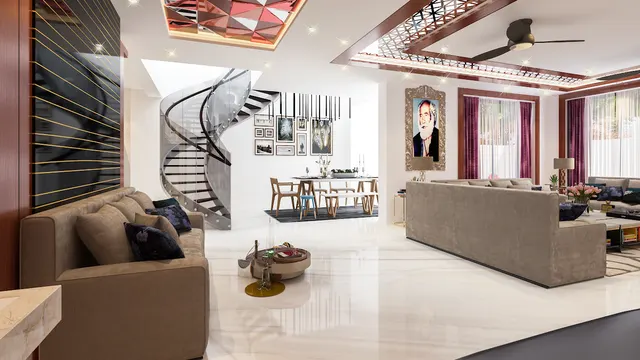
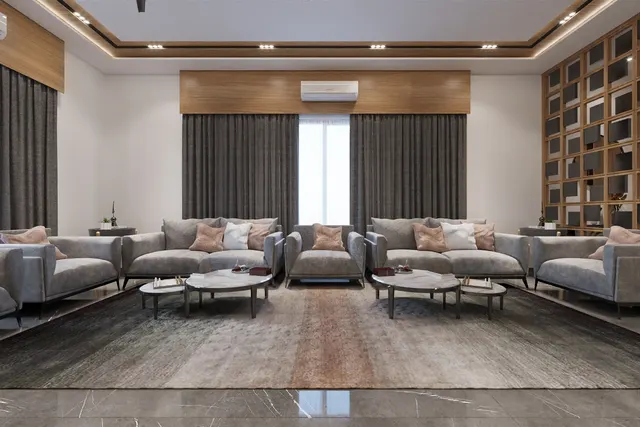
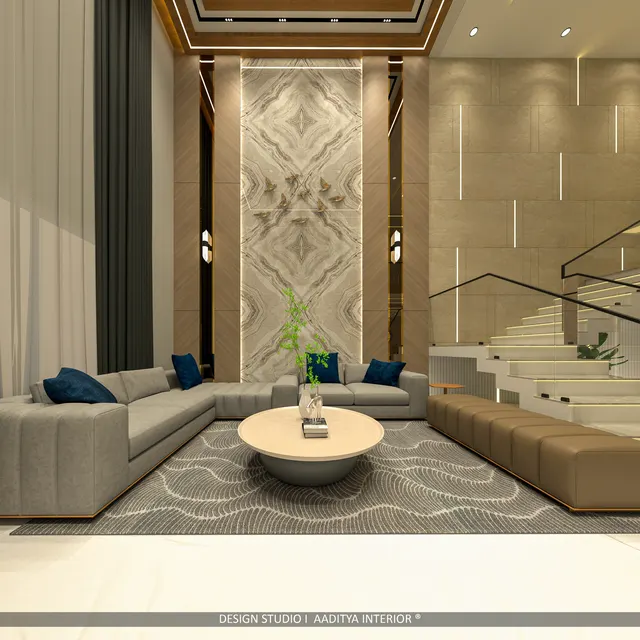
Curtains are chosen for their fabric, but they live or die by their hardware. A heavy linen drape on an undersized rod sags in the middle within a month; a pencil-pleat curtain on a cheap plastic track jams and jerks every time it is drawn; a ceiling-mounted track screwed into a gypsum false ceiling tears loose under the weight of the fabric. The visible part of curtain hardware is a small line item next to the cost of the fabric and the stitching, yet it decides whether the finished window looks crisp and moves smoothly for years, or looks tired and catches every time someone touches it. It is the part of the window most often specified last and thought about least.
In Indian homes the decision is usually made badly for two reasons. First, the hardware is picked by appearance alone — a decorative rod with a fancy finial because it looks rich in the showroom — without anyone checking whether that rod is stiff enough for the span, or whether the wall behind the bracket is solid concrete or hollow block. Second, the fixing is left to whoever is drilling on the day, long after the false ceiling has gone up, so the track ends up anchored to 12.5 millimetre gypsum board with nothing solid behind it. Then there is the modern temptation: motorised curtains, specified as an afterthought, with no power point left at the right end of the window and no thought given to how the motor is controlled.
This article treats curtain hardware as a proper design decision. It sets out where rods and tracks came from, when to choose a decorative rod and when to choose a concealed track, the diameters and bracket spacings that keep a pole straight, the common track profiles including the wave or S-fold track that gives the smart ripple seen in hotels, how to fix either system into concrete or around a false ceiling, and what a motorised system genuinely requires — motor type, power, control and the limits worth knowing. Prices are indicative October 2026 ranges to be confirmed locally.
Where curtain hardware came from
Hanging cloth over an opening is ancient, but the hardware most homes use today has two clear ancestors. The decorative rod descends from the drapery poles of grand European interiors, where a turned timber or cast-metal pole with ornamental finials carried heavy curtains on rings and was meant to be seen as part of the room's dressing. The concealed track descends from the theatre and the institutional interior, where the point was the opposite — to move large, heavy curtains smoothly and invisibly, with the mechanism hidden above a pelmet or inside a ceiling recess. The modern market sits between these two: a homeowner can buy a showpiece rod that announces itself, or a slim track that disappears, and the choice is as much about how visible the hardware should be as about how the curtain moves.
The twentieth century added the aluminium extrusion, which made slim, strong, smooth-running tracks affordable, and the late twentieth and early twenty-first centuries added two refinements that now define the premium end. The wave or S-fold track, with regularly spaced glides and a cord or tape that holds the fabric in a continuous soft ripple, gave the clean contemporary look seen in hotels and showrooms. And the tubular motor, small enough to sit inside a track or a roller tube, brought motorised and then app-controlled curtains into ordinary homes. The hardware, in other words, has quietly become as much a technology choice as a decorative one.
Rod or track: choosing the system
The first decision is whether the hardware should be seen or hidden. A decorative rod is a visible object: a metal or timber pole, typically 19 to 35 millimetres in diameter, carried on wall or ceiling brackets, with the curtain hung from rings or through eyelets and finished with finials at the ends. It suits eyelet and tab-top curtains, reads well in classic and casual rooms, and is the simplest system to install and live with. A concealed track is a slim aluminium or uPVC channel in which runners or glides slide, hidden above a pelmet, behind a fascia or recessed into the ceiling. It suits pencil-pleat, pinch-pleat and wave headings, gives the cleanest contemporary look, bends around bay windows and curves, and is the sensible choice for heavy curtains, wide spans and motorisation.
The practical guidance is straightforward. Choose a decorative rod when the hardware is meant to be part of the look, the curtain is light to medium in weight, the window is a single straightforward span, and eyelet or tab-top heading is wanted. Choose a concealed track when the look should be minimal and the hardware invisible, the curtain is heavy or wide, the window is a bay or a curve, a wave or pinch-pleat heading is wanted, or the curtains are to be motorised. Many homes mix both — decorative rods in the living and dining rooms where they add character, concealed ceiling tracks in bedrooms where a clean, dark, light-blocking finish matters more than ornament.
Rod sizes, materials and spans
A decorative rod has one job beyond looking good: to stay straight under the weight of the curtain. That depends on three things — the diameter, the material, and the distance between brackets. Thin rods look elegant but sag over a wide window; the cure is either a larger diameter or an extra centre bracket. As a working guide, a 19 millimetre rod suits light curtains over a narrow window; 25 millimetres is the everyday choice for medium curtains; and 28 to 35 millimetres is needed for heavy curtains, wide spans or a deliberately chunky look. Brackets should sit no more than about 1500 millimetres apart, and any rod longer than roughly 1500 millimetres needs a centre bracket — closer still for heavy velvet or lined curtains. A rod that passes the eye test in the showroom at arm's length can still bow over a three-metre living-room window, so the span, not the showroom, should decide the diameter.
Material affects both the look and the stiffness. Mild-steel and stainless-steel rods are the stiffest and carry heavy curtains over the widest spans; aluminium is lighter and cheaper but needs care on wide spans; timber and timber-look rods suit classic and warm interiors but a slender timber pole will sag sooner than steel of the same diameter; brass and designer finishes are chosen for appearance and priced accordingly. Finishes — matte black, antique brass, brushed nickel, chrome, powder-coated colours — are a style decision, but a good powder coat or plating also protects the rod from the humidity of coastal and monsoon climates, which matters in cities like Surat where bare mild steel will rust at the brackets.
| Rod diameter | Suits | Max span without centre bracket | Typical material |
|---|---|---|---|
| 19 mm | Light sheers, café curtains | ≈ 1200 mm | Aluminium, light steel |
| 25 mm | Medium curtains (everyday) | ≈ 1500 mm | Steel, aluminium, timber |
| 28 mm | Medium–heavy, lined curtains | ≈ 1800 mm | Steel, stainless steel |
| 32–35 mm | Heavy velvet, wide spans, bold look | ≈ 2000 mm | Steel, stainless steel, brass |
| Timber pole 28–35 mm | Classic, warm rooms | ≈ 1500 mm (sags sooner) | Timber, timber-look |
Tracks: profiles and the wave system
A concealed track is a channel carrying runners, and the differences between tracks are in the profile, the operation and the heading they are built for. A plain I-rail or slim-line aluminium track is the workhorse: curtains hang from gliding hooks and are drawn by hand. A cord-operated track adds a pulley and a draw cord at one end so the curtains can be opened and closed without touching the fabric, which keeps light curtains clean and is useful for high or wide windows. A heavy-duty track uses a stronger profile and more robust glides for lined, blackout or very wide curtains. And the wave or S-fold track is the contemporary favourite: evenly spaced glides, linked to a special heading tape, hold the curtain in a continuous soft ripple from top to bottom, giving the clean, uniform look seen in hotels and modern apartments. Wave headings use a defined fullness — commonly in the region of two to two-and-a-half times the track length — and the glide spacing on the track sets the depth of the ripple.
Tracks have two practical virtues that rods lack. They bend: an aluminium track can be curved around a bay window or a gentle radius on site or in the factory, so a continuous curtain can follow a non-straight window that a rigid rod cannot. And they hide: mounted to the ceiling or behind a slim fascia, a track disappears, so the eye sees only the fabric. The cost of these virtues is that the track is not meant to be seen, so it needs either a ceiling recess, a pelmet or a fascia to look finished, and a poorly detailed exposed track on a wall can look cheap in a way a good rod never does. For bedrooms, the ceiling-recessed blackout track — a track set into a plastered pocket in the false ceiling so the curtain falls straight from the ceiling line — is the detail that makes a room properly dark.
| Track type | Operation | Best for | Note |
|---|---|---|---|
| I-rail / slim-line | Hand-drawn | Most curtains, hidden behind pelmet | The everyday workhorse |
| Cord-operated | Draw cord + pulley | High or wide windows, light curtains | Keeps fabric clean |
| Heavy-duty track | Hand or cord | Lined, blackout, very wide curtains | Stronger profile and glides |
| Wave / S-fold | Hand or motorised | Contemporary even ripple | Needs special glides and tape |
| Bendable track | Hand or cord | Bay windows and curves | Curved on site or in factory |
| Ceiling-recessed blackout | Hand or motorised | Bedrooms needing full darkness | Set into a plastered ceiling pocket |
Fixing: concrete, brick and the false-ceiling trap
The single most common hardware failure is a sound rod or track pulling out of the wall or ceiling, and it is almost always a fixing problem rather than a hardware problem. The rule is simple: the fixing must reach something solid. Into a reinforced-concrete slab or lintel, a good wall plug or anchor into drilled concrete holds firmly. Into a solid brick or block wall, a plug into the brick itself — not into the plaster — holds well. The trap is the gypsum false ceiling: 12.5 millimetre gypsum board screwed to a light metal grid will not hold the weight of a loaded curtain track, and a screw driven into it alone will tear out. A ceiling-mounted track must be fixed either to the concrete slab above the false ceiling, using a drop rod or a timber or metal batten built into the ceiling at curtain positions, or to a solid timber backing planned and fixed before the ceiling is boarded.
This is why curtain positions must be decided before the false ceiling goes up, not after. If the designer knows a ceiling track or a ceiling-recessed blackout track is wanted, a continuous timber or metal support is built into the ceiling along the window, and the gypsum is cut around a plastered pocket for the recessed track. Retrofitting this into a finished ceiling means opening it up again. Wall-mounted brackets have their own clearance logic: the bracket must project far enough to clear the window sill, the handle of a casement window, an air-conditioner, or a radiator-style convector, and it must hold the curtain clear of the glass so condensation and heat do not mark the fabric. A projection of around 75 to 120 millimetres suits most windows; more where there is a deep sill or a projecting handle.
Motorised and smart curtain systems
Motorised curtains have moved from luxury to mainstream because the hardware has shrunk and the price has fallen. A motorised system is, at heart, a track or a roller tube with a small electric motor that drives the curtain open and closed, controlled by a wall switch, a remote, a timer or a phone app. For draw curtains, the motor sits at one end of the track and pulls the leading glide along a belt; for roller and Roman blinds, a tubular motor sits inside the tube. The motor needs power, and this is where most motorised installations go wrong: the decision is taken late, and there is no power point at the end of the window where the motor lives. The right-hand or left-hand end of each motorised window needs a concealed power socket or a wired supply, planned at the electrical stage, ideally hidden in the pelmet or ceiling recess.
Beyond power, three choices define a motorised system. The motor type: a mains-wired motor is reliable and needs no battery changes but must be wired in during fit-out, while a rechargeable battery motor is easier to retrofit but needs recharging every few months. The control: a simple remote and wall switch is enough for many homes, while integration with a smart-home system lets curtains run on schedules, respond to voice assistants, and open with the morning alarm or close at sunset. And the safety and comfort details: quiet motors matter in bedrooms, and limit settings that stop the curtain gently at each end protect both the fabric and the mechanism. Motorisation suits wide and heavy curtains, high windows that are hard to reach, and anyone who wants scheduled or voice control; it is less worth the cost on a small, easily reached window. Aaditya Interior generally advises wiring the power point for motorisation into every large living-room and bedroom window even when the motor is not fitted on day one, because adding the wiring later is the expensive part.
Dimensions, stack-back and clearances
A few dimensions make the difference between curtains that frame a window and curtains that fight it. The rod or track should extend beyond the window on each side so the open curtain stacks off the glass and lets in full daylight; around 150 to 400 millimetres each side is usual, more for heavy curtains that bunch into a deep stack. That stack — the stack-back — is the width the gathered curtain occupies when fully open, and it is larger than people expect: a generously full pair of curtains can stack back 15 to 25 per cent of their width on each side, so a wide window needs wall beside it for the curtains to clear the glass. The height matters too: mounting the rod or track well above the window, close to the ceiling, makes the window look taller and the room feel higher, and lets the curtain fall in a long clean line rather than starting halfway up the wall.
Curtain length is a separate topic in its own right, but the hardware height sets the top of it, so the two are decided together. For draw curtains on a track, allow an overlap in the centre where the two leaves meet so there is no light gap, and a return at each end where the leading edge wraps back to the wall for the same reason. For bay windows, a bendable track or a jointed set of rods follows the angles; for very wide living-room windows, splitting into two or three leaves that draw to the sides keeps each stack manageable. These are small numbers, but they are the ones that separate a professionally dressed window from a home-made one.
| Dimension | Typical value | Why |
|---|---|---|
| Extension beyond window (each side) | 150–400 mm | Open curtain clears the glass for full daylight |
| Stack-back (each side) | 15–25 % of curtain width | Space the gathered curtain needs when open |
| Rod/track height above window | 100–300 mm, or to ceiling | Makes the window look taller; clean fall |
| Bracket projection (wall) | 75–120 mm | Clears sill, handle or air-conditioner |
| Centre overlap (draw curtains) | 80–150 mm | No light gap where the leaves meet |
| Return to wall (track end) | match projection | Closes the light gap at the ends |
Costs and buying well
Curtain hardware spans a wide price range, and the sensible approach is to match the spend to the window's demands rather than to buy the cheapest or the most expensive everywhere. As indicative October 2026 ranges, a basic decorative rod set runs roughly ₹150–400 per running foot including brackets and finials, a good steel or designer rod ₹400–1,200 per running foot, a plain concealed aluminium track ₹120–350 per running foot, and a wave or S-fold track system ₹350–900 per running foot including the special glides and tape. Cord-operated and heavy-duty tracks sit in between. Motorisation is priced per window and varies most of all: a motorised track system commonly runs from about ₹12,000 to ₹45,000 per window depending on width, motor type and control, with smart-home integration adding more. These figures exclude the curtains themselves — fabric and stitching, usually priced per metre of fabric — and should be confirmed with a local supplier before budgeting.
Buying well means spending on the hardware that works hard and saving on the hardware that does not. A heavy living-room drape over a three-metre span justifies a stiff steel rod or a heavy-duty track; a light sheer over a small bedroom window does not need a designer pole. The fixing is worth paying for everywhere, because a cheap fixing undoes expensive hardware. And motorisation is worth wiring for in the large windows even if the motors come later. The hardware is a small fraction of the window's total cost, so the saving from buying the cheapest is small, while the cost of a sagging rod or a torn-out track — in redoing the work and in daily irritation — is large.
| Hardware (indicative Oct 2026) | Typical cost | Priced by |
|---|---|---|
| Basic decorative rod set | ₹150–400 per running foot | Rod length, with brackets and finials |
| Steel / designer rod set | ₹400–1,200 per running foot | Material, finish and finials |
| Plain concealed aluminium track | ₹120–350 per running foot | Track length |
| Wave / S-fold track system | ₹350–900 per running foot | Track plus special glides and tape |
| Cord-operated track | ₹250–600 per running foot | Track plus pulley and cord set |
| Motorised track system | ₹12,000–45,000 per window | Width, motor type and control |
Ten rules for specifying curtain hardware
- Choose the system first — visible decorative rod or hidden track — from how the hardware should read in the room.
- Match the rod diameter to the span: 25 mm for everyday, 28–35 mm for heavy or wide curtains.
- Keep brackets no more than about 1500 mm apart, and add a centre bracket on any long rod.
- Use a track for bays, curves, heavy or wide curtains, wave headings and anything motorised.
- Fix into the concrete slab, a lintel or built-in battens — never into gypsum false ceiling alone.
- Decide curtain positions before the false ceiling goes up so supports and blackout pockets can be built in.
- Extend the rod or track 150–400 mm beyond the window and allow for the stack-back each side.
- Mount the hardware high — near the ceiling — to make the window look taller and the fall cleaner.
- Wire a concealed power point at the motor end of every large window, even if motors come later.
- Spend on the hardware and the fixing that carry heavy curtains; save on the light, small windows.
Frequently asked questions
Is a curtain rod or a track better?
Neither is better in general; each suits different windows. A decorative rod is simpler, is meant to be seen, and suits eyelet and tab-top curtains on straightforward windows. A concealed track hides, bends around bays and curves, carries heavy and wide curtains, suits wave and pleat headings, and is the right choice for motorisation. Many homes use rods where the hardware adds character and tracks where a clean, dark or minimal look matters.
How far apart should curtain rod brackets be?
No more than about 1500 millimetres apart, and closer for heavy fabric. Any rod longer than roughly 1500 millimetres should have a centre bracket to stop it sagging, and a wide living-room window may need two intermediate brackets. The heavier the curtain and the thinner the rod, the closer the brackets must be.
Can a curtain track be fixed to a false ceiling?
Not to the gypsum board alone — it will tear out under the weight of the curtain. The track must be fixed to the concrete slab above using a drop rod, or to a timber or metal batten built into the ceiling along the window before it is boarded. This is why curtain positions must be decided before the false ceiling goes up.
Do motorised curtains need a power point at the window?
Yes, for mains-wired motors, which need a concealed socket or wired supply at the motor end of the track, planned at the electrical stage and hidden in the pelmet or ceiling recess. Rechargeable battery motors avoid the wiring but need recharging every few months. Because adding wiring to a finished window is the expensive part, it is wise to run a power point to every large window even if the motor is fitted later.
What is a wave or S-fold curtain?
A wave or S-fold curtain hangs in a continuous, even ripple from top to bottom, rather than in gathered pleats. It is made with a special heading tape linked to evenly spaced glides on a dedicated track, which hold the fabric in that uniform soft curve. It gives the clean, contemporary look seen in hotels and modern apartments and uses a fullness of roughly two to two-and-a-half times the track length.
Sources & standards
- Neufert, Architects' Data — windows, curtains and fittings planning dimensions
- Time-Saver Standards for Interior Design and Space Planning — window treatments and hardware
- Bureau of Indian Standards — IS codes for aluminium extrusions and fasteners (generic hardware and fixing references)
- National Building Code of India 2016, Part 8 (Building Services) — electrical provisions relevant to motorised systems
- Curtain hardware manufacturers' technical data — rod spans, track profiles, wave fullness and motor specifications (generic industry ranges)
- Price ranges: indicative October 2026 estimates — confirm locally before budgeting