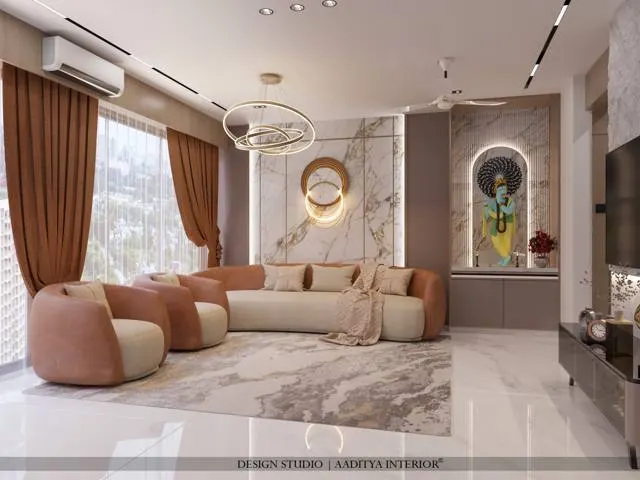
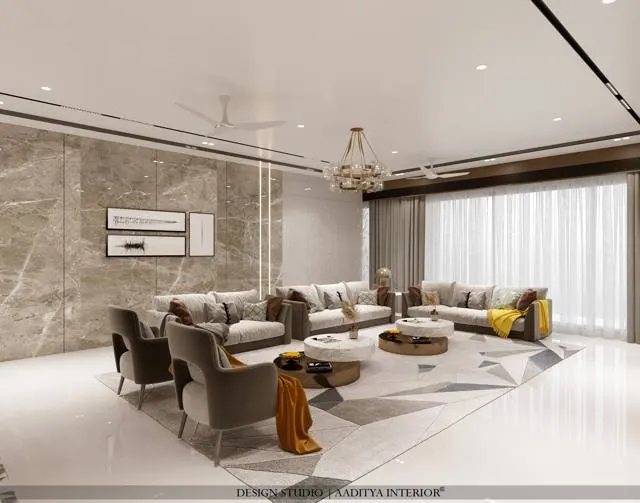
I lead design at our studio, which means I spend my days on things most people will never consciously notice: the grain direction on a wardrobe shutter, the gap between a false ceiling and a wall, the exact warmth of a cove light. This is not fussiness. It is the job.
A client will never walk into their new home and say, “what beautiful edge-banding.” But they will feel that the kitchen is easy to clean, that the wardrobe shutters close with a satisfying softness, that the lighting flatters the room instead of fighting it. Good detailing is invisible. Bad detailing is all you can see.
Materials are a promise
Every material we specify is a promise about how the space will age. A veneer that looks stunning in a showroom but peels in Surat's humidity is not a bargain – it is a future repair bill. We choose laminates, stones, fabrics and hardware for how they will look in year five, not just on handover day.
This is also why we show material palettes alongside our 3D renders. You should touch the laminate, see the stone under real light, and understand why we paired them – before they are ordered.
Luxury is not a price tag. It is a hinge that still feels perfect after ten thousand closes.
Finishing is where trust is built
During site execution, our supervisors check the small things: joint lines, paint edges, alignment of handles, the finish inside a drawer nobody photographs. Clients may not inspect these corners, but they live with them. When a home still feels crisp two years later, that is finishing doing its quiet work.
So if you are comparing designers, look past the renders. Ask who supervises the site, how often, and what exactly they check. The answer will tell you more about your finished home than any portfolio ever could.