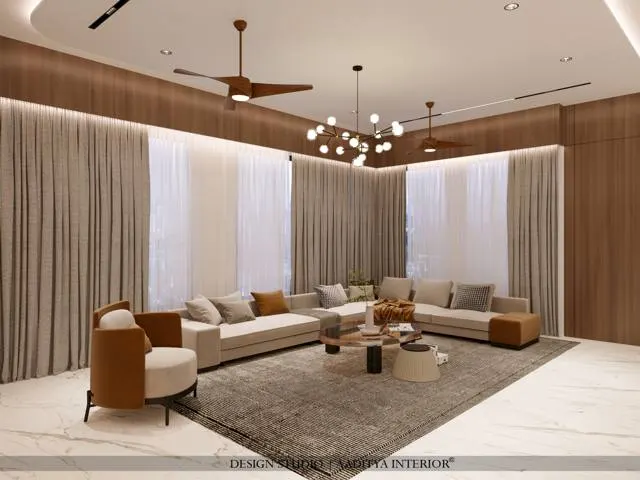
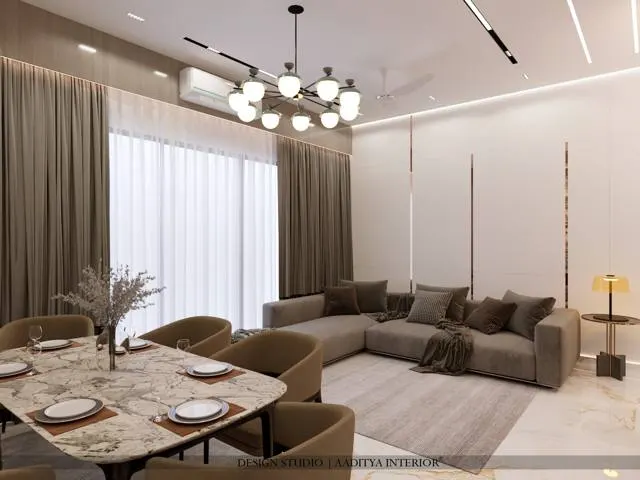
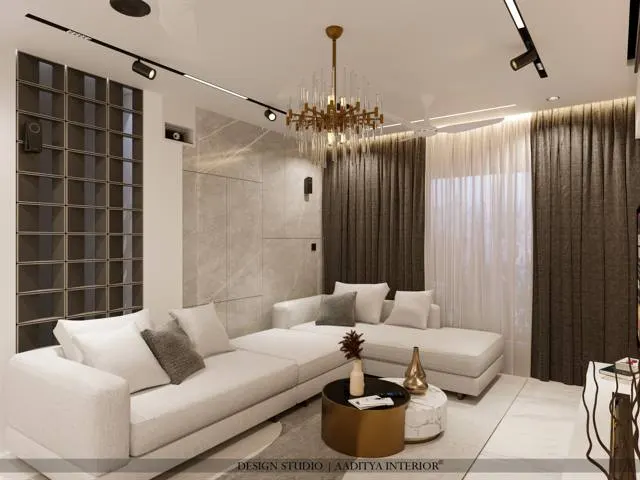
Federal style is the American version of neoclassicism, and it is the most elegant and the most formal of the styles in this set. It developed in the United States after independence, roughly from 1780 to 1820, when the new republic wanted houses that looked dignified and rational without copying the palaces of Europe. The style takes its language from the Adam brothers in Britain — pale walls, delicate plasterwork, oval and fan motifs, mahogany furniture — and gives it an American character: fanlights over the door, oval rooms, tall windows, and a restraint that comes from a young country building with limited means but high ambitions. A Federal room is quiet, symmetrical and beautifully proportioned, and it feels formal without feeling grand.
For an Indian homeowner the Federal style is a useful model for the most formal room in the house — the drawing room, the entrance, or the dining room where guests are received. Indian homes often have a formal sitting area that is used rarely, and the Federal method gives that area a clear character: a centre line, a fanlight or a mirror as the focal point, mahogany furniture in pairs, and pale walls with classical details used lightly. The style also suits the Indian climate, because its colours are pale and its rooms are planned for light and air. It is not a style for the whole house; it is a style for the rooms where the household presents itself, and that distinction is part of its discipline.
The mistakes are familiar but have a Federal shape. The first is over-formality: a room so stiff and symmetrical that it feels like a waiting room rather than a home, with furniture that may not be sat on and a carpet that may not be walked on. The second is fake classicism: plastic pilasters, polystyrene cornices and printed fanlights that look like a film set beside real mahogany. The third is the wrong scale: a grand fanlight in a flat with a 2700 mm ceiling, or an oval table too large for the room, so that the proportions that are the whole point of the style are lost. This article explains the history, the details, the dimensions and the costs of doing Federal properly in India.
The past: Adam elegance crosses the Atlantic
Federal style begins in London, with Robert Adam, and crosses the Atlantic with the pattern books that American builders carried home. Adam's delicate plasterwork, his oval and fan motifs, his pale colours and his mahogany furniture were exactly what the new American republic wanted: a classical language that was elegant without being royal, and rational without being cold. American architects such as Charles Bulfinch in Boston and the builders of the new capital in Washington adapted Adam's rooms to American houses — which were usually timber-framed, with tall windows and a central hall — and the result was a style that is recognisably Adam in its details but American in its plan. The houses are symmetrical, with a central door, windows in pairs, and a fanlight over the entrance that has become the style's signature.
The political meaning of the style matters, because it explains its restraint. The new republic did not want palaces, and it did not want the heavy ornament of the old world. Federal houses are dignified but modest, and their interiors are the same: a good fireplace, a good mirror, a few pieces of mahogany furniture, and nothing more. The style is also democratic in a practical sense — it was built by local carpenters from pattern books, not by imported craftsmen, and a good Federal room could be made by a competent builder who followed the drawings. That is the same situation as in India today, where a good carpenter with a clear drawing can make a Federal doorway, a mahogany table or a panelled wall that is as good as anything imported.
The three signatures: fanlight, oval and mirror
Every Federal interior can be read through three signatures, and a designer who understands them can use the style without copying a single house. The first is the fanlight: a semicircular window over the entrance door, divided into radiating panes like a fan, which brings light into the hall and announces the house. The fanlight is often flanked by sidelights — narrow windows on either side of the door — and framed by slender pilasters. The second is the oval: oval rooms, oval tables, oval mirrors and oval motifs in the plasterwork, which soften the rectangular plan and give the room a gentle, curved focus. The third is the mirror: a large mirror over the fireplace or in the hall, often with an eagle or a classical motif at the top, which reflects light and doubles the room.
The signatures work because they are used in fixed proportions. The fanlight is the largest single detail in the entrance, the oval is the shape of the table or the room, and the mirror is the largest object on the wall. When a room reverses those proportions — a small fanlight, a rectangular table, a small mirror — it stops being Federal and becomes merely classical in a vague sense. In Indian homes the fanlight can be made in timber and glass by a local carpenter, the oval table in mahogany or teak, and the mirror in a simple gilt or brass frame. The eagle motif, so common in American Federal work, is best left out in India, or replaced by a simple classical motif, because it belongs to a different country's symbolism.
| Signature | What it is | Where it goes | Indian adaptation |
|---|---|---|---|
| Fanlight | Semicircular window over door | Entrance, 2000 mm wide | Timber and glass, local carpenter |
| Oval | Oval room, table, mirror | Dining table, hall mirror | Teak or mahogany oval table |
| Mirror | Large, over fireplace | Drawing room, hall | Brass or gilt frame, plain |
| Pilasters | Slender, flanking door | Entrance, fireplace | Painted timber, slim |
| Swag motif | Draped garland in plaster | Cornice, fireplace | Simple plaster, restrained |
The Federal plan: hall, drawing room and oval rooms
The Federal plan is a symmetrical plan, and it is the clearest of all the historic plans. The entrance is in the centre, with a hall that runs through the house, a drawing room on one side and a dining room on the other, and bedrooms above. The hall is the spine of the house, and it is where the fanlight, the mirror and the staircase are displayed. The drawing room is the most formal room, with a fireplace on the centre line and furniture arranged in pairs. The dining room is more practical, with a long table and a sideboard, but it follows the same symmetry. The oval room, where it exists, is usually the drawing room or a small parlour, and it is the most elegant room in the house, because the curved wall makes the furniture arrangement feel natural rather than imposed.
In Indian flats the Federal plan must be adapted, because a flat rarely has a central hall or an oval room. The adaptation is to create the symmetry on the show wall — the wall opposite the entrance — and to let the rest of the room follow. A fanlight can be fitted over the entrance door, a mirror over the fireplace, and an oval table in the dining area, and the room will read as Federal even if the plan is rectangular. The hall, where it exists, should be kept pale and uncluttered, with a console, a mirror and a rug, so that the entrance feels like a room rather than a passage. The key is to choose one Federal gesture per room — a fanlight, an oval table, a mirror — and to let it carry the style, rather than trying to fit all three into every space.
Mahogany, brass and pale walls: the Federal materials
Mahogany is the Federal timber, and it is the test by which any Federal room should be judged. The furniture is mahogany, often with brass inlay or brass handles, and it is elegant rather than heavy: a dining table with tapered legs, a sideboard with a light top, a chair with a slender back and a shield or urn motif. The wood is polished to a deep, warm brown, and it is used against pale walls — cream, pale grey, soft blue or pale yellow — so that the dark furniture reads as drawing on paper. In India the nearest timber is dark teak or sheesham, both of which take a dark polish well, and a carpenter who knows the timber can make a Federal-style table or sideboard that will last for decades. The key is to use solid timber or thick veneer, not a thin laminate, because the eye can tell the difference.
Brass is the Federal metal, used for handles, inlay, light fittings and mirror frames. It is warm, restrained and easy to maintain, and it suits Indian homes, where brass has a long craft tradition of its own. The walls are painted in premium emulsion at about ₹20–30 per sq ft, in a pale colour, and the woodwork is painted white or cream, with slim mouldings. The floor is timber or pale tile, with a rug in the centre of the room, and the curtains are full-length, in a plain fabric or a small stripe. The overall effect is a room that is formal but not cold, and that is the hardest balance in interior design — and the one that Federal does best.
| Element | Federal choice | Indicative October 2026 range | Notes |
|---|---|---|---|
| Wall paint, pale | Premium emulsion, matt | ₹20–30 per sq ft | Woodwork white or cream |
| Fanlight + sidelights | Timber and glass, 2000 mm | ₹35,000–80,000 | Drawn to the door first |
| Oval dining table | Mahogany or teak, six | ₹70,000–1,40,000 | 1800 × 1050 mm oval |
| Sideboard | Mahogany, brass handles | ₹45,000–90,000 | 1500 mm long, 450 mm deep |
| Mirror, gilt or brass | 1200 × 900 mm | ₹15,000–40,000 | Over fireplace or in hall |
| Chandelier, brass | Central, drawing room | ₹25,000–70,000 | Warm white, dimmable |
| Rug, drawing room | 2400 × 3000 mm | ₹15,000–45,000 | Centred on the fireplace |
The Federal doorway: fanlight, sidelights and pilasters
The Federal doorway is the most important single detail in the style, and it is worth drawing carefully before it is built. The door itself is 900 mm wide and 2100 mm high, panelled, with brass furniture. Above it is the fanlight, a semicircular window about 2000 mm wide overall, divided into radiating panes, which brings light into the hall. On either side are the sidelights, narrow windows 300–400 mm wide, which bring in more light and make the entrance feel generous. The whole composition is framed by slender pilasters, painted white, with a simple cornice above. The total width is about 2000 mm and the total height about 2400 mm, and it is the largest single object in the hall.
In Indian homes the Federal doorway is usually fitted to the main entrance, where it replaces a plain door and a blank wall with a composition that announces the home. The cost is about ₹35,000–80,000 for the fanlight, sidelights and pilasters in timber and glass, and the work should be done by a carpenter who has seen the drawing, because the fanlight must be made to the door, not to a standard size. The doorway should never be fitted to a door that is not on the centre line of the hall, because the whole composition depends on symmetry, and a fanlight over an off-centre door will look wrong every day. Where the entrance cannot be centred, the Federal gesture should be used inside — a mirror over the fireplace, an oval table in the dining room — rather than forced onto the door.
| Doorway element | Federal dimension | Indian note | Why it matters |
|---|---|---|---|
| Door | 900 × 2100 mm | Same | Panelled, brass furniture |
| Fanlight | 2000 mm wide, semicircular | Timber and glass | Light into the hall |
| Sidelights | 300–400 mm wide each | Same | Makes entrance generous |
| Pilasters | Slender, painted white | Painted timber | Frames the composition |
| Total composition | 2000 × 2400 mm | Drawn to the door | Largest object in the hall |
Dimensions: drawing room, dining room and hall
Federal dimensions are generous but not grand, and they translate well to Indian flats. A drawing room of 6600 by 4500 mm is a good Federal size; a dining room of 4800 by 3600 mm works for six; a hall of 1800 mm wide is comfortable. The sofa is 1900 mm long, the chairs are 550 mm wide, and the walkway in front of the sofa is 900 mm, with 750 mm between the sofa and the coffee table. The oval dining table is 1800 by 1050 mm for six, and each diner needs 600 mm of width and 900 mm of chair pull-out. The mirror over the fireplace is 1200 by 900 mm, with its centre at 1500 mm from the floor, and the chandelier hangs 2100 mm from the floor in a drawing room, or 750–900 mm above a dining table.
The ceiling in a Federal house is typically 3000–3300 mm, with a slim cornice and a ceiling rose for the chandelier. In Indian flats, where the ceiling is usually 3000 mm, the same effect is achieved by keeping the cornice slim at 75–100 mm and the chandelier at the right height, so that it lights the room without hanging in the eyeline. The doors are 2100 mm high and 900 mm wide, with six panels, and the skirting is 150 mm. These numbers are not fussy; they are the reason the room feels right, and a room that ignores them will feel either cramped or empty, however good its furniture is. A Federal room is a drawing made real, and the drawing costs nothing.
| Element | Federal dimension | Indian flat note | Why it matters |
|---|---|---|---|
| Drawing room | 6600 × 4500 mm | 5400 × 3600 mm also works | Sofa scales with the room |
| Dining room | 4800 × 3600 mm | Six diners, 900 mm pull-out | Oval table 1800 × 1050 mm |
| Hall | 1800 mm wide | Console, mirror, rug | Entrance as a room |
| Mirror | 1200 × 900 mm | Centre at 1500 mm | Reflects light, doubles room |
| Chandelier | 2100 mm from floor | 750–900 mm above table | Lights room, not eyes |
| Walkway | 900 mm clear | 900 mm minimum | Room must be walkable |
Costs and phasing: a Federal room in October 2026
A Federal drawing room is a mid-range Indian project, and the money goes on the doorway, the furniture and the mirror, because those are the pieces the eye actually sees. For a drawing room of about 300 sq ft, a full Federal scheme — paint, a fanlight doorway, an oval table or a sofa set, a mirror, a chandelier and a rug — typically costs about ₹3,00,000–6,00,000 in October 2026. The largest items are the furniture and the doorway, and the most important single purchase is the mirror, because a pale room with a good mirror feels twice as large. The work should be phased in the right order: the doorway first, then paint, then the large furniture, then the mirror and the chandelier, and finally the rug and the curtains, so that each layer is chosen against the one before it.
The cheapest way into the style is to start with the mirror and the symmetry. A large mirror over the fireplace, a pair of matching chairs, and curtains hung full-length will make a room read as Federal, and they cost less than a fanlight doorway. The most expensive mistake is the opposite: buying plastic pilasters and a printed fanlight that look like a film set, and then living with a room that feels neither Federal nor modern. Buy solid, buy once, and use the style in the formal rooms only. A Federal drawing room that is done well will be the most elegant room in the house; a Federal flat that is done badly will be the most formal and the least lived-in.
The future: Federal restraint in modern Indian homes
Federal design has aged well, because its values — symmetry, proportion, pale colour and restraint — are not fashions but principles. Modern Indian homes borrow it constantly, often without knowing the name: a living room planned on an axis, a mirror over the fireplace, an oval table in the dining room, a fanlight over the entrance. The contemporary version is lighter than the original — less plasterwork, more paint, furniture with cleaner lines — but the logic is the same, and it survives because it works. Digital drawing tools have made it easier, because a room can be modelled and the doorway tested before a single board is cut, but the judgement is still the one the Federal builders used: does the room feel balanced, does the eye rest, does the furniture earn its place.
The future of the style in India is likely to be a hybrid: Federal planning with Indian materials. Dark teak instead of mahogany, brass from Moradabad, a handloom rug, and a mirror in a brass frame made by a local workshop — all of these give the Federal feeling without importing a single piece. The homes that will age best in the next twenty years are likely to be the ones that were planned on a centre line, with measured rooms and quiet walls, because fashion changes and proportion does not. Aaditya Interior recommends drawing the centre line before buying a single piece of furniture, and letting the room, not the catalogue, decide what goes where.
| Approach | Cost signal | Best for | Risk |
|---|---|---|---|
| Full Federal room | ₹3,00,000–6,00,000 | Drawing room, 300 sq ft | Over-formal, unlived-in |
| Mirror and symmetry | ₹60,000–1,50,000 | Rented home | Small mirror, no impact |
| Doorway only | ₹35,000–80,000 | Entrance hall | Off-centre door |
| Federal + Indian craft | ₹2,50,000–5,00,000 | Teak, brass, handloom | Plastic classical details |
Eight rules for a Federal room
The whole article comes down to eight rules. Follow them in order, and the room will feel Federal even without a single antique.
- Draw the centre line first, on the wall opposite the door, and put the fireplace or the mirror on it.
- Use one Federal gesture per room — a fanlight, an oval table or a large mirror — and let it carry the style.
- Make the fanlight 2000 mm wide overall, with sidelights 300–400 mm wide, and only on a centred door.
- Keep the walls pale and the woodwork white, and save strong colour for upholstery and curtains.
- Use mahogany or dark teak, solid or thick veneer, with brass handles — never plastic classical details.
- Hang the mirror 1200 × 900 mm over the fireplace, with its centre at 1500 mm from the floor.
- Keep furniture in pairs around the centre line, with 900 mm walkways and 750 mm between sofa and table.
- Light with warm white at 2700–3000 K, a central chandelier and wall lights in pairs, on a dimmer.
Frequently asked questions
What is Federal style interior design?
Federal style is the American neoclassical style of roughly 1780–1820, adapted from the Adam style in Britain. It is characterised by pale walls, mahogany furniture, fanlights over the door, oval rooms and tables, large mirrors and classical details used lightly. It is the style of the early American republic, dignified and restrained.
What is the difference between Federal and Georgian design?
Georgian design is British, heavier and more panelled, with fielded panelling and a strong classical order. Federal design is American, lighter and more delicate, with fanlights, ovals and mirrors, and less panelling. The two share symmetry and proportion, but Federal feels more elegant and less formal, and it uses mahogany and brass rather than painted panelling as its main material.
What is a fanlight?
A fanlight is a semicircular window over an entrance door, divided into radiating panes like a fan, which brings light into the hall. In Federal houses it is often flanked by sidelights and framed by slender pilasters, and the whole composition is about 2000 mm wide and 2400 mm high. In India it is made in timber and glass by a local carpenter.
Can Federal style work in a modern Indian flat?
Yes, in the formal rooms, if the symmetry is created on the show wall and the details are kept light. A drawing room of 5400 × 3600 mm works with a large mirror, an oval table and paired chairs, provided the fanlight is only used on a centred door. The whole flat should not be done in Federal, or it will feel too formal to live in.
How much does a Federal drawing room cost in India?
For a drawing room of about 300 sq ft, a full Federal scheme typically costs about ₹3,00,000–6,00,000 in October 2026, including a fanlight doorway, furniture, a mirror, a chandelier and a rug. A fanlight doorway alone costs about ₹35,000–80,000 and an oval dining table about ₹70,000–1,40,000. Prices vary by city and should be confirmed locally before budgeting.
Sources & standards
- National Building Code of India 2016, Part 3 (Development Control Rules and General Building Requirements) and Part 8 (Building Services, Section 1: Lighting and Natural Ventilation) — Bureau of Indian Standards
- Bureau of Indian Standards — IS 303 (plywood for general purposes), IS 710 (marine plywood) and IS 12406 (medium density fibreboard)
- Neufert, Architects' Data — standard dimensions for living rooms, dining rooms and entrances
- Time-Saver Standards for Interior Design and Space Planning — residential layouts, clearances and furniture dimensions
- National Park Service, USA — Preservation Briefs on historic American houses and interiors
- Energy Conservation Building Code (ECBC) and Bureau of Energy Efficiency (BEE) — lighting efficiency guidance
- Price ranges: indicative October 2026 estimates — confirm locally before budgeting