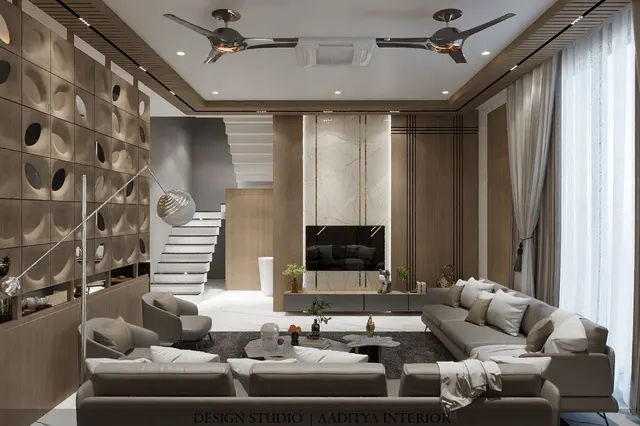
Walk through any newly finished Indian flat and one surface keeps reappearing: a wall of slim vertical ribs behind the television, around the bed, or lining the entrance passage. Fluted and ribbed panels have become the decade's defining feature finish, the way textured paint was in the 2000s and veneer was in the 2010s. The appeal is easy to understand. A flat wall is a blank; a fluted wall catches raking light along every rib, throws a line of soft shadow between them, and changes through the day as the light moves. It adds depth without colour and richness without clutter.
But the popularity has outrun the understanding. Panels are bought by the look alone, with no thought for the material behind the ribs, the pitch that suits the room, or the substrate the panel is stuck to. The result is a wall that bows in the afternoon sun, a rib that lifts at a corner, a joint that stands out like a seam, or a bathroom wall that swells within a monsoon. A fluted panel is a simple idea, but like a jaali or a false ceiling it only works when the profile, the material, the module and the fixing are chosen on purpose.
This article separates the four decisions that matter. It explains what the common profiles actually are and how each reads in light; it compares the materials used in Indian projects on moisture, weight, finish and cost; it sets out the standard sizes, pitches and proportions that keep a wall looking deliberate; and it details how panels are fixed so they stay flat and flush for years. Prices throughout are indicative October 2026 ranges and should be confirmed with a local supplier before budgeting.
What fluted and ribbed panels actually are
A fluted or ribbed panel is any sheet whose face carries a repeating three-dimensional profile running in one direction, usually vertical. The words are used loosely in the trade, but there is a useful distinction. Fluting, in its original architectural sense, means concave grooves cut into a surface — the hollow channels running up a Greek column. Ribbing or reeding means the opposite: convex rounded strips standing proud of the surface. In modern interiors both are sold under the single label fluted, and the family has grown to include square ribs, V-grooves, tambour reeding and wide slat louvres. What they share is the essential trick: a surface broken into parallel lines that read as light-and-shadow rather than as a flat plane.
The profile is not decoration alone; it decides how the wall behaves optically. A deep, widely spaced rib throws a strong shadow and reads boldly from across a room, which suits a large feature wall seen from a distance. A fine, shallow reed reads as a soft texture up close and almost disappears from far away, which suits a narrow passage or a wall that should be quiet. A square rib gives a crisp, architectural, almost corrugated-metal rhythm; a half-round rib gives a softer, more traditional panelled feel. Choosing the profile is therefore the first design act, and it should follow the viewing distance and the mood of the room, not the first sample in the showroom.
A short history: from fluted columns to the tambour revival
Fluting is one of the oldest surface treatments in architecture. The Greeks cut vertical flutes into stone columns more than two thousand five hundred years ago, partly to emphasise the column's height and partly to catch the Mediterranean light in a run of fine shadows. Roman and later Renaissance builders carried the idea onto pilasters and furniture. In European and colonial Indian interiors of the seventeenth to nineteenth centuries, reeded and fluted mouldings appeared on panelled walls, door frames, table legs and cabinet fronts — always as a mark of craftsmanship, because every groove had to be cut and finished by hand.
The modern slat wall has a more recent ancestor: the mid-century tambour, a flexible slatted sheet of thin wooden reeds glued to a cloth backing, used on roll-top desks, radio cabinets and sideboards in the 1950s and 1960s. When the warm, textured look of that era returned to fashion around the end of the 2010s, designers revived tambour panelling for walls and reception desks, and manufacturers quickly turned it into an easy product: pre-finished panels in MDF, WPC, PVC and veneer that a carpenter could stick up in an afternoon. What was once slow hand-craft became a catalogue item, which is exactly why the detailing is now so often neglected.
The materials, compared
The same profile can be cut or moulded in very different materials, and the material decides almost everything that matters after the wall is up: whether it survives a bathroom, how it feels to the hand, how it burns, how heavy it is, and what it costs. Indian projects use six materials most often. The table below compares them for a finished, installed feature wall; prices are indicative October 2026 ranges per square foot of wall, including the panel, adhesive and basic fixing but excluding any backing frame, and they vary with finish, brand and quantity.
| Material | Typical panel | Moisture | Finish and feel | Indicative installed cost (₹/sq ft) | Best for | Avoid |
|---|---|---|---|---|---|---|
| MDF, routed and laminated or painted | 18–25 mm face, 2400–3000 mm long | Poor — swells if wet | Smoothest painted or laminate finish, warm | ₹250–650 | Dry living rooms, bedrooms, TV walls | Bathrooms, balconies, kitchens near the sink |
| WPC (wood-plastic composite) | Hollow slat panel on a backer, 2900 mm | Good — water-resistant | Matte wood-look foil, slightly plasticky | ₹180–400 | Humid cities, semi-wet walls, rentals | Strong direct sun (can bow); very fine detail |
| PVC / charcoal-filled PVC | Hollow extruded slat, 2900 mm | Very good — waterproof | Light, foil or solid colour, hollow sound | ₹120–300 | Budget walls, utility areas, wet zones | Luxury rooms where a hollow tap reads cheap |
| Veneer on MDF or plywood base | 18–25 mm, real wood face | Poor — needs dry room | Real timber grain, premium, repairable | ₹450–950 | Statement walls, boardrooms, hotel lobbies | Wet areas; direct afternoon sun (fades) |
| Solid wood (teak, ash, oak reeds) | Reeds on a frame, custom | Fair with proper sealing | The real thing; ages and can be re-oiled | ₹700–1,500 | Heritage interiors, bespoke joinery | Tight budgets; unseasoned timber warps |
| Acoustic PET felt with wood slats | Slats on a pressed-felt backer | Good | Soft, sound-absorbing, warm wood slats | ₹300–700 | Media rooms, offices, echoey living rooms | Rooms needing a wipe-clean hard surface |
Sizes, pitch and proportion
Fluted panels are sold as sheet goods, so the sheet quietly controls the design just as it does for jaalis and wardrobes. Pre-finished WPC and PVC slat panels are commonly supplied at about 2900 mm long and 150–160 mm wide per strip, so they cover a 2700–3000 mm Indian ceiling height in one piece with no horizontal joint — a real advantage, because a horizontal joint across vertical ribs is almost impossible to hide. MDF and veneer fluted panels are cut from 2440 × 1220 mm or 3050 × 1220 mm boards, so a full-height wall taller than the board needs a planned joint, ideally capped by a slim reveal or a shelf line rather than left as a raw butt.
Proportion is what separates a wall that looks designed from one that looks stuck-on. Three habits help. First, run the ribs full height, floor to ceiling, so the eye reads one clean sweep; a panel that stops short and floats on a wall usually looks unfinished unless it is deliberately framed. Second, finish the panel into a corner, a shadow-gap reveal or a trim, never at a ragged half-rib. Third, plan the panel width so the wall divides into whole ribs — a wall that ends on a sliver of a rib looks like a mistake. The table below gives the working dimensions Aaditya Interior uses on site.
| Element | Typical dimension | Why it matters |
|---|---|---|
| Pre-finished slat panel (WPC/PVC) | 2900 mm long × 150–160 mm wide | Covers a 2700–3000 mm ceiling with no horizontal joint |
| MDF/veneer fluted board | 2440 or 3050 mm × 1220 mm | A wall taller than the board needs a planned joint |
| Rib pitch, feature wall (far view) | 30–50 mm | Reads boldly from across a living room |
| Rib pitch, fine reed (close view) | 12–22 mm | Quiet texture for passages and quieter walls |
| Rib depth | 6–18 mm | Deeper = stronger shadow but more dust in valleys |
| Panel thickness on wall | 6–25 mm | Thin WPC/PVC on gypsum; thicker MDF on masonry |
| Horizontal joint, if unavoidable | 1800–2100 mm, capped by a reveal | Keeps the joint above eye level and detailed, not raw |
| End condition | Whole rib into a corner or trim | A ragged half-rib looks like an error |
How fluted panels are fixed
A fluted wall fails at the fixing far more often than at the panel. The substrate must be flat, dry and sound: an undulating plaster wall telegraphs every hollow through a thin panel, and a damp wall destroys an MDF or veneer panel from behind within a season. For thin, light WPC and PVC panels on a true wall, a good-quality construction adhesive applied in continuous vertical beads, pressed and temporarily pinned while it cures, is usually enough. For heavier MDF and veneer panels, or for uneven walls, the reliable method is to fix a grid of battens — timber or aluminium — plumb and level, pack them out to a flat plane, and then glue and pin the panels to the battens. Battens also leave a cavity that lets a masonry wall breathe, which matters in humid cities.
Three details separate a clean job from a shoddy one. The internal and external corners should be mitred or closed with a matching trim so no raw panel edge or hollow core shows. The top and bottom should die into the ceiling and the skirting, or into a shadow-gap reveal, rather than stopping at a visible cut line. And any joint between two panels should fall in the valley of a flute, never on the crown of a rib, so the seam disappears into an existing shadow line. The section below shows the batten method and a closed external corner.
| Substrate | Recommended method | Panel types | Watch out for |
|---|---|---|---|
| Flat, dry plastered masonry | Continuous adhesive beads, pinned while curing | Light WPC, PVC | Hollows telegraph through thin panels |
| Uneven or damp masonry | Battens packed to a flat plane, then glue and pin | MDF, veneer, heavy panels | Fix into sound masonry, not loose plaster |
| Gypsum / drywall partition | Fix battens into the metal studs behind | WPC, PVC, PET felt | Adhesive alone can peel the board paper |
| Bathroom / wet wall | Waterproof adhesive, WPC or PVC only | WPC, PVC | Never MDF or veneer; seal all cut edges |
Where fluted panels work in an Indian home
Used with restraint, fluted panels earn their popularity. The most successful locations are the television or console wall in a living room, where the ribs give the screen a quiet backdrop; the headboard wall in a bedroom, often with a soft PET-felt slat for a little sound absorption; the entrance foyer, where a run of fluting leads the eye inward; and the faces of reception desks, kitchen islands and bar units, where a vertical rib adds craft to a plain box. In media rooms and home offices, acoustic PET slat panels do double duty, looking warm while taming echo.
The failures are just as predictable. Fluting on every wall of a room cancels its own effect and makes the space restless; one or two surfaces are plenty. MDF or veneer panels in bathrooms, open balconies or behind a cooking hob fail from moisture or heat. Very deep ribs beside a busy road or in a dusty city need frequent dusting, because the valleys trap grime. And a thin hollow PVC panel in an otherwise premium room gives itself away the moment someone taps it. Aaditya Interior's rule on site is simple: match the material to the room's punishment, and let the fluting be the exception on the wall, not the rule.
Cost and how to budget a feature wall
A fluted wall is usually priced per square foot of finished wall, and the number swings widely with the material. At the budget end, a PVC or charcoal slat panel installed runs about ₹120–300 per square foot; WPC sits a little higher at ₹180–400; MDF with a laminate or paint finish is ₹250–650; acoustic PET felt with wood slats ₹300–700; veneer-finished panels ₹450–950; and solid timber reeding ₹700–1,500 and upward for bespoke work. These are indicative October 2026 ranges including the panel, adhesive and basic fixing; a battened substrate, mitred corners, a shadow-gap reveal or integrated lighting all add to the figure.
To budget, measure the wall in square feet, pick the material band, and add roughly 10–15 per cent for wastage and setting-out, plus a line for the substrate if battens are needed. A typical living-room feature wall of about 100 square feet in WPC therefore lands around ₹20,000–40,000 installed, while the same wall in veneer lands around ₹45,000–95,000. The table makes the comparison direct.
| Material | Indicative installed (₹/sq ft) | 100 sq ft feature wall | Notes |
|---|---|---|---|
| PVC / charcoal slat | ₹120–300 | ₹12,000–30,000 | Lightest, waterproof, hollow tap |
| WPC slat | ₹180–400 | ₹18,000–40,000 | Water-resistant all-rounder |
| MDF laminated/painted | ₹250–650 | ₹25,000–65,000 | Best painted finish, dry rooms only |
| Acoustic PET felt + slats | ₹300–700 | ₹30,000–70,000 | Adds sound absorption |
| Veneer on MDF/ply | ₹450–950 | ₹45,000–95,000 | Real wood grain, premium |
| Solid timber reeding | ₹700–1,500+ | ₹70,000–150,000+ | Bespoke joinery, long life |
Where ribbed surfaces are going next
The fluted wall is not a passing trend so much as the current form of a very old idea, and its next moves are already visible. Manufacturers are pushing waterproof WPC and mineral-composite panels so the look can move into bathrooms and balconies safely; acoustic PET slat systems made partly from recycled plastic are spreading from offices into homes as open-plan living makes echo a real problem; and curved and flexible slat panels are letting designers wrap columns, reception desks and curved walls that a rigid board could never follow. The direction of travel is toward panels that are tougher, quieter and more flexible, while the design brief stays what it has always been: break the flat plane into lines of light. The table sets out the arc.
| Era | Making method | Typical material | What it changed |
|---|---|---|---|
| Antiquity | Hand-cut flutes in stone | Marble, sandstone | Emphasised height, caught light on columns |
| 17c–19c | Reeding plane and chisel | Teak, rosewood, mahogany | Panelling and furniture craft |
| 1950s–60s | Glued reeds on cloth (tambour) | Thin timber slats | Flexible slatted cabinet fronts |
| 2018–2025 | Factory extrusion and routing | MDF, WPC, PVC, veneer | Cheap, fast, catalogue feature walls |
| 2025 onward | Mineral and recycled composites, curved panels | WPC, PET felt, composite | Waterproof, acoustic and curvable surfaces |
Ten rules for specifying fluted panels
- Choose the profile from the viewing distance: bold wide ribs for far walls, fine reeds for close ones.
- Match the material to the room — MDF and veneer only in dry rooms; WPC or PVC near any water.
- Run the ribs full height, floor to ceiling, so the eye reads one clean sweep.
- Set out the wall in whole ribs and start from the centre line, so both ends match and no half-rib shows.
- Keep the substrate flat, dry and sound; batten out any uneven or damp wall before panelling.
- Place any panel-to-panel joint in a flute valley, never on the crown of a rib.
- Mitre or trim every internal and external corner so no raw edge or hollow core is visible.
- Die the top and bottom into the ceiling and skirting, or into a shadow-gap reveal — not a raw cut.
- Use fluting as the exception on one or two walls, not on every surface of a room.
- Add about 10–15 per cent for wastage and a separate line for battens when budgeting.
Frequently asked questions
Are fluted and ribbed panels the same thing?
In today's trade they are used interchangeably, and most suppliers sell both under the word fluted. Strictly, fluting means concave grooves cut into a surface while ribbing or reeding means convex strips standing proud of it, but for specifying a wall the useful choices are the profile shape, the pitch and the depth rather than the label.
Can fluted panels be used in a bathroom?
Only in the right material. MDF and veneer fluted panels swell and delaminate in a bathroom and must not be used there. WPC and PVC panels are water-resistant and are the correct choice for bathrooms, balconies and any wall that may see water, provided a waterproof adhesive is used and all cut edges are sealed.
How do you clean a fluted wall?
Dust it along the ribs every week or two with a soft brush or a vacuum brush attachment, running with the direction of the flutes so grit does not collect in the valleys. A WPC or PVC panel can be wiped with a slightly damp microfibre cloth; an MDF or veneer panel should only be dusted or lightly wiped, never soaked. Deep ribs near a road need more frequent dusting.
Do fluted panels make a room look smaller?
Used on one or two walls they usually make a room feel taller and more considered, because vertical ribs draw the eye upward and add depth without colour. Fluting every wall of a small room, or using very deep ribs throughout, can make the space feel busy and closed. One feature surface is almost always enough.
What is the cheapest fluted panel option?
Charcoal-filled PVC slat panels are the most affordable, at roughly ₹120–300 per square foot installed in October 2026. They are light and waterproof, but they sound hollow when tapped and can look less premium in an otherwise high-end room, so they are best in budget projects, rentals and utility areas rather than statement living rooms.
Sources & standards
- Bureau of Indian Standards — IS 12406 (medium density fibreboard), IS 303 (plywood for general purposes), IS 710 (marine plywood)
- National Building Code of India 2016, Part 6 (Structural Design) and Part 8 (Building Services) for substrate, fixing and interior finishes guidance
- Indian Green Building Council (IGBC) and GRIHA — guidance on low-emission boards and recycled-content interior materials
- Neufert, Architects' Data — wall panelling, panel proportion and setting-out principles
- Manufacturer technical data for WPC, PVC and acoustic PET slat wall panels — standard panel lengths, widths and fixing methods (described generically)
- IndiaMART / TradeIndia dealer listings, October 2026 — fluted panels: PVC ₹120–300, WPC ₹180–400, MDF ₹250–650, PET felt ₹300–700, veneer ₹450–950 per sq ft installed (indicative)
- Price ranges: indicative October 2026 estimates — confirm locally before budgeting