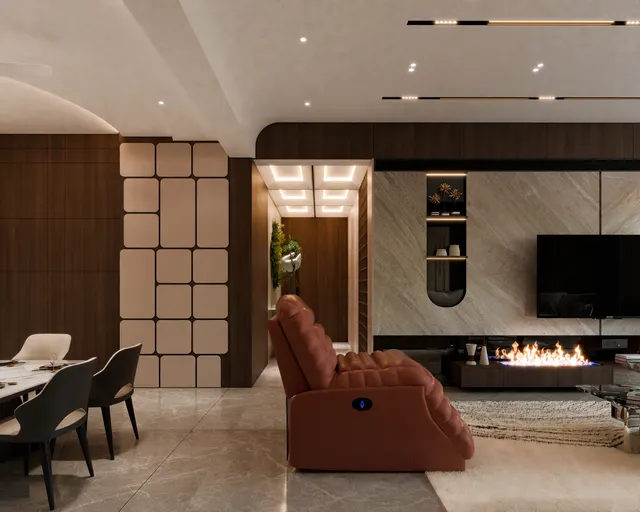
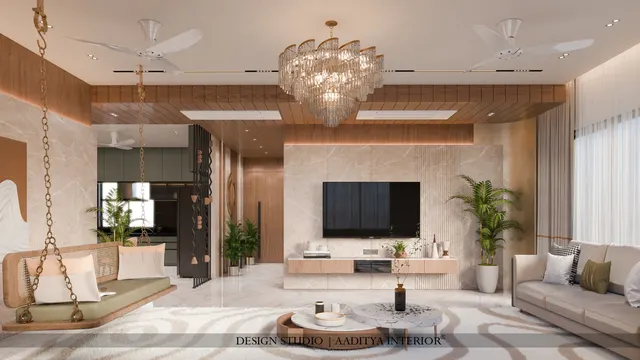
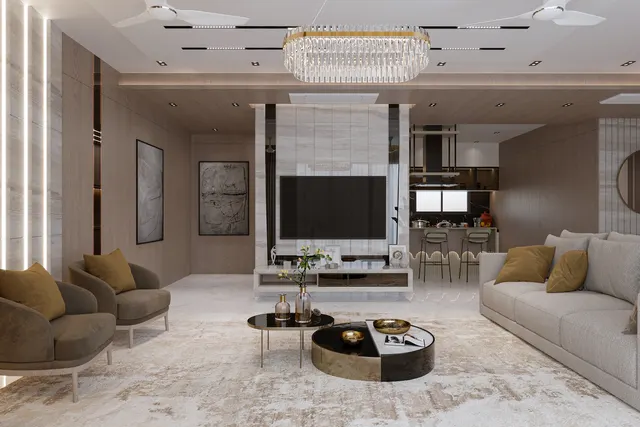
Fluted surfaces have become the signature detail of Indian interiors in the 2020s. They wrap TV walls and bed backs, kitchen islands and reception desks, columns, wardrobe shutters and lift lobbies. A run of vertical grooves catches light, adds shadow and rhythm, makes a ceiling feel higher and hides the joints between boards. The look photographs beautifully, which is part of the problem: a homeowner shows a picture of a 'fluted wall' to three vendors and gets three products that share only a name — a pre-finished WPC louver, a CNC-routed MDF board painted in PU, and a slab of grooved marble — at prices that differ by ten times.
Each of these materials behaves differently. MDF gives the sharpest profile and the smoothest painted finish but swells if it meets water. WPC shrugs off moisture and termites and installs in a day, but its profiles are rounder, its joints show, and cheap boards bow in heat. Stone lasts for generations and feels luxurious under the hand, but it is heavy, slow to fix and unforgiving of poor setting out. Choosing well means looking past the photograph to five questions: where the panel goes, how wet or hot the place is, what profile and scale is wanted, how it will be fixed, and who will clean the grooves.
This article explains the anatomy of a fluted profile, compares MDF, WPC and stone — with the board sizes, thicknesses, weights, fixing details and indicative October 2026 costs for each — and sets out rules for TV walls, bedrooms, kitchens, bathrooms and facades. It is consistent with this blog's living room partition guide, which compares fluted glass, fluted panels and slatted screens as room dividers.
From temple columns to TV walls: a short history of fluting
Fluting is one of the oldest ornaments in architecture. The columns of classical Greek temples were carved with shallow vertical channels — flutes — that made thick stone shafts look slender and caught the Mediterranean light in bands of shadow. The Romans carried the idea across their empire, and the European classical revival of later centuries brought fluted pilasters and columns to banks, churches and government buildings, including many colonial buildings in Indian cities. The convex version, reeding — rows of rounded ribs rather than grooves — was used on furniture legs and mouldings for the same reason: it adds rhythm and light to a plain surface.
The twentieth century gave fluting its modern form. Art Deco designers of the 1920s and 1930s used reeded glass, fluted wood and grooved plaster to express speed and verticality, and Mumbai's Art Deco buildings — part of the Victorian Gothic and Art Deco Ensembles of Mumbai inscribed by UNESCO in 2018 — still show fluted pilasters, reeded doors and grooved facades. Mid-century furniture used reeded fronts on sideboards and cabinets. What changed in the last decade was manufacturing: CNC routers made it cheap to cut grooves into MDF, extrusion made it possible to produce WPC and PVC louvers by the kilometre, and CNC stone-cutting brought fluted marble within reach of ordinary projects. The ornament is ancient; its price is new.
Fluted, reeded, slatted or louvered? The vocabulary
The words are used loosely in the market, which leads to misunderstandings in quotations. Strictly, a fluted surface has concave grooves cut into it; a reeded surface has convex ribs standing out from it; a slatted surface is made of separate battens with gaps between them; and a louver, in the Indian interior market, usually means an extruded WPC or PVC panel with a fluted or ribbed face, sold in narrow modules that clip together. All four create vertical lines, but they differ in depth of shadow, how they meet at corners, how they clean and what they cost.
| Term | What it is | Typical material | Shadow and look | Cleaning |
|---|---|---|---|---|
| Fluted | Concave grooves cut or moulded into a solid face | CNC MDF or HDHMR, stone, plaster, GFRC | Crisp lines; depth set by groove | Dust settles in grooves; brush or vacuum |
| Reeded | Convex half-round ribs standing proud | MDF, solid wood, glass, WPC | Soft, rounded highlights | Easier — no sharp internal corners |
| Slatted | Separate battens fixed with open gaps | Solid wood, veneered MDF, aluminium, WPC | Deep shadows; can be see-through | Dust on every batten face |
| Louver (market term) | Extruded panel with fluted face, clip-together modules | WPC, PVC, polystyrene | Uniform, slightly rounded profile | Wipeable; water-tolerant |
| Fluted glass | Glass with a ribbed face | Toughened patterned glass | Light through, view blurred | Flutes trap dust; see partition guide |
Anatomy of a fluted profile
Every fluted profile is described by four numbers and a shape. The pitch is the repeat distance from the centre of one groove to the next. The groove width is the opening at the face. The land is the flat strip left between grooves (pitch minus groove width). The depth is how far the groove goes into the material. The shape — half-round, U, V or square — decides how the light falls. For interiors, pitches of 20–40 mm read well from a sofa or bed; facades and lobbies, seen from further away, can go to 50–100 mm. As this blog's partition guide notes, shallow, wider flutes of 30–40 mm pitch are easier to clean than fine 15–20 mm ribs, which matters in dusty Indian cities.
| Setting | Pitch (mm) | Groove width (mm) | Depth (mm) | Why |
|---|---|---|---|---|
| Shutters, drawer fronts, small furniture | 12–20 | 6–12 | 3–4 | Fine scale suits surfaces seen up close; shallow keeps the board strong |
| TV walls and bed backs in bedrooms and living rooms | 20–40 | 10–25 | 4–6 | Reads well at 2–4 m; easy to clean at 30–40 mm |
| Kitchen islands and reception desks | 25–50 | 15–30 | 5–8 | Takes knocks; wider grooves clean faster |
| Columns, lift lobbies, double-height walls | 40–80 | 20–50 | 6–12 | Larger scale for longer viewing distances |
| Facades (GFRC, stone, aluminium) | 50–150 | 25–100 | 10–25 | Must read from the street; deep shadows in strong sun |
CNC-routed MDF: the custom, crisp option
MDF — medium density fibreboard, covered by IS 12406 — is the most versatile base for fluted panels because it is homogeneous: it has no grain or core voids, so a router can cut a clean, sharp groove in any direction, and the cut surface takes paint smoothly. Boards come in the standard 2440 × 1220 mm sheet, in thicknesses of 12, 15, 18 and 25 mm. Fluted MDF is used in three ways. It can be routed from plain board on a CNC to any profile the designer draws, then finished with primer and PU paint or duco; it can be bought as pre-grooved sheets in standard profiles and painted on site; or it can be bought as membrane-pressed or pre-laminated fluted panels, in which a PVC foil or finish is vacuum-formed over the routed profile to give a wood-grain or solid-colour finish.
The finish decides the cost and the look. PU paint gives the crispest, most architectural result in any colour, at about ₹1,000–1,800 per sq ft installed — the range used in this blog's partition guide. Membrane or pre-laminated fluted MDF is cheaper, at roughly ₹500–850 per sq ft, consistent with the membrane shutter band, but its edges and corners must be detailed carefully because the foil can lift at cut ends. A natural-veneer fluted look is usually made either from separately veneered battens or from purpose-made veneered fluted boards, because routing grooves into a veneered sheet cuts through the thin veneer and exposes the core; budget about ₹600–1,100 per sq ft for veneer work.
MDF's weakness is water. An unsealed edge or groove that gets wet swells, and the swelling does not reverse. Fluted MDF therefore belongs in dry rooms — living rooms, bedrooms, offices, wardrobes — and should be kept off the floor by a plinth or skirting, sealed on all faces including the back, and never used behind a sink, in a bathroom or on a wall with seepage. In humid coastal cities such as Surat and Mumbai, HDHMR — a denser, more moisture-tolerant board that this blog's board comparison covers in detail — is the safer routed base for kitchens and utility areas, at a modest premium. An 18 mm MDF panel weighs roughly 13 kg per square metre, so a full 2440 × 1220 mm sheet is about 38–40 kg — heavy enough to need a proper backing, not just adhesive on plaster.
WPC louvers: the quick, water-tolerant option
WPC — wood-plastic composite — is a blend of wood fibre or flour with a thermoplastic, usually PVC, extruded through a die. In the fluted panel market it is sold as narrow louver modules, commonly about 150–200 mm wide and around 2.7–3.0 m long, with a fluted or ribbed face and a tongue-and-groove or clip edge so that modules lock together. Faces are pre-finished with a printed or laminated film in wood-grain, stone-look or solid colours, so there is no painting on site. Many louvers are hollow-core for lightness; solid ones are heavier and hold screws better. Related products in PVC and polystyrene are lighter and cheaper still, with thinner faces.
WPC's strengths are the same ones this blog's WPC door guide describes: the plastic matrix does not absorb water, so the panel does not swell or rot, and termites do not eat it. That makes WPC louvers the sensible choice for bathrooms (away from direct spray), utility areas, balconies under a roof, basement lobbies and any wall with a history of damp. Installation is fast — a TV wall can be clad in a day — and the price is the lowest of the three families, at about ₹250–500 per sq ft installed (indicative October 2026). The weaknesses are equally clear. The profile is uniform and slightly rounded, so it looks less crisp than routed MDF; the module joints show as a line every 150–200 mm unless the profile hides them in a groove; the film face can scratch and is hard to repair; and plastic composites expand with heat, so cheap boards bow in strong sun and every run needs small expansion gaps at the ends and around openings.
Fluted stone: the permanent option
Fluted stone is cut on a CNC bridge saw or router from slabs of marble, sandstone, limestone, travertine or granite, and occasionally from engineered quartz or sintered stone. Interior marble is usually worked from 18–20 mm slabs with grooves of 4–8 mm; sandstone and limestone for walls and facades from 25–40 mm stock with deeper grooves of 8–15 mm. Granite is the hardest to cut, and so the slowest and most expensive to flute. Stone is the only option that can be used anywhere — wet, dry, inside or outside — and the only one that improves with age, gaining a patina instead of wearing out. A fluted marble island front, reception desk or bathroom wall is a permanent decision.
Its weight is the issue. Natural stone cladding weighs roughly 50–100 kg per square metre at the thicknesses used for walls, as this blog's elevation cladding guide notes — four to eight times the weight of MDF. Small pieces at low level on a sound wall can be bonded with a polymer-modified stone adhesive; larger panels, panels above head height and all exterior cladding need stainless steel mechanical anchors or clamps into the structure, designed for the weight. Joints must be planned so that flutes line up from slab to slab, which means setting out the whole wall before cutting. Porous stones such as sandstone and many limestones need a penetrating sealer, especially near water. For a similar look at lower weight and cost, porcelain and ceramic tiles with fluted relief faces are widely available, fixed with tile adhesive like any large wall tile.
| Material | Common thickness | Module or sheet | Weight (approx.) | Moisture | Indicative installed cost (₹/sq ft, Oct 2026) |
|---|---|---|---|---|---|
| MDF, CNC-routed, PU or duco painted | 12–18 mm (25 for deep flutes) | 2440 × 1220 sheet | ≈ 10–13 kg/m² (18 mm) | Dry rooms only | ₹1,000–1,800 |
| MDF, membrane-pressed or pre-laminated | 12–18 mm | 2440 × 1220 or 600–1200 wide panels | ≈ 10–13 kg/m² | Dry rooms only | ₹500–850 |
| HDHMR, routed and painted | 12–18 mm | 2440 × 1220 sheet | ≈ 14–15 kg/m² (18 mm) | Humid rooms; not wet | Slightly above MDF painted |
| Veneered battens or veneered fluted board | 12–25 mm | Battens 25–60 wide, or sheets | ≈ 8–13 kg/m² | Dry rooms only | ₹600–1,100 |
| WPC louvers (pre-finished film) | ≈ 12–25 mm overall | ≈ 150–200 × 2700–3000 modules | Light (hollow) to medium (solid) | Water-tolerant | ₹250–500 |
| Fluted porcelain or ceramic tiles | 8–12 mm | Tile formats, often 300 × 600 to 600 × 1200 | ≈ 20–28 kg/m² | Wet areas OK | ₹250–600 (tile + fixing) |
| Fluted sandstone or limestone | 25–40 mm | Slabs cut to module | ≈ 55–100 kg/m² | Any; seal porous stone | ≈ ₹700–1,600 |
| Fluted marble | 18–20 mm | Slabs cut to module | ≈ 50–55 kg/m² | Any; seal; avoid acid cleaners | ≈ ₹1,500–4,000+ |
The weights are approximate, worked from typical densities — about 700–750 kg/m³ for MDF and about 2,500–2,700 kg/m³ for marble and granite — and the costs are indicative installed ranges per square foot of finished face in metro and tier-2 cities. Stone prices in particular vary enormously with the variety, the slab quality, the depth and complexity of the flutes and the fixing system; always ask for stone, cutting and fixing to be quoted as one package. Price ranges should be confirmed locally before budgeting.
How each material is fixed
The fixing detail matters as much as the material, because a fluted wall exaggerates any unevenness: a 3 mm bow in a board throws every groove's shadow out of line. Indian walls are rarely flat to that tolerance, so most fluted panels are fixed over a levelled framework rather than directly onto plaster. For MDF, the usual method is a grid of battens or a plywood backing board fixed to the wall with anchors, packed out to a true plane, with the fluted MDF glued and pin-nailed or screwed through the grooves where the heads disappear. WPC louvers clip or screw onto battens at about 400–600 mm centres, running across the direction of the flutes. Stone is either bonded directly to a flat, sound wall or hung on anchors with a ventilated gap behind.
Fig. 2 shows the three build-ups and their thicknesses, which are easy to forget. A fluted MDF wall on battens and a ply backing stands about 45–55 mm proud of the plaster; a WPC louver wall about 40–50 mm; bonded stone 25–50 mm. That projection affects switch and socket positions (which need extension boxes), the junction with door frames and architraves, the skirting, and the alignment with any adjacent TV unit or wardrobe. Electrical points for a TV, a wall light or a backlight strip must be positioned before the battens go up, and service access — for a set-top box, a router or an LED driver — should be planned as a removable fluted panel or a concealed shutter, not a hole cut later.
Joints, corners, edges and light
Fluting is unforgiving at its edges. Where two boards meet, the joint should fall in the bottom of a groove, never across a land, so that it disappears into the shadow; with a 2440 × 1220 mm sheet and a 30 mm pitch, that means setting out the flutes so that the sheet width is a whole number of pitches, or trimming sheets so the joint lands in a groove. At external corners, the two faces should be mitred at 45 degrees so that the profile wraps the corner without showing the board's core, or finished with a solid corner strip. At the top and bottom, a fluted wall looks best when it stops against a defined line — a shadow gap of 10–15 mm at the ceiling, a recessed skirting or a plinth — rather than butting raggedly against a wavy ceiling or floor.
Lighting a fluted wall
Fluting needs light that rakes across it, not light that hits it head-on. A linear LED in the ceiling a little in front of the wall, or a cove at the top washing downwards, makes every groove cast a shadow and the wall comes alive; a downlight aimed straight at the wall flattens it. Behind a TV or a bed back, a strip set in an aluminium profile with a diffuser along the top or sides of a central panel gives a soft halo. Warm white of 2700–3000 K suits most homes, and the lighting should have its own switch or dimmer. Installed LED cove lighting costs about ₹150–300 per running foot (indicative October 2026), the same band used across this blog's lighting guides. Keep the driver accessible behind a removable module.
Which material where: a room-by-room guide
The right fluted material is the one that suits the room's moisture, heat, wear and viewing distance. The guide below reflects the choices Aaditya Interior makes most often in homes and commercial projects; it is not a rule that one material is always better, but a starting point for the conversation with the client and the fabricator.
| Location | First choice | Also works | Avoid |
|---|---|---|---|
| Living-room TV wall | PU-painted CNC MDF or veneered battens | Membrane MDF; WPC louvers on a budget | Stone on a thin AAC partition wall |
| Bed back panel | Upholstery with fluted MDF or veneer sides | WPC louvers | Sharp V-grooves where heads rest |
| Kitchen island front, bar counter | Fluted HDHMR painted, or fluted stone | WPC louvers | Plain MDF near sinks or mopping |
| Wardrobe and crockery shutters | Routed MDF or HDHMR shutters, PU or membrane | Fluted glass in profiles | Deep grooves that weaken 18 mm shutters |
| Bathroom feature wall | Fluted porcelain tiles or fluted stone | WPC louvers outside the shower zone | Any MDF or veneer |
| Reception desks and lobbies | Fluted stone or PU-painted MDF | Solid wood or veneered battens | Thin film finishes in high-traffic zones |
| Columns | Fluted MDF or GFRC wrap | Stone cladding with anchors | Unfixed wraps that rattle |
| Facades and compound walls | Fluted stone, GFRC or aluminium profiles | Exterior-grade cladding systems | Interior WPC, MDF or PVC louvers in direct sun and rain |
Cleaning and maintenance
Every fluted surface collects dust in its grooves, and in Indian cities that dust is constant. The practical difference between materials is how easy it is to remove. Painted MDF and WPC can be dusted with a soft brush or a vacuum brush attachment run along the flutes, and wiped with a barely damp microfibre cloth; never soak painted MDF. Veneer needs dusting and an occasional polish. Stone is the most forgiving — it can be brushed and washed — but marble must be kept away from acidic cleaners, lemon juice and vinegar, which etch its surface, and porous stones need resealing every few years. Wider, shallower flutes clean fastest; fine V-grooves and deep square grooves near kitchens trap grease and need more frequent attention.
| Material | Weekly care | Occasional care | Typical problems | Repair |
|---|---|---|---|---|
| PU-painted MDF | Soft brush or vacuum along flutes | Damp microfibre wipe | Chips on ridges; swelling if wetted | Touch-up paint; swollen boards must be replaced |
| Membrane / laminated MDF | Dust and wipe | Check edges for lifting foil | Foil peeling at cut ends and corners | Re-glue edges; replace panel |
| Veneer | Dust | Polish or oil as specified | Fading in direct sun | Re-polish; spot repairs blend well |
| WPC louvers | Wipe with damp cloth | Check expansion gaps and clips | Scratched film; bowing in heat | Replace individual modules |
| Marble | Dry dust; damp wipe | Reseal; neutral cleaner only | Etching from acids; stains | Hone and polish by a stone specialist |
| Sandstone / limestone | Brush | Reseal porous stone | Staining, dust in pores | Clean, reseal; replace damaged slabs |
Where fluted panels are going
Fluting is at the peak of its popularity, and like every trend it will settle into a few lasting uses. The detail that seems likely to last is the fluted feature — one wall, an island, a desk, a column — rather than fluting on every surface, which already looks dated in some recent projects. Materials are also moving. Acoustic fluted panels, which combine slotted wooden or felt faces with absorbent backing, are appearing in offices, studios and home theatres, where they add genuine sound absorption that ordinary fluting does not; it is worth knowing that a plain fluted surface scatters sound slightly but absorbs very little. Thin sintered stone and porcelain with fluted faces are bringing the stone look to walls that cannot take real stone's weight, and CNC and parametric design allow flutes that vary in width or depth across a wall, curving or fading to plain. For homeowners, the safest long-term choice is a fluted element in a durable, repairable material, at a calm pitch of 25–40 mm, in a colour that belongs to the rest of the room.
Rules for specifying fluted panels
- Decide the material from the room's moisture first: MDF only in dry rooms, HDHMR in humid ones, WPC, tile or stone where water reaches.
- Specify the profile in numbers — pitch, groove width, depth and shape — and ask for a physical sample of at least 300 × 300 mm.
- Keep routed grooves to about one-third of board thickness: 5–6 mm in 18 mm MDF, with lands of 5 mm or more.
- Use 20–40 mm pitch in rooms and 50–100 mm in lobbies and facades; choose 30–40 mm where dust and cleaning matter.
- Set out flutes so sheet joints fall in a groove, and mitre or cap every external corner.
- Fix over a trued batten frame or ply backing anchored to RCC or solid masonry, not onto uneven plaster.
- Allow 40–55 mm of build-up for switches, architraves and skirting, and run all wiring before the battens go up.
- Leave 5–10 mm expansion gaps at the ends of WPC runs, and keep interior WPC out of direct sun and rain.
- Anchor stone mechanically above head height and outdoors; bond only small, low panels on sound, flat walls.
- Light fluting from the side or top with a grazing LED in warm white; never flatten it with a head-on downlight.
Frequently asked questions
Which is better for fluted panels, MDF or WPC?
MDF, routed on a CNC and painted, gives a crisper, more custom profile and a smoother finish, and suits dry living rooms and bedrooms. WPC is cheaper, faster to install and tolerates moisture and termites, so it suits bathrooms, utility areas and walls with damp, but its profile is rounder and its module joints show. For a feature wall in a dry room, MDF usually looks better; for anywhere water may reach, WPC is safer.
What is the price of fluted panels per sq ft in India?
Indicative October 2026 installed ranges are about ₹250–500 per sq ft for WPC louvers, ₹500–850 for membrane or pre-laminated fluted MDF, ₹600–1,100 for veneer, ₹1,000–1,800 for PU-painted CNC MDF, ₹250–600 for fluted porcelain tiles, roughly ₹700–1,600 for fluted sandstone and ₹1,500–4,000 or more for fluted marble. Confirm locally, because profile, finish and fixing change the price.
Can fluted panels be used in a bathroom?
Yes, if the material tolerates water. Fluted porcelain tiles and natural stone are the best choices; WPC louvers can be used on walls away from direct shower spray. MDF, membrane MDF and veneer should never be used in bathrooms.
How do you clean fluted wall panels?
Dust weekly with a soft brush or a vacuum brush attachment run along the grooves, and wipe occasionally with a slightly damp microfibre cloth. Do not soak painted MDF. Clean marble with a neutral cleaner only, never with acids such as lemon or vinegar, and reseal porous stone every few years.
What thickness of MDF is used for fluted panels?
Usually 18 mm for walls and 12–18 mm for shutters, with grooves about 5–6 mm deep in 18 mm board so that at least 12 mm of solid material remains. For deep or wide flutes on columns and desks, 25 mm board gives more strength behind the groove.
Is fluted panelling going out of fashion?
Fluting on every surface is likely to date, but a single fluted feature — a TV wall, an island, a reception desk — at a calm 25–40 mm pitch in a durable material should age well. Fluting has been used in architecture since classical antiquity and revived repeatedly, from Art Deco to today.
Sources & standards
- Bureau of Indian Standards — IS 12406, Medium Density Fibreboards for General Purposes: specification
- Bureau of Indian Standards — IS 1130, Marble (blocks, slabs and tiles): specification
- Bureau of Indian Standards — National Building Code of India 2016, Part 4 (Fire and Life Safety): interior finishes and surface spread of flame
- UNESCO World Heritage Centre — Victorian Gothic and Art Deco Ensembles of Mumbai (inscribed 2018)
- Ernst and Peter Neufert — Architects' Data: material densities and wall build-ups
- Manufacturer standard ranges for MDF sheets (2440 × 1220 mm), WPC louver modules and porcelain wall tiles, described generically
- Price ranges: indicative October 2026 estimates — confirm locally before budgeting