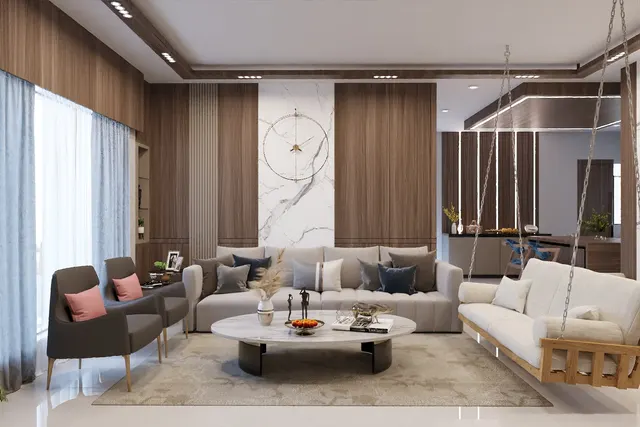
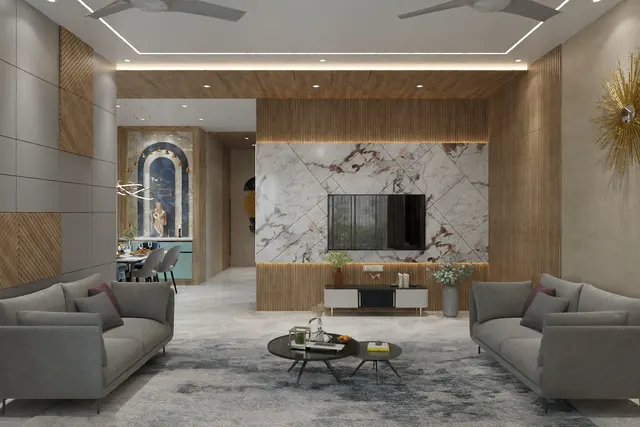
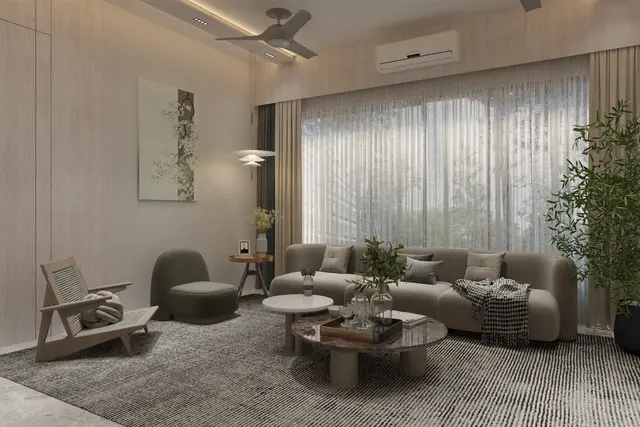
Fluted panels or wallpaper? It is the most common feature-wall question a client asks after choosing a sofa, and the honest one-line answer is this: fluted panels give you texture and toughness, wallpaper gives you pattern and colour, and they cost very different amounts. Here is why that difference matters, and how to decide for a specific wall rather than in the abstract.
A feature wall is the one surface in a room the eye meets first and the furniture faces — usually the TV or sofa wall, the bed back wall, or the wall seen from the front door. It is worth spending on, but it is also the wall most likely to be over-designed. Fluted panelling and wallpaper are the two most-chosen treatments in Indian homes right now, and they are not really competitors so much as answers to different questions. This comparison lays out where each one genuinely wins.
The two materials, briefly
Fluted panels are rigid boards with a repeating vertical (or sometimes horizontal) half-round or square profile machined or extruded into the face. In Indian homes they come mainly in three forms: WPC (wood-plastic composite) flutes, which are moisture-tolerant and come pre-finished; MDF flutes finished in laminate or PU paint, which give the smoothest, most premium result in dry rooms; and veneer-finished flutes for a real-wood look. They are fixed to the wall on a frame or directly with adhesive and pins, and their whole appeal is the play of light and shadow across the ribs, which changes through the day.
Wallpaper is a printed or textured covering — most commonly vinyl, non-woven or fabric-backed — pasted to a prepared wall. Its appeal is the image: a pattern, a large-scale mural, a botanical or a stone or plaster effect, in colours and detail no paint can match, applied in a day. Modern non-woven papers are more forgiving to hang and to remove than older vinyls, but every wallpaper shares one weakness — it is a thin surface bonded to the wall, so it is only as good as the wall behind it and the dryness of the room.
Side by side
The table below compares the two on the criteria that actually decide a feature wall. Rates are indicative October 2026 installed ranges in Indian metros and tier-2 cities and vary with finish, pattern and quantity.
| Criterion | Fluted panels | Wallpaper |
|---|---|---|
| What it gives | Three-dimensional texture, shadow, calm tone-on-tone | Pattern, mural, scenery, colour and image depth |
| Indicative cost (installed) | ₹350–850 (WPC/MDF laminate); ₹1,000–1,800 (PU) | ₹60–250 per sq ft |
| Durability | High — tolerates knocks, furniture against it, wiping | Low–medium — thin surface; edges and corners wear |
| Water / humidity | WPC handles humidity; MDF only in dry rooms | Dry walls only; peels and grows mould if damp |
| Wall condition needed | Hides minor defects; built on a frame or adhesive | Needs a flawless, puttied, primed, dry wall |
| Installation time | 1–3 days incl. framing and finishing | Often 1 day for a single wall |
| Cleaning | Dust the ribs; wipe laminate/PU with a damp cloth | Wipe vinyl gently; many papers cannot be scrubbed |
| Changing it later | A refit job — unscrew/pry panels, patch wall | Strip and re-hang; non-woven papers peel cleanly |
| Best rooms | Living, bedroom, foyer, TV walls; WPC for semi-wet | Living, bedroom, dining, study, powder room (dry) |
| Risk to avoid | Flutes near a hob or shower; cheap bowing WPC | Humid walls, behind beds that rub, seams lifting |
Where fluted panels win
Fluted panels win wherever texture, toughness and permanence matter more than image. On a TV or sofa wall that furniture will sit against and shoulders will brush, the ribbed surface shrugs off the contact that would wear a wallpaper's edges. In a tone-on-tone, warm-minimalist or contemporary scheme, the shadow lines of the flutes give the wall quiet movement without any pattern at all, and they read as more premium and more built-in than a printed surface. Because the panels build out from the wall on a frame or thick adhesive, they also forgive a slightly uneven plaster that would telegraph through wallpaper.
They also stretch further than wallpaper into semi-wet and hard-use zones. WPC flutes tolerate the humidity of a dining area beside an open kitchen or a shaded balcony, and the harder PU-painted MDF version suits a premium bedroom or lounge where the finish must be flawless. The practical rule fabricators follow is to keep panel joints falling on a flute line so they disappear, and to fix the panels to a frame anchored into the slab or masonry rather than trusting adhesive alone on a tall wall.
Where wallpaper wins
Wallpaper wins whenever the point of the wall is an image. A large-scale mural behind a bed, a botanical panel in a dining nook, a subtle plaster or stone effect across a study wall, a child's scene in a nursery — none of these can be done in fluted panelling, and all of them can be had for a fraction of the cost. On a dry, well-prepared wall, wallpaper is also the fastest feature wall there is: a single wall can be hung in a day with no framing, no finishing coats and no dust. For renters or anyone who likes to change a room every few years, modern non-woven papers peel off far more cleanly than old vinyls, which makes the low cost feel even lower.
The two conditions wallpaper insists on are a dry room and a flawless wall. Because it is skin-thin, it shows every bump, so the plaster must be puttied, primed and smooth; and because it is paper-and-paste, it must stay away from showers, splashbacks and damp external walls, where it will peel and grow mould. Keep it off walls that bodies rub — directly behind a bed headboard without a buffer, or in a tight passage where shoulders brush — and it will last well.
| Feature wall (3.6 × 2.7 m ≈ 105 sq ft) | Material + install | Indicative cost (Oct 2026) |
|---|---|---|
| Wallpaper (vinyl / non-woven), installed | ₹60–250 per sq ft | ₹6,300–26,250 |
| WPC or MDF fluted panels, laminate finish | ₹350–850 per sq ft | ₹36,750–89,250 |
| Fluted MDF, PU-painted (premium) | ₹1,000–1,800 per sq ft | ₹1,05,000–1,89,000 |
| Combination — fluted main panel + framed wallpaper | Mixed | ≈ ₹30,000–80,000 typical |
Using both together
The most resolved feature walls in current Indian interiors often refuse to choose. A common and effective composition is a fluted panel as the main event — behind the TV or the bed — with a framed panel of wallpaper set beside or behind it, so the texture of the flutes and the image of the paper play off each other. The fluted portion takes the hard use and gives the wall its depth; the wallpaper adds the pattern or scene the flutes cannot. Keeping the wallpaper framed inside panelling, rather than running wall-to-wall, also protects its edges and makes it cheap to change later. On a controlled budget, this hybrid gives more impact than spending the whole amount on either one alone.
| Wall / room | Better pick | Why |
|---|---|---|
| TV or sofa wall (furniture against it) | Fluted panels | Takes contact and knocks; adds depth and shadow |
| Bed back wall with a mural or scene | Wallpaper | Image and colour no panel can give; low contact |
| Dining or study accent wall | Either, or both | Fluted for calm texture; wallpaper for a pattern |
| Foyer / passage feature wall | Fluted panels | Shoulders brush the walls; durability matters |
| Powder room (dry) feature | Wallpaper, framed | Pattern in a small room; keep off wet zones |
| Semi-humid wall (near open kitchen) | WPC fluted panels | Tolerates humidity; wallpaper would peel |
Frequently asked questions
Which is cheaper, fluted panels or wallpaper?
Wallpaper, by a wide margin. Installed wallpaper runs about ₹60–250 per sq ft, while fluted panels run about ₹350–850 per sq ft for WPC or laminate-finished MDF and ₹1,000–1,800 for PU-painted. For the same 105 sq ft feature wall, that is roughly ₹6,300–26,250 for wallpaper against ₹36,750 and up for flutes (indicative October 2026).
Can fluted panels or wallpaper go in a bathroom?
Wallpaper should not — it needs a dry wall and will peel and grow mould in a wet room; at most use it as a framed panel behind glass on a dry wall, as some designs do. WPC fluted panels tolerate humidity and can be used on dry bathroom walls away from direct splashing, but keep any fluting away from the shower and the basin splash zone, where tile, stone or glass belong.
Do fluted panels make a room look smaller?
Not if used on one wall. A single fluted feature wall adds depth and interest without closing a room in; vertical flutes can even make a wall feel taller. The caution is build-out — flutes sit about 30–55 mm off the wall including the frame — so in a very tight room check the panel does not foul a door swing or a wardrobe, and keep the rest of the walls plain and light.
How long does each last?
A well-fixed fluted panel in a dry room lasts many years and tolerates daily contact; laminate and PU finishes wipe clean and resist knocks. Wallpaper in a dry, low-traffic room typically looks good for several years before edges, seams or sunlight-faded patches show; in humid or high-contact spots it fails sooner. Both are far more durable when the wall behind is dry and properly prepared.
Sources & standards
- Manufacturer technical data for WPC and MDF fluted panels and for vinyl / non-woven wallpapers (Indian market), described as typical ranges
- Bureau of Indian Standards — IS 12406 (medium density fibreboard) and general guidance on interior wall linings
- This site's wall-finish and accent-wall guides — rate ranges for wallpaper, fluted panels and panelling
- Price ranges: indicative October 2026 estimates for finished, installed feature walls — confirm with a local fabricator before budgeting