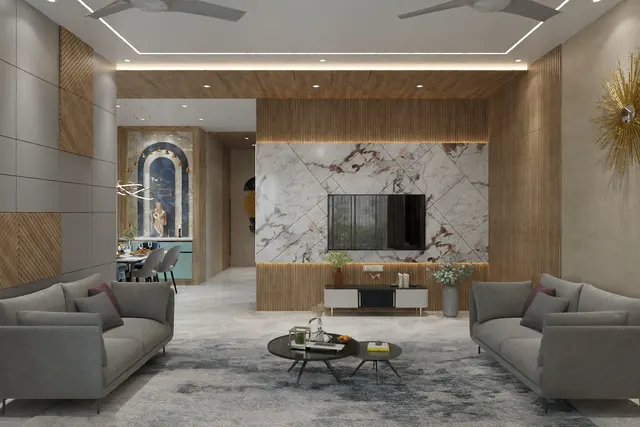
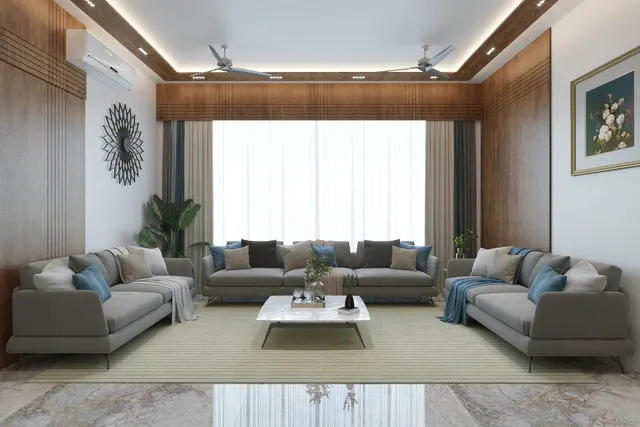
Granite and quartz are constantly compared, but the comparison people have usually read is about kitchen countertops, where engineered quartz has become the fashionable choice. Flooring is a different question with a different answer. A floor is a large area, often lit by the sun, walked on with gritty shoes, and expected to last for decades at a sensible cost. Those conditions suit the two materials very differently, and a choice copied from a countertop article can go expensively wrong. This article compares granite and quartz specifically as flooring, in the Indian context, where natural granite has paved homes, temples and offices for generations and engineered quartz is a newer, premium arrival.
The confusion starts with the word quartz itself, because it means two different things. Quartz is a natural mineral, one of the hardest common minerals and a major ingredient of granite. Engineered quartz, the slab product sold for surfaces, is something else: crushed natural quartz bound together with resin and pigment. When flooring is discussed, quartz almost always means this engineered slab, and its resin content is the key to everything that follows — it makes the surface non-porous and uniform, but also heat-sensitive and prone to fading in sunlight. Granite, by contrast, is solid natural rock all the way through. The rest of this article explains what that difference means for a floor, with the hardness, water, heat, cost and slab-size facts set side by side, so the choice can be made for the room rather than the fashion.
Stone floors in India, and the rise of engineered quartz
India has floored its buildings in natural stone for as long as it has built in masonry. Sandstone, limestone such as Kota, marble and granite have paved courtyards, temples and homes for centuries, chosen for the stone available in each region. Granite, being one of the hardest and most durable stones and quarried widely across southern and eastern India, became a mainstay of flooring through the twentieth century, especially once gang saws and polishing lines could turn rough blocks into large, mirror-polished slabs. A polished granite floor became a symbol of a solid, well-built Indian home, and it remains one of the most common hard floors in the country. Engineered quartz, by contrast, is a late-twentieth-century invention that reached Indian homes mainly in this century, first as a countertop material and only more recently proposed for floors. It arrived with the promise of consistent colour and a flawless, non-porous surface — qualities natural stone cannot guarantee — and that promise is genuine, but it comes with conditions that matter far more on a floor than on a worktop.
What they actually are
Granite is an igneous rock, formed as molten material cooled slowly deep in the earth, giving it interlocked crystals of quartz, feldspar and mica. It is natural, so every slab is unique, with the movement, flecks and colour variation of real stone, and it is solid mineral throughout. Engineered quartz is a manufactured slab, typically around 90 per cent crushed natural quartz mixed with roughly 7–10 per cent polymer resin and pigments, compacted under vibration and vacuum and cured. That recipe gives it a dense, non-porous, colour-consistent surface — but the resin that binds it is a plastic, and plastics do not like heat or ultraviolet light. This single fact explains most of the practical differences: granite behaves like rock because it is rock, while engineered quartz behaves like a very hard, resin-rich composite, superb in some conditions and vulnerable in others.
It is worth dwelling on the resin, because it is the whole story in miniature. In an engineered quartz slab the natural quartz is crushed to grains and then held together by a polymer — most of the strength and hardness comes from the quartz, but the colour, the gloss and the non-porous skin come from the resin. That is why quartz slabs can be made in any colour, including flawless whites and marble-look veining that no quarry produces, and why they do not need sealing: the resin closes every pore. But a polymer also softens and discolours under heat and ultraviolet light, where a mineral does not. Granite has no binder to fail: it is the same hard rock on the surface as it is a centimetre down, so a scratch or a chip shows the same stone, not a different core, and nothing in sun or heat changes it. Understanding this one trade-off — manufactured perfection held in a vulnerable binder, versus natural variation in an indestructible solid — answers almost every practical question about the two as floors.
How a stone or quartz floor is built
Both materials are laid as large slabs or tiles on a mortar bed over the structural floor, and the build-up is broadly the same. Understanding it helps judge cost, thickness and the quality of a finished floor. The section below shows the typical layers: the structural slab, a cement mortar bed that both bonds and levels, the stone or quartz slab itself, and the skirting that finishes the wall junction. Flooring slabs are usually 15–20 mm thick — thinner than a 20–30 mm countertop — and the joints between them are kept tight and filled.
The technical comparison
The table and chart below set the two materials side by side on the properties that decide a floor. The headline differences are consistent and worth memorising: engineered quartz has a slightly harder, more scratch-resistant and completely non-porous surface, while granite is far more resistant to heat and, crucially for a floor, to sunlight. Engineered quartz is not recommended in areas of direct, sustained sunlight because ultraviolet light can fade or yellow the resin over time, and it can be scorched by a very hot object; granite shrugs off both. These are not marginal points for a floor, which is often the sunniest surface in a room.
| Property | Granite (natural) | Engineered quartz |
|---|---|---|
| Composition | Solid natural rock throughout | ≈ 90% crushed quartz + 7–10% resin |
| Surface hardness | Hard (Mohs ≈ 6–7) | Very hard surface (quartz ≈ 7) |
| Water absorption | Low (≈ 0.4%); seal to be safe | Non-porous (≈ 0% once sealed by resin) |
| Heat resistance | Excellent — true stone | Moderate — resin can scorch at high heat |
| Sunlight / UV stability | Excellent — does not fade | Poor — can fade or yellow in direct sun |
| Colour consistency | Natural variation slab to slab | Highly uniform, predictable |
| Finish options | Polished, honed, flamed, leather | Mostly polished / honed |
| Suited to large floors | Yes — the traditional choice | Yes but costly; avoid sun-lit areas |
A word on slip and safety, which matters more on a floor than any other property. A mirror-polished floor of either material is beautiful but slippery, especially when wet, so for bathrooms, balconies, kitchens and staircases a less reflective finish is safer. Granite offers the widest choice here — honed (matt), flamed (rough, textured) and leather finishes all cut the slip risk, and flamed granite is a genuinely good outdoor and wet-area floor. Engineered quartz is mostly available polished or lightly honed, which is one more reason it suits dry, shaded living areas rather than wet or outdoor floors. Whatever the material, the wet-area floor should also fall gently to a drain, and a doormat at every entrance keeps out the grit that scratches and dulls any hard floor over the years far faster than normal use does.
Slab sizes, joints and wastage
Both materials come as large slabs, which keeps joints few and a floor looking seamless — an advantage over small tiles. Granite slabs are commonly around 2700–3200 mm long and 1500–1900 mm wide, varying with the block; engineered quartz is made to fixed factory sizes, commonly about 3060 × 1440 mm with jumbo slabs around 3200 × 1600 mm. For a floor this means long, large pieces with tight joints in either material. The difference is in cutting and wastage: natural granite has to be selected and matched for colour and may carry natural flaws, so some wastage is normal; engineered quartz is uniform, so it cuts predictably, but its higher price makes every offcut more expensive. The figure below compares typical slab sizes.
Where each suits a floor
The right choice depends on the room. Granite is the all-rounder: it works in living rooms, kitchens, passages, staircases, balconies, verandahs and sun-lit spaces, indoors and out, because nothing about sun or heat troubles it. Engineered quartz makes most sense indoors, away from direct sunlight, where its flawless uniform colour and non-porous surface are wanted — a feature floor in a lobby, a powder room, or a shaded, premium living space. It is a poor choice for a sun-drenched hall, a balcony, a verandah or any outdoor floor, and its cost makes it hard to justify across a whole large home. The room-by-room table makes this concrete.
| Area | Granite | Engineered quartz |
|---|---|---|
| Living / dining (shaded) | Excellent | Good, if budget allows |
| Living / dining (sun-lit) | Excellent | Avoid — risk of fading |
| Kitchen floor | Excellent | Good; keep away from direct heat sources |
| Bathrooms (floor) | Good with honed, anti-skid finish | Good; non-porous surface |
| Staircase | Excellent | Workable but costly |
| Balcony / verandah / outdoor | Excellent (flamed/leather finish) | Not recommended — sun fades it |
| Commercial lobby | Excellent | Excellent where sun is controlled |
Cost
Cost is where the comparison usually settles for a floor, because the area is large. Granite flooring is markedly cheaper than engineered quartz flooring. As a guide, indicative October 2026 ranges, excluding GST: common granite runs about ₹60–200+ per square foot in material, with laying labour of roughly ₹30–50, for an installed figure often around ₹110–280 per square foot; exotic granite colours price far higher. Engineered quartz, following the bands used for quartz surfaces, runs roughly ₹250–600 per square foot in material for standard to designer ranges and ₹550–1,000+ for premium, so installed as flooring it commonly lands around ₹300–900+ per square foot. Across a 1,000 square foot home that difference is very large, which is the main practical reason granite remains the default Indian floor and quartz stays a selective, premium choice. All figures are indicative and should be confirmed with written local quotes before budgeting. The honest way to compare quotes is on the installed total per square foot, not the slab price alone: granite and quartz both carry laying labour, and granite may add a small cost for sealing while quartz adds nothing there, so the all-in number is what reveals the real gap. It is also worth asking what the quote assumes about wastage, because a complicated floor with many cuts raises the effective rate of the costlier material much more than it raises granite's.
| Floor material | Material ₹/sq ft | Laying ₹/sq ft | Installed (approx.) |
|---|---|---|---|
| Granite (common colours) | ₹60–200+ | ₹30–50 | ₹110–280 |
| Granite (exotic colours) | Prices far higher | ₹30–50 | Verify locally |
| Engineered quartz (standard–designer) | ₹250–600 | ₹40–60 | ₹300–700 |
| Engineered quartz (premium) | ₹550–1,000+ | ₹40–60 | ₹600–1,000+ |
Maintenance over the years
Both are low-maintenance floors by the standards of, say, marble, but they ask for different things. Granite is sealed on installation and benefits from occasional resealing, because although its absorption is low it is not zero; day to day it needs only sweeping and a damp mop, and it tolerates almost any cleaner. Engineered quartz is non-porous and never needs sealing, and a damp mop keeps it clean, but it must be protected from the two things resin dislikes: strong, sustained sunlight and high heat. Harsh alkaline or abrasive cleaners should be avoided on quartz as they can dull the resin. The detail below shows the skirting and threshold junctions that finish either floor, and the maintenance table compares the routines.
| Maintenance task | Granite | Engineered quartz |
|---|---|---|
| Daily | Sweep and damp mop | Sweep and damp mop |
| Sealing | On install; reseal occasionally | Never needed (non-porous) |
| Cleaners | Tolerates most; avoid strong acids | Mild only; avoid abrasives and strong alkalis |
| Sunlight | No concern | Keep out of direct, sustained sun |
| Heat | No concern | Use mats under very hot objects |
| Repair of a chip | Specialist stone repair | Resin fill by a fabricator |
Where flooring is heading
The direction of travel in Indian flooring is towards large-format, low-maintenance surfaces with few joints, and both of these materials fit that trend — alongside large porcelain and sintered-stone slabs that increasingly compete with both. Granite is being used in more finishes than the old mirror polish, with honed, flamed and leather textures giving a softer, more contemporary and less slippery floor. Engineered quartz is being refined with better resins and more natural-looking patterns, and newer sintered and porcelain slabs are appearing that keep quartz's uniformity while solving its heat and sun weaknesses. For a floor today, the honest position is that granite remains the dependable, economical, sun-proof default, engineered quartz is a selective premium indoor choice, and large porcelain or sintered slabs are a third option worth pricing alongside them. Aaditya Interior specifies the floor to the room's light, use and budget rather than to a single favourite material. The best advice for a homeowner is to resist choosing a floor from a glossy sample under showroom light, and instead to picture the material in the actual room — how much sun it gets through the day, how hot and wet the area becomes, and how large the floor is to be paved — because those three questions decide the right answer far more reliably than the look of a polished offcut.
Rules for choosing between granite and quartz flooring
- Start with sunlight: never use engineered quartz on a sun-lit, balcony or outdoor floor — choose granite there.
- Match heat exposure: granite near hot zones and cooking areas; protect quartz from high heat.
- Weigh the budget over the whole area — granite is far cheaper across a large floor.
- Choose quartz only where its flawless, uniform, non-porous surface is genuinely wanted and the area is shaded.
- Insist on a full mortar bed with no hollows under the slab, whichever material is used.
- Pick an anti-skid finish (honed or flamed granite) for bathrooms, balconies and staircases.
- Seal granite on installation and reseal occasionally; keep harsh and abrasive cleaners off quartz.
- Get written per-square-foot quotes that separate material from laying, and compare installed totals.
Frequently asked questions
Is quartz good for flooring?
Engineered quartz can be used for flooring and gives a very hard, non-porous, perfectly uniform surface, but it has two real weaknesses on a floor: it fades or yellows in direct sunlight and can be scorched by high heat, and it costs considerably more than granite. It is best kept to shaded indoor areas where its uniform look is wanted, not sun-lit halls, balconies or outdoor floors.
Which is cheaper, granite or quartz flooring?
Granite is cheaper for flooring. Indicative October 2026 figures put common granite at roughly ₹110–280 per square foot installed, against about ₹300–900+ for engineered quartz. Across a whole home the difference is large, which is a major reason granite remains the standard Indian floor and quartz is used selectively.
Does quartz flooring fade in sunlight?
Yes — this is its most important limitation as a floor. The resin that binds engineered quartz is not fully stable under ultraviolet light, so a quartz floor in direct, sustained sunlight can fade or discolour over time. Granite, being natural stone, does not fade, which is why it is the safe choice for any sun-lit or outdoor floor.
Which is more scratch-resistant for a floor?
Engineered quartz has a slightly harder, more scratch-resistant surface than granite, but both are hard enough for domestic floors. The more common cause of a dulled stone or quartz floor is gritty dirt walked in from outside, so a doormat and regular sweeping protect either material far more than the small difference in hardness between them.
Sources & standards
- Bureau of Indian Standards — IS 14223 (polished building stones / granite) and related natural stone standards
- Bureau of Indian Standards — National Building Code of India 2016, Part 5 (Building Materials) and Part 6 (Structural Design) context for flooring
- Neufert, Architects' Data — floor finishes, stone flooring build-up and skirtings
- Time-Saver Standards for Architectural Design — flooring materials and detailing
- Engineered quartz manufacturer technical data (composition ≈ 90% quartz with polymer resin; UV and heat limitations), described generically
- General geology references on granite as an igneous rock and quartz mineral hardness (Mohs scale)
- Price ranges: indicative October 2026 estimates — confirm locally before budgeting