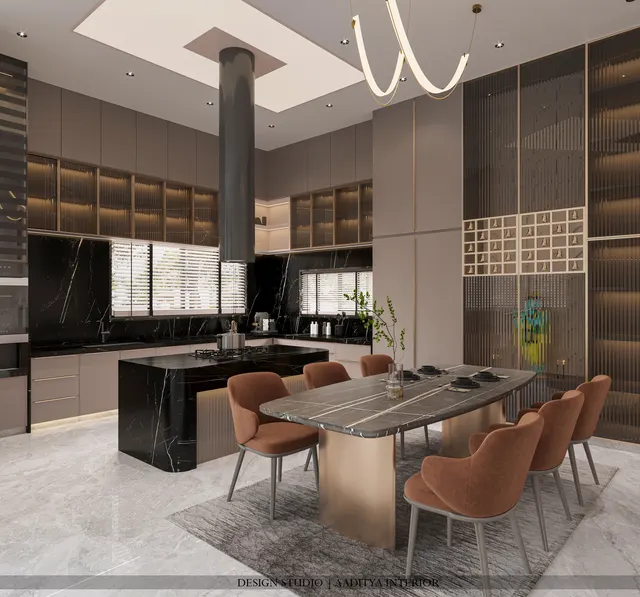
Here is the short version a client usually wants before the long one: pick granite if you want a natural, one-of-a-kind stone, the lowest price and total indifference to a hot pan; pick quartz if you want a flawless, consistent colour, no sealing and the easiest possible upkeep. Both are excellent kitchen worktops. The decision is not about quality — it is about which set of trade-offs fits how you cook and what you want the kitchen to look like.
Granite and quartz dominate Indian kitchen platforms for good reason, and they are constantly confused because both are hard, stone-like and sold from the same yards. But they are fundamentally different materials. Granite is natural igneous rock, quarried and polished into slabs, so every slab is unique and slightly porous. Quartz — often called engineered stone — is roughly 90–93 per cent crushed natural quartz bound with resin and pigment, manufactured into slabs, so it is uniform and non-porous. That one difference, natural versus engineered, drives every practical comparison below.
The two materials at a glance
The side-by-side table below compares the two on the criteria that actually decide a kitchen. Read it as a whole: granite wins on heat and price, quartz wins on stains and consistency, and they are close on strength and lifespan. Prices are indicative October 2026 material bands for the Indian market and exclude fabrication and installation, which both materials need.
| Criterion | Granite (natural stone) | Quartz (engineered stone) |
|---|---|---|
| Origin | Quarried natural rock; each slab unique | Engineered — ~90–93% quartz, resin, pigment |
| Look | Natural grains, movement, speckles; limited to what nature made | Consistent colour; marble-look veining and plain shades made to order |
| Porosity / stains | Slightly porous; needs sealing to resist oil and turmeric | Non-porous; highly stain-resistant, no sealing |
| Heat tolerance | Excellent — a hot vessel rarely harms it | Good but limited — resin can scorch; use a trivet |
| Scratch / hardness | Very hard; resists knife scratches | Very hard; resists scratches (still use a board) |
| Seams / joints | Visible seams; natural pattern hides them poorly | Consistent colour hides seams better |
| Maintenance | Reseal periodically; wipe spills promptly | Wipe clean; no sealing — the lowest upkeep |
| Repair | Chips can be filled; colour match is natural | Chips hard to match; resin can discolour near heat |
| UV / outdoor | Stable outdoors and in strong sun | Resin can fade or yellow in direct sun — indoor use |
| Thickness | Commonly 18–20 mm slabs | Commonly 20 mm (also 12/30 mm) |
| Material cost (per sq ft) | ₹100–350+ (common blacks ₹110–180) | Basic ₹250–425; designer ₹400–600; premium ₹550–1,000+ |
Where granite wins
Granite wins on three fronts, and for many Indian kitchens they are decisive. First, heat: granite is natural rock and shrugs off a hot kadhai or a pressure cooker placed straight on it — a real advantage in a kitchen where vessels come off a high flame. Quartz can scorch because its resin binder is heat-sensitive, so it always wants a trivet. Second, price: granite is the budget champion, with common black varieties at roughly ₹110–180 per sq ft and the overall band spanning ₹100–350+ depending on variety, which is the widest and lowest in the market. Third, character: because each slab is unique, a granite counter has natural movement and grain that no two kitchens share — and it is stable outdoors and in strong sun, which matters for an open or semi-outdoor kitchen.
The cost of those wins is maintenance. Granite is slightly porous, so it needs periodic sealing and prompt wiping of oil, turmeric and acidic spills, which can stain or etch an unsealed surface. Seams are also more visible because the natural pattern cannot be matched perfectly across a joint. For a cook who is relaxed about sealing once a year and wipes spills quickly, none of this is a problem — and the heat tolerance and price often settle the decision.
Where quartz wins
Quartz wins on consistency and upkeep. Because it is engineered, a quartz slab has exactly the colour and pattern you chose, with no surprises between the sample and the slab — important if you want a specific plain shade or a clean marble look across a large island. It is non-porous, so it never needs sealing and resists stains from oil, turmeric, wine and citrus far better than granite; a wipe is all it takes. Seams are less visible because the colour is uniform, and the surface is hard and hygienic. For busy families who want a worktop they never have to think about, quartz is the low-maintenance answer.
Quartz asks for two compromises. It costs more — basic 20 mm quartz runs about ₹250–425 per sq ft, designer quartz ₹400–600 and premium ₹550–1,000+, roughly double to triple common granite. And it is heat-sensitive: a very hot vessel placed directly on it can scorch or discolour the resin, so trivets are not optional. It is also an indoor material, because the resin can fade or yellow in direct sun — so it is the wrong choice for an open terrace kitchen that granite would handle easily.
Cost: what a real platform works out to
Material rate per square foot is only part of the story; the platform is a fixed size, so it is more useful to cost a typical kitchen. A common mid-size Indian kitchen platform is about 40 sq ft. The table below applies the indicative October 2026 material bands to that platform, so the two materials can be compared on the number that actually appears in a budget. Fabrication, edge polishing, cutouts and installation are extra and broadly similar for both.
| Material | Rate (per sq ft) | ≈ 40 sq ft platform (material) |
|---|---|---|
| Granite — common blacks | ₹110–180 | ₹4,400–7,200 |
| Granite — exotic / premium varieties | ₹100–350+ | ₹4,000–14,000+ |
| Quartz — basic (20 mm) | ₹250–425 | ₹10,000–17,000 |
| Quartz — designer | ₹400–600 | ₹16,000–24,000 |
| Quartz — premium | ₹550–1,000+ | ₹22,000–40,000+ |
| Reference anchor | mid quartz ≈ ₹350 | ≈ ₹14,000 material (40 × ~₹350) |
The arithmetic makes the trade-off concrete. A granite platform in a common black costs roughly ₹4,400–7,200 in material; the same platform in mid-range quartz is about ₹14,000. Quartz typically costs two to three times common granite — the price of consistency, zero porosity and no sealing. Whether that premium is worth it depends entirely on how much the family values low maintenance and an exact colour over the lowest price and the best heat tolerance. Fabrication and fitting are broadly similar for both, so the slab rate is where the real cost difference sits.
| Material | Daily care | Long-term care |
|---|---|---|
| Granite | Wipe spills promptly; mild soap, no acids | Reseal periodically because it is slightly porous |
| Quartz | Wipe with a damp cloth and mild soap | No sealing; avoid direct heat and harsh abrasives |
Which to choose, by kitchen
- Heavy Indian cooking with hot vessels going straight down — lean granite for its heat tolerance, or commit to using trivets with quartz.
- A busy family that wants zero upkeep and no staining worries — choose quartz; it never needs sealing.
- A tight budget — granite in a common black is the lowest-cost durable stone at ₹110–180 per sq ft.
- A specific plain colour or a clean marble-look island — quartz delivers exactly the shade and pattern you picked.
- An open, semi-outdoor or sunlit kitchen — choose granite; quartz can fade in direct sun.
- A large island with long runs and visible seams — quartz hides seams better thanks to its uniform colour.
- A statement, one-of-a-kind natural surface — granite's unique grain is the point; no two slabs are alike.
Frequently asked questions
Is granite or quartz better for an Indian kitchen?
Both are excellent; the better one depends on your priorities. Granite suits heavy cooking because it tolerates hot vessels and costs less, but it needs sealing and prompt wiping of turmeric and oil. Quartz suits families who want a flawless, low-maintenance, non-porous surface in a chosen colour, and who will use trivets. For most Indian kitchens with a lot of hot-vessel cooking, granite is the pragmatic pick; for low-maintenance perfectionists, quartz wins.
Does quartz stain with turmeric and oil?
Far less than granite. Quartz is non-porous, so turmeric, oil and acidic spills sit on the surface and wipe off, with no sealing required. It is one of quartz's main advantages. Granite is slightly porous and can stain if a spill is left on an unsealed surface, which is why granite is sealed periodically and spills are wiped promptly.
Can I put a hot pan directly on quartz?
Better not to. Quartz is bound with resin that is heat-sensitive, so a very hot vessel placed straight on it can scorch or discolour the surface — always use a trivet or hot pad. Granite, being natural rock, handles direct heat far better, which is one of the strongest reasons heavy-cooking kitchens choose it.
Is quartz the same as quartzite?
No. Quartz here means engineered stone — crushed natural quartz bound with resin and pigment, manufactured into slabs. Quartzite is a natural quarried rock, closer to granite in behaviour: very hard, heat-tolerant and slightly porous, needing sealing. They sound alike but behave differently, so always confirm which material a yard is quoting.
Sources & standards
- Bureau of Indian Standards — IS 14223 (polished building stone) and related natural-stone references, used generically
- Manufacturer technical data for engineered quartz surfaces (composition, heat and stain behaviour), described as typical ranges
- Indian market dealer listings for granite and engineered-quartz slab rates, reviewed October 2026
- This site's countertop and kitchen-cost guides — consistent indicative bands for granite and quartz
- Price ranges: indicative October 2026 estimates — material only, excluding fabrication and installation; confirm locally before budgeting