The false ceiling does quiet, essential work: it hides wiring, ducts and plumbing lines, carries the lighting design, improves acoustics, and sets the room's finished height. It is also one of the most argued-about line items in interior quotations, because three very different systems — gypsum board, POP (plaster of Paris), and PVC panels — all claim the same ceiling. They differ in cost, finish quality, design flexibility, moisture tolerance and speed, and choosing wrong shows up as cracks, sagging, peeling paint or a ceiling that fights the lighting plan.
Gypsum is the modern factory system: boards screwed to a metal frame, jointed and finished to a seamless surface. POP is the craftsman's system: plaster applied over a mesh, shaped by hand into any curve the artisan can form. PVC is the practical system: interlocking plastic panels fixed to a frame — waterproof, fast and economical, but unmistakably panelled. This article compares all three on the parameters that matter, with realistic installed-cost bands and a clear map of where each belongs — living rooms, bedrooms, bathrooms and balconies.
What this article settles: what each ceiling system is and how it is built, a full comparison on cost, finish, flexibility, moisture and speed, the dimensioned anatomy of a cove ceiling, realistic price bands per square foot, and room-by-room verdicts. Board sizes come from IS 2095; prices are indicative October 2026 market ranges.
The three systems: what they actually are
Gypsum — the factory board system
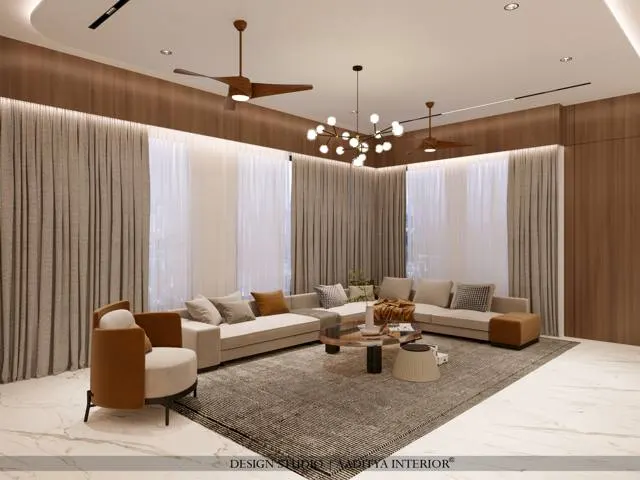
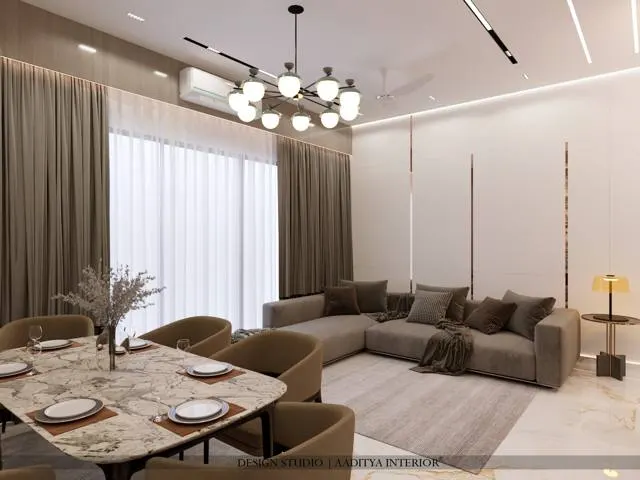
Gypsum false ceilings use factory-made boards — 12.5 mm thick in the standard 2440 by 1220 mm size (IS 2095 Part 1, 2011; 9.5, 15, 16 and 18 mm boards are also made) — screwed to a galvanized iron (GI) frame suspended from the slab. Joints are taped and compounded, then the whole surface is finished like a wall: putty, primer and paint. The result is a crisp, seamless, dimensionally stable ceiling that takes cove lighting, recessed spots and layered designs beautifully. It is the default for designer ceilings in living rooms and bedrooms, and the fastest route to a flawless painted finish.
POP — the craftsman's plaster
POP (plaster of Paris) ceilings are built by hand: a chicken-wire mesh or fibre framework is fixed below the slab, and plaster is applied, shaped and finished by artisans. POP's unique strength is sculptural freedom — domes, curves, cornices, medallions and flowing organic forms that no board system can follow. Its weaknesses are craft-dependence (the finish is only as good as the artisan), slower installation, and vulnerability to water: a terrace leak above a POP ceiling stains, softens and eventually collapses the plaster. POP suits ornamental and curved designs in dry interiors where the artisan's skill justifies the time.
PVC — the waterproof panel system
PVC ceilings use interlocking plastic panels fixed to a light frame. The panels are inherently waterproof — the only one of the three that can be hosed down — and installation is the fastest and cheapest. The trade-offs are aesthetic: the panel joints remain visible as fine lines, the finish never achieves gypsum's seamless painted look, and cheap panels can look exactly that. PVC is the rational choice for bathrooms, balconies, utility areas and budget renovations — rooms where moisture or cost dominates the decision.
The full comparison
All three systems side by side. The rows on moisture, finish and speed usually decide the choice before cost is even discussed.
| Parameter | Gypsum board | POP (plaster of Paris) | PVC panels |
|---|---|---|---|
| What it is | 12.5 mm boards (IS 2095) on GI frame, jointed and painted | Plaster hand-applied over mesh, shaped by artisans | Interlocking waterproof plastic panels on a frame |
| Installed cost (per sq ft) | ₹60–80 (with painting); designer/cove ₹80–180 | ₹70–100 | ₹50–90 |
| Finish quality | Crisp, seamless, wall-like painted finish | Depends entirely on artisan skill; can be superb | Panel joints visible; never seamless |
| Design flexibility | Excellent for layered, geometric and cove designs | Best for curves, domes, cornices, ornament | Limited — straight panel runs |
| Moisture suitability | Poor — boards sag and stain with water ingress | Poor — plaster softens and fails when wet | Excellent — waterproof; the wet-area champion |
| Installation time | Fast — dry system, modular | Slowest — wet plaster, curing, hand finishing | Fastest — dry panels, minimal finishing |
| Repairability | Good — cut out and re-board a section | Moderate — needs a skilled artisan to patch invisibly | Good — replace individual panels |
| Weight on slab | Light — GI frame plus boards | Heavier — plaster and mesh add load | Lightest |
| Lighting integration | Excellent — coves, spots, profiles all easy | Good — but artisan must form the recesses | Limited — surface lights and simple spots |
| Service life tier (dry rooms) | Long — stable and repaintable | Long if kept dry; fails fast with leaks | Long — waterproof and low-maintenance |
| Best for | Living rooms, bedrooms, designer ceilings | Ornamental, curved and heritage-style ceilings | Bathrooms, balconies, utilities, budget jobs |
The cove ceiling: anatomy of the most-asked design
The perimeter cove — a dropped border around the room with hidden LED strip light washing the walls — is the most requested ceiling feature in Indian living rooms, and it is worth understanding as a construction detail rather than a picture. The typical build: a gypsum border dropped 150 to 300 mm below the slab (typical detail), with an inner tray recess that holds the LED strip; cove LED strips cost roughly ₹150–300 per running foot installed (indicative October 2026). The light washes upward and outward, so the wall finish above the cove line must be flawless — every undulation shows in grazing light. Wiring for the strip, its driver location, and access for future replacement must be planned before the boards close, because opening a finished cove later is destructive.
Two failure modes recur. First, water: a terrace or bathroom leak above a gypsum cove stains the boards and sags the joints — which is why top-floor rooms and wet areas below plumbing need either guaranteed waterproofing or PVC instead. Second, proportion: a deep cove in a room with a low slab steals perceived height. NBC 2016 sets habitable-room ceiling height at a minimum of 2.75 m (2.4 m if air-conditioned); a 300 mm drop in a 2.75 m room leaves 2.45 m clear, which is legal but feels low — keep drops shallow where the slab is already at the minimum.
Prices: what each ceiling costs
False-ceiling prices below are per square foot installed, indicative October 2026 market ranges excluding GST. Gypsum's plain band includes painting; designer work with coves, layers and curves prices in the upper band. POP and PVC bands are all-in for standard work.
| Ceiling system | ₹ per sq ft (installed) | Includes |
|---|---|---|
| Gypsum (plain, with painting) | ₹60 – ₹80 | GI frame, 12.5 mm boards, jointing, putty, primer, paint |
| Gypsum (designer / with cove) | ₹80 – ₹180 | Layered designs, cove trays, curves; lighting extra |
| POP | ₹70 – ₹100 | Mesh, plaster, hand finishing, paint |
| PVC panels | ₹50 – ₹90 | Frame and interlocking panels; minimal finishing |
| Cove LED strip (reference) | ₹150 – ₹300 per running ft | Strip, driver and installation |
Where each ceiling belongs
- Living rooms: gypsum designer — the showcase ceiling, built for coves, spots and layered lighting.
- Bedrooms: gypsum plain or simple designer — calm, seamless, repaintable.
- Bathrooms: PVC — waterproof, wipeable, and indifferent to steam. Never gypsum or POP here.
- Balconies and semi-open areas: PVC — rain and humidity defeat the other two.
- Kitchens: gypsum plain (away from direct steam) or PVC; keep intricate coves out of heavy-grease zones.
- Heritage and ornamental designs: POP — curves, domes and cornices no board can follow.
- Top-floor rooms under terraces: PVC or gypsum only with guaranteed waterproofing above — leaks destroy both.
- Budget renovations: PVC — fastest, cheapest, and good enough where the ceiling is not the feature.
Sources & standards
- IS 2095 (Part 1): 2011 — gypsum plaster boards, 12.5 mm standard — Bureau of Indian Standards
- False ceiling cost bands — October 2026 market reference (indicative, excl. GST)
- Cove LED strip ₹150–300 per running ft installed — October 2026 market reference
- NBC 2016 Part 3 — habitable room ceiling height 2.75 m (2.4 m if air-conditioned)