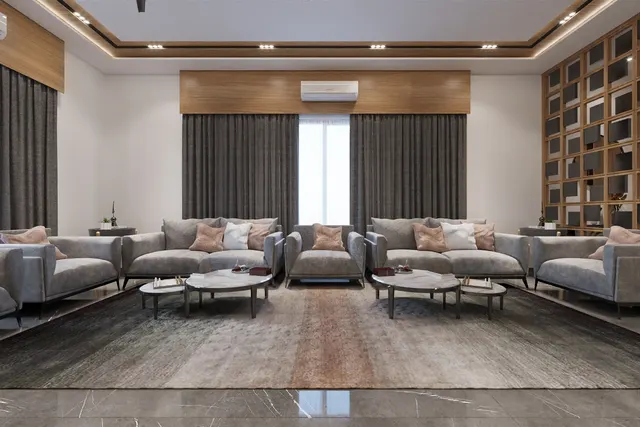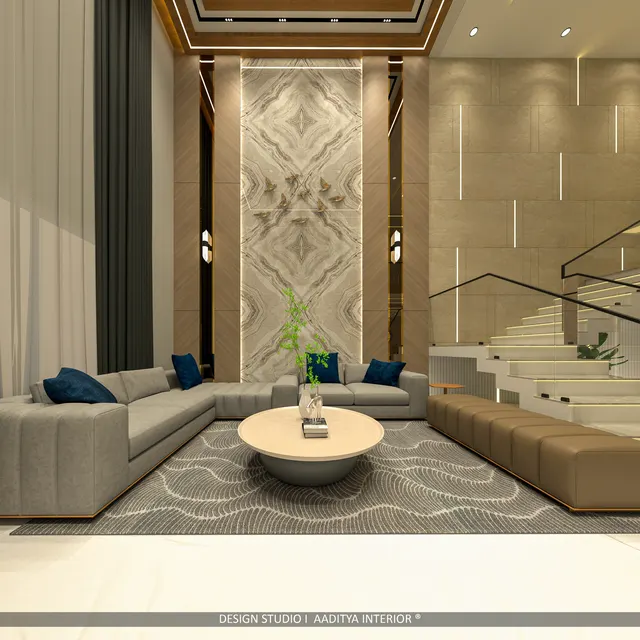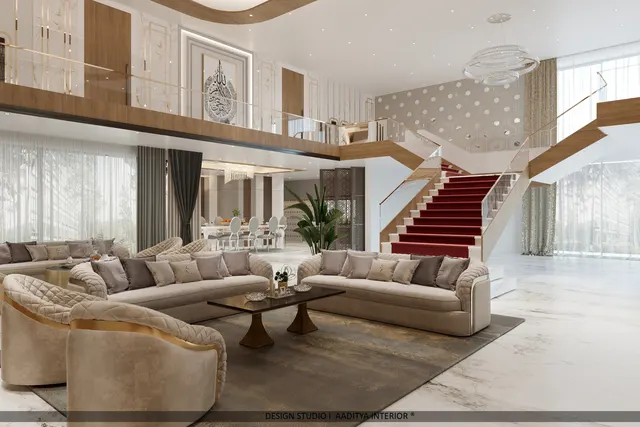

The three-bedroom flat is the aspirational family home across Ahmedabad's newer western and SG Highway corridors, and it is a meaningfully larger project than a 2 BHK, not merely one room bigger. A typical 3 BHK offers around fourteen hundred to fifteen hundred square feet of carpet area, three bedrooms, usually three bathrooms, a larger living-dining space and often a utility or servant area. Every one of those extra spaces carries its own storage, its own finishes and its own services, so the interior budget does not rise by a seventh - the proportion by which the floor grows - but by rather more, because the third bedroom adds a full wardrobe and the third bathroom a full fitting set.
As with any interior, the total is built from a small set of per-square-foot and per-room rates applied to the flat's carpet area, and those rates are the same across Gujarat; Ahmedabad sits within a rupee or two of Surat because both draw on the same dense regional supply of plywood, hardware and skilled carpentry. What differs between a 2 BHK and a 3 BHK is not the rate but the quantity: more wardrobe elevation, more paintable wall, more ceiling, more bathrooms and a larger kitchen. This guide sets out the three price bands for an Ahmedabad 3 BHK, breaks a mid-range example into its rooms, and gives the cross-checks that keep a larger project from drifting.
Prices here are indicative October 2026 ranges for the Ahmedabad market, excluding GST, and assume a builder-provided flat with basic flooring and plumbing already in place. The emphasis is on the choices a family controls - finish grade, hardware, the amount of built-in storage and the extent of false ceiling - rather than civil work, which varies too widely between projects to band. Where Aaditya Interior is named it is to describe project practice, not to quote a single firm's price list; the rates are market rates.
The quick answer: three bands for an Ahmedabad 3 BHK
For a typical fourteen-hundred-and-fifty square foot carpet-area 3 BHK in Ahmedabad, a complete interior falls into three bands in 2026. A budget build lands at roughly twelve to seventeen lakh, a mid-range build at eighteen to twenty-seven lakh, and a luxury build at thirty-two lakh and above. These track the same per-square-foot bands used for every interior - basic, mid-range and premium - multiplied by the larger carpet area of a 3 BHK. The budget band uses laminate finishes and standard hardware; the mid-range band adds soft-close branded hardware, gypsum ceilings with cove lighting and good loose furniture; the luxury band upgrades every surface and fills every room with built-ins.
From carpet area to a budget: the per-square-foot math
The rate means nothing without its denominator, and for interiors the denominator is always carpet area - the usable floor inside the walls - never the super built-up area in the sale agreement. In Ahmedabad's new projects the two figures can be far apart, because super built-up often loads a generous share of common areas, club amenities and double-height lobbies onto each flat. A unit sold as two thousand square feet super built-up may have only fourteen hundred and fifty of carpet. Multiplying an interior rate by the larger number inflates the budget by a third or more, so the first thing to settle before any quotation is which area the rate is applied to.
With carpet area fixed, the bands convert directly. The 2026 full-home bands are eight hundred to twelve hundred rupees per square foot for basic, twelve hundred to two thousand for mid-range, and two thousand to three thousand five hundred and above for premium. On fourteen hundred and fifty square feet those give twelve to seventeen lakh, eighteen to twenty-nine lakh and twenty-nine lakh and above. Most Ahmedabad families land at fourteen hundred to eighteen hundred and fifty rupees per square foot, which is why the mid-range total of twenty to twenty-seven lakh is the figure quoted most often for a 3 BHK in the city.
| Band | Per sq ft (carpet) | 1450 sq ft total | What it buys |
|---|---|---|---|
| Basic | Rs 800-1,200 | Rs 12-17 lakh | Laminate, standard hardware, minimal ceiling |
| Mid-range | Rs 1,200-2,000 | Rs 18-29 lakh | Soft-close hardware, gypsum cove, good furniture |
| Premium | Rs 2,000-3,500+ | Rs 29-50 lakh+ | Designer finishes, full built-ins, layered light |
| Typical | Rs 1,400-1,850 | Rs 20-27 lakh | Where most Ahmedabad families actually land |
Room by room: the line-item table
A band gives a first sanity check; a family planning a 3 BHK needs the room-by-room breakdown, because that is where the choices sit. The table below builds a mid-range Ahmedabad 3 BHK of about twenty-two lakh from its parts, each line traceable to a published rate. The kitchen is costed as a larger L or U-shape; three wardrobes are costed from their elevation area; painting from paintable area; the false ceiling over the living room and bedrooms; and three bathrooms each carry a mid-range fitting set. Loose furniture across a larger home - three beds, a bigger sofa, a dining set, a television unit - and the design-and-labour overhead complete the sum.
| Line item | Budget | Mid-range | Luxury | Basis |
|---|---|---|---|---|
| Modular kitchen (L/U-shape) | Rs 1.8L | Rs 2.8L | Rs 4.5L+ | Cabinetry Rs 1,340+/sq ft; finish decides band |
| Wardrobes (three bedrooms) | Rs 1.8L | Rs 3.3L | Rs 5L | Rs 1,200-2,200/sq ft elevation, ~145 sq ft |
| Loose furniture | Rs 2.2L | Rs 4.2L | Rs 7L+ | Three beds, sofa, dining, TV unit |
| False ceiling + painting | Rs 1.5L | Rs 2.6L | Rs 4.5L | Gypsum Rs 60-80; emulsion Rs 12-30/sq ft |
| Lighting + electrical | Rs 1.5L | Rs 2.6L | Rs 4.5L | Panels, cove LED, points, pendants |
| Bathrooms (three) | Rs 1.0L | Rs 1.5L | Rs 3L | Fitting set Rs 30-35k + labour per bath |
| Design + labour + misc | Rs 2.5L | Rs 5.0L | Rs 7L | Site supervision, fixing, consumables |
Read down any column and the band assembles: the budget column sums to roughly twelve to thirteen lakh, the mid-range column to about twenty-two, and the luxury column to past thirty-two. The proportions barely shift between bands - kitchen and wardrobes together take about a quarter to a third, loose furniture and the overhead take most of the rest - but the absolute numbers are larger than a 2 BHK at every line, which is the honest reason a 3 BHK is not simply a 2 BHK plus one room.
What the third bedroom and bathroom really add
The jump from a 2 BHK to a 3 BHK is concentrated in three places, and naming them makes the larger budget legible. The first is the wardrobe: a third bedroom adds a full wardrobe of forty-five to fifty square feet of elevation, which at the mid-range rate is sixty thousand to a lakh on its own. The second is the bathroom: a third bath adds a complete fitting set at thirty to thirty-five thousand rupees plus labour, plus its own tiling, waterproofing and ventilation. The third is the general multiplication - more paintable wall, more ceiling, more flooring if it is being changed, more lighting points and a larger kitchen to serve a bigger household. None of these is optional in the way a feature wall is; they come with the extra room.
This is why the per-square-foot rate, not a per-room rate, is the reliable way to budget a 3 BHK. A per-room estimate tempts a family to assume the third bedroom costs the same as the first, when in truth the marginal room carries its own storage, services and share of the overhead. Anchoring on fourteen hundred to eighteen hundred and fifty rupees per square foot of carpet, and then checking that the room-by-room lines add up to roughly that, catches the two classic errors at once: a quote that is secretly a 2 BHK quote with a bedroom bolted on, and a quote that has inflated the rate by applying it to super built-up area.
What is not in the quote
In a larger home the excluded items are larger too, so the discipline of normalising scope matters more, not less. An Ahmedabad 3 BHK quote typically excludes appliances - hob, chimney, refrigerator, washing machine and, in a bigger flat, three or four air-conditioners, which alone can run to four or five lakh. It excludes civil work such as wall-breaking and plumbing re-routing; electrical point-shifting beyond the builder's provision; curtains for more and larger windows; pooja-unit upgrades; home automation; and GST. A 3 BHK that looks a few lakh cheaper on paper is very often a quote with more of these pushed outside the scope, and the gap only appears when the family starts buying the excluded items one by one.
| Item outside the quote | Typical cost | Note |
|---|---|---|
| Appliances (hob, chimney, fridge, washer, three to four ACs) | Rs 3-5 lakh | A bigger flat needs more air-conditioners |
| Civil work (wall-breaking, plumbing re-routing) | Varies widely | Sits before the interior; budget it on its own |
| Curtains and blinds | Rs 50,000-1.2 lakh | More and larger windows than a 2 BHK |
| Home automation | Rs 80,000-3 lakh | Optional; scales with the number of rooms |
| GST | 18% on most items | Added on top of the headline interior total |
The honest way to use this table is to copy its items onto every competing quote and add them to each, so that two headline numbers are compared on identical scope. A 3 BHK quote that looks a few lakh cheaper almost always turns out to have pushed more of these lines outside its scope rather than to have found a genuine saving, and the difference surfaces slowly, one purchase at a time, long after the quote has been signed. Normalising the scope first is the single discipline that keeps a larger budget from drifting.
- Confirm every rate is on carpet area, never super built-up - in new Ahmedabad projects the gap can exceed a third.
- Budget the third bedroom and third bathroom as full rooms, not as cheap add-ons to a 2 BHK sum.
- Protect kitchen and wardrobes across all three bedrooms; cut finish grade, not storage, when trimming.
- Ask for board grade, shutter finish and hardware brand named in writing before approving any cabinetry.
- Cross-check the total against Rs 1,400-1,850 per sq ft of carpet; a figure far below usually means deleted scope.
- Count the air-conditioners early - a 3 BHK often needs three or four, and they rarely sit inside the interior quote.
- Keep false ceiling to the living room and bedroom periphery; boxing every ceiling adds cost and lowers the rooms.
- Budget lighting as its own line across a larger home - more rooms means more panels, cove and points.
- Normalise appliances, civil work and GST across competing quotes before comparing the headline numbers.
- Refuse any total that will not itemise room by room; in a 3 BHK an un-itemised number hides more, not less.
Phasing a larger project sensibly
A 3 BHK is a large enough commitment that phasing is often wiser than a single lump-sum spend, and the logic is the same as for any home: do the disruptive, dust-heavy work first, while the flat is empty. The first phase should carry the modular kitchen, the false ceiling across all rooms, the electrical point-shifting, all three bathrooms and the painting - everything that needs scaffolding, a clear run and a vacant flat, and that is expensive and messy to retrofit. Getting these right in one pass avoids the far higher cost of opening up a lived-in home later.
The second phase can safely carry the self-contained items: the wardrobes in one or two bedrooms if temporary storage will serve for a few months, loose furniture, curtains and decorative lighting. In a 3 BHK this phasing has a particular benefit, because a larger home reveals its usage patterns slowly - which bedroom becomes a study, which corner wants a reading light, whether the third bathroom is used enough to justify a premium fit-out. Spending the second-phase money after a season of living in the flat places it on evidence rather than on a drawing, and it lets a family absorb a large total from income rather than a single loan. The rule that holds is never to split a single trade across two visits: paint, wiring and tiling are done once, completely, or they cost more and look worse.
How Ahmedabad compares with nearby cities
Ahmedabad and Surat are effectively the same market for interiors, within a few per cent of each other, because both cities draw on the dense Gujarat supply of plywood, laminate, hardware and skilled carpenters, and material is bought close to source. Pune sits a little above, carrying a modest metro premium on labour and overheads, while Mumbai sits clearly higher on labour, logistics and site access. The practical consequence for an Ahmedabad family is that the city sets a cost-efficient floor: the same 3 BHK specification that costs twenty to twenty-seven lakh in Ahmedabad would cost somewhat more in Mumbai for no gain in quality. The specification, not the city, remains the main driver of the final number.
| City | Typical per sq ft | Relative to Ahmedabad | Why |
|---|---|---|---|
| Ahmedabad | Rs 1,400-1,850 | Baseline | Dense Gujarat workshop and material supply |
| Surat | Rs 1,400-1,800 | About the same | Same regional supply chain and labour |
| Pune | Rs 1,500-1,950 | A few per cent higher | Metro labour and higher overheads |
| Mumbai | Rs 1,700-2,200 | 10-20% higher | Labour, logistics and site-access costs |
Frequently asked questions
How much does it cost to do up a 3 BHK in Ahmedabad in 2026?
For a typical fourteen-hundred-and-fifty square foot carpet-area 3 BHK, budget twelve to seventeen lakh for a basic interior, eighteen to twenty-seven lakh for a mid-range interior and thirty-two lakh or more for a luxury interior, excluding GST. Most families land in the mid band at around twenty to twenty-seven lakh, which is fourteen hundred to eighteen hundred and fifty rupees per square foot of carpet.
Why does a 3 BHK cost so much more than a 2 BHK?
Because the extra room is not free of fittings. A third bedroom adds a full wardrobe, a third bathroom adds a complete fitting set, and the whole home carries more paintable wall, more ceiling, more lighting and a larger kitchen. The budget rises by more than the one-seventh by which the floor area grows, which is why a per-square-foot anchor is more reliable than a per-room one.
Is Ahmedabad cheaper than Mumbai for interiors?
Yes, by roughly ten to twenty per cent for the same specification, almost entirely on labour and logistics. Ahmedabad draws on the Gujarat supply chain and has plentiful skilled carpentry, so material and labour are cheaper than in Mumbai. Ahmedabad and Surat are about level; Pune sits a few per cent above Ahmedabad.
What is usually left out of an Ahmedabad interior quote?
Appliances including three or four air-conditioners, civil work, plumbing and electrical re-routing, curtains beyond a basic allowance, pooja-unit upgrades, home automation and GST are commonly excluded. In a 3 BHK these add up to several lakh, so list and add them to every competing quote before comparing the headline numbers.
Can a 3 BHK be done for under fifteen lakh?
Yes, at the budget-band specification: laminate shutters, standard soft-close hardware, false ceiling limited to the living room, mid-grade emulsion and carefully chosen loose furniture, with storage kept in all three bedrooms. Below about twelve lakh for fourteen hundred and fifty square feet, something on the inclusions list has usually been removed rather than genuinely saved.
Sources & standards
- Full-home interior bands 2026: basic Rs 800-1,200; mid Rs 1,200-2,000; premium Rs 2,000-3,500+; typical Rs 1,400-1,850 per sq ft of carpet area
- Modular kitchen: L and U-shape Rs 1.5-4 lakh; factory benchmark about Rs 1,340 per sq ft of cabinetry (HDHMR carcass + laminate shutters)
- Wardrobes: Rs 1,200-2,200 per sq ft of elevation (mid-range); hinged Rs 1,200-1,800, sliding Rs 1,800-3,000; hardware upgrade + Rs 5,000-15,000 per unit
- Painting: economy emulsion Rs 12-18, premium Rs 20-30 per sq ft; paintable area about carpet x 3-3.3; false ceiling gypsum Rs 60-80, designer Rs 80-180
- Bathroom fittings Rs 30,000-35,000 + about Rs 8,000 labour per bath; cove LED Rs 150-300 per running foot; LED panels Rs 400-1,200 each
- National Building Code of India 2016, Part 3 - minimum room sizes (habitable room 9.5 sq m, kitchen 5.0 sq m)
- IndiaMART / TradeIndia dealer listings and Gujarat workshop rates, October 2026 (indicative, excluding GST)
- Price ranges: indicative October 2026 estimates - confirm locally before budgeting