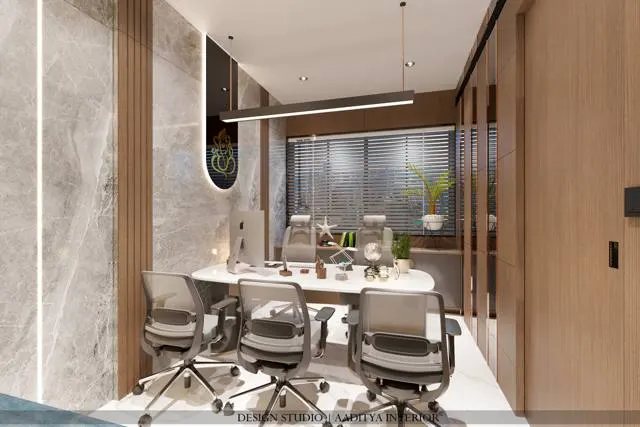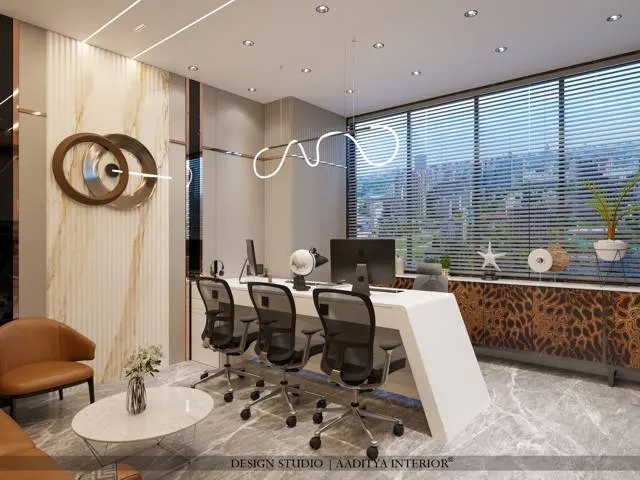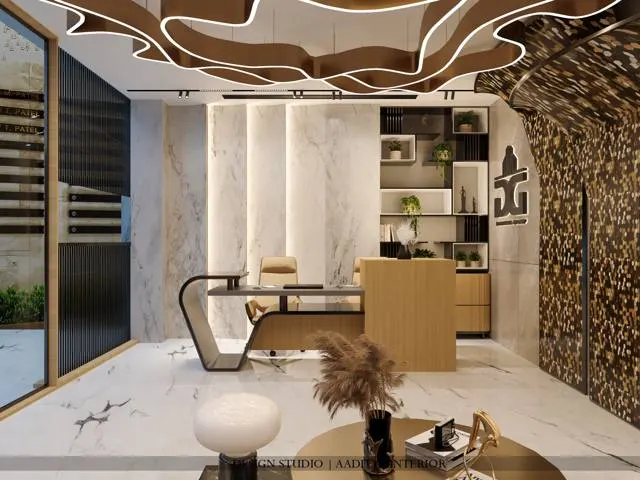

In a jewellery showroom, the counter is where the sale happens. A customer sits, a tray comes out of a drawer, a necklace is laid on a velvet pad under a carefully aimed light, and for the next twenty minutes — or two hours, for a wedding purchase — the counter is the whole world. If it is too high, the customer's shoulders tire and the piece is seen from the wrong angle. If it is too deep, the salesperson stretches and the customer cannot reach. If the drawers do not fit the trays, stock is stacked and scratched. If the glass reflects every ceiling light, the diamonds disappear. Almost every problem a jeweller complains about in an old showroom comes back to a counter dimension.
Indian jewellery retail is unusual in how much of it is done seated. In most countries, jewellery is shown across standing counters; in India, especially for gold and bridal purchases, families sit, often three generations together, and the counter is designed for long, comfortable conversations. That changes every number: the counter height, the chair, the knee and toe space, the length per customer and the aisles on both sides. Many showrooms also need standing counters for quick sales and billing, glass vitrines for display, and wall showcases behind the staff.
This article is the dimensional companion to Aaditya Interior's jewellery showroom design guide. That guide covers zoning, lighting, security layers and overall fit-out costs; this one goes into the counter itself, millimetre by millimetre: heights, depths, lengths per position, display boxes, drawers, glass, wall showcases, aisles, lighting positions and indicative costs per running foot. Security systems, safes and locks are mentioned only in design terms; every store should have them specified by qualified security specialists and checked with its insurer.
The counter types in an Indian jewellery showroom
Most showrooms use a family of four or five counter types, each with its own height logic. The seated sales counter is the workhorse of gold, diamond and bridal sales. The standing counter serves quick purchases, silver, coins and repeat customers, and doubles as billing. The vitrine or display counter — a glass box on a solid base — shows pieces without a salesperson and is common in malls and branded stores. Island or tower showcases stand free on the floor to display hero pieces. Wall showcases run behind the staff and along the perimeter. A lounge table, low and wide, serves bridal and private rooms.
| Counter type | Typical height | Typical depth | Used for |
|---|---|---|---|
| Seated sales counter | About 750 mm (720–780) | 600–750 mm | Gold, diamond and bridal sales with customers seated |
| Standing sales counter | 900–1050 mm | 550–650 mm | Quick sales, silver, coins, repeat customers |
| Billing and purity-testing desk | About 750 mm seated or 1000–1050 mm standing | 600–750 mm | Billing, card machine, karat meter and weighing scale |
| Vitrine (glass-top display counter) | About 1000–1050 mm overall | 500–600 mm | Self-browsing display; mall and branded stores |
| Island or tower showcase | About 1800–2100 mm | 450–600 mm square or round | Hero pieces, new collections, entrance displays |
| Wall showcase | Display zone about 900–2100 mm | 350–450 mm overall | Back-of-counter display behind staff |
| Lounge table (bridal room) | About 450 mm | 600–750 mm | Long seated purchases on sofas |
The seated counter, millimetre by millimetre
The seated counter is built around two seated people facing each other across a working surface. The customer sits on a chair with a seat at about 450 mm; the counter top at about 750 mm puts the piece at a comfortable viewing distance and lets the customer rest forearms on the top without hunching. Heights of 720–780 mm are all workable; anything above about 800 mm with a 450 mm chair forces the shoulders up and tires a customer within half an hour. If taller stools are used, the counter must rise with them, and a footrest becomes essential.
Depth is a balance between display and reach. A counter of 600–750 mm lets the salesperson pass a tray across comfortably while leaving room for a glass display box at the customer's side. Deeper counters make the salesperson lean and push the conversation apart; shallower ones leave no room for a display box. At the customer side, a toe recess of about 100–150 mm at the base and a top overhang of about 50–100 mm let the chair come close enough. At least one position should have a true knee recess, so that a wheelchair user or an elder who cannot sit sideways can pull right up to the counter.
| Element of the seated counter | Typical dimension | Why |
|---|---|---|
| Counter top height | About 750 mm (720–780) | Comfortable seated viewing and forearm rest with a 450 mm chair |
| Counter depth overall | 600–750 mm | Tray passes across easily; room for a display box |
| Customer chair seat height | About 450 mm, with a back | Long purchases; elders need back support and armrests |
| Toe recess, customer side | 100–150 mm deep, 100–150 mm high | Chair and feet come close; no awkward leaning |
| Top overhang, customer side | 50–100 mm | Knees and hands clear the front panel |
| Knee recess at an accessible position | About 650–700 mm clear height, 450–600 mm deep (commonly cited) | Wheelchair users and elders can sit square to the counter |
| Staff chair seat height | About 450 mm, or matching the customer's eye level | Eye contact at the same level builds trust |
| Glass top over display box | Toughened or laminated, commonly 10–12 mm | Strength and safety; laminated resists break-through better |
Length per customer and per family
Counter length is where showrooms most often go wrong. A single customer needs about 600–750 mm of counter; a family of three or four buying for a wedding needs 1500–1800 mm, because they sit together, pass pieces between them and need space for several trays at once. A 3600 mm counter therefore seats about five individual customers or two families — not eight, as an optimistic plan might show. Fewer, more comfortable positions sell more, because high-value families will not sit shoulder to shoulder with strangers.
Counter runs are usually built in modules of 1200, 1500 or 1800 mm, joined on site, with the joints falling between customer positions rather than under a display box. Ends of counter runs should be rounded or chamfered, because the customer zone in front is also a circulation route. Where two counter runs face each other across a customer zone, that zone should be at least 1500 mm, and 1800 mm where chairs are placed on both sides with a passing route between them.
Inside the counter: display box, drawers and trays
A seated counter is really three things stacked together: a display box under glass at the customer's side, a working surface where the tray and pad are placed, and lockable storage on the staff side. The display box lets a customer look at pieces while waiting, and it is where the counter's own lighting lives. Its internal height is usually about 100–150 mm for flat displays of chains, bangles and rings on pads, and 150–250 mm where small busts or stands are used. A concealed LED strip along the staff-side edge of the box, angled away from the customer, lights the pieces without glare.
The working surface, where the salesperson lays out pieces, is often a solid top rather than glass: leather inlay, suede-finish laminate or honed stone, sometimes with a removable velvet pad. A solid surface gives a quieter background and does not reflect the ceiling spotlights. Many showrooms combine both, with a glass display strip of 250–350 mm at the customer edge and a solid working zone of 300–400 mm behind it.
Drawers on the staff side hold the trays that are brought out to customers. The most practical approach is to choose the tray system first and size the drawers to it. Jewellery trays used in Indian showrooms come in a range of sizes; many fall around 350–400 mm by 240–300 mm. Drawers should be about 10–15 mm larger internally than the tray in each direction, with an internal height of about 40–60 mm per tray layer. Heavy-duty full-extension slides, soft-close and a central locking system that locks every drawer with one key are standard. The drawer stack usually leaves a staff knee space of about 600 mm wide at each seated position.
| Internal component | Typical size | Notes |
|---|---|---|
| Display box internal height (flat display) | 100–150 mm | Pads, chains, bangles, rings |
| Display box internal height (stands, busts) | 150–250 mm | Raises the counter top or needs a stepped top |
| Glass display strip width | 250–350 mm | At the customer edge; visible while waiting |
| Solid working zone | 300–400 mm | Leather, suede-finish laminate or honed stone |
| Common jewellery tray footprint | Many around 350–400 × 240–300 mm | Choose the tray system before sizing drawers |
| Drawer internal clearance | Tray + 10–15 mm each way; 40–60 mm high per layer | Full-extension heavy-duty slides, soft close |
| Staff knee space at each seat | About 600 mm wide | Between drawer stacks |
| LED in display box | Concealed strip, CRI ≥ 90 | Colour temperature matched to the product |
Standing counters, vitrines and island showcases
Standing counters work at 900–1050 mm, the range in which a standing customer can lean on the top and see pieces without bending. They are shallower than seated counters, typically 550–650 mm, because both people are closer to the top. Billing counters often use the upper part of the range, about 1000–1050 mm, with a lower seated section at 750 mm for elders and for long billing conversations. Standing counters need a solid kick plate and a recess of about 75–100 mm at the base for the customer's toes.
A vitrine is a display counter with a glass box on top of a solid base, designed for self-browsing. The top of the glass box sits at about 1000–1050 mm, with the display deck inside at about 750–850 mm and a glass enclosure of about 200–300 mm above it. Vitrines are common in mall showrooms and in diamond and fashion-jewellery sections, where customers browse before asking to see a piece. Island and tower showcases, freestanding on the floor, place their main display zone at about 1100–1600 mm, the standing eye-level band, with lighting inside the top canopy and a lockable storage plinth below.
Wall showcases behind the counter
The wall showcase does two jobs: it displays stock to customers seated across the counter, and it stores trays and boxes in locked cabinets below. Its display zone runs from about 900 mm to about 2100 mm, with the most valuable display between about 900 and 1500 mm, which is where a seated customer's eye falls naturally across the counter. Above 2100 mm, a showcase is decoration or branding; few customers look that high. The overall depth is usually 350–450 mm, of which about 250–400 mm is usable display, and the base storage below 900 mm is typically 450–600 mm deep where floor space allows.
The staff aisle between the back of the counter and the face of the wall showcase must be at least 1000–1200 mm. That width lets a staff member sit, a colleague pass behind, drawers in both the counter and the showcase base open fully, and a tray be carried without collision. Plans that squeeze the aisle to 800 mm to add another counter run make staff stand up and step aside every time a colleague passes, which customers notice.
Showcase lighting is usually built in: concealed LED strips in the front edge of each shelf or the top, plus small spotlights for hero pieces, all at a colour rendering index of 90 or more and matched to the product — about 2700–3000 K for yellow gold and about 4000–5000 K for diamonds, platinum and silver, as explained in the showroom design guide. Glass shelves should be supported to the supplier's span recommendations; mirror backs, though once popular, double every LED dot and are now generally avoided in favour of matte fabric, suede or veneer.
| Showcase element | Typical dimension | Notes |
|---|---|---|
| Display zone height | About 900–2100 mm | Prime band 900–1500 mm for seated customers |
| Overall depth | 350–450 mm | Usable display 250–400 mm |
| Base storage | 0–900 mm high; 450–600 mm deep where space allows | Lockable; holds trays, boxes and packaging |
| Shelf spacing | 200–350 mm | Closer for rings and earrings, wider for necklaces on busts |
| Bay width | 600–1200 mm | Matches glass shutter sizes and counter positions |
| Staff aisle in front | 1000–1200 mm | Seated staff plus a colleague passing |
| Lighting | Concealed LED plus small spots, CRI ≥ 90 | 2700–3000 K gold; 4000–5000 K diamonds and white metals |
Lighting, power and data at the counter
Ceiling spotlights over counters should be aimed at the working zone from an angle — commonly about 30 degrees from vertical — rather than directly above the customer's head, so that the light does not shine into the customer's eyes or reflect in the glass top. Spots are best positioned above the staff side of the counter or the aisle, aimed towards the customer edge. As the showroom guide notes, display light in a jewellery store is usually several times the ambient level, which makes glare control at the counter all the more important.
Each seated position needs more power and data than a normal shop counter: a socket for a weighing scale, one for a card machine or tablet, one for a desk lamp or magnifier, and data for billing where it happens at the counter. The purity-testing desk needs dedicated sockets for the karat meter and its computer. All of these should be planned inside the counter carcass with cable trays and access panels, so that no cables cross the customer side. Concealed positions for panic buttons and alarm sensors must be agreed with the security systems integrator before the counter is fabricated.
What counters cost
Counters and showcases are usually the largest single share of a jewellery showroom's interior budget. The ranges below are indicative October 2026 figures per running foot for factory-made joinery in Surat and similar cities, including carcass, finish, glass, internal LED, drawers and standard locks, but excluding specialist security hardware, stone tops of exceptional value and GST. They sit within the overall fit-out bands of about ₹1,800–2,500 per sq ft for a compact store, ₹2,200–3,500 for a standard showroom and ₹3,500–6,000 or more for a flagship, used in the showroom design and showroom cost guides.
| Element | Specification | Indicative cost (October 2026) | What moves the price |
|---|---|---|---|
| Seated counter, standard | BWR ply or HDHMR, laminate or veneer, glass display strip, tray drawers, LED | ₹10,000–25,000 per running ft | Display box length, drawer count, finish |
| Seated counter, premium | Veneer or lacquer, leather top, brass or PVD trims, tunable LED | ₹25,000–45,000+ per running ft | Bespoke detailing, metal work, stone |
| Standing or billing counter | Laminate, veneer or stone top, storage below | ₹40,000–1,50,000 per counter (1800–3000 mm long) | Length, stone top, built-in equipment |
| Vitrine display counter | Glass box on solid base, internal lighting, locks | ₹30,000–1,00,000 per unit | Glass type and size, lighting, lock grade |
| Wall showcase | Glass shutters and shelves, LED, locked base storage | ₹8,000–20,000 per running ft | Height, glass, lighting, base storage depth |
| Island or tower showcase | Freestanding, glass, canopy lighting, locked plinth | ₹60,000–2,00,000 per piece | Size, glass, finish, security fittings |
As a worked example, a 1,500 sq ft standard showroom might carry about 50–60 running feet of seated counters and about 70–90 running feet of wall showcases. At the standard rates above, that is roughly ₹5–15 lakh for counters and ₹5.6–18 lakh for showcases — a large part of the ₹33–52 lakh interior budget suggested for such a showroom, before lighting, floors, ceilings, the lounge and the facade. Timelines are driven by the factory: about three to five weeks to make counters and showcases after drawings are approved, with glass and specialist locks sometimes taking longer.
Where counter design is heading
Counters are changing in three ways. First, comfort and privacy: more stores are moving from long continuous counters to individual consultation tables and semi-private bays, especially for diamonds and bridal sales, where a family can sit at a table-height counter of about 750 mm with chairs on all sides. Second, technology: tablets and digital catalogues at the counter let a customer see designs that are not in stock, and some stores include screens or try-on mirrors at the counter. Third, lighting: tunable-white and high-CRI fittings let staff adjust the light to the piece. None of this changes the core dimensions; it changes how many trays come out of the drawer.
Rules for specifying jewellery counters
- Fix seated counters at about 750 mm (720–780) with 450 mm chairs with backs; raise both together if stools are used.
- Keep counter depth at 600–750 mm, with a 100–150 mm toe recess and a 50–100 mm top overhang on the customer side.
- Allow 600–750 mm per individual customer and 1500–1800 mm per family; do not count chairs that will not fit.
- Keep the customer zone at 1500–1800 mm and the staff aisle at 1000–1200 mm.
- Choose the tray system first, then size drawers to it with 10–15 mm clearance and full-extension slides.
- Use 10–12 mm toughened or laminated glass on display boxes, with LED on the staff side, CRI 90 or more.
- Aim ceiling spots from about 30 degrees, from the staff side, never directly above a seated customer.
- Agree locks, alarm points, panic buttons and glass specification with the security specialist and insurer before fabrication.
Frequently asked questions
What is the standard height of a jewellery counter?
For seated selling, which is the norm in Indian jewellery stores, about 750 mm (720–780 mm) with chairs of about 450 mm seat height. Standing counters for quick sales or billing are usually 900–1050 mm.
How deep should a jewellery counter be?
Typically 600–750 mm for seated counters and 550–650 mm for standing counters. That lets the salesperson pass a tray across comfortably while leaving room for a glass display strip on the customer side.
How many customers can sit at a jewellery counter?
Allow about 600–750 mm per individual customer and 1500–1800 mm per family group. A 3600 mm counter comfortably seats about five people — for example two individuals and a family of three.
What glass is used in jewellery counters?
Display tops are commonly 10–12 mm toughened or laminated glass. Laminated glass holds together when broken and resists break-through better, which is why many security advisers prefer it; the final specification should come from the store's security specialist and insurer.
How much does a jewellery counter cost per running foot?
Indicatively in October 2026, a standard seated counter with glass display, drawers and LED costs about ₹10,000–25,000 per running foot, and a premium counter ₹25,000–45,000 or more. Wall showcases cost about ₹8,000–20,000 per running foot. Security hardware and GST are extra.
Sources & standards
- Neufert, Architects' Data — retail counters, seated and standing working heights
- De Chiara and Crosbie, Time-Saver Standards for Building Types — retail stores and jewellery shops
- Panero and Zelnik, Human Dimension and Interior Space — seated and standing counter anthropometrics
- Bureau of Indian Standards — IS 2553 (safety glass) and National Building Code of India 2016, Part 4 (Fire and Life Safety) for exits in retail occupancies
- Central Public Works Department — Harmonised Guidelines and Standards for Universal Accessibility in India (accessible counters)
- Bureau of Indian Standards — IS 3646 (Part 1): interior illumination; manufacturer data for high-CRI display lighting
- Price ranges: indicative October 2026 estimates — confirm locally before budgeting