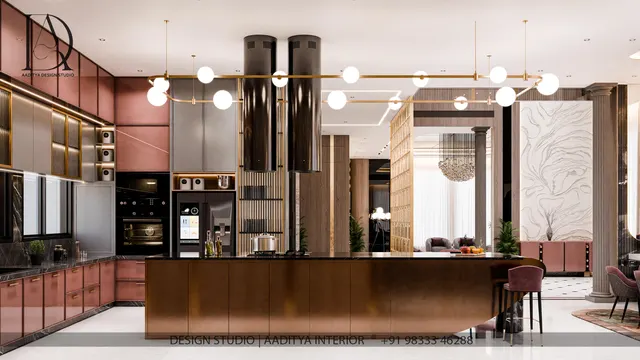
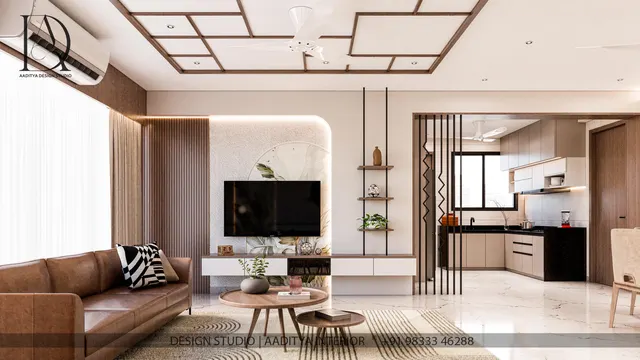
Indian kitchens work harder than most. A single day can bring tadka smoke, turmeric and chilli powder, boiling milk, tea, pressure-cooker steam, atta dust, oil splatter from frying and hard-water spots around the sink. A kitchen that looked spotless on the day of handover can look tired within a month — not because it is dirty, but because its colours and finishes make every mark visible. A high-gloss white shutter shows every fingerprint and every yellow tinge from turmeric; a gloss black one shows every speck of dust and every dried drop of water.
This article is not about which colours are fashionable. This site's guide to modular kitchen colour combinations covers palettes, two-tone schemes and how colour works with light. Here the question is narrower and more practical: which combinations of colour, finish and pattern stay looking clean between cleanings in a kitchen where Indian food is cooked every day? The answer depends on the colour of the dirt itself, on where each kind of dirt lands, and on how each surface reflects light. Get those three right and a kitchen can look composed even at the end of a busy cooking day.
The common mistakes are easy to name: pure white gloss everywhere because it looked fresh in a showroom; an absolute-black counter because it looked luxurious in a render; white grout between backsplash tiles; deep-red or navy gloss shutters next to the hob; and open-grain natural wood on the base units where water and oil splash. Each of these can work in a kitchen that is used lightly. In a kitchen that is used twice a day for Indian cooking, each one quietly doubles the cleaning.
The colours of kitchen dirt
Every surface shows dirt by contrast. A mark is visible when it is noticeably darker, lighter, or a different hue from the surface it sits on, or when it changes the surface's sheen. Indian kitchen dirt falls into three broad groups. Dark soils include tea and coffee rings, burnt-on residue and the grey film of smoke. Warm mid-tone soils include turmeric, chilli and masala stains, and the amber film that frying oil leaves on surfaces near the hob. Light soils include atta and flour dust, ordinary household dust, dried water spots and the white mineral deposits that hard water leaves around taps and sinks. Fingerprints are a fourth category: skin oil leaves a sheen change rather than a colour change, so it shows most on gloss and on very dark, very smooth matt surfaces.
| Soil | Its colour | Where it lands | Shows most on | Hides best on |
|---|---|---|---|---|
| Turmeric and masala stains | Warm yellow to orange-red | Counter, backsplash, shutters beside the hob | Pure white, pale grey, white grout | Warm beige, wood tones, speckled stone |
| Oil film and splatter | Amber, glossy | Backsplash, chimney area, wall-unit undersides | Gloss dark colours and gloss white (sheen change) | Matt mid-tones, textured finishes |
| Tea, coffee, burnt residue | Brown to near-black | Counter, sink area, hob surround | White and pale quartz | Mid to dark speckled granite or quartz |
| Atta, flour, dust | Off-white to grey | Counter, top of wall units, base shutters | Black and deep navy, especially gloss | Greige, light wood, light speckled stone |
| Hard-water spots and scale | Chalky white | Sink, taps, counter near the sink | Absolute black granite, dark gloss | Mid-grey, speckled and veined surfaces |
| Fingerprints and skin oil | Sheen change | Shutters at handle height, tall-unit doors | High gloss, dark super-smooth finishes | Textured, woodgrain and anti-fingerprint matt |
| Scuffs from feet and vessels | Grey-black marks | Toe-kick and lowest 150 mm of base units | Pale matt shutters, white skirting | Dark toe-kick, metal or wood-tone skirting |
The table points to a simple conclusion. Very light surfaces show dark and warm soils; very dark surfaces show light soils and water spots; gloss shows sheen changes from oil and fingerprints. The surfaces that hide most are in the middle on all three counts: mid-tone in lightness, slightly warm or neutral in hue, and matt or textured in finish, often with a little visual pattern — a woodgrain, a speckle or a soft vein — that breaks up small marks.
From kadappa and brass to modular gloss: a short background
Traditional Indian kitchens were, by accident or by wisdom, very forgiving. Floors were often finished in lime, oxide or local stone; platforms were frequently black Cuddapah (kadappa) or local granite; walls were limewashed, and vessels were brass, copper, steel and clay. The palette was earthy and mid-to-dark, the surfaces matt, and marks blended in. Limewash could be renewed cheaply, and stone platforms were scrubbed rather than polished.
The urban kitchen of the later twentieth century changed the palette. White glazed dado tiles became the norm, often to full height, with white or grey cement grout; green or black granite replaced kadappa on the platform. White tiles looked hygienic, but their grout lines yellowed near the hob and greyed near the sink. Then came modular kitchens, and with them a wave of high-gloss acrylic and lacquered shutters in white, red and black that photographed brilliantly and showed every fingerprint. The current direction — matt and super-matt laminates, woodgrains, greige and sage, speckled quartz and large-format backsplash tiles with fewer joints — is in many ways a return to the forgiving logic of the old kitchen, carried out in modern materials.
Finish matters as much as colour
Two shutters in the same colour can behave completely differently. A high-gloss surface reflects light like a mirror, so any film — oil, fingerprints, a cleaning streak — interrupts the reflection and shows immediately, even on white. A matt surface scatters light, so thin films are much less visible, though some very dark smooth matt finishes show skin oil as darker patches. Textured finishes — woodgrain, linen, stone-texture or fine suede — add tiny shadows that disguise small marks. Many laminate manufacturers now offer super-matt surfaces described as anti-fingerprint, made with a special top coat; they are noticeably better at hiding touch marks and can often be wiped back to an even surface. Prices below are the indicative October 2026 shutter-finish bands used across this site.
| Shutter finish | Fingerprints | Oil film | Scratches | Wipe-down | Indicative cost (₹ per sq ft of shutter) |
|---|---|---|---|---|---|
| Laminate, textured or woodgrain | Hides well | Hides well | Hides well | Easy; mild detergent | ₹350–650 |
| Laminate, super-matt anti-fingerprint | Hides very well | Hides well | Fair; avoid scouring | Easy; microfibre | Upper half of ₹350–650 typically; confirm with dealer |
| Laminate, high gloss | Shows clearly | Shows clearly | Shows clearly | Needs streak-free cleaning | ₹350–650 |
| PVC membrane, matt | Fair | Fair | Fair | Easy; keep away from hob heat | ₹500–850 |
| Acrylic, high gloss | Shows clearly | Shows clearly | Shows fine scratches | Soft cloth only | ₹900–1,500 |
| Acrylic or PU, matt | Fair to good | Good | Fair | Soft cloth; no abrasives | ₹900–1,500 / ₹1,000–1,800 |
| Glass in aluminium profile | Shows clearly | Shows clearly | Hides well | Glass cleaner; best on wall units | ₹700–1,400 |
The practical rule is to keep gloss away from the hob and the handle zone. If gloss is wanted, put it on wall units away from the cooking zone, or on a tall unit that is opened less often, and use a matt or textured version of a similar shade on the base units. A two-finish kitchen of this kind usually looks more considered, not less, and it is much easier to keep.
Where dirt lands: the kitchen wall in five zones
Dirt is not spread evenly. It concentrates in predictable bands, and each band deserves its own colour and finish decision. The lowest 100–150 mm — the toe-kick and plinth — collects scuffs from feet, mops and vessels. The handle zone, roughly 600–900 mm above the floor on base units and around eye height on tall units, collects fingerprints. The splash zone, from the counter top up to about 600 mm above it near the hob and sink, collects oil, turmeric and water. The underside of wall units and the area around the chimney collect an oil film from rising vapour. And the top of the wall units, if they stop below the ceiling, collects a sticky layer of dust and grease that nobody sees until it is cleaned.
Base units
Base units carry zones A and B and sit right below zone C, so they deserve the most forgiving choice in the kitchen: a mid-tone or mid-dark woodgrain, a warm grey, a sage or olive green, a muted blue-grey or a greige, in a textured or super-matt finish. Avoid pure white and gloss black here. A darker toe-kick — matching the base colour or in brushed aluminium — hides scuffs better than a pale one.
Wall units and lofts
Wall units are seen at eye level and are touched less, so they can be lighter to keep the kitchen bright: off-white, ivory, light greige or pale wood, ideally in an LRV around 55–75 rather than a brilliant white. Near the chimney, a slightly warm off-white hides the faint amber of oil film better than a cool bright white. Lofts should run to the ceiling, or be closed on top, so that there is no exposed horizontal surface to collect greasy dust.
Handles
Handle choice changes how much a shutter is touched. Integrated profile handles (G-profile or J-profile) and long bar handles in brushed steel, brushed gold or matt black keep fingers on the metal rather than the shutter face. Knob handles on gloss shutters are the worst combination for fingerprints. Push-to-open fittings look clean but lead to more fingerprints on the shutter face itself.
Ten colour combinations that stay clean
The combinations below are chosen for forgiveness first and appearance second. Each pairs a base, an upper, a counter and a backsplash so that every surface sits in a sensible band for the dirt it receives. All can be built in laminate at mid-range prices; most can be upgraded to acrylic or PU matt on the wall units if the budget allows.
| Combination | Base units | Wall units | Counter | Backsplash and grout | Why it forgives |
|---|---|---|---|---|---|
| Walnut and ivory | Mid-walnut woodgrain, textured | Ivory matt | Speckled beige quartz | Beige matt tile, beige epoxy grout | Warm mid-tones absorb haldi and oil; grain hides marks |
| Sage and greige | Sage green super-matt | Light greige | Grey-beige speckled quartz | Greige large-format tile | Muted green hides dust and splashes |
| Warm grey and oak | Warm mid-grey matt | Light oak woodgrain | Grey speckled granite | Grey tile, grey grout | Grey sits mid-scale; oak grain hides vapour film |
| Blue-grey and white oak | Muted blue-grey textured | White oak woodgrain | Concrete-grey quartz | Off-white tile, warm grey grout | Muted blue hides scuffs; never gloss |
| Olive and cream | Olive or moss matt | Cream | Brown-beige granite | Cream glazed tile, matched grout | Earthy palette close to masala tones |
| Teak and stone | Teak woodgrain | Stone-texture greige laminate | Speckled granite | Stone-look tile | All-pattern scheme; marks blend in |
| Charcoal and ash wood | Charcoal textured (not gloss) | Ash or birch woodgrain | Salt-and-pepper granite | Light grey tile, grey grout | Texture keeps charcoal from showing dust |
| Terracotta and sand | Terracotta or rust matt | Sand beige | Beige veined quartz | Handmade-look terracotta tile | Warm reds hide chilli and turmeric |
| Taupe and linen | Taupe linen-texture | Linen white | Taupe quartz | Taupe tile, matched grout | Low contrast throughout |
| Two woods | Darker wood (walnut, teak) | Lighter wood (oak, ash) | Mid-tone speckled quartz | Sand tile | Grain on every shutter; very forgiving |
All ten avoid three things: pure white gloss on base units, solid-black or deep-navy gloss anywhere near the hob, and white grout. They also keep the strongest contrast away from the splash zone. If a family loves white, the forgiving version is an off-white or ivory on the uppers with a wood or greige base; if they love black, the forgiving version is a charcoal textured base with a salt-and-pepper counter rather than gloss black with absolute-black granite.
Counters: the surface that decides the daily impression
The counter carries the heaviest daily soiling and is the first thing anyone sees. Absolute-black granite is tough and heat-tolerant, but it shows every dried water ring, every trace of flour and every smear from a cleaning cloth. Pure white quartz shows turmeric, tea and coffee unless it is wiped immediately; the stain usually lifts, but the counter looks used all day. Speckled and softly veined surfaces in mid-tones are the most forgiving, because small marks fall into the pattern. Natural marble near the hob is best avoided: it is softer and can etch with lemon, tamarind and tomato, which leaves dull spots no colour can hide. Prices below are the indicative October 2026 counter bands used across this site.
| Counter | Shows | Hides | Indicative cost (₹ per sq ft) | Verdict for Indian cooking |
|---|---|---|---|---|
| Absolute-black granite, polished | Water rings, flour, cloth streaks | Tea, turmeric | ₹110–180 (common blacks) | Tough; needs drying after each wipe |
| Speckled granite (salt-and-pepper, brown, grey) | Very little | Most soils | Varies by variety; often near the common band | Very forgiving; seal as advised |
| Pure white quartz | Turmeric, tea, oil if left | Flour, dust | ₹250–425 basic band | Wipe immediately; looks used all day |
| Speckled or concrete-grey quartz | Very little | Most soils | ₹250–425 basic; ₹400–600 designer | Forgiving and non-porous |
| Marble-look veined quartz | Little in veined areas | Most soils | ₹400–600 designer band | Choose busy veining near the hob |
| Natural marble | Etching, turmeric | Dust | Varies widely | Avoid at the hob and sink |
| Steel counter (at the sink or wash area) | Water spots, fingerprints | Stains, heat marks | Fabrication quote | Practical in utility areas; brushed finish only |
Backsplash and grout: where most kitchens give themselves away
In many kitchens the shutters and the counter are well chosen, and the backsplash is what looks dirty — specifically its grout. Cement grout is porous; in white or very light shades, the lines behind the hob turn yellow and those behind the sink turn grey within months. Two decisions solve most of the problem. First, use fewer joints: larger tiles, a single slab of quartz or sintered stone, or back-painted glass have far fewer lines to stain. Second, use epoxy grout in a colour matched to the tile's mid-tone, not white. Epoxy grout is non-porous and resists oil and turmeric much better than cement grout; its kits cost about ₹600–1,500 per kg with labour of about ₹10–25 per sq ft, as this site's tile guides note, and it needs a skilled applicator.
The joint arithmetic in Fig. 3 is worth remembering. A one-metre square of 100 × 100 mm mosaic carries about 20 metres of grout line; the same square in 300 × 600 mm tiles carries about 5 metres; in 600 × 1200 mm tiles about 2.5 metres. A single slab or back-painted glass panel carries almost none, apart from its edges. Back-painted glass costs more — about ₹500–1,000 per sq ft against ₹65–160 for common tiles in this site's kitchen cost guide — but it wipes in seconds and should be chosen in a soft off-white, greige or mid-tone rather than pure white or black, for the same reasons as the shutters.
Planning colour around the cooking zones
A kitchen plan shows where each kind of dirt is generated. The hob is the source of oil, smoke and spice; the sink is the source of water, scale and food scraps; the space between them, the preparation zone, receives flour, vegetable peel and the drips that travel from one to the other. Colour and finish can follow that map: the most forgiving surfaces around the hob, a water-tolerant and spot-hiding surface around the sink, and the lightest, brightest surfaces where little dirt is made — at the far end of the counter, on tall units and on the uppers away from the chimney.
Floors and walls
Kitchen floors follow the same logic. A matt vitrified tile in a mid-tone with a little pattern — a stone or terrazzo look, a soft speckle, a wood-look plank — hides spilt flour, footprints and water spots far better than a polished white or black tile. Choose a grout one shade darker than the tile. On painted walls outside the backsplash, a washable or scrubbable emulsion in an off-white or greige can be wiped down; this site's renovation guide prices premium emulsion at about ₹20–30 per sq ft all-in.
Lighting reveals what colour hides
Under-cabinet strip lights graze across the backsplash and counter, and grazing light shows every smear and ridge. That is useful for cooking — the light should still be there — but it means gloss backsplashes and very smooth counters look dirtier under task lighting than in daylight. Neutral-white task light of about 4000 K with good colour rendering (CRI 90 or more) shows food truthfully without exaggerating stains; a diffused profile rather than bare dots softens the grazing effect. Test every chosen laminate, tile and counter sample at night under the kitchen's actual lights before ordering.
A realistic cleaning routine for each finish
No colour removes the need to clean. What the right colours do is stretch the time between cleanings before the kitchen looks dirty, and the right finishes make each cleaning quicker. The routine below is a practical guide for a kitchen used for daily Indian cooking.
| Surface | Daily | Weekly | Avoid |
|---|---|---|---|
| Laminate shutters (matt, textured, anti-fingerprint) | Wipe the handle zone near the hob with a damp microfibre | Mild detergent on all base units; dry | Scouring pads, solvent cleaners on super-matt |
| Acrylic or PU shutters | Soft cloth, damp | Mild soap solution; dry with soft cloth | Abrasive powders, rough sponges |
| Granite counter | Wipe and dry, especially black granite | Mild detergent; re-seal as the supplier advises | Acidic cleaners left standing |
| Quartz counter | Wipe turmeric and tea at once | Mild detergent | Very high heat directly from vessels; harsh alkalis |
| Backsplash tile and epoxy grout | Wipe behind the hob after frying | Degreaser on tile and grout | Wire brushes on grout |
| Back-painted glass | Wipe behind the hob | Glass cleaner | Abrasives that scratch the paint layer |
| Chimney surround and wall-unit undersides | — | Degreaser wipe | Letting film build for months |
Where kitchen surfaces are heading
Several directions are already visible in the Indian market. Super-matt and anti-fingerprint laminates are spreading from premium ranges into everyday ones, and textured woodgrains that read as real timber are now common. Sintered stone and large porcelain slabs are being used as single-piece backsplashes, removing grout from the splash zone altogether. Some laminate and quartz makers market antibacterial or stain-resistant surface treatments; their benefits vary by product, and claims should be checked against the maker's test data rather than taken from a brochure. Colour trends are moving away from stark white and gloss towards greige, muted greens, warm woods and earthy reds — which happens to suit Indian cooking very well. In Aaditya Interior's experience, the families who are happiest with their kitchens two years after handover are rarely the ones who chose the most dramatic colours; they are the ones who chose surfaces that looked good on an ordinary Tuesday evening.
Rules for a kitchen that looks clean
- Keep the base units, the counter and the backsplash in the forgiving middle — roughly LRV 25–60 — and put lighter colours on wall units and tall units.
- Use matt, super-matt or textured finishes within 600 mm of the hob; keep gloss to wall units away from the chimney.
- Choose a counter with speckle or soft veining; avoid absolute black at the sink and pure white at the hob unless the household wipes at once.
- Never use white grout in a kitchen; use epoxy grout matched to the tile's mid-tone, and prefer larger tiles or a slab.
- Use profile or long bar handles in a brushed finish to keep fingers off shutter faces.
- Make the toe-kick dark or metal, and take lofts to the ceiling to remove the greasy dust shelf.
- Test every sample at night under the kitchen's own task lights before ordering.
- Plan the cleaning routine with the finish: if nobody will wipe daily, choose surfaces that forgive.
Frequently asked questions
Which kitchen colour does not show dirt?
Mid-tones show least: warm greys, greige, sage and olive greens, muted blue-greys and medium woodgrains, in matt or textured finishes. They sit between the dark stains of Indian cooking and the light soils of dust, flour and water spots, so neither stands out.
Is a white kitchen a bad idea for Indian cooking?
Not if it is planned. Use off-white or ivory rather than brilliant white, in matt rather than gloss, on the wall units, and pair it with a wood or greige base, a speckled counter and a mid-tone backsplash. An all-white gloss kitchen with white quartz and white grout is the hardest combination to keep looking clean.
Does a black granite counter hide stains?
It hides tea, turmeric and dark stains well, but it shows water rings, flour and cloth streaks clearly, especially when polished. A speckled granite or a mid-tone quartz is more forgiving overall. If black is preferred, a honed or leathered finish shows water marks less than a mirror polish.
Matt or gloss: which kitchen finish is easier to maintain?
Matt and textured finishes hide fingerprints, oil film and fine scratches much better. Gloss is easy to wipe but shows every smear, so it needs more frequent and more careful cleaning. Super-matt anti-fingerprint laminates are the easiest of all for daily use, provided abrasive cleaners are avoided.
What grout colour is best for a kitchen backsplash?
A mid-tone matched to the tile or one shade darker — grey, beige or taupe — in epoxy rather than cement grout. White and very light grouts yellow behind the hob and grey behind the sink within months.
Sources & standards
- Bureau of Indian Standards — IS 2046 (decorative thermosetting synthetic resin bonded laminated sheets), for laminate surface properties
- Bureau of Indian Standards — IS 13630 (ceramic tiles — methods of test) and IS 15622 (pressed ceramic tiles), for tile and stain-resistance testing
- National Building Code of India 2016, Part 8 (Building Services) — lighting and ventilation of kitchens
- Bureau of Energy Efficiency — guidance on LED lighting, colour temperature and colour rendering
- Neufert, Architects' Data — kitchen planning, work zones and counter heights
- Manufacturer standard ranges and published light reflectance values (LRV) for laminates, paints and quartz, described generically
- Price ranges: indicative October 2026 estimates — confirm locally before budgeting