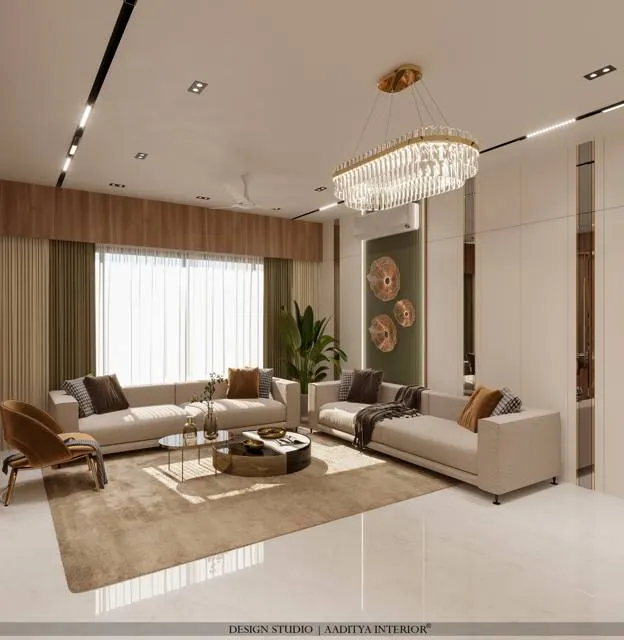
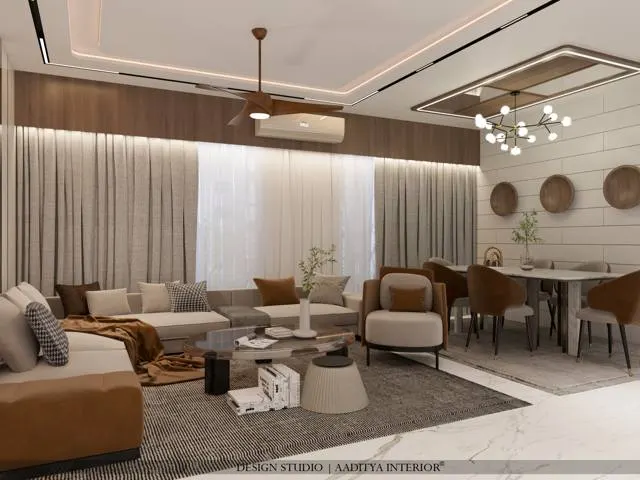
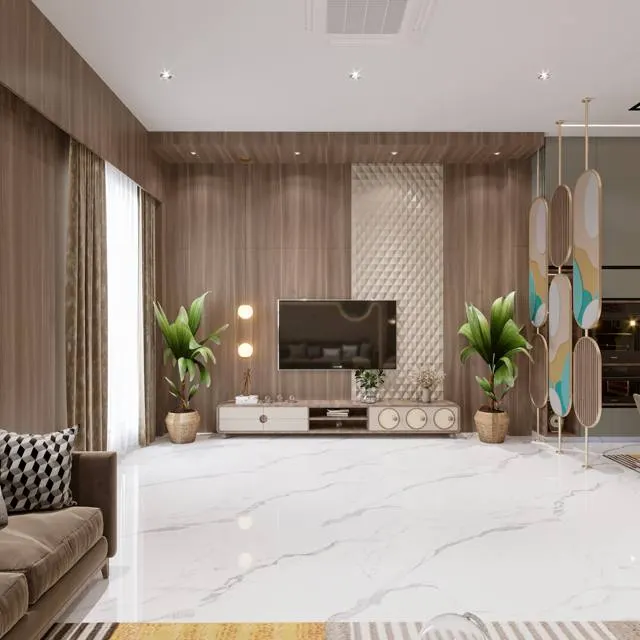
Most Indian kitchens are lit by a single tube light on the ceiling — and the cook works in their own shadow. The wall units block the overhead light exactly where the knife work happens: at the counter, under the cabinets. Vegetables are chopped in half-light, the tadka's colour is judged under a yellow cast, and the masala dabba's labels are read by squinting. The fix is not a brighter tube. It is a lighting plan with three layers, each doing a job the others cannot.
The three layers are task, ambient and accent. Task lighting puts bright, neutral-white light directly on the work surface — under-cabinet LED strips are the workhorse. Ambient lighting fills the room so the cook is not working in a bright pool surrounded by darkness — ceiling panels or battens do this. Accent lighting — cove strips in the false ceiling, pendants over a breakfast counter — makes the kitchen feel designed rather than merely lit. Indian standards back the task layer with numbers: IS 3646 (Part 1) specifies 300–500–750 lux for food preparation and cooking areas, with 500 lux as the service illuminance — the middle of the range, and the figure to design to.
The critical planning insight is timing: lighting is wired during the interiors, not after. LED strip channels are routed into the carpentry before the wall units go up; pendant points are dropped from the false ceiling before it closes; switch positions are decided before the tiles go on. Retrofitting any of it means surface-mounted conduits and visible wires — functional, but never as clean. This guide gives the lux targets, the colour temperatures, the mounting positions and the wiring checklist, in the order a project actually needs them.
The lux targets: what IS 3646 asks for
IS 3646-1 is the Indian standard for interior illumination, and its kitchen-relevant figures are specific. Food preparation and cooking areas: 300–500–750 lux, service level 500 lux. Servery, vegetable preparation and washing-up zones: 200–300–500 lux, service 300 lux. Dining rooms: 150–200–300 lux, service 200 lux. Corridors and passageways: 50–100–150 lux, service 100 lux. The pattern is deliberate — the brightest light falls where the sharp objects and hot vessels are, and levels step down as the eye moves toward dining and circulation. Designing a kitchen counter to 500 lux and the dining corner to 200 lux is not over-lighting; it is the standard's own gradient, and it matches how the eye adapts between work and rest.
| Zone | IS 3646-1 range (lux) | Service illuminance — design to this | How to achieve it |
|---|---|---|---|
| Food preparation and cooking (counter, hob) | 300 – 500 – 750 | 500 lux | 4000 K LED strips under wall units + ambient ceiling light |
| Vegetable prep, servery, washing-up | 200 – 300 – 500 | 300 lux | Under-cabinet strip over the sink run; dedicated sink light |
| Dining area / breakfast counter | 150 – 200 – 300 | 200 lux | Pendant(s) over the table; dimmable for mood |
| General kitchen ambient | 150 – 300 (CIBSE residential kitchen) | 200 lux | Ceiling panels or battens on a separate switch |
| Passage / entry to kitchen | 50 – 100 – 150 | 100 lux | Spill from adjacent rooms or a small ceiling light |
| Inside tall units / pantry | Not specified — task lighting applies | Bright enough to read labels | Sensor LED strips inside deep units |
Colour temperature: why 4000 K for task zones
Colour temperature, measured in Kelvin, decides whether light reads warm-yellow or cool-white. The commonly cited practice for kitchens is 4000 K — neutral white — at the task zones, and it is worth understanding why rather than just following it. Warm 2700–3000 K light flatters skin and food at the dining table but yellows everything at the counter: turmeric looks done before it is, green vegetables look tired, and the cook misjudges browning. Cool 6000 K+ daylight white is harsh, clinical, and makes the kitchen feel like a laboratory. Neutral 4000 K renders colours truthfully — the tadka's actual colour, the vegetable's actual freshness — while still feeling like a home. The practical scheme: 4000 K for under-cabinet task strips and ceiling task lights, 3000 K for dining pendants and cove accents where warmth is wanted. Never mix temperatures in one visual field — a 3000 K cove washing over a 4000 K counter creates a visible colour clash.
Mounting positions: where each light goes
Position decides performance more than wattage does. Under-cabinet strips mount at the front underside of the wall unit — not the back — so the light washes forward across the full 600 mm counter depth instead of pooling against the backsplash. The strip sits in an aluminium channel with a diffuser: the channel sinks heat (which is what kills LED life) and the diffuser kills the dotted glare of bare LED points. Over the hob, the chimney's own LED lamp covers the cooking zone; do not add a strip there — heat and grease will destroy it. Pendants hang over dining tables and breakfast counters, never over the main work counter where the cook's head and the rising steam live; the commonly cited mounting height is 700–860 mm above the tabletop. Cove strips in the false ceiling perimeter give the soft ambient wash, but the cove must be planned in the ceiling design — a retrofit cove is just a surface strip pretending.
Wiring during interiors: the checklist
Lighting fails most often not in the fixture but in the wiring that was never run. The checklist below is the sequence a project should follow while the walls are still open. Every item is cheap at the wiring stage and expensive afterwards — which is exactly why the list exists. The electrician needs the lighting plan before the false ceiling closes and before the wall units are hung; the carpenter needs to know where strip channels are routed before the shutters are finished.
- Dedicated switch for task strips, separate from the ceiling lights — the cook needs task light without flooding the room at night.
- Strip wiring chased into the wall or run in the cabinet pelmet before wall units go up; driver (transformer) housed in an accessible loft or cabinet, never sealed inside the ceiling.
- Pendant drop points fixed in the false-ceiling frame before the boards close, positioned over the final table position — not the room centre.
- Switch positions at the kitchen entry and near the main work zone; consider a two-way switch for the ambient layer in larger kitchens.
- Load planning: LED strips and panels are low-wattage, but put the kitchen lighting on its own MCB so a fault does not take the room's power with it.
- Sensor strips inside deep tall units and pantry pull-outs — wired to the same stage, triggered on door open.
- Conduit spare: one empty conduit from the distribution board to the kitchen for future additions costs almost nothing now and saves breaking tiles later.
What kitchen lighting costs
Kitchen lighting is among the cheapest upgrades per unit of daily impact. A 2.4 m under-cabinet strip installation, a couple of ceiling panels and a dining pendant together cost less than a single tandem drawer — yet they are used every single time anyone enters the kitchen. The figures below use India-market bands; drivers and channels are part of the strip cost and should be itemised, not assumed.
| Item | Indicative cost | Notes |
|---|---|---|
| Cove / under-cabinet LED strip, installed | ₹150–300 per running ft | Includes channel + diffuser + driver in a proper quote; 4000 K for task |
| Ceiling panel lights | ₹400–1,200 per piece | 600 × 600 or round; ambient layer on its own switch |
| Dining pendant | ₹2,000–15,000 per piece | 3000 K warm; hang 700–860 mm above the tabletop |
| Sensor strips for tall units | ₹800–2,000 per unit (indicative, verify locally) | Door-triggered; wired during interiors |
| Extra wiring + switches + MCB | ₹3,000–8,000 (indicative, verify locally) | Cheap now, expensive after the ceiling closes |
Where it works, and where to avoid
- Under-cabinet 4000 K strips: non-negotiable in every kitchen with wall units — this is the layer that actually lights the work.
- Ceiling panels on a separate switch: the ambient fill that stops the kitchen feeling like a bright counter in a dark room.
- Pendants over the dining table or breakfast counter at 700–860 mm: the accent layer; 3000 K for warmth.
- Sensor strips inside tall units and pantry pull-outs: cheap, wired once, used daily.
- Avoid: a single central tube as the only light; strips mounted at the back of the wall unit; pendants over the main work counter; mixing 3000 K and 4000 K in one view; any lighting planned after the ceiling closes.
Sources & standards
- IS 3646 (Part 1):1992 — interior illumination: food preparation 300–500–750 lux; servery/washing-up 200–300–500 lux; dining 150–200–300 lux; corridors 50–100–150 lux (service = middle of range)
- CIBSE Code for Lighting — residential kitchen 150–300 lux (cross-reference)
- Commonly cited practice — 4000 K neutral white for task zones, 3000 K for dining accents; pendant 700–860 mm above tabletop; strips in aluminium channels at front underside of wall units
- PRICE-REFERENCE.md, October 2026 — cove LED ₹150–300/running ft; panel lights ₹400–1,200/pc; designer pendants ₹2,000–15,000/pc; sensor/wiring figures indicative, verify locally