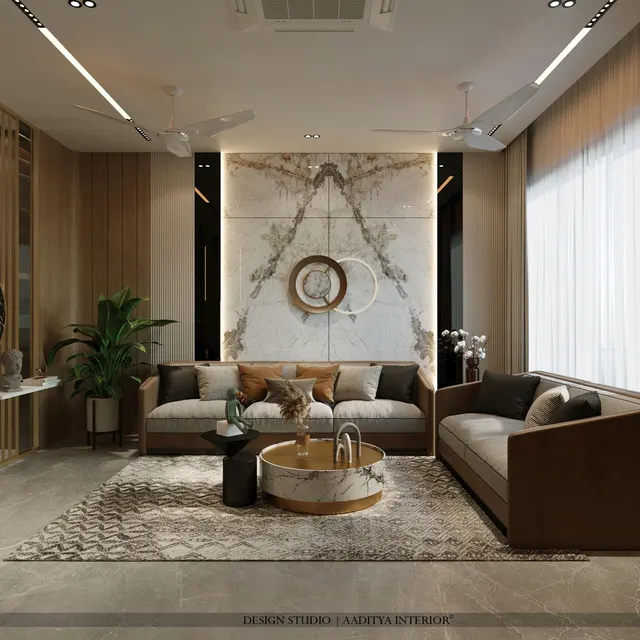
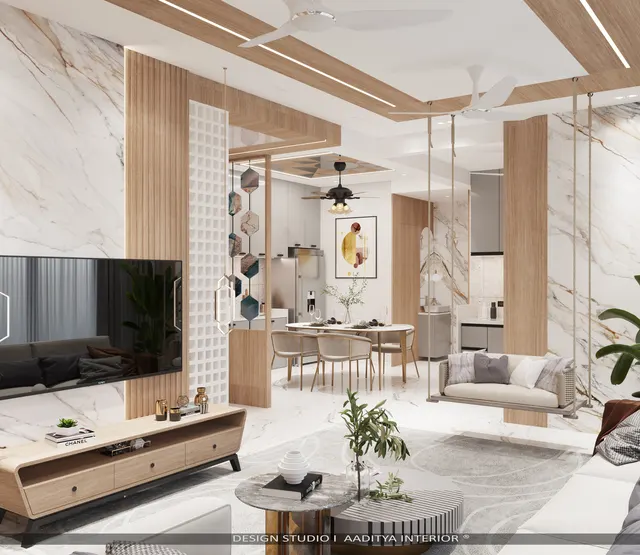
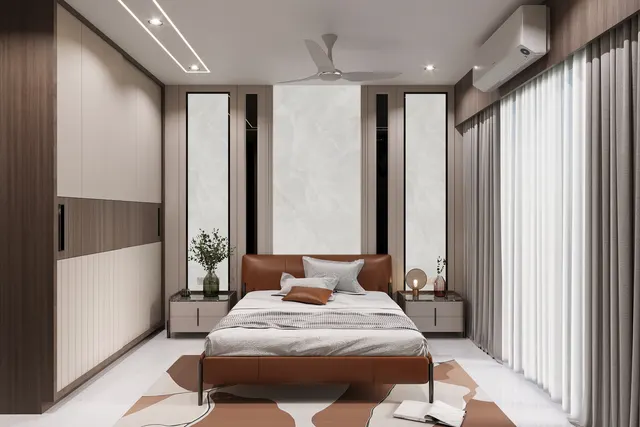
Walk into most Indian homes after dark and the lighting tells the same story: a single bright tube or a ring of white downlights blazing from the ceiling, a ceiling fan light, and nothing else. The room is lit, in the sense that one can see, but it is flat. There is no warmth to sit in, no pool of light to read under, nothing picking out the texture of a wall or the shape of a plant. The switchboard offers one choice — everything on, or everything off — and the room has one mood, all day and all night. This is what happens when lighting is treated as a utility bought by the point rather than as a design layer planned by the room.
The fault is rarely the fittings; it is the thinking. Lighting is specified late, after the walls and the false ceiling are decided, when all that is left is to dot the ceiling with recessed lights at equal spacing. Nobody has asked where people will actually read, chop vegetables, apply make-up or watch television, and nobody has asked what the room should feel like at nine at night versus nine in the morning. The result is a ceiling that looks tidy on a drawing and a room that is tiring to be in — too bright where it should be gentle, too dim where real work happens, and the same cold colour everywhere.
The professional answer is layered lighting: the deliberate combination of three kinds of light — ambient, task and accent — each with its own job, its own fittings, its own switch or dimmer. This article explains the three layers, sets out the light levels and colour temperatures Indian rooms actually need, gives the mounting heights that make each layer work, and shows how to put it all on a reflected ceiling plan before the electrician chases a single wall. Aaditya Interior plans lighting at the same stage as the furniture layout, because the two decide each other.
Why one light is never enough
A single ceiling light fails for a reason rooted in how the eye works. The eye judges brightness by contrast, not by absolute levels, and it relaxes when a space has a gentle gradient of light and shade rather than one uniform blaze. A room lit by one strong overhead source is flat because every surface receives light from the same direction at the same intensity; shadows disappear, texture flattens, and faces look harsh because the light falls straight down onto them. The same room lit in three layers has depth: the ambient layer lifts the whole space to a comfortable base level, the task layer adds brightness exactly where it is needed, and the accent layer creates the highlights and shadows that make a room feel three-dimensional and alive.
Layer one: ambient, the base
Ambient or general lighting is the soft, even light that lets a person move around a room safely and see its overall shape. It is the layer most homes over-rely on. Good ambient light is indirect or diffused — a cove washing the ceiling, a set of widely spaced recessed downlights with a frosted trim, or a central fitting with a shade — rather than a bare tube glaring down. It should be dimmable, because the right ambient level at breakfast is far higher than the right level while watching a film. A useful test: with only the ambient layer on, the room should feel calm and complete, never clinical.
Layer two: task, the working light
Task lighting is aimed, concentrated light placed exactly where a visual task happens — the kitchen counter, the study desk, the dressing mirror, the bedside, the stovetop. It exists because ambient light, coming from the ceiling behind a standing person, throws the person's own shadow onto the work surface. Task light comes from the front or the side, close to the task, so it banishes that shadow and raises the brightness to the level the task needs. Under-cabinet strips over a kitchen counter, a focused pendant over a study table, and mirror-side lights at a dressing unit are the three task lights every home should plan.
Layer three: accent, the drama
Accent lighting is the layer that turns a lit room into a designed one. It is directional light aimed at something worth looking at — a textured wall, a painting, a plant, an alcove, a run of crockery. The rule of thumb is that an accent should be noticeably brighter than its surroundings, roughly three times the ambient level on the object, so the eye is drawn to it. Accent light contributes little to seeing by and everything to atmosphere; it is the layer most often left out, and its absence is exactly why a competently lit room can still feel like an office.
Seen together, the three layers divide the work of a room cleanly. The table summarises what each one does, the fittings that deliver it, the kind of light level it aims for and how it should be controlled. A plan that can tick all three rows, each on its own switch, is a plan that will light a room properly; a plan that fills only the first row is the flat, one-mood lighting most homes end up with.
| Layer | Its job | Typical fittings | Aim / control |
|---|---|---|---|
| Ambient | Fill the whole room to a comfortable base | Cove, diffused downlights, shaded central fitting | 100–200 lux, always dimmable |
| Task | Light a specific job, shadow-free | Under-cabinet strips, pendants, desk and bedside lights | 300–500 lux, local switch |
| Accent | Draw the eye to texture and objects | Spots, track lights, wall-washers, picture lights | ~3× ambient on the object |
How much light: lux by room and task
Light level is measured in lux — lumens falling on a square metre of surface. Indian and international practice, reflected in IS 3646 and the lighting provisions of the National Building Code of India 2016, sets recommended levels by activity rather than by room, because a kitchen counter and a kitchen gangway need very different amounts. The table gives working ranges for home spaces. These are targets for the task plane — the counter, the desk, the floor — not for the fitting, and they assume the task layer, not the ambient layer, is doing the heavy lifting where close work happens.
| Space / task | Recommended level (lux) | Which layer delivers it |
|---|---|---|
| Living room, general | 100–200 | Ambient, dimmable |
| Living room, reading corner | 300–500 | Task (floor or table lamp) |
| Kitchen, general | 150–300 | Ambient |
| Kitchen counter / hob | 300–500 | Task (under-cabinet) |
| Dining table | 150–300 | Task pendant + accent |
| Study / work desk | 300–500 | Task (desk or focused pendant) |
| Bedroom, general | 100–150 | Ambient, warm, dimmable |
| Dressing mirror | 300–500 | Task (both sides of mirror) |
| Bathroom, general / mirror | 150–200 / 300–500 | Ambient / mirror task |
| Staircase, corridor | 100–150 | Ambient (safety first) |
What colour of light: warm, neutral and when to mix
Colour temperature, measured in kelvin, decides whether light feels warm and golden or cool and crisp. Low numbers are warm: a 2700 K lamp is close to the old incandescent glow, flattering to skin and relaxing in the evening. Higher numbers are cooler and bluer: 4000 K reads as neutral white, good for concentration and for judging colour; 5000 K and above feels like overcast daylight, alert but clinical. The common Indian mistake is to light the whole home in cool white 6500 K tubes because they look brightest in the showroom — which is why so many living rooms feel like a clinic. A warmer palette, with cooler light reserved for work areas, is far kinder to live in.
| Colour temperature | How it feels | Best for | Avoid in |
|---|---|---|---|
| 2700 K (warm) | Golden, cosy, like a sunset | Living room, bedroom, dining | Study desk, close detail work |
| 3000 K (warm white) | Warm but clean | Whole-home default, corridors | Where true colour must be judged |
| 4000 K (neutral white) | Crisp, alert, neutral | Kitchen, bathroom, study, wardrobe | A bedroom meant for rest |
| 5000–6500 K (cool / daylight) | Bright, bluish, clinical | Utility, garage, workshop | Any room meant to relax in |
Two practical notes. First, keep colour temperature consistent within a sightline — a living room with some 2700 K and some 6500 K lamps visible at once looks broken; mixing warm ambient with neutral task light is fine only when the task light is local and shaded. Second, pay attention to the colour rendering index, or CRI: a number of eighty is the minimum worth buying, and ninety or above is worth the premium in kitchens, wardrobes and dressing areas, where seeing the true colour of food, clothes and skin actually matters.
Mounting heights that make each layer work
A layer placed at the wrong height fails no matter how good the fitting is. A dining pendant hung too high dazzles; too low, it blocks the view across the table. An under-cabinet strip fixed at the back of the shelf lights the wall, not the chopping board. The figure and table set out the heights that work, measured in millimetres from the finished floor or the relevant surface. These are starting points to adjust for ceiling height and the people using the room, but getting them roughly right is the single biggest improvement most home lighting can make.
| Fitting | Mounting height / position | Why |
|---|---|---|
| Dining pendant | 750–900 mm above the table top | Lights the table without dazzling seated diners |
| Cove / indirect ambient | Dropped 150–300 mm below the slab | Washes the ceiling evenly; strip stays hidden |
| Recessed downlights | Spaced about equal to the ceiling height | Even ambient wash without bright scallops |
| Under-cabinet task | At the front edge of the shelf, ~600 mm above counter | Lights the chopping board, not the wall behind |
| Wall sconce / accent | 1500–1700 mm above finished floor | Above eye level; glare-free at standing height |
| Bedside reading light | 550–650 mm above the mattress | Pool of light on the book, clear of the pillow |
| Mirror / dressing lights | Either side at face height, ~1600 mm | Lights the face evenly, kills under-eye shadows |
Putting it on a plan: the reflected ceiling plan
Lighting only comes together on paper. The tool is the reflected ceiling plan — the ceiling drawn as if seen in a mirror on the floor, with every fitting, cove and strip marked in its real position over the furniture below. On it, each layer is drawn as a separate circuit and given its own switch or dimmer: ambient on one, task lights on another, accents on a third. This is where the furniture layout and the lighting finally meet, because a reading lamp planned over an empty floor is useless; the sofa has to be there. Drawing it before the walls are chased is what separates a lighting plan from a scatter of downlights.
The past and future of home lighting
Layered lighting is not new; it is a return. Before electricity, Indian homes were lit in layers by necessity — the general glow of oil lamps and lanterns, the focused light of a lamp carried to a task, the flicker of a diya marking a niche or a threshold. Early electric lighting flattened all of that into the single bright bulb, prized simply because it was so much brighter than a flame. The tube light, and then the compact fluorescent, entrenched the one-source habit for decades. It is only with the LED that layering has become easy and affordable again, because LEDs are small, cool, cheap to run and simple to dim and tuck into coves and under cabinets.
The near future pushes layering further through control. Tunable-white LEDs can shift from warm evening light to neutral daytime light on the same fitting, so a room's colour temperature follows the time of day. Dimming and scene control, once a luxury, now come through ordinary smart switches and apps, letting a single tap set a whole layered scene — bright and neutral for cooking, low and warm for a film. The principle underneath never changes, though: three layers, each with a job, each controlled on its own. The technology only makes the layers easier to build and to live with.
Beam angles and what the layers cost
Two practical levers finish the plan. The first is beam angle, which decides whether a fitting floods a room or spotlights an object: a narrow beam of fifteen to twenty-four degrees is an accent tool, a medium beam of twenty-five to forty degrees suits general task and wall work, and a wide beam of sixty degrees or more is for ambient wash. Choosing the wrong beam is a common reason an expensive fitting disappoints — a wide-flood lamp can never make a crisp accent. The second lever is budget, and here the good news is that the layers are cheap to build; the money is better spent on dimmers and on a few good colour-rendering lamps than on one elaborate fixture.
| Fitting | Indicative October 2026 cost | Note |
|---|---|---|
| Recessed LED downlight or spot | ₹400–1,200 each | Price tracks optics and driver quality, not size |
| Cove LED strip, installed | ₹150–300 per running ft | Plus driver; hidden in the ceiling cove |
| LED strip reel (5 m) for task runs | ₹1,500–3,000 | Needs a driver and an aluminium profile |
| Dimmer or smart switch | ₹800–5,000 per point | Often the best-value upgrade in the whole plan |
| Statement pendant or wall light | ₹2,000–15,000 | Chandeliers quoted far higher, by design |
| Under-cabinet task strip | ₹150–300 per running ft | Choose warm-neutral, CRI 90, for kitchens |
Rules for a layered lighting plan
- Start from the furniture layout and the activities, not from a tidy grid of ceiling points.
- Give every room all three layers — ambient to fill it, task where work happens, accent for life.
- Put each layer on its own switch or dimmer, so one room can hold many moods.
- Match the lux to the task, not the room: 100–200 to relax, 300–500 to read, cook or work.
- Keep colour temperature warm where you rest (2700–3000 K) and neutral where you work (4000 K).
- Buy only lamps with a colour rendering index of 80 or more, and 90-plus for kitchens and wardrobes.
- Hang task lights at the right height — a dining pendant 750–900 mm above the table, bedside 550–650 mm above the mattress.
- Hide the source: light coves, trims and shades should let you see the light, not the bare LED.
Frequently asked questions
What are the three types of layered lighting?
Ambient, task and accent. Ambient is the general light that fills a room and lets you move around safely. Task is concentrated light aimed where a visual job happens — the counter, the desk, the mirror. Accent is directional light that picks out a wall, a painting or an object for effect. A complete plan uses all three, each on its own control.
How many downlights do I need in a room?
There is no fixed count, because downlights are only the ambient layer and should be spaced for an even wash rather than packed to brute-force brightness. A rough starting point is to space them about as far apart as the ceiling is high, then check the result against the lux target and add task and accent lights where close work and highlights are needed. A room lit only by many downlights will still feel flat; the layers matter more than the number.
Should home lighting be warm white or cool white?
Mostly warm. Use warm light of 2700–3000 K in living rooms, bedrooms and dining spaces, where it is relaxing and flattering, and reserve neutral white of about 4000 K for task areas such as the kitchen, bathroom, study and wardrobe, where crisp light helps. Cool daylight white above 5000 K suits only utility, garage and workshop spaces; using it across a whole home is why many rooms feel clinical.
Is a dimmer worth it?
Almost always, and often more than an expensive fitting. A dimmer lets one ambient layer serve both a bright morning and a low-lit evening, which is the whole point of layering, and it extends lamp life and saves energy. Make sure the LED lamps and drivers are marked dimmable and matched to the dimmer type, or they may flicker or buzz.
Can I add layered lighting without breaking the ceiling?
Yes, to a large degree. Plug-in floor and table lamps add task and accent layers with no wiring at all; track lights and surface-mounted spots add accent light where only one ceiling point exists; and under-cabinet strips often run off a nearby socket. A full cove or recessed scheme does need the false-ceiling and wiring stage, so it is best planned before that work, but the portable layers can transform a finished room immediately.
Sources & standards
- Bureau of Indian Standards — IS 3646 (Code of Practice for Interior Illumination) — recommended lux levels
- National Building Code of India 2016, Part 8, Section 2 (Lighting and Ventilation) and Part 11 (Approach to Sustainability)
- Bureau of Energy Efficiency (BEE) — star labelling and guidance on efficient LED lighting
- Neufert, Architects' Data — lighting levels, mounting heights and room data
- Time-Saver Standards for Architectural Design — illumination and layered lighting principles
- Indian Society of Lighting Engineers and general LED luminaire manufacturer data (colour temperature, CRI, beam angle) described generically
- Price ranges: indicative October 2026 estimates — confirm locally before budgeting