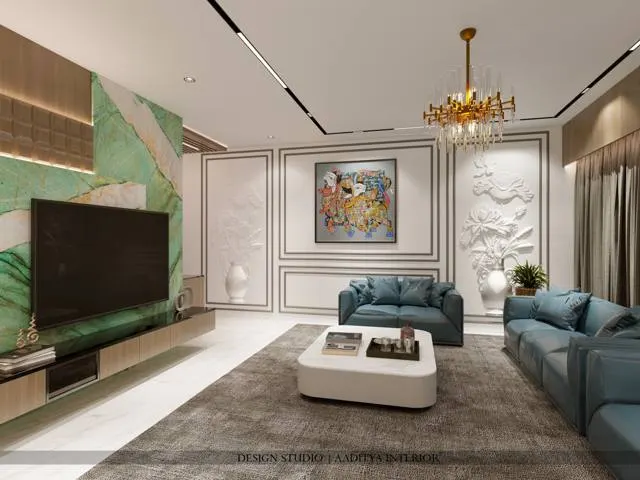
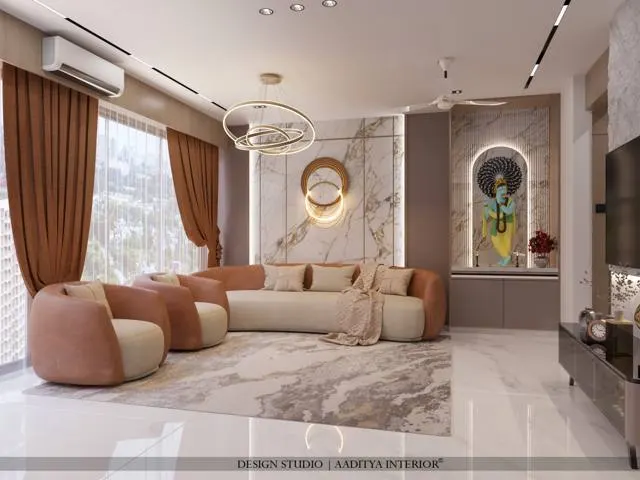
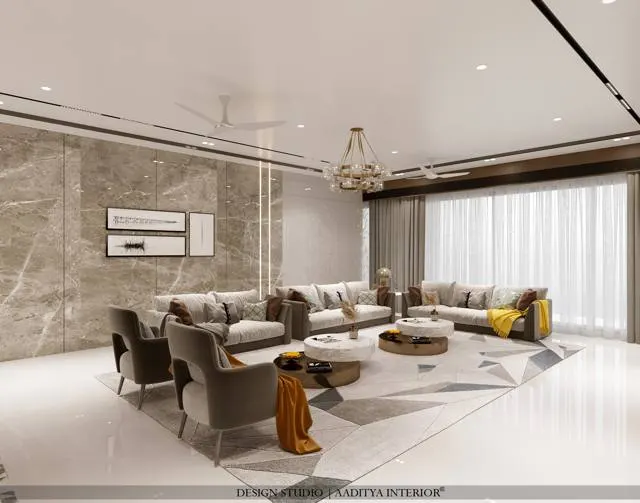
Louis XVI style is the calm, straight-lined answer to the swirling curves that came before it, and it remains one of the most reliable ways to make an Indian living room feel formal without feeling stiff. Where the earlier Rococo filled rooms with scrolls and asymmetry, Louis XVI brought back the straight line, the fluted column, the oval medallion and the measured panel, all arranged with a symmetry that the eye reads as order. For a homeowner in Surat, Ahmedabad or Mumbai, that order is the appeal: a room that looks considered and expensive even when the furniture is modest, because the proportions do the work rather than the ornament.
The style is often misunderstood in India as simply painting everything white and adding gold. That version looks thin within a year, because the real style is a system of proportions, not a colour scheme. The panels on the wall have a fixed relationship to the ceiling height, the chair legs taper at a precise angle, the mirror sits over the fireplace or the console at a height that suits a standing person, and the gilding is used sparingly, on carved edges rather than on whole surfaces. When those relationships are ignored, the room looks like a film set. When they are respected, even a small flat can carry the style convincingly.
This article explains the style from its origins in eighteenth-century France to the way it is built today in Indian homes, with the dimensions, materials, costs and checks that decide whether the result feels authentic or merely decorative. It covers wall panelling, furniture, fabrics, lighting and colour, and it gives a practical sequence for a living room or bedroom, so that a homeowner can brief a carpenter or designer with numbers rather than with adjectives.
From Rococo excess to Neoclassical order: the history
Louis XVI style takes its name from the French king who reigned from 1774, and it grew out of a deliberate reaction against the Rococo that had dominated French interiors for decades. Archaeological discoveries in Italy, and a wider fashion for the art of ancient Rome and Greece, encouraged designers to return to straight lines, classical columns and restrained ornament. The change was not sudden: early Louis XVI rooms still kept some Rococo softness, but by the later years of the reign the new language was settled, with fluted pilasters, Greek key borders, laurel wreaths, urns and medallions replacing the shell and the scroll.
The style was a court style first, seen in royal residences and in the houses of the French aristocracy, but its logic travelled well because it was based on geometry rather than on wealth. A panelled wall needs a carpenter who can measure, not a fortune in carving. That is why the style spread across Europe and, through pattern books and furniture exports, to Britain and America, where it merged with Georgian and Federal taste. In India it arrived through colonial houses, hotels and the homes of families who collected European furniture, and it survives today in heritage hotels, in formal drawing rooms and in the showrooms of furniture makers who still copy the classic chair and console forms.
Understanding the history matters because it explains the discipline of the style. Louis XVI is not decoration piled onto a room; it is architecture brought indoors. The wall is treated as a piece of classical architecture, divided into bays by pilasters, with a dado at the bottom, panels in the middle and a cornice at the top, exactly as a stone facade would be divided. Once a homeowner sees the wall that way, the decisions become easier: the panels must be regular, the centre must be marked by a fireplace, a mirror or a painting, and nothing should break the symmetry without a reason.
The language of the style: straight lines, fluting and the oval
The most recognisable element of Louis XVI furniture is the straight, tapered leg, usually fluted with fine vertical grooves and ending in a small turned foot. Chairs, tables, consoles and commodes all stand on such legs, which gives a room a sense of lightness even when the pieces are large. The chair back is commonly oval or shield-shaped, upholstered in silk or a fine cotton, with a carved crest rail carrying a small rosette, ribbon or laurel motif. The seat is square or gently rounded, and the frame is often painted in white, cream or pale grey, with gilded highlights on the carving only.
On walls, the language is the panel. Boiserie, the French term for wood panelling, divides the wall into rectangles with applied mouldings, and the rectangles are proportioned to the room: tall and narrow on a high wall, wider and squarer on a lower one. A typical Indian living room with a ceiling at 3000 mm suits a dado at 900 mm from the floor, panels about 600 to 750 mm wide, and a cornice of 100 to 150 mm at the top. The moulding itself is slim, usually 20 to 40 mm wide, and it is the crispness of its corners, not its size, that gives the wall its character.
Ornament in Louis XVI work is always contained. The motifs are classical and small: the rosette, the ribbon bow, the laurel leaf, the urn, the Greek key and the fluted column. They appear at the centre of a panel, at the top of a chair leg, or along a frieze, and they are repeated with discipline rather than scattered. Gold is used as a line, not as a field: a gilded edge on a moulding, a gilded rosette, a gilded frame. A room in which whole panels are gilded has left Louis XVI behind and entered a different, louder style altogether.
| Element | Typical size (mm) | Material in India | Finish | Common mistake |
|---|---|---|---|---|
| Dado height | 850–900 | MDF or teak-veneer ply | Painted cream or white | Dado too high, cuts the wall in half |
| Wall panel | 600–750 wide | MDF with applied moulding | Painted, matte | Panels of unequal width on one wall |
| Cornice | 100–150 deep | POP or PU moulding | Painted to match wall | Cornice too deep for a 3000 mm ceiling |
| Chair leg | 450 seat height | Teak or beech | Painted with gilt edge | Leg too thick, looks Georgian not Louis XVI |
| Console table | 1200 × 400, 800 high | Teak frame, marble top | Painted frame, honed marble | Console too deep, blocks circulation |
| Mirror over console | 900 × 1200 | Gilded wood frame | Antique gold leaf | Mirror hung too high to use |
Proportions that work in Indian rooms
Indian rooms are usually lower and smaller than the French salons the style was made for, so the proportions must be scaled rather than copied. A ceiling of 3000 mm, common in Indian flats, can carry a dado and panels comfortably, but the cornice should stay slim and the panels should be narrower than they would be in a 4200 mm salon. A room 3600 mm wide suits three panels on the long wall, not four cramped ones, and a room 4800 mm long suits a central fireplace or mirror with a pair of chairs flanking it. The rule is simple: fewer, larger, regular panels always look better than many small ones.
Furniture must also be scaled. A Louis XVI armchair is about 600 mm wide and 900 mm high, and it needs at least 750 mm of space in front of it for a person to rise comfortably. A sofa in the style is typically 1800 to 2100 mm long, and it should sit at least 900 mm from a coffee table that is 1100 to 1200 mm long and 450 mm high. In a living room of 3600 by 4800 mm, that leaves room for two armchairs opposite the sofa and a console on the side wall, which is the classic arrangement. Crowding a third armchair into the same room breaks the symmetry and the circulation at once.
Circulation is part of the proportion. The style is formal, so people move through the room on clear axes: from the door to the seating group, and from the seating group to the balcony or dining area. A main passage of 900 to 1200 mm should be kept clear, and no chair back should sit closer than 600 mm to a wall panel, or the panel disappears behind the furniture. When a room feels cramped in this style, the cause is almost always too much furniture rather than too little space, and removing one piece usually restores the balance.
Colour, gilding and fabric: restraint is the luxury
The Louis XVI palette is pale and cool: ivory, cream, pale grey, soft blue-grey and sage, with white woodwork and a floor in pale stone or light timber. Colour enters through the upholstery and the curtains, in muted tones such as dusty blue, pale rose, sage green or a restrained gold, and through a single stronger note, often a deep blue or burgundy cushion, used sparingly. Walls in Indian homes suit a matte emulsion in ivory or pale grey, because a glossy wall shows every unevenness and fights the matte character of the style.
Gilding should be treated as jewellery, not as paint. Genuine gold leaf is used on carved rosettes, on the edges of mouldings and on mirror frames, and it is usually antiqued slightly so that it does not shine like new brass. Imitation gold leaf and gold paint are acceptable on small carvings, but they should never cover a whole panel or a whole chair frame, because they read as flat and yellow under Indian daylight. A good test is to look at the room in the afternoon: if the gold glints only at the edges, the balance is right; if whole surfaces glow, there is too much of it.
Fabrics are smooth and fine rather than heavy. Silk, linen and fine cotton in plain colours or in small classical patterns such as stripes, tiny florals or a restrained toile suit the style, while heavy brocade and large bold prints belong to other periods. Curtains hang full length, from a simple gilt or painted rod, and they are lined so that they fall straight. In the hot Indian climate, a cotton-linen blend is often more practical than pure silk, which fades in strong sun, and a sheer inner curtain protects the upholstery while keeping the pale palette bright.
| Surface | Louis XVI choice | Indian alternative | Indicative cost (Oct 2026) | Care |
|---|---|---|---|---|
| Walls | Matte ivory emulsion | Asian Paints or equivalent matte | ₹20–30 per sq ft painting | Washable matte, touch up yearly |
| Panelling | Painted MDF moulding | PU moulding on MDF | ₹150–300 per running ft | Dust weekly, repaint every 4–5 years |
| Floor | Pale marble or light timber | Italian marble look tile | ₹85–160+ per sq ft tiles | Seal marble, mop with mild cleaner |
| Upholstery | Silk or linen blend | Cotton-linen blend | ₹400–900 per metre fabric | Keep out of direct sun |
| Curtains | Lined linen, full length | Cotton-linen with lining | ₹350–800 per metre | Dry clean, reline if faded |
| Gilding | Gold leaf on carving | Imitation leaf on small carvings | ₹2,500–6,000 per chair frame | Dust only, never polish with water |
Furniture: what to buy, what to copy, what to skip
The essential Louis XVI pieces for a living room are a sofa, two armchairs, a console table with a mirror above it, and a low coffee table. A commode, which is a low chest of drawers with a shaped front, suits a bedroom or a dining room, and a small writing desk, called a bonheur du jour, suits a study corner. Each piece should be bought or made once, well, rather than bought cheaply several times: a well-made chair frame in teak with proper joints will last decades, while a softwood copy with glued joints will loosen within two seasons of Indian humidity and use.
In India, the practical route is usually a mix. The sofa and armchairs can be made by a good local carpenter from a measured drawing, with the frame in teak or beech and the upholstery done by a specialist. The console and mirror are often better bought ready-made from a furniture market, where the carving is already done, and then painted to match the room. Antique pieces should be bought only after checking the joints, the seat rails and the underside for woodworm, and after confirming that the size suits the room: many imported antiques are larger than their Indian copies and overwhelm a flat.
Pieces to skip are the ones that fight the style. A heavy carved teak sofa with a high back, a bulky recliner, a glass-top dining table with chrome legs, or a television unit that dominates the wall all break the classical balance. The television, in particular, needs a plan: it should sit in a panelled cabinet with doors, or on a side wall, so that the fireplace or mirror remains the centre of the main wall. A room in which the television is the largest object on the main wall is not a Louis XVI room, whatever the chairs look like.
Building the look in an Indian home: a room-by-room sequence
Start with the living room, because it is the room guests see and the room where the style reads most clearly. Measure the walls, decide the panel layout on paper, and fix the position of the sofa wall before ordering anything. The panelling goes up first, then the painting, then the floor finish if it is being changed, and only then the furniture. Ordering furniture before the panelling is finished is the most common sequencing mistake, because a sofa that was measured against a bare wall often sits 50 mm proud of a panelled one, and the gap shows.
The bedroom in this style is quieter: a panelled headboard wall, a pair of bedside tables with fluted legs, an oval mirror over a small dressing table, and curtains in a pale tone. The bed itself should be a simple four-poster or a low upholstered frame, never a heavy carved headboard that competes with the panelling. A dining room suits a rectangular table 1800 to 2400 mm long, with six chairs, a sideboard against the long wall and a chandelier centred over the table at 750 to 900 mm above the tabletop.
Kitchens and bathrooms are rarely done in full Louis XVI style, and that is sensible: the style belongs in living and sleeping rooms, and a kitchen needs washable surfaces and clear worktops. A nod is enough, such as a panelled door, a classical mirror in the powder room, or a marble-topped console in the passage. Keeping the style to the rooms where it can be done properly is better than spreading it thinly across the whole house, where it becomes a theme rather than a design.
| Room | First step | Key piece | Budget share | Time needed |
|---|---|---|---|---|
| Living room | Panel layout on paper | Sofa + 2 armchairs | 50–60% of room budget | 4–6 weeks |
| Bedroom | Headboard wall panels | Bed + 2 bedside tables | 40–50% | 3–4 weeks |
| Dining room | Table position and light | Table + 6 chairs | 45–55% | 3–5 weeks |
| Passage | One console + mirror | Console + mirror | 5–10% | 1–2 weeks |
| Study corner | Desk against panelled wall | Writing desk + chair | 10–15% | 2–3 weeks |
Costs, phasing and where the money should go
A Louis XVI living room in India typically costs between ₹2,50,000 and ₹6,00,000 in October 2026 for a room of about 3600 by 4800 mm, excluding the television and air conditioning, with the wide range reflecting the difference between painted MDF panelling and teak-veneer work, and between locally made chairs and imported or antique pieces. Wall panelling and painting usually take ₹60,000 to ₹1,50,000, the sofa and two armchairs ₹1,20,000 to ₹2,50,000, and the console, mirror and coffee table ₹45,000 to ₹1,20,000. Curtains, lighting and accessories make up the rest, and they should not be cut to the bone, because a pale room without good curtains and light looks unfinished.
Phasing is straightforward if the order is respected. Phase one is the shell: panelling, cornice, painting and any electrical work for wall lights and the chandelier. Phase two is the large furniture: sofa, chairs and tables, made or ordered while phase one is under way so that delivery follows painting by a few days. Phase three is the soft layer: curtains, upholstery final fitting, mirror hanging and accessories. Rushing phase three is the usual mistake; a room that is lived in for a week before the curtains go up reveals whether the seating distances are right, and a curtain ordered after that week fits the room as it is actually used.
Where to spend is clear: the chair frames, the sofa frame and the mirror. Where to save is equally clear: the panelling can be painted MDF rather than solid teak, the gilding can be imitation leaf on small carvings, and the fabrics can be cotton-linen rather than pure silk. A homeowner who spends on the frame and saves on the finish gets a room that lasts; a homeowner who does the opposite gets a room that looks good in photographs and loosens within two years. Aaditya Interior recommends getting the frame and the panel layout right first, because everything else can be changed later without rebuilding the room.
| Item | Budget option (₹) | Mid-range (₹) | Premium (₹) | Notes |
|---|---|---|---|---|
| Wall panelling, living room | 60,000–90,000 | 90,000–1,50,000 | 1,50,000–2,50,000 | MDF, veneer, solid teak |
| Sofa, 3-seater | 45,000–75,000 | 75,000–1,25,000 | 1,25,000–2,50,000 | Frame quality decides life |
| Armchair, each | 18,000–30,000 | 30,000–55,000 | 55,000–1,00,000 | Pair keeps symmetry |
| Console + mirror | 25,000–45,000 | 45,000–75,000 | 75,000–1,50,000 | Marble top adds cost |
| Chandelier | 15,000–30,000 | 30,000–60,000 | 60,000–1,50,000 | Crystal vs glass drops |
| Curtains, full room | 20,000–35,000 | 35,000–60,000 | 60,000–1,00,000 | Lining included |
Where the style is heading, and what to avoid
Louis XVI style today is moving towards a lighter, more liveable version. Designers keep the panelling and the proportions but use paler fabrics, fewer gilded pieces and cleaner lighting, so that the room works for everyday family life rather than only for formal entertaining. The style also mixes more freely now: a Louis XVI chair can sit beside a plain modern side table, and a classical mirror can hang over a simple console, provided the proportions and the symmetry are respected. The future of the style in India is this edited version, not a museum copy of a French salon.
The mistakes to avoid are consistent across Indian projects. The first is over-gilding, which turns a calm room into a glittering one. The second is mixing Louis XVI with heavy Rococo scrolls or with bulky colonial furniture, which confuses the eye because the two languages contradict each other. The third is panelling one wall and leaving the rest bare, which makes the panelled wall look like a backdrop rather than part of the room. The fourth is buying chairs by appearance alone, without sitting in them: a Louis XVI chair should be comfortable for an hour, not only photogenic for a minute.
A final caution concerns scale in small flats. In a living room smaller than 3000 by 3600 mm, full panelling on every wall will close the room in, and a better choice is panelling on the single sofa wall, with plain painted walls elsewhere. The style survives the edit, because the eye reads the panelled wall as the room's architecture and the plain walls as its background. Knowing when to stop is part of the style itself: Louis XVI was, above all, a reaction against excess, and a restrained room honours it better than a crowded one.
Eight rules for a Louis XVI room that feels authentic
- Keep the room symmetrical: mark the centre with a fireplace, mirror or painting, and balance every piece across it.
- Scale the panels to a 3000 to 3600 mm ceiling: dado 850 to 900 mm, panels 600 to 750 mm wide, cornice 100 to 150 mm.
- Use straight tapered, fluted legs on every chair and table, and keep the seat height at 450 mm.
- Gild only the carved edges and rosettes; never gild a whole panel, door or chair frame.
- Hold the palette pale: ivory, cream and pale grey walls, with colour in the upholstery and curtains only.
- Keep 900 to 1200 mm of clear passage and at least 600 mm between a chair back and a panelled wall.
- Hide the television in a cabinet or on a side wall so the mirror or fireplace keeps the main wall.
- Buy the frame well and save on the finish: teak frames and painted MDF panels outlast cheap copies.
Frequently asked questions
What is the difference between Louis XVI and Louis XV style?
Louis XV is Rococo: curved cabriole legs, asymmetrical scrolls, shell motifs and rich gilding across whole surfaces. Louis XVI is Neoclassical: straight tapered fluted legs, oval backs, regular panels, classical motifs such as the rosette and the Greek key, and gold used only on carved edges. A quick test is the chair leg: if it curves, it is Louis XV; if it is straight and fluted, it is Louis XVI.
Can Louis XVI style work in a small Indian flat?
Yes, if it is edited. Panel only the sofa wall, keep the furniture to a sofa and two armchairs, use pale colours and slim furniture, and avoid a large chandelier in a room below 3000 mm ceiling height. A living room of 3000 by 3600 mm can carry the style on one wall convincingly, while panelling every wall in the same room would make it feel smaller.
How much does a Louis XVI living room cost in India?
For a room of about 3600 by 4800 mm, a typical range is ₹2,50,000 to ₹6,00,000 in October 2026, excluding television and air conditioning. Panelling and painting take ₹60,000 to ₹1,50,000, the sofa and two armchairs ₹1,20,000 to ₹2,50,000, and the console, mirror and coffee table ₹45,000 to ₹1,20,000. Painted MDF and imitation leaf keep a project near the lower end.
Is gold leaf necessary, or can gold paint be used?
Gold leaf is best on the pieces the eye rests on, such as a mirror frame or a console carving, but imitation leaf and good gold paint are acceptable on small carvings and moulding edges. The rule is to use gold as a line on carved edges, never as a flat field, because a flat gold surface reads as yellow paint under Indian daylight while a gilded edge catches light the way the style intends.
Which wood is best for Louis XVI furniture in India?
Teak is the most reliable choice for chair and table frames because it is stable in Indian humidity and holds carving well; beech is a good second choice for painted pieces. The frame should be joined properly, not only glued, and the seat rails should be checked before upholstery. Painted MDF is fine for wall panelling, but it should not be used for chair legs or any piece that carries weight.
Sources & standards
- Bureau of Indian Standards — National Building Code of India 2016, Part 3 (Development Control Rules and General Building Requirements) and Part 8 (Building Services, Section 1: Lighting and Ventilation)
- Bureau of Indian Standards — IS 303 (plywood for general purposes) and IS 12406 (medium density fibreboard)
- Neufert, Ernst — Neufert Architects' Data, 4th edition: standard dimensions for rooms, furniture and circulation
- Time-Saver Standards for Interior Design and Space Planning, 2nd edition: historic styles, room planning and furniture data
- Energy Conservation Building Code (ECBC), Bureau of Energy Efficiency, and IGBC rating guidance for homes
- Price ranges: indicative October 2026 estimates — confirm locally before budgeting