When a family chooses paint, almost all the attention goes to colour. The shade card is studied for weeks; the sheen is decided in thirty seconds when the painter asks, "Matt or shine?" Yet sheen changes how a colour looks, how a wall feels under light, how easily it can be cleaned, how well the painter's putty work is hidden, and how invisible a touch-up will be five years later. The same warm white in a flat finish and a high-sheen finish can look like two different colours in the same room.
Indian homes make the choice harder. Walls are hand-plastered and puttied, so they are rarely perfectly flat; windows often sit at the end of long rooms and throw light across the wall at a low angle; cove lighting and wall washers are now common and do the same at night; kitchens see oil and turmeric; children draw on walls; and monsoon humidity encourages mildew in bathrooms. A sheen that would look perfect on a flat, dry, evenly lit European wall can look patchy, show every putty mark, or stain quickly here.
An earlier article on this site compared matte and glossy finishes on furniture shutters and surfaces. This one goes deeper into paint itself: what sheen physically is, how manufacturers measure it, what the four main families — matt, eggshell, satin and gloss — do well and badly, where each belongs in an Indian home, how surface preparation and lighting change the result, and what it costs. Prices are indicative October 2026 ranges, consistent with the painting cost articles on this site.
What sheen actually is
Every paint film reflects light in two ways at once. Part of the light bounces off the surface at the same angle at which it arrived, as in a mirror; this is specular reflection, and it is what we see as shine. The rest is scattered in all directions by the pigment particles and the microscopic roughness of the surface; this diffuse reflection is what lets us see the colour evenly from any angle. Sheen is simply the balance between the two. A gloss paint dries to a very smooth surface with the binder forming a continuous, glassy skin over the pigment, so most of the surface reflection is mirror-like. A matt paint dries to a micro-rough surface, so light is scattered and there is little or no shine.
Paint chemists control this mainly through the proportion of pigment and extender to binder, expressed as the pigment volume concentration (PVC). A low-PVC paint has plenty of binder to fill the gaps between particles and form a smooth, glossy film; a high-PVC paint has particles sticking out of the binder, which scatter light and produce a flat finish. This is also why sheen and durability are linked: more binder generally means a tighter, more washable film. Modern premium matt emulsions use better binders and additives to narrow this gap, which is why some matt products are now marketed as washable or stain-resistant.
Sheen also changes how colour reads. Because a glossy surface reflects the light source rather than the colour wherever a highlight appears, but shows a deeper, more saturated colour elsewhere, the same shade tends to look richer and slightly darker in gloss and softer and slightly lighter in matt. This is why a colour should always be approved in the sheen in which it will be applied — a sample patch of matt paint does not show how the satin version will look.
How sheen is measured and named
Sheen is measured with a glossmeter, which shines a beam of light at a fixed angle onto a flat painted panel and measures how much is reflected at the mirror angle. The result is expressed in gloss units (GU) on a scale referenced to a polished black glass standard. International test methods such as ISO 2813 and ASTM D523 specify three geometries: 60° for most paints, 20° to separate high-gloss finishes more clearly, and 85° — a near-grazing angle — to separate low-sheen and matt finishes, which all read close to zero at 60°.
The names on paint tins are not standardised. One manufacturer's eggshell is another's low sheen; one's satin is another's soft sheen or silk. In the Indian market, interior emulsions are commonly sold as matt, low sheen or soft sheen, sheen and high sheen, while enamels are sold as satin, semi-gloss or gloss. The ranges below are approximate bands commonly used in the paint industry at the 60° geometry, given to show the order of the scale; for a specific product, the manufacturer's technical datasheet is the only reliable source.
| Sheen family | Approximate gloss at 60° (GU) | Other names in use | Typical products in India |
|---|---|---|---|
| Flat / dead flat | Below about 5 | Dead matt, ceiling flat | Ceiling paints, distemper, some economy emulsions |
| Matt | About 5–10 | Low sheen (some ranges) | Most interior emulsions, many exterior emulsions |
| Eggshell | About 10–25 | Low sheen, soft sheen | Premium emulsions in soft-sheen versions |
| Satin | About 25–40 | Silk, sheen, pearl | Sheen emulsions, satin enamels, some exterior sheen paints |
| Semi-gloss | About 40–70 | High sheen (emulsion) | High-sheen emulsions, semi-gloss enamels |
| Gloss | About 70–85 | Full gloss | Synthetic and PU enamels for doors, grills, trims |
| High gloss | Above about 85 | Mirror gloss, lacquer | PU and lacquer finishes on joinery, automotive-style finishes |
The four main families compared
Matt
Matt and flat finishes reflect very little light at the mirror angle, so they show colour evenly from every angle and are the most forgiving of uneven walls. Small undulations in putty, joints in plaster, roller laps and hairline repairs are much less visible. Touch-ups blend well, because a patch of fresh matt paint has nearly the same surface as the old film. The weakness of traditional matt paint is the surface itself: its micro-rough film holds dirt, and scrubbing can burnish it — polishing a shiny patch into the matt surface — or remove paint. Premium matt emulsions have improved this greatly, but in high-touch zones they still need gentler cleaning than satin.
Eggshell
Eggshell, often sold as low sheen or soft sheen, has a faint glow, like the surface of an egg. It is the most popular compromise for living rooms and bedrooms in premium ranges: a little more washable and stain-resistant than matt, a little more depth of colour, and still reasonably forgiving of wall imperfections in normal light. Under strong grazing light it begins to show defects that matt would hide.
Satin
Satin, sold as sheen or silk, has a noticeable soft shine. Its tighter film resists moisture, grease and fingerprints better and can be wiped regularly, which makes it the usual choice for kitchens, bathrooms, children's rooms, corridors, staircases and dados. It also shows more: surface preparation must be better, and touch-ups are more likely to show as a slightly different shine. In satin enamels, it is a refined, modern finish for doors, frames and metalwork that avoids the plastic look of high gloss.
Gloss
Gloss and semi-gloss finishes form hard, smooth, highly reflective films. They are the most wipeable and the best at resisting moisture and dirt, which is why gloss enamels have long been used on doors, windows, grills, railings and the oil-painted dados of older Indian kitchens and bathrooms. Their weakness is visual: every dent, brush mark, putty ridge and patch shows, and large glossy walls produce glare from windows and lamps. On walls, gloss is now used mainly for deliberate effects — a lacquered dining room or a small powder room — on very carefully prepared surfaces.
| Property | Matt | Eggshell | Satin | Gloss |
|---|---|---|---|---|
| Hides wall imperfections | Best | Good | Fair | Poor — shows everything |
| Washability | Fair (good in premium washable matt) | Good | Very good | Excellent |
| Stain and grease resistance | Fair | Good | Very good | Excellent |
| Touch-up invisibility | Best | Good | Fair | Poor — patches show as sheen differences |
| Glare from windows and lamps | None | Low | Moderate | High |
| Colour appearance | Soft, slightly lighter | Soft with depth | Richer | Deepest, most saturated |
| Demand on surface preparation | Normal | Good | Very good | Excellent — near-perfect surfaces |
| Typical place | Ceilings, living, bedrooms | Living, bedrooms, dining | Kitchens, baths, kids, corridors | Doors, grills, trims, joinery |
Surface preparation decides how a sheen looks
The higher the sheen, the more the wall underneath matters. A good interior paint system in India usually means repaired plaster, two coats of wall putty sanded smooth, a coat of primer and two finish coats; the cost of this full system is already included in the per-square-foot rates quoted for emulsions. With a matt finish, a slightly wavy putty job may never be noticed. With satin or gloss, the same wall can look like the surface of a lake on a windy day. If a satin or higher finish is planned on large walls, ask the painter for an extra sanding pass and check the putty under a torch held flat against the wall before the primer goes on.
Two further details matter. First, primer and putty must be compatible with the finish and fully dry; uneven absorption by patchy primer shows as patchy sheen, a defect called flashing. Second, the finish coats should be applied in one continuous working session per wall, keeping a wet edge, because overlaps of partly dried paint produce visible laps in satin and gloss. Professional painters cut in the edges and roll each wall from corner to corner without stopping in the middle.
| Layer | Purpose | Typical treatment | Effect on sheen |
|---|---|---|---|
| Plaster repair | Sound, level base | Fill cracks and hollows; cure fully | Hollows and ridges show through any finish |
| Wall putty (2 coats) | Smooth surface | Acrylic or cement-based putty, sanded | Quality of sanding decides how satin and gloss look |
| Primer (1 coat) | Even absorption and adhesion | Interior or exterior primer to suit the finish | Prevents flashing — patchy sheen |
| First finish coat | Colour and film build | Emulsion or enamel, thinned as specified | Sets base colour |
| Second finish coat | Final colour and sheen | Same product, full coat, wet edge kept | The sheen you see depends on this coat being even |
| Enamel on metal | Corrosion protection | Rust removal, red-oxide or zinc-rich primer, 2 coats enamel | Gloss or satin; gloss is more weather-resistant |
Light changes everything: windows, coves and grazing light
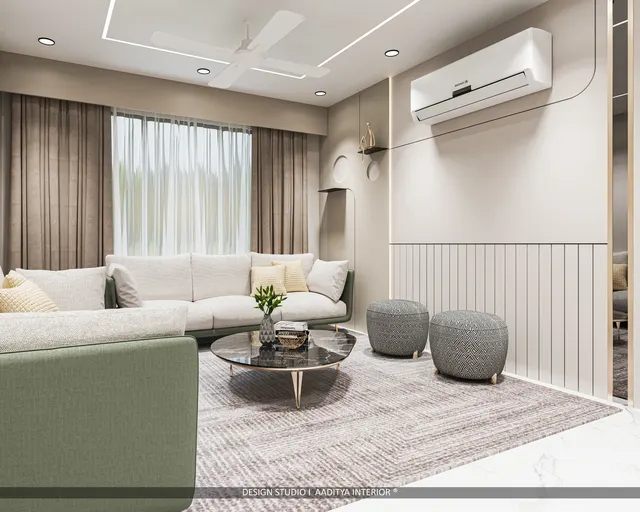
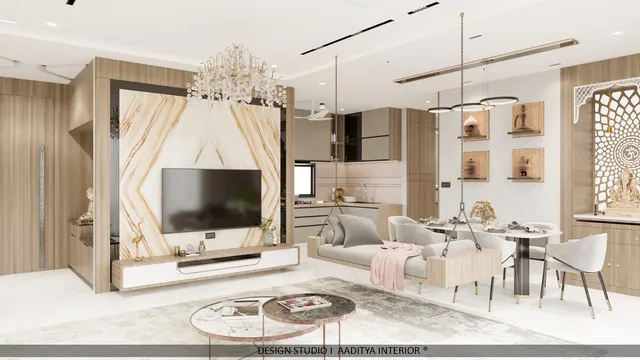
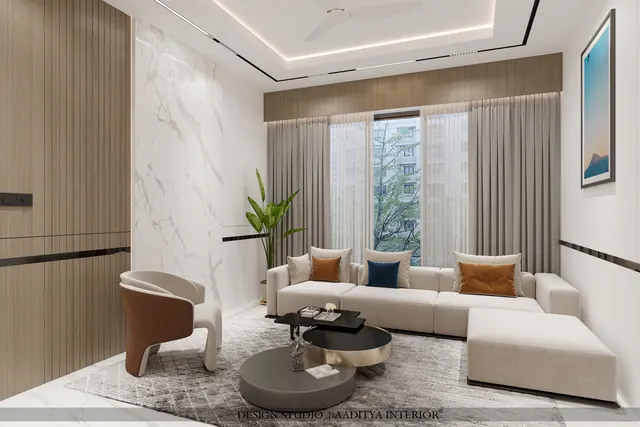
Light striking a wall straight on flattens it; light striking at a low, grazing angle exaggerates every bump. In Indian homes, grazing light comes from three common sources: a window in a side wall throwing morning or evening sun along the adjacent wall; cove lighting and LED profiles fixed close to a wall or ceiling; and wall washers and downlights set near a wall. The closer a light source is to the surface and the more parallel its beam, the more it reveals. A satin wall that looks perfect at noon can show every putty stroke at night under a cove light set 150 mm from it.
The practical rule is to decide sheen and lighting together. Walls that will be grazed by a cove, a wall-washer or a side window should normally stay matt or eggshell, unless the plaster and putty are of a very high standard. Feature walls painted in satin or gloss should be lit from further away, at a steeper angle. Ceilings should almost always be flat: downlights, fans and cove light all strike them at low angles, and any sheen on a ceiling reveals every board joint and patch.
Room by room: which sheen goes where
The table below summarises the choices Aaditya Interior typically recommends in Indian homes. It assumes a decent putty finish and normal residential use; very high-quality preparation widens the options, while rough walls push everything towards matt.
| Space or surface | Recommended sheen | Why | Watch out for |
|---|---|---|---|
| Ceilings | Flat or matt | Hides joints and patches; no glare from lights | Avoid sheen on gypsum ceilings with coves |
| Living and dining walls | Matt or eggshell | Calm, even colour; forgiving | Use washable matt near switches and sofas |
| Bedrooms | Matt or eggshell | Soft light, no glare at night | Headboard wall takes hand marks — washable grade |
| Children's rooms | Satin or washable matt | Wipes off crayon and hand marks | Satin shows putty flaws more |
| Kitchens (walls beyond tiles) | Satin | Resists grease and steam; wipeable | Keep paint off the hob zone; tile or glass there |
| Bathrooms and utility | Satin, anti-fungal grades | Moisture and mildew resistance | Ventilation matters more than any paint |
| Corridors, staircases, dados | Satin or semi-gloss | Heavy touch and scuffing | Consider a 900–1200 mm dado in a tougher finish |
| Doors, frames, windows (painted) | Satin or gloss enamel; PU on joinery | Hard, wipeable film | Gloss shows brush marks; satin looks more modern |
| Metal grills, gates, railings | Gloss or satin enamel over primer | Weather and corrosion resistance | Surface preparation and primer matter most |
| Exterior walls | Matt to low-sheen exterior emulsion | Hides plaster texture; weather resistant | Higher sheen shows plaster waves in raking sun |
Washability, cleaning and touch-ups
Washability is the reason most families consider a higher sheen. A satin or gloss film can usually be wiped with a damp cloth and mild soap without damage, while a traditional matt film may lose colour or develop shiny patches where it is rubbed. Premium washable matt emulsions now close much of this gap, which is why many designers use them in living rooms and bedrooms instead of moving to satin. Whatever the sheen, the cleaning method matters: a soft cloth or sponge, mild liquid soap, light pressure, a test in an inconspicuous corner first, and no abrasive powders, scouring pads or strong solvents.
Touch-ups are where sheen choice is most often regretted. Paint on a wall changes slightly with age, light and cleaning; a fresh patch of the same paint can look different even if the colour matches perfectly. On matt walls, this difference is usually invisible. On satin and gloss walls, the patch often shows as a slightly different shine, especially when seen at an angle. The safest approach on higher sheens is to repaint from corner to corner or edge to edge rather than patching, and to keep a labelled tin of the exact product, shade code and sheen for future repairs.
| Problem | What it looks like | Usual cause | Prevention or fix |
|---|---|---|---|
| Flashing | Patchy shine on a uniform wall | Uneven primer or putty absorption; touch-ups | Prime evenly; repaint the whole wall, not patches |
| Lap marks | Bands of different shine | Rolling into partly dried paint | Keep a wet edge; finish each wall in one go |
| Burnishing | Shiny patches on matt walls | Rubbing or scrubbing, furniture contact | Washable matt or satin in high-touch zones |
| Visible putty waves | Streaks under grazing light | Poor sanding with satin or gloss | Better preparation, lower sheen, or move the light |
| Brush marks on enamel | Ridges on doors and grills | Thick enamel, poor brush, quick drying in heat | Thin correctly; use a good brush or spray |
| Mildew on bathroom ceiling | Black spots | Poor ventilation, condensation | Exhaust fan; anti-fungal satin; clean before repainting |
Costs: what sheen does to the budget
In Indian painting work, the price depends mostly on the product tier and the surface preparation, not on the sheen within a tier. Within the same range, matt, soft-sheen and high-sheen versions are often priced similarly, though some high-sheen and specialty finishes carry a premium. The bigger cost effect of a higher sheen is indirect: better preparation, an extra sanding pass and more careful application. The rates below are indicative all-in October 2026 ranges per square foot of paintable area, with putty, primer and two coats where relevant, consistent with the painting cost articles on this site.
| Finish | Usual sheen options | Indicative all-in rate (₹ per sq ft) | Notes |
|---|---|---|---|
| Distemper | Flat only | ₹7–12 | Cheapest; not washable; shortest repaint cycle |
| Economy (plastic) emulsion | Mostly matt; some low sheen | ₹12–18 | Whole-house default |
| Premium / luxury emulsion | Matt, soft sheen, sheen, high sheen | ₹20–30 | Washable; better colour retention |
| Exterior weather-shield emulsion | Matt to low sheen; some sheen | ₹17–26 | Exterior walls; light colours reflect more heat |
| Enamel on metal grills, gates and railings | Satin or gloss | ₹18–35 | Includes rust removal and primer; per sq ft of painted surface |
| PU paint on joinery shutters | Matte to mirror gloss | ₹1,000–1,800 per sq ft of shutter | Factory or workshop finish, not site painting |
| Texture and designer finishes | Usually matt or low sheen | ₹40–150+ | Artisan pricing, set by design and skill |
A short history of sheen in Indian homes
Older Indian homes used limewash — whitewash — and later distemper on walls, both naturally flat, breathable and cheap enough to renew before festivals. Where durability was needed, oil-based paints were used: glossy oil-painted dados of about 1000–1200 mm in kitchens, bathrooms, staircases, hospitals and government buildings, and gloss enamel on doors, windows and grills. That is why many people still associate gloss with practicality and matt with economy.
From the 1980s and 1990s, water-based acrylic emulsions spread across Indian cities, first in matt and then in sheen and high-sheen versions marketed as luxury finishes. For a time, high-sheen walls were seen as premium. More recently, taste has swung back towards matt and eggshell walls, helped by washable matt technology and by the popularity of calm, earthy palettes and mineral finishes such as limewash. Enamels have also changed, with water-based and low-odour versions and PU finishes replacing traditional oil enamels in many interiors.
Where paint finishes are going
Three directions are visible. First, performance is moving into the matt end of the scale: scrubbable, stain-resistant matt emulsions mean that homeowners increasingly get the look of matt with much of the cleanability of satin. Second, health and environment: low-VOC and low-odour paints, water-based enamels and better labelling are spreading, which matters in bedrooms and in homes where families move back in soon after painting. Third, mineral and textured finishes — limewash, lime plaster, micro-cement and mineral paints — are bringing back naturally flat, slightly variable surfaces that hide imperfections by design. Gloss is not disappearing; it is becoming a deliberate accent on joinery, metalwork and the occasional lacquered feature wall rather than a default.
Rules for choosing a paint sheen
- Keep ceilings flat or matt, always.
- Use matt or eggshell on living, dining and bedroom walls; choose a washable matt grade near switches, sofas and headboards.
- Use satin in kitchens, bathrooms, children's rooms, corridors and staircases where walls are wiped often.
- Use satin or gloss enamel on doors, frames, grills and railings, over the correct primer.
- Decide sheen and lighting together; keep grazed walls matt or move the light further from the wall.
- The higher the sheen, the better the putty and sanding must be — check walls with a torch before priming.
- Approve colour in the actual sheen, on the wall, in day and night light.
- Change sheen only at a clear break line, and keep a labelled tin of each product, shade and sheen for touch-ups.
Frequently asked questions
Which paint finish is best for interior walls in India?
For most living rooms and bedrooms, a washable matt or eggshell premium emulsion is the best balance: it hides wall imperfections, looks calm and can be wiped gently. Use satin in kitchens, bathrooms and children's rooms, and keep ceilings flat.
What is the difference between eggshell and satin?
Eggshell has a faint, low glow; satin has a noticeable soft shine. Satin is more washable and moisture-resistant but shows wall defects and touch-ups more. Exact gloss levels vary between manufacturers, so compare the products' datasheets rather than their names.
Is matt paint washable?
Traditional matt paint is not very washable, but many premium matt emulsions are now formulated to be washable and stain-resistant. Clean them gently with a soft cloth and mild soap, and test in a hidden spot first. Scrubbing hard can create shiny patches on any matt finish.
Should I use gloss or matt paint on doors and grills?
Doors, frames and grills need a hard, wipeable film, so enamel in satin or gloss is usual. Gloss is the most weather-resistant on exterior metalwork; satin looks more modern on interior doors and frames and shows brush marks less. Good primer and surface preparation matter more than the sheen.
Why does my satin wall look patchy?
Patchy shine on a satin wall is usually flashing from uneven primer or putty absorption, lap marks from rolling into partly dried paint, or touch-ups that dried with a different sheen. The reliable fix is to repaint the whole wall from corner to corner after correcting the surface.
Does sheen change the colour of paint?
Yes. The same shade generally looks deeper and more saturated in a higher sheen and softer and slightly lighter in matt, and glossy walls reflect light sources as highlights. Approve colours with a sample patch in the actual sheen on the actual wall.
Sources & standards
- ISO 2813 — Paints and varnishes: Determination of gloss value at 20°, 60° and 85°
- ASTM D523 — Standard Test Method for Specular Gloss
- Bureau of Indian Standards — IS 15489 (plastic emulsion paint) and IS 2932 (synthetic enamel paint), specifications
- Bureau of Indian Standards — IS 2395 (Parts 1 and 2): Code of practice for painting concrete, masonry and plaster surfaces
- Bureau of Indian Standards — National Building Code of India 2016, Part 7 (Constructional Practices and Safety) and Part 8 (Building Services) — lighting
- Manufacturer technical datasheets for interior and exterior emulsions and enamels (gloss level, washability, coverage), described generically
- Price ranges: indicative October 2026 estimates — confirm locally before budgeting