A first-time homeowner in Patna usually asks one question: how much will the interior of a 3BHK cost? The answer the homeowner receives is usually a single number, and the number is usually wrong, because it hides the rooms. A 3BHK is not one interior; it is six interiors, and each one has its own cost. The kitchen costs more than a bedroom. The living room costs more than the study. The bathrooms cost more per square foot than any other room. A single number for the whole flat tells the homeowner nothing about where the money goes, and it gives no way to reduce the cost without reducing the whole house. A room-wise breakdown is the only budget that a first-time homeowner can actually use.
Patna has its own conditions. The city is hot and humid for much of the year, and the dust in the dry season is heavy, so the materials need to survive both the moisture and the dust. The new flats along Bailey Road, Boring Road, Danapur and the bypass are often 1,100 to 1,300 sq ft for a 3BHK, with a living room, three bedrooms, a kitchen and two bathrooms, and the ceiling height is usually 3,000 mm. The water in several localities is hard, which affects the bathroom fittings and the kitchen. The labour and the material rates in Patna are lower than in the larger metros, but the choice of brands is narrower, and a designer product may need to be ordered from outside the city. These are the conditions that shape the costs in this article.
This article gives the room-wise cost of a 3BHK interior in Patna in October 2026, for a first-time homeowner. It covers the kitchen, the living and dining room, the three bedrooms, the bathrooms, the false ceiling, the painting and the loose furniture, with a basic, a mid-range and a premium figure for each room. It explains where the money goes, which rooms deserve the best money and which can be done simply, and it ends with a checklist that a homeowner can use to get a quotation that can be compared. All prices are indicative October 2026 estimates and must be confirmed locally before budgeting.
The total cost first: three budgets for a 3BHK
For a 3BHK flat of about 1,100 to 1,300 sq ft in Patna, the interior typically costs about ₹5 lakh to ₹8 lakh for a basic finish, about ₹8 lakh to ₹16 lakh for a mid-range finish, and about ₹16 lakh to ₹25 lakh for a premium finish, in October 2026. The basic finish uses laminate wardrobes, a granite kitchen platform with a few cabinets, standard vitrified flooring where the builder has not provided it, emulsion paint and standard fittings. The mid-range finish adds a modular kitchen carcass, designer tiles in the bathrooms, a false ceiling in the living room and the bedrooms, and better hardware. The premium finish adds a full modular kitchen with a quartz counter, veneer or PU wardrobes, designer sanitary ware, a false ceiling throughout and home automation points.
The per-square-foot rate is a useful check: the basic interior costs about ₹450 to ₹700 per sq ft of carpet area, the mid-range about ₹700 to ₹1,300 per sq ft, and the premium about ₹1,300 to ₹2,000 per sq ft. These rates are for the interior only, and they exclude the loose furniture, the appliances and the soft furnishings, which are usually bought separately. A homeowner who is quoted a single rate should ask what it includes: the kitchen, the wardrobes, the false ceiling, the painting, the electrical work and the bathroom fittings are the items that decide whether the rate is complete. A rate that excludes the kitchen is not a rate for a 3BHK interior; it is a rate for the rest of the flat.
The budget should be set room by room, not as a single number. The kitchen takes about a quarter to a third of the total, the living and dining room takes about a fifth, the three bedrooms together take about a third, and the bathrooms take about a tenth. A homeowner who sets a budget for each room can reduce the cost in one room without reducing the whole house, and can spend more in the room that matters most. The kitchen is the room that matters most in most Indian homes, because it is used every day by the whole family, and it is the room where the extra money is felt. The study or the third bedroom, which may be used only occasionally, is the room where the money can be saved.
| Budget tier | Total for 1,100–1,300 sq ft | Per sq ft | What it includes |
|---|---|---|---|
| Basic | ₹5,00,000–8,00,000 | ₹450–700 | Laminate wardrobes, granite kitchen, emulsion |
| Mid-range | ₹8,00,000–16,00,000 | ₹700–1,300 | Modular kitchen, designer baths, ceilings |
| Premium | ₹16,00,000–25,00,000 | ₹1,300–2,000 | Quartz kitchen, veneer, designer fittings |
| Loose furniture | ₹2,00,000–5,00,000 | Separate | Beds, sofa, dining, tables |
| Appliances | ₹1,50,000–3,50,000 | Separate | Fridge, washing machine, AC, TV |
The kitchen: the largest single room cost
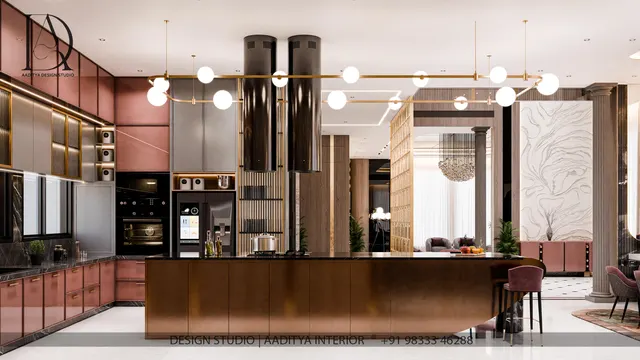
The kitchen is the largest single room cost in a 3BHK interior, and it is the room where the specification matters most. A basic kitchen with a granite platform, a sink, a hob and a chimney, and a few wall cabinets, costs about ₹1,50,000 to ₹2,70,000. A mid-range modular kitchen with a BWR plywood carcass, laminate shutters, a granite or quartz counter and designer hardware costs about ₹2,25,000 to ₹4,55,000. A premium kitchen with a quartz counter at about ₹250 to ₹425 per sq ft, tall units, a pantry, a built-in hob and chimney, and soft-close hardware costs about ₹4,00,000 to ₹8,00,000. The carcass in BWR plywood with laminate shutters costs about ₹1,340 to ₹1,800 per sq ft of cabinetry, and the premium difference comes from the shutters, the hardware, the counter and the appliances.
The kitchen layout decides the cost as much as the materials. A straight kitchen is the cheapest, an L-shaped kitchen costs more because it has a corner unit, and a U-shaped kitchen costs the most because it has the most cabinetry. The counter height should be 850 to 900 mm, the wall units should sit 600 mm above the counter, and the tall units should run to 2,100 mm. The sink should be under the window where possible, the hob should have a chimney above it, and the refrigerator should be near the entrance so that it can be reached without crossing the cooking area. The electrical points should be planned for the chimney, the hob, the microwave, the refrigerator, the water purifier and the mixer, because a point added later means chasing the wall and repainting the kitchen.
The kitchen in Patna needs two local considerations. The first is the water: hard water leaves deposits on the sink, the tap and the purifier, and a filter or a softener protects the fittings. The second is the heat and the humidity: the kitchen should have a chimney that vents outside, not a recirculating filter, and the cabinets should be in BWR plywood, not MDF, because MDF swells in moisture. The flooring should be a vitrified tile that is easy to clean, and the wall should have a dado of tiles up to 600 mm above the counter. A kitchen that is planned for the way an Indian family cooks, with a pressure cooker, a mixer, a wet grinder and a large stock of containers, needs more storage than a kitchen designed from a catalogue, and the storage should be planned by the family, not by the showroom.
| Kitchen item | Basic | Mid-range | Premium |
|---|---|---|---|
| Carcass + shutters | ₹1,50,000–2,00,000 | ₹2,25,000–3,50,000 | ₹4,00,000–6,00,000 |
| Counter | Granite | Granite / quartz | Quartz ₹250–425 per sq ft |
| Hardware | Standard hinges | Soft-close, tandem | Designer, soft-close |
| Sink + tap | ₹8,000–15,000 | ₹15,000–30,000 | ₹30,000–60,000 |
| Chimney + hob | ₹20,000–35,000 | ₹35,000–60,000 | ₹60,000–1,20,000 |
| Electrical points | 6–8 points | 10–12 points | 14+ points, automation |
The living and dining room
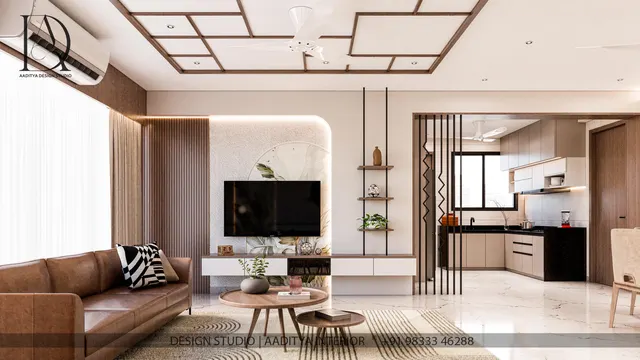
The living and dining room is the room that sets the impression of the flat, and it is the room where the false ceiling, the lighting and the furniture matter most. A basic living room with emulsion paint, a simple false ceiling and a sofa costs about ₹1,00,000 to ₹2,00,000 for the interior work, excluding the loose furniture. A mid-range living room with a designer false ceiling, cove lighting, a TV unit and a crockery unit costs about ₹2,00,000 to ₹4,00,000. A premium living room with a full false ceiling, designer lighting, a veneer TV unit and a designer crockery unit costs about ₹4,00,000 to ₹7,00,000. The false ceiling in gypsum costs about ₹80 to ₹180 per sq ft, and the TV unit in BWR plywood with laminate costs about ₹1,340 to ₹1,800 per sq ft of cabinetry.
The dining area needs a table for six, a crockery unit and a light above the table. A dining table for six needs about 1,800 mm by 900 mm of table and 750 mm of clearance on each side for the chairs, so the dining zone needs about 3,300 mm by 2,400 mm. The crockery unit should be near the kitchen, so that the plates and the glasses are carried a short distance, and the light above the table should be a warm pendant at about 750 mm above the table. The living room should have a point for the television, a point for the set-top box, and a point for the Wi-Fi router, and the wiring should be hidden in the TV unit. The sofa should face the television and the balcony, and the room should have a curtain track that is fixed before the painting, so that the curtains can be hung without drilling into the fresh paint.
The living room in Patna needs shade and air. The balcony should have a curtain or a blind that can be drawn in the afternoon, and the living room should have a ceiling fan and a provision for an air conditioner. The flooring is usually provided by the builder, and the interior budget should not include it unless the flooring is being changed. The painting costs about ₹20 to ₹30 per sq ft for emulsion with putty, and a feature wall with a texture or a wallpaper costs two to four times as much. A single feature wall behind the television or the sofa gives the premium feel at a fraction of the cost of finishing every wall, and it is the most practical way to spend the money in the living room.
The three bedrooms: master, second and third
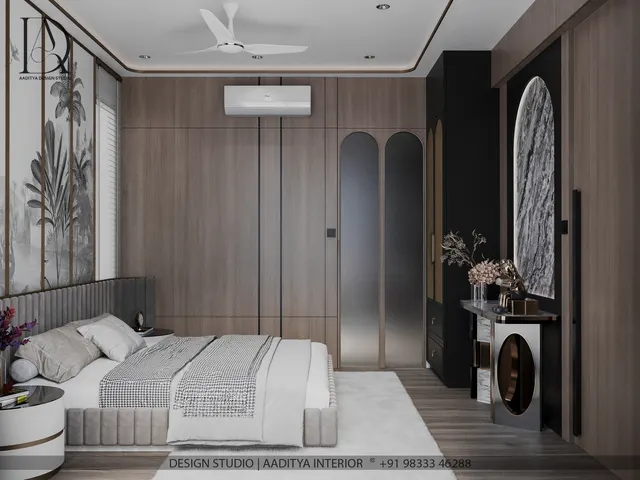
The master bedroom is the most expensive bedroom, because it has the largest wardrobe, the largest bed and often an attached bathroom. A basic master bedroom with a laminate wardrobe, a bed and a side table costs about ₹1,00,000 to ₹1,50,000 for the interior work, excluding the bed and the mattress. A mid-range master bedroom with a sliding wardrobe, a dressing unit and a false ceiling costs about ₹1,50,000 to ₹3,00,000. A premium master bedroom with a veneer wardrobe, a designer dressing unit and a full false ceiling costs about ₹3,00,000 to ₹5,00,000. The wardrobe in laminate costs about ₹1,340 to ₹1,800 per sq ft of cabinetry, and the premium difference comes from the shutters, the hardware and the internal fittings.
The second bedroom is usually the children's room or the parents' room, and it needs a wardrobe, a bed, a study table and a bookshelf. A basic second bedroom costs about ₹75,000 to ₹1,25,000 for the interior work, a mid-range second bedroom costs about ₹1,00,000 to ₹2,00,000, and a premium second bedroom costs about ₹2,00,000 to ₹3,50,000. The study table should be near the window, with a light above it and a point for a laptop, and the bookshelf should be within reach of the table. The third bedroom is often a guest room or a study, and it is the room where the money can be saved: a basic third bedroom with a simple wardrobe and a bed costs about ₹60,000 to ₹1,00,000, a mid-range third bedroom costs about ₹90,000 to ₹1,80,000, and a premium third bedroom costs about ₹1,80,000 to ₹3,00,000.
The bedroom sizes decide the furniture. A queen bed is 1,500 mm by 2,000 mm and needs 750 mm of clearance on three sides, so a bedroom needs at least 3,000 mm by 3,600 mm for a queen bed and a wardrobe. A king bed is 1,800 mm by 2,000 mm and needs a larger room. The wardrobe should be 600 mm deep, with a hanging height of 1,200 mm for shirts and 1,500 mm for long clothes, and a loft above 2,100 mm for storage. The dressing unit should have a mirror at eye level, a light on both sides of the mirror, and a stool that can be pushed under the table. The bedrooms should have a blackout curtain for the afternoon sleep, and a point for the air conditioner, the fan and the charging of phones.
| Room | Basic | Mid-range | Premium |
|---|---|---|---|
| Master bedroom | ₹1,00,000–1,50,000 | ₹1,50,000–3,00,000 | ₹3,00,000–5,00,000 |
| Second bedroom | ₹75,000–1,25,000 | ₹1,00,000–2,00,000 | ₹2,00,000–3,50,000 |
| Third bedroom / study | ₹60,000–1,00,000 | ₹90,000–1,80,000 | ₹1,80,000–3,00,000 |
| Living + dining | ₹1,00,000–2,00,000 | ₹2,00,000–4,00,000 | ₹4,00,000–7,00,000 |
| Kitchen | ₹1,50,000–2,70,000 | ₹2,25,000–4,55,000 | ₹4,00,000–8,00,000 |
| Bathrooms (2) | ₹60,000–1,20,000 | ₹1,20,000–2,50,000 | ₹2,50,000–4,50,000 |
Bathrooms, ceilings, paint and electrical work
The two bathrooms in a 3BHK are small rooms with a high cost per square foot, because they have tiling, waterproofing, plumbing and fittings. A basic bathroom with standard sanitary ware and a mixer costs about ₹30,000 to ₹60,000 for the fittings and the tiling, a mid-range bathroom costs about ₹60,000 to ₹1,25,000, and a premium bathroom costs about ₹1,25,000 to ₹2,25,000. The waterproofing, at about ₹45 to ₹80 per sq ft, should be specified with the product name and the number of coats, because a single thin coat is not waterproofing. The tiles should be anti-skid on the floor and glazed on the wall, and the dado should run to 2,100 mm. The mirror should have a light above it, and the exhaust fan should vent outside, not into the false ceiling.
The false ceiling and the painting are the two items that cover the whole flat, and they are priced by the square foot. A gypsum false ceiling costs about ₹80 to ₹180 per sq ft, and a 3BHK flat with a ceiling in the living room and the three bedrooms spends about ₹1,00,000 to ₹2,50,000 on the ceiling, depending on the design. The painting costs about ₹20 to ₹30 per sq ft for emulsion with putty, and the whole flat costs about ₹50,000 to ₹1,00,000 for the painting, depending on the area and the finish. The electrical work, including the wiring, the switches and the points, costs about ₹1,200 to ₹2,500 per point, and a 3BHK flat typically has 60 to 80 points, so the electrical work costs about ₹1,00,000 to ₹2,00,000. These three items together are about a fifth of the total interior cost, and they should be quoted by the square foot or by the point, not as a lump sum.
The electrical plan should be made before the painting, because the points decide where the switches, the sockets and the lights go. The living room needs a point for the television, the set-top box, the Wi-Fi router and the air conditioner. Each bedroom needs a point for the air conditioner, the fan, the charging of phones and the study table. The kitchen needs a point for every appliance. The bathrooms need a point for the geyser and the exhaust fan. A point added after the painting means chasing the wall, patching the plaster and repainting the patch, and the patch is always visible. A homeowner who spends an afternoon on the electrical plan saves a week of rework and a repaint.
| Whole-flat item | Unit rate | Typical quantity | Typical cost |
|---|---|---|---|
| False ceiling, gypsum | ₹80–180 per sq ft | 800–1,100 sq ft | ₹1,00,000–2,50,000 |
| Painting, emulsion | ₹20–30 per sq ft | 2,500–3,500 sq ft | ₹50,000–1,00,000 |
| Electrical points | ₹1,200–2,500 per point | 60–80 points | ₹1,00,000–2,00,000 |
| Bathroom waterproofing | ₹45–80 per sq ft | 150–250 sq ft | ₹15,000–35,000 |
| Curtains + blinds | ₹150–300 per rft | 150–250 rft | ₹40,000–90,000 |
| Cleaning + handover | Lump sum | Whole flat | ₹15,000–30,000 |
Furniture, appliances and the move-in budget
The loose furniture and the appliances are usually bought separately from the interior work, and they need their own budget. The loose furniture for a 3BHK, including a sofa, a dining table with six chairs, three beds with mattresses, side tables, a study table and a TV unit if it is not built in, costs about ₹2,00,000 to ₹5,00,000, depending on the brand and the material. A good sofa costs about ₹40,000 to ₹1,20,000, a dining table with six chairs costs about ₹35,000 to ₹90,000, and a queen bed with a mattress costs about ₹35,000 to ₹80,000. The appliances, including a refrigerator, a washing machine, three air conditioners, a television and a microwave, cost about ₹1,50,000 to ₹3,50,000. The soft furnishings, including the curtains, the cushions, the bed linen and the rugs, cost about ₹50,000 to ₹1,50,000.
The move-in budget is the part that first-time homeowners forget. The flat needs curtains on every window, a gas connection, a water purifier, a shoe rack, a dustbin, a cleaning kit and a few tools, and these small items add up to ₹50,000 to ₹1,00,000. The society charges, the maintenance deposit and the moving cost add more. A homeowner who budgets only for the interior work and the furniture will be short by a lakh or two at the move-in, and the shortfall always appears in the last week, when there is no time to negotiate. A contingency of 10 per cent on the total budget is the practical way to handle it, and the contingency should be kept aside, not spent on the first upgrade.
The order of buying matters. The furniture that is built in, such as the kitchen, the wardrobes and the TV unit, should be ordered first, because it is made to order and takes four to six weeks. The loose furniture should be bought after the built-in work is finished, so that the sizes can be checked against the actual rooms. The appliances should be bought last, so that they are not damaged during the work, and the air conditioners should be installed after the painting, so that the indoor unit is not covered in dust. A homeowner who buys the sofa before the living room is painted will find that the sofa is the wrong size or the wrong colour, and a homeowner who buys the refrigerator before the kitchen is finished will find that it does not fit through the door.
Timeline and the order of work
A 3BHK interior in Patna typically takes ten to fourteen weeks, and the order of work is the same for every flat. The design and the quotation take one to two weeks, the civil work, including the demolition, the plumbing and the electrical chasing, takes two weeks, the electrical wiring and the false ceiling take two weeks, the furniture is made off-site while the civil work runs, and the installation of the furniture, the painting and the fittings take three to four weeks. The cleaning and the handover take a week. The furniture is the longest item, and it should be ordered at the start, so that it is ready when the site is ready for installation. A delay in ordering the furniture is the most common cause of a delay in the handover.
The payment schedule should follow the work. A fair pattern is 10 per cent on signing, 20 per cent on completion of the civil work, 30 per cent on delivery of the furniture to the site, 20 per cent on completion of the installation, 10 per cent on completion of the painting and the fittings, and the final 10 per cent on handover after the snag list is cleared. The snag list is the list of small defects found at handover, such as a shutter that does not close, a light that does not work or a patch of paint that is uneven, and the final payment should not be released until the list is cleared. A retention of 5 per cent for three months after handover is a reasonable protection against defects that appear only after the flat is occupied.
The agreement should state the specification, the brands, the timeline, the payment stages and the defect liability period, and it should be signed before the advance is paid. The measurement of the furniture should be by the square foot of the shutter area or by the running foot, and the method should be written down before the work begins. The most common dispute in a flat interior is about the measurement of the wardrobe: the contractor measures the shutter area and the homeowner expects the carcass area, and the difference is the price of a wardrobe. A written measurement method, a written specification and a written payment schedule are worth more than a low rate, because they are the only record that matters if there is a dispute.
| Week | Work | What the homeowner should check | Payment |
|---|---|---|---|
| 1–2 | Design + quotation | Drawings, spec, brands | 10% on signing |
| 3–4 | Civil + plumbing | Chasing, pipes, waterproofing | 20% civil complete |
| 5–6 | Electrical + ceiling | Points, wiring, ceiling level | Part of 30% stage |
| 7–8 | Furniture installation | Shutters, alignment, hardware | 30% on delivery |
| 9–10 | Painting + fittings | Finish, lights, fittings | 20% installation |
| 11–12 | Cleaning + handover | Snag list cleared | 10% on handover |
Where Patna 3BHK costs are heading
Interior costs in Patna have risen steadily, driven by the price of plywood, hardware and labour, and by the demand for modular kitchens and designer finishes. The trend is unlikely to reverse, because the city is growing and the demand for good interiors is strong. The more useful question for a first-time homeowner is which parts of the interior deserve the best money and which can be done simply. The kitchen, the wardrobes and the waterproofing are the parts that are expensive to change, and they deserve the best quality the budget allows. The paint, the curtains and the loose furniture are the parts that can be upgraded later without breaking the walls, and they can be chosen at a mid-range level now.
Two changes are already visible in Patna. The first is the wider use of BWR plywood and branded hardware, which last longer in the humidity and the dust than the cheaper alternatives. The second is the growing demand for modular kitchens and for wardrobes with internal fittings, which use the space better than a simple shutter. A homeowner who asks the designer about the plywood grade, the hardware brand and the waterproofing is asking the questions that decide the life of the interior. The room-wise budget is the tool that keeps those answers in the plan, and a homeowner who uses it will find that the interior costs what it should, and that the flat is ready to live in on the day it is handed over.
Rules for budgeting a 3BHK interior in Patna
- Set the budget room by room, not as a single number, and decide for each room whether it is basic, mid-range or premium.
- Spend the best money on the kitchen, the wardrobes and the bathroom waterproofing, because they are expensive to change.
- Ask for a room-wise quotation with the specification and the brands named, and compare two quotations on the same basis.
- Order the built-in furniture at the start, because it takes four to six weeks to make, and buy the loose furniture after the rooms are finished.
- Plan the electrical points before the painting, with a point for every appliance in the kitchen and the bedrooms.
- Keep a contingency of 10 per cent aside for the move-in items, the society charges and the small extras.
- Pay by completed stage, keep the final 10 per cent for handover, and hold 5 per cent retention for three months.
- Write the measurement method for the furniture into the agreement, so that the wardrobe is measured the same way by both sides.
Frequently asked questions
What is the 3BHK interior cost in Patna in 2026?
A 3BHK interior in Patna typically costs about ₹5 lakh to ₹8 lakh for a basic finish, about ₹8 lakh to ₹16 lakh for mid-range, and about ₹16 lakh to ₹25 lakh for premium, in October 2026, for a flat of about 1,100 to 1,300 sq ft. The cost excludes the loose furniture and the appliances, which add about ₹2 lakh to ₹5 lakh and ₹1,50,000 to ₹3,50,000 respectively. The rate should be confirmed locally before budgeting.
How much does a modular kitchen cost in a 3BHK in Patna?
A basic kitchen with a granite platform and a few cabinets costs about ₹1,50,000 to ₹2,70,000. A mid-range modular kitchen with a BWR plywood carcass and laminate shutters costs about ₹2,25,000 to ₹4,55,000. A premium kitchen with a quartz counter, tall units and designer hardware costs about ₹4,00,000 to ₹8,00,000. The carcass costs about ₹1,340 to ₹1,800 per sq ft of cabinetry, and the counter costs about ₹250 to ₹425 per sq ft for quartz.
What is the interior cost per sq ft for a 3BHK in Patna?
The interior costs about ₹450 to ₹700 per sq ft for a basic finish, about ₹700 to ₹1,300 per sq ft for mid-range, and about ₹1,300 to ₹2,000 per sq ft for premium, per sq ft of carpet area, in October 2026. The rate is for the interior work only, and it excludes the loose furniture, the appliances and the soft furnishings. A quotation should state what it includes, because a rate that excludes the kitchen is not a rate for a 3BHK interior.
How long does a 3BHK interior take in Patna?
A 3BHK interior typically takes ten to fourteen weeks, including the design, the civil work, the electrical work, the false ceiling, the furniture installation, the painting and the handover. The furniture is made off-site while the civil work runs, and it should be ordered at the start, because it takes four to six weeks to make. A delay in ordering the furniture is the most common cause of a delay in the handover.
Should the wardrobe be laminate or veneer in a Patna flat?
Laminate is the practical choice for most bedrooms in Patna, because it is durable, easy to clean and costs about ₹1,340 to ₹1,800 per sq ft of cabinetry. Veneer or PU finish looks richer but costs more and needs more care in the humidity and the dust. A good approach is to use laminate in the children's and guest bedrooms, and veneer or a designer finish in the master bedroom, where the wardrobe is seen every day.
Sources & standards
- National Building Code of India 2016 (SP 7), Part 3 — Development Control Rules and General Building Requirements; Part 8 — Building Services
- BIS IS 456:2000 — Plain and Reinforced Concrete: Code of Practice
- BIS IS 1200 (Parts 1–18) — Method of Measurement of Building and Civil Engineering Works
- Neufert, Architects' Data, 4th edition — standard dimensions, clearances and room sizes
- Time-Saver Standards for Architectural Design Data — residential planning and services data
- Energy Conservation Building Code (ECBC) 2017 and BEE guidelines for efficient homes
- IGBC Green Homes Rating and GRIHA guidelines for resource-efficient residential construction
- Price ranges: indicative October 2026 estimates — confirm locally before budgeting