A frameless glass balustrade and a painted mild-steel railing can climb the same flight of stairs — and sit five to eight times apart on the quotation, rupee for rupee of the same length. That single fact is why railing is the most argued-over line on a staircase estimate. The structure is fixed by the civil work, the tread cladding is chosen once, but the railing is where the look, the safety and the budget collide, and where a client can swing the cost of a whole staircase by picking a material.
The confusion is made worse by how railing is quoted. Some fabricators price per running foot of railing length, some per square foot of railing face, some per piece for the glass and separately for the handrail. A quotation of "₹1,200" means nothing until it says ₹1,200 for what — a bare stainless tube, or a tube with glass infill, a timber cap and installation. This article fixes the units, prices the four common materials the way fabricators in Surat and other Indian cities actually bill them, and then takes one glass balustrade apart line by line so the total can be checked rather than trusted.
The four materials, priced the way fabricators bill them
Railing is sold by the running foot of its length, measured along the slope of the flight and along the edge of every landing and floor opening. The rate bundles the uprights, the infill (bars, mesh or glass), the top handrail, the fixing into the slab or stringer, polishing or painting, and installation. The bands below are indicative October 2026 figures for metro and tier-2 cities; they move with design complexity, the quality of the stainless or glass, and the number of curves and landings. A straight flight is cheap to fabricate; a curved or spiral railing can add 30–60 per cent for the same material.
| Railing material | Indicative installed cost (₹ per running ft) | How it reads | Watch out for |
|---|---|---|---|
| Mild steel (MS), powder-coated, vertical bars | ₹900–2,000 | Simple, sturdy, budget | Needs repainting; rust if the coating fails |
| Forged / wrought-iron decorative panels | ₹1,200–3,500 | Ornamental, traditional | Weight; dusting between scrolls |
| Stainless steel (SS 304) tube with verticals | ₹1,500–3,500 | Clean, low maintenance | Use vertical infill, not climbable horizontals |
| Wood — timber handrail on a metal frame | ₹2,500–4,500 | Warm top rail, metal strength | Handrail needs periodic polish |
| Wood — full hardwood balustrade (teak/sal) | ₹3,500–8,000 | Rich, classic, heavy | Cost of seasoned timber; joints can loosen |
| Glass — toughened/laminated, framed or clamped | ₹3,000–7,000+ | Light, see-through, premium | Safety glass only; spigots must be engineered |
Two of these bands deserve a word. Stainless steel is quoted for SS 304; the cheaper SS 202 looks identical on day one but pits and tea-stains within a couple of years in humid Surat air, so the grade must be written on the order, not assumed. And glass spans the widest band because "glass railing" covers two very different things: a toughened glass panel held in a slim top-and-bottom frame or clamps, which sits at the lower end, and a frameless structural balustrade on stainless spigots or a base channel, which carries most of the load in the glass itself and sits at the top. The frameless look is the expensive one.
A glass balustrade, line by line
Glass draws the most questions because its rate looks high until it is unpacked. The table below builds up the installed cost of one running foot of a mid-specification clamped balustrade — a 12 mm toughened glass panel about one metre high, held on stainless steel spigots, capped with a slim handrail. Every line is a real cost a fabricator carries, and the lines add to the total, so a quotation can be checked against it rather than accepted on faith.
| Component (per running foot of balustrade) | Low | High |
|---|---|---|
| 12 mm toughened glass panel, cut and edge-polished | ₹1,400 | ₹2,400 |
| Stainless spigots / clamps and base fixing | ₹900 | ₹1,800 |
| Top handrail / capping (SS or timber) | ₹700 | ₹1,500 |
| Fabrication, hardware, polishing, installation | ₹500 | ₹800 |
| Installed total, per running foot | ₹3,500 | ₹6,500 |
Read the swing in each line. Laminated glass instead of plain toughened — the right choice beside a stairwell drop, because a laminated panel holds together even when it breaks — lifts the glass line and pushes the total towards and past the top of the band. A frameless detail with a continuous base channel set into the floor, instead of individual spigots, adds concealed structure and alignment labour and takes the installed cost above ₹7,000 per running foot. Curves, a bull-nosed timber handrail, or PVD gold or black on the stainless all add further. The lower end of the band is a framed panel in a visible top-and-bottom track, which hides the glass edges and forgives small alignment errors.
How much railing does a staircase actually need?
A material rate is only half the bill; the other half is length. Measure the railing along the slope of each flight, then add the guard along every landing and along the edge of the floor opening at the top, where most people forget to measure. A typical internal duplex stair of two flights with a mid-landing carries roughly 16–24 running feet of railing once the landing and the first-floor void edge are counted. An open, double-height stair with a long gallery guard above can easily reach 30–40 running feet, which is why the same material costs far more in an open-plan home than in a tight dog-leg.
| Stair situation | Approx. railing length | MS | SS 304 | Glass |
|---|---|---|---|---|
| Compact dog-leg duplex stair | 16–20 running ft | ₹14,000–40,000 | ₹24,000–70,000 | ₹48,000–1,40,000 |
| Stair with a longer first-floor gallery guard | 26–34 running ft | ₹23,000–68,000 | ₹39,000–1,19,000 | ₹78,000–2,38,000+ |
| Short straight flight, one short guard | 10–14 running ft | ₹9,000–28,000 | ₹15,000–49,000 | ₹30,000–98,000 |
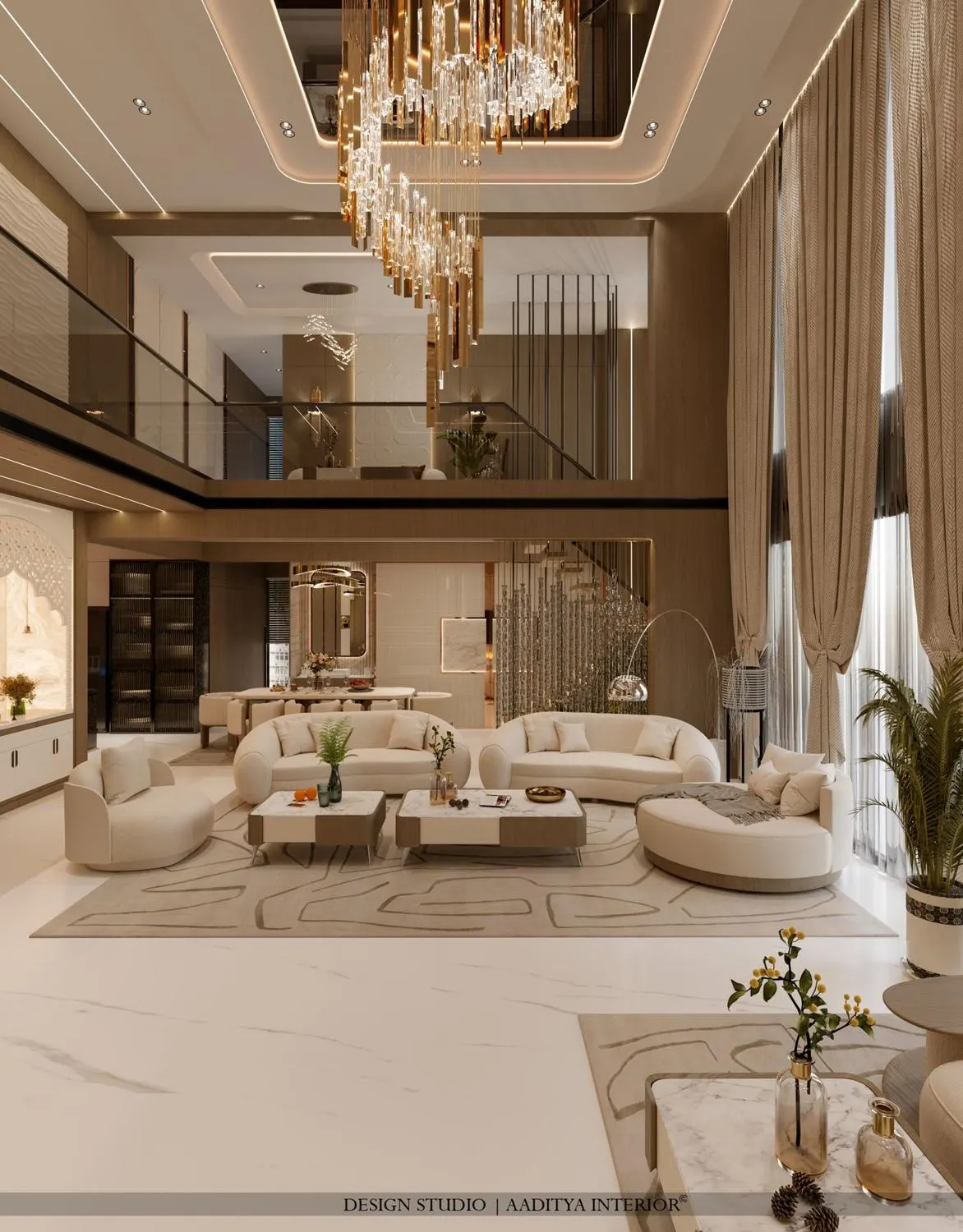
The photograph shows why length matters as much as material. The glass guard does not just run up the flight; it wraps the whole first-floor gallery above the living room. That continuous run, not the per-foot rate, is what turns a glass railing into a large line on a double-height home's budget — and why a client comparing quotations must compare the measured length as carefully as the material and the glass grade.
What pushes the price up
- Frameless vs framed: a structural frameless balustrade costs far more than a panel in a visible top-and-bottom track.
- Glass grade: laminated safety glass costs more than plain toughened, and is the right choice beside any open drop.
- Stainless grade and finish: SS 304 over SS 202, and PVD gold or black over a plain satin finish, both add cost.
- Curves and spirals: a curved railing can add 30–60 per cent over a straight run in the same material.
- Length you forgot: the landing guard and the first-floor void edge are real running feet that quotations often miss.
- Timber species: a seasoned teak balustrade costs several times a painted-MDF or engineered handrail.
- Site vs factory finish: powder coating and PVD are factory processes; on-site painting is cheaper but wears faster.
How to save without cutting safety
Railing is one of the few staircase lines where the cheapest option can also be the safest, so saving here is about design intelligence, not corner-cutting. The rules below trim the bill while keeping the guard height, the infill gap and the fixing that the railing exists to provide.
- Keep the design straight and the runs modular; save curves and spirals for where they are truly seen.
- Mix materials: an MS or SS frame with a glass or vertical-bar infill costs less than a full frameless balustrade and looks premium.
- Choose a framed glass panel over a frameless one where the drop is modest; it hides the edges and forgives alignment.
- Specify SS 304, written on the order, rather than paying later to replace stained SS 202.
- Measure the real length before approving a rate, so the per-foot number is compared against the same scope.
- Never save on the fixing or the glass grade — anchor into the RCC slab and use safety glass; a failed railing is not a cosmetic fault.
Frequently asked questions
Which staircase railing is cheapest?
Powder-coated mild steel with vertical bars is the cheapest, at about ₹900–2,000 per running foot installed in October 2026. It is sturdy and safe if the height and infill gaps are right; its only real cost is a repaint every few years to keep rust out of the pipes.
Is a glass railing worth the extra money?
For an open, double-height stair where the view and the sense of space are the point, yes — glass keeps sightlines open where a solid railing would close them. For a tight internal stair that few people see, the money is usually better spent on the tread cladding. A good middle path is a framed glass panel or a metal frame with glass infill, which gives most of the look for less than a frameless balustrade.
How is railing measured — per foot or per square foot?
Most Indian fabricators quote railing per running foot of its length, measured along the slope and along every landing and floor-opening edge. Some quote glass separately per square foot and the handrail per running foot. Always confirm which, and confirm whether the rate includes the glass, the handrail, the fixing and installation, before comparing two quotations.
Does a curved or spiral railing cost more?
Yes. Curving the handrail, the glass or the metal needs templates, more skilled fabrication and more site fitting, and typically adds 30–60 per cent over a straight run in the same material. Spiral stairs and helical glass balustrades sit well above the bands quoted here and should be priced individually.
Sources & standards
- Bureau of Indian Standards — IS 2062 (structural steel), IS 6911 (stainless steel), IS 2553 (safety glass), IS 14900 (transparent float glass)
- National Building Code of India 2016, Part 4 (fire and life safety) and Part 3 — guard and handrail heights and baluster spacing for stairs and landings
- This site's guides to staircase design, balcony railing height and glass types for partitions and balustrades
- Manufacturer system data for stainless spigots, base channels and structural glass balustrades — follow the tested fixing detail
- Price ranges: indicative October 2026 estimates for finished, installed railing — confirm with a local fabricator before budgeting