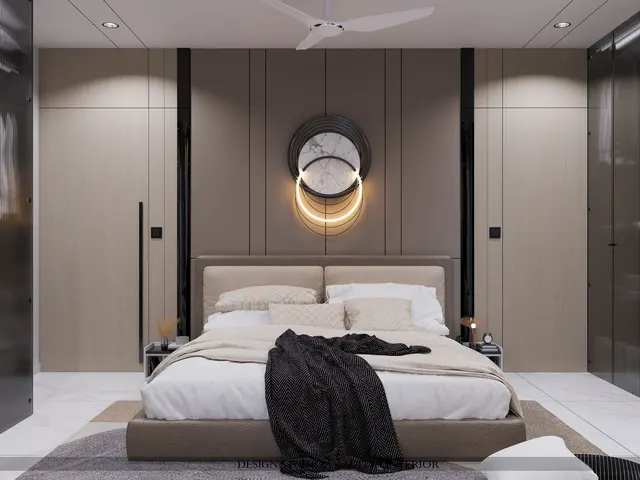
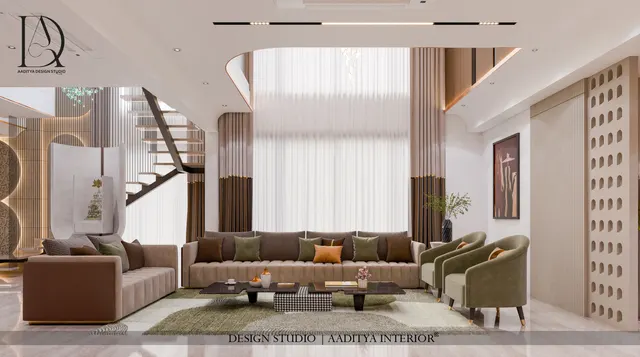
A stretch ceiling solves a problem gypsum and POP struggle with: a perfectly flat, perfectly smooth, perfectly seamless ceiling that goes up in a day, with almost no dust, and can glow with light from within. It is a thin membrane — usually PVC, sometimes a woven polyester fabric — cut to the exact size of the room in a factory, then stretched and clipped into a track fixed around the perimeter so that it sits taut and dead level below the structural ceiling. The best-known name, Barrisol, has become shorthand for the whole category in the way that a few brand names do, but the system is made by many manufacturers.
In Indian homes and shops the stretch ceiling is still unfamiliar enough that it is often either over-sold or misunderstood. Some buyers expect it to be a cheap alternative to gypsum and are surprised by the price; others expect a site carpenter to make it and are surprised that it arrives as a precision-cut sheet from a workshop. Its real strengths are specific — a flawless flat or glossy surface, a translucent sheet that turns an entire ceiling into a soft light, a printed sky over a child's room, and a very shallow build-up where height is tight — and its weaknesses are specific too. Knowing both is what keeps it from being the wrong choice beautifully executed.
This article explains where the stretch ceiling came from, how the membrane and track actually work, the finishes available, how a translucent backlit ceiling is built, what it costs in India, and how it compares with a gypsum ceiling. It treats it as the specialist, factory-made system it is, with the dimensions and the plenum depths that make it succeed.
Where the stretch ceiling came from
The idea of a taut membrane stretched below a structural ceiling is old — tented and fabric ceilings have decorated interiors for centuries — but the modern stretch ceiling, a thin PVC sheet clipped into a perimeter track, was developed in Europe, and in France in particular, in the second half of the twentieth century. The breakthrough was the harpoon edge: a flexible barbed welt heat-welded to the edge of the membrane that hooks into a matching perimeter track, so the sheet can be stretched and locked without screws through its face. The Barrisol brand became closely associated with the system and lent its name to it across much of the world.
From a European product for commercial interiors it spread globally, helped by two developments. Translucent membranes turned the ceiling into a giant diffuser for lighting hidden above it, creating the glowing ceilings now common in hotels, clinics, retail and spas. Digital printing let any image be printed onto the membrane, from a plain colour to a photographic sky. In India the stretch ceiling arrived first in commercial and hospitality projects and is now reaching homes, especially where a flawless flat surface, a backlit feature or a very shallow build-up is wanted.
How a stretch ceiling works
A stretch ceiling has only three parts. The membrane is a thin sheet — PVC roughly 0.17 to 0.35 mm thick, or a woven polyester fabric — cut in the factory to the measured shape of the room, with its edges finished in a harpoon welt. The track (or profile) is an aluminium or rigid PVC channel fixed around the perimeter of the room, to the walls or to a sub-frame, at the level the finished ceiling will sit. On site the membrane is unfolded, warmed with a gas heater so the PVC softens and expands, and its harpoon edge is tucked into the track all the way round; as it cools it shrinks and pulls dead taut and flat. Fabric membranes are stretched cold. The whole operation is clean and takes hours, not days.
Because the membrane carries no weight and needs no framework across its span, a stretch ceiling can be very shallow — a plain matte or gloss finish needs only enough plenum to clear the track and any wiring, often just 30 to 50 mm, which is far less than a gypsum ceiling hung on sections. It also spans large areas without joints, hides a rough or cracked structural ceiling completely, and allows fittings — lights, speakers, grilles, sprinklers — to be mounted on rings bonded to the membrane. The flip side is that it is a membrane: it can be punctured by a sharp knock, it is a specialist installation that cannot be patched by a local carpenter, and access above it means a technician partly releasing and re-tensioning the sheet.
Finishes: matte, satin, gloss, translucent and printed
The membrane's finish changes the whole character of the ceiling. A matte or satin PVC reads almost exactly like a flawless painted plaster ceiling, which is often the point — it is the invisible, perfect version. A lacquered gloss finish turns the ceiling into a soft mirror that reflects the room and visually doubles the height, dramatic in a dark or small room but unforgiving of clutter below. A translucent membrane is the specialist's favourite: lit from above it becomes an even, glowing surface, a false skylight or a whole luminous ceiling. A printed membrane carries any image, from a plain custom colour to a photographic sky. Fabric membranes give a soft matte look and are more robust, though they do not come in gloss.
| Finish | Look | Best for | Watch out for |
|---|---|---|---|
| Matte PVC | Like flawless painted plaster | Living rooms, bedrooms, offices | Least dramatic — that is the point |
| Satin PVC | Soft sheen, gentle light bounce | Living and dining rooms | Slight reflection of strong lights |
| Lacquer gloss PVC | Mirror-like, doubles the height | Small or dark rooms, feature areas | Reflects clutter; shows any ripple |
| Translucent PVC | Even glow when backlit | Backlit ceilings, false skylights | Needs a deep, well-lit plenum |
| Printed PVC | Any colour or image | Kids' rooms, retail, feature ceilings | Image quality depends on the file |
| Woven fabric | Soft matte, more robust | Acoustic and large spans | No gloss; usually pricier per area |
Colour and sheen interact with the room's light, so a sample should always be seen in the actual space before ordering. A gloss ceiling in a bright, cluttered room reflects everything below it and can look busy; the same gloss in a small, dark, tidy room reads as a dramatic doubling of height. A satin finish is the diplomatic middle ground, adding a faint glow without turning the ceiling into a mirror. White is the safe default, but the membrane comes in a wide palette, and a very pale warm tint often flatters a living room better than a cold pure white that can look clinical under warm lamps.
Backlit and translucent ceilings
The glowing ceiling is where the stretch system does something no other ceiling can. A translucent membrane is stretched below a plenum whose inside is painted white or lined with a reflective sheet, and LED modules or strips are arranged across the structural ceiling above. The light bounces around the white plenum and passes evenly through the membrane, so the whole surface glows without a single visible fitting. The one dimension that decides success is the plenum depth: the LEDs must sit far enough above the membrane for their light to blend before it reaches the sheet, otherwise each module shows as a bright patch. For an even glow, a depth of about 150 to 300 mm is usual, more for widely spaced sources.
Installation: fast, clean, specialist
Installation is the opposite of wet ceiling trades. The room is measured precisely, often digitally, and the membrane is cut and welded to shape in the workshop. On site the perimeter track is fixed dead level around the room; any lights, fans or grilles are prepared on their rings and backing plates; the membrane is unfolded and, for PVC, the room is warmed with a gas heater; and the harpoon edge is worked into the track from the corners outwards until the sheet is taut. Cut-outs for fittings are made and their rings bonded on. There is no curing, no sanding and almost no dust, so it can be among the last trades, after painting is done. This sequencing is one of its quiet advantages on a renovation: because the wet and dusty work is finished first and the membrane goes up clean at the end, a stretch ceiling can be added to a room that is already furnished with far less disruption than a gypsum ceiling, which brings its own plaster dust and days of mess. The trade-off is that it demands an accurate survey and a settled design, because the membrane is cut to final size and the fitting positions are fixed before it reaches the site, with little room to improvise once it arrives.
Stretch ceiling versus gypsum
A stretch ceiling and a gypsum false ceiling solve overlapping problems, and the honest comparison is what helps a homeowner choose. Gypsum is the site-built, paintable, infinitely shapeable workhorse — coffers, trays, curves, steps — and it is repaired and repainted by any contractor. A stretch ceiling is the factory-made, flawless, fast, backlightable specialist — flat or gently shaped, seamless, shallow and clean, but a membrane that a specialist must service. Many good ceilings combine the two: a gypsum tray or border with a stretch membrane, often translucent, set into the centre. This pairing is often the smartest answer in an Indian home, because it uses gypsum for the modelling and the coves where the trade is cheap and familiar, and reserves the stretch membrane for the one effect it does uniquely well — a flawless flat panel or a glowing translucent centre — instead of paying the specialist rate for the whole ceiling.
| Factor | Stretch ceiling | Gypsum false ceiling |
|---|---|---|
| Surface | Perfectly flat, seamless | Flat but with taped joints |
| Shapes | Flat or gently curved | Coffers, trays, curves, steps |
| Backlighting | Translucent, whole-surface glow | Cove and spot lighting only |
| Build-up / plenum | As little as 30–50 mm | Typically 100 mm or more |
| Speed and mess | Hours, almost dust-free | Days, wet and dusty |
| Repair / access | Specialist re-tensions it | Any contractor patches it |
Cost in India
A stretch ceiling is priced per square foot of ceiling, supplied and installed, and the figure depends mainly on the finish and whether it is backlit. The ranges below are indicative October 2026 estimates for metro and tier-2 cities, excluding the LED and drivers for a backlit ceiling, which are extra. A stretch ceiling is rarely the cheapest option against plain gypsum, but it buys a flawless surface, speed, cleanliness and effects gypsum cannot match. Confirm rates with a local specialist installer before budgeting.
| Finish / type | Build-up | Indicative installed cost (₹/sq ft) | Note |
|---|---|---|---|
| Matte / satin PVC | Plain membrane on track | ₹250–600 | The flawless flat ceiling |
| Lacquer gloss PVC | Mirror membrane on track | ₹400–900 | Reflective, doubles the height |
| Printed PVC | Custom-printed membrane | ₹700–1,500 | Price varies with image and area |
| Translucent, backlit | Membrane + white plenum | ₹600–1,200 | LED and drivers extra |
| Woven fabric membrane | Fabric on track | ₹500–1,100 | Robust, matte, acoustic options |
| Backlight LED (add-on) | Modules + drivers | ₹150–300 per running ft or by area | Priced separately from the membrane |
Where stretch ceilings are going
Three trends are shaping the stretch ceiling's future in India. The first is the luminous ceiling as architecture: translucent membranes with tunable-white and addressable LED behind them, so an entire ceiling becomes a controllable light source that can imitate daylight, dim to a warm evening tone, or wash a room in colour. The second is acoustics: micro-perforated membranes with absorptive backing that quieten a room while keeping the seamless look, useful in open-plan homes, offices and clinics. The third is better, greener membranes — low-emission and recyclable films and fabrics — as the industry answers questions about PVC. Printing, meanwhile, keeps getting sharper, making photographic and artwork ceilings routine.
What stays constant is the principle: a light, factory-cut membrane stretched taut in a perimeter track, carrying no load and hiding everything above it. The membrane may grow smarter, quieter and greener, but the shallow plenum, the harpoon edge and the dead-flat surface that define the system are the same ones that made it useful in the first place.
| Era | Development | What it changed |
|---|---|---|
| Mid-1900s | Tensioned fabric ceilings | The membrane idea, decoratively |
| Late 1900s | PVC membrane with harpoon track | Fast, seamless, screw-free flat ceilings |
| 1990s | Translucent membranes | The whole-ceiling backlit glow |
| 2000s–2010s | Digital printing on membrane | Any colour or image overhead |
| 2020s onward | Tunable LED, acoustic, greener films | Smart luminous, quieter, lower-impact ceilings |
Eight rules for a stretch ceiling
- Treat it as a specialist, factory-made system — measure precisely and order cut to size, not site-made.
- Keep at least 30–50 mm of plenum for a plain ceiling, and 150–300 mm for an even backlit glow.
- Use only cool-running LED near or behind the membrane; keep halogen and hot lamps away.
- Choose the finish for the room: matte to disappear, gloss for a small dark room, translucent to glow.
- For a backlit ceiling, line the plenum white or reflective and space the LEDs for an even wash.
- Pick the perimeter profile — visible, shadow-gap or light-line — as part of the design, not as an afterthought.
- Mount every light, fan or grille on a proper bonded ring; never cut the membrane without one.
- Plan access: know how a technician will reach services above before the membrane closes the ceiling in.
Frequently asked questions
Is Barrisol the same as a stretch ceiling?
Barrisol is a well-known brand of stretch ceiling, not a separate product; its name is widely used as shorthand for the whole category, the way some brand names come to mean the thing itself. A stretch ceiling is made by many manufacturers, all working on the same membrane-and-track principle.
How much height does a stretch ceiling take?
Less than most ceilings. A plain matte or gloss stretch ceiling needs only enough plenum to clear the track and wiring, often 30 to 50 mm, which makes it useful where height is tight. A backlit translucent ceiling needs much more, about 150 to 300 mm, so the LED light can blend into an even glow.
Can a stretch ceiling be used in a bathroom or kitchen?
Yes. The PVC membrane is unaffected by moisture and wipes clean, so it suits bathrooms and covered balconies well; a famous trick is that it can even catch water from a leak above temporarily. In a kitchen it is fine away from the direct cooking zone; grease near a hob is better met by a washable surface close to the chimney.
What happens if it is punctured?
A sharp knock can tear the membrane, and unlike plaster it cannot simply be filled. A small cut can sometimes be patched by a specialist, but a bad tear usually means replacing the membrane for that room, which is why stretch ceilings suit ceilings rather than low or exposed surfaces that get knocked.
Is a stretch ceiling cheaper than gypsum?
Usually not for a plain ceiling: matte stretch at ₹250–600 per sq ft sits above plain gypsum at ₹60–85. What it buys is a flawless seamless surface, speed, cleanliness, a shallow build-up and effects like a backlit glow that gypsum cannot produce. It is chosen for those strengths, not to save money.
Sources & standards
- National Building Code of India 2016, Part 3 (General Building Requirements) and Part 8 (Building Services) — clear heights, lighting and fire-safety of linings
- Bureau of Indian Standards — IS codes for PVC sheeting and interior finishes, and reaction-to-fire classification of membranes
- Ernst Neufert, Architects' Data — suspended and membrane ceilings
- Time-Saver Standards for Architectural Design — suspended ceiling systems and detailing
- Manufacturer technical data for PVC and fabric stretch-ceiling membranes, harpoon tracks and backlighting, described generically
- Price ranges: indicative October 2026 estimates for finished, installed stretch ceilings — confirm with a local specialist before budgeting