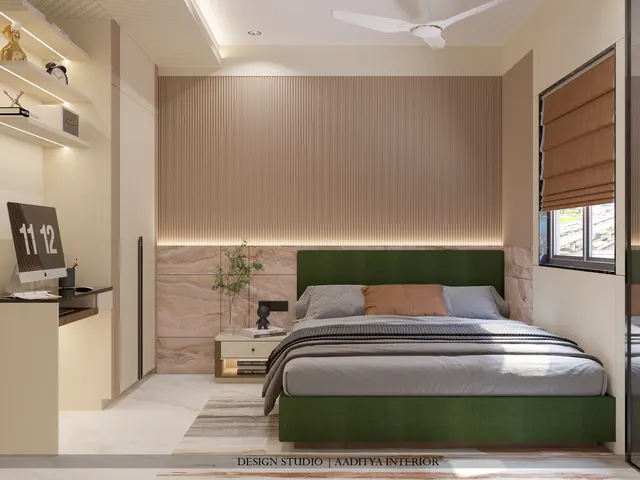
For most of the last fifty years an Indian wall has ended the same way: cement plaster, wall putty, primer and two coats of emulsion. It is cheap, fast and flat — and that flatness is exactly what a growing number of homeowners now want to escape. Lime plaster and its polished cousin tadelakt offer the opposite: a seamless mineral surface with faint cloud-like variations in tone, a soft sheen that shifts with the light, and a depth that no roller-applied paint can imitate. These are not new inventions. They are among the oldest wall finishes known, returning now because they are breathable, repairable and quietly beautiful.
They are also widely misunderstood. Homeowners see a photograph of a glowing Moroccan bathroom and ask for tadelakt without knowing that it is a skilled, multi-coat hand finish applied by trained artisans, not a product poured from a tin. Others confuse lime plaster with ordinary cement plaster, or with the acrylic textured paints sold as Italian stucco. The differences matter, because a lime finish applied over the wrong base, sealed with the wrong product, or used in the wrong room will craze, dust or fail. A good lime wall is a system, from the background to the final soap, and every layer has a job.
This article explains what tadelakt and lime plaster actually are, traces the long tradition they come from — including India's own lime craft — and sets out how they are built up coat by coat, where they belong in an Indian home, how they behave with moisture and time, how they are cared for, and what they cost. Prices are indicative October 2026 ranges and should be confirmed locally, because lime finishes are labour-led and vary sharply with the artisan's skill and the number of coats.
What tadelakt and lime plaster actually are
Lime plaster is a wall finish made from lime — limestone burnt and slaked into a putty or sold as hydrated lime powder — mixed with fine sand or marble dust and applied in thin coats. As it cures it slowly reabsorbs carbon dioxide from the air and turns back toward stone, a process called carbonation. The result is a hard but breathable surface that lets water vapour pass through rather than trapping it. Tadelakt is a particular, highly refined lime finish from Morocco: lime plaster applied in very fine coats, compressed and burnished with a smooth stone, and then treated with a natural soap that reacts with the lime to form a water-repellent, almost waterproof, gently glossy skin. In short, all tadelakt is lime plaster, but very little lime plaster is tadelakt.
Both are quite different from the two finishes they are often confused with. Cement plaster is strong and cheap but rigid and non-breathable; it sets by hydration, not carbonation, and it cannot be burnished to tadelakt's glow. The acrylic textured coatings sold as Italian stucco or Venetian plaster are paints with filler: they sit on the wall as a plastic film, do not breathe, and cannot be repaired seamlessly. Lime finishes, by contrast, are mineral through their whole thickness, bond chemically with a lime or mineral base, breathe, and can be re-worked and patched by a skilled hand almost invisibly. That combination of breathability and repairability is the real reason they are returning.
A long tradition, including India's own
Lime is one of humanity's oldest building materials. Lime plasters and renders survive on structures thousands of years old around the Mediterranean, in West Asia and in South Asia, valued because they are durable, breathable and forgiving. Tadelakt itself is traditionally associated with Marrakesh in Morocco, where it was used to line cisterns, hammams and bathing rooms precisely because the burnished, soap-treated lime shed water. The technique was a closely held craft, passed from master to apprentice, and its revival in global interiors over the last two decades has brought that craft to a wider market.
India has its own deep lime tradition, and it is worth remembering when these finishes are discussed as imports. Lime mortars and plasters built and finished countless forts, stepwells, havelis and temples across Gujarat, Rajasthan and the rest of the subcontinent long before cement arrived. The fine polished lime finish known in parts of India as araish or araish-work, and the lime surface called chun or chuna, produced glowing, marble-smooth walls using slaked lime, marble dust and, in some recipes, organic additives, burnished to a sheen by hand. In technique and spirit this Indian lime craft is a close cousin of tadelakt. The current interest in lime is therefore less a new fashion than the rediscovery of a craft the country never fully lost.
How a lime finish is built up
A lime or tadelakt wall is made of many thin coats, each thinner than the one below, applied by hand over several days with careful drying between. The sequence begins with a sound, slightly absorbent background — bare masonry or a lime base coat, never glossy paint, which the lime cannot grip. A base or scratch coat of lime and coarser sand, roughly 8–12 mm, levels the wall. Over it go one or more fine coats of lime mixed with finer sand or marble dust, 2–4 mm each, floated flat. For tadelakt, a very fine finish coat under 2 mm is then compressed and burnished with a smooth, hard stone while it is still setting, which closes the surface and brings up the characteristic soft sheen.
The final step for tadelakt is the soap. A natural soft soap, traditionally an olive-based black soap, is worked into the burnished surface, where it reacts with the lime to form insoluble compounds that make the skin water-repellent. The wall is then left to cure and carbonate over weeks, hardening slowly. Timing and skill run through the whole process: each coat must be applied while the one below is at the right dampness, the burnishing must happen in a narrow window as the lime stiffens, and rushing any stage shows up later as crazing, dusting or a dull patch. This is why these finishes are priced by labour and skill, not by the material alone.
| Coat | Thickness | Purpose |
|---|---|---|
| Background | — | Sound, absorbent masonry or lime base; never glossy paint |
| Base / scratch coat | 8–12 mm | Levels the wall and gives a key for the next coat |
| Fine lime coats | 2–4 mm each | Lime with fine sand or marble dust, floated flat |
| Finish coat | under 2 mm | Very fine coat, compressed and smoothed |
| Burnish | — | Stone-polished while setting, brings up the sheen |
| Soap (tadelakt only) | — | Reacts with lime to make the surface water-repellent |
Why they breathe, and what that means for Indian walls
The defining property of a lime finish is that it is vapour-open: water vapour can move through it in both directions. This matters a great deal on Indian walls, which face monsoon driving rain, rising damp from the plinth, and the condensation that builds in closed air-conditioned rooms. A breathable lime finish lets a wall that has taken in moisture dry outward again, instead of trapping the water behind an impervious film where it blisters paint and feeds salt damage. Lime is also mildly alkaline, which discourages mould and fungus — a real advantage in humid coastal and monsoon climates. For an old building with lime masonry, a lime finish is not just attractive but technically correct, because sealing such a wall with cement and plastic paint is what causes much of the damp failure seen today.
Breathability has limits worth stating plainly. A lime finish manages and releases moisture; it is not a damp-proof course and will not cure a wall that is being actively soaked by a leaking pipe, a failed terrace or rising ground water. Those faults must be fixed at source first. Tadelakt's soap-sealed surface resists splashing water well enough for bathroom and basin walls, but it is a water-repellent skin on a breathable body, not a plastic tank lining, and it is maintained by re-soaping rather than left alone. Used on the right wall, for the right reason, lime rewards the homeowner; used to paper over a genuine leak, it fails like anything else.
| Property | Lime / tadelakt | Cement plaster + emulsion | Acrylic textured paint |
|---|---|---|---|
| Breathable (vapour-open) | Yes | No | No |
| Seamless, no joints | Yes | Paint yes, plaster cracks | Mostly |
| Repairable invisibly | Yes, by a skilled hand | Patch shows | Patch shows |
| Resists mould naturally | Yes (alkaline) | No | No |
| Water-repellent surface | Tadelakt only, with soap | No | Film only |
| Labour and skill needed | High — trained artisan | Low | Low to medium |
Where tadelakt and lime plaster belong in a home
Lime finishes reward the places where their qualities show. A living-room or bedroom feature wall in polished lime gives a soft, cloudy depth that photographs beautifully and changes through the day. An entrance or stairwell lined in lime feels calm and solid. Tadelakt, with its soap-sealed surface, is the traditional choice for the very places cement struggles with: bathroom and shower walls, washbasin surrounds, and even built-in basins and bathtubs made seamless in tadelakt, where the absence of tile joints means nothing to grout, stain or regrow mould. In an old lime-built house anywhere in India, a lime finish on repaired walls is also the technically sound way to let the building breathe again.
There are places to avoid. Plain lime plaster without the tadelakt soap treatment should not be used on surfaces that will be splashed or scrubbed daily, because it is breathable but not water-repellent. No lime finish belongs on a wall with an unresolved leak or active rising damp. External lime renders are possible and traditional, but they are a specialist job and must be detailed for the local rainfall. And because the finish is skill-dependent, it is unwise to ask a general painter to attempt tadelakt from a video; the result is usually a crazed, dusty disappointment. Aaditya Interior treats lime and tadelakt as artisan finishes, specified where their breathability and hand-worked look genuinely earn their higher cost.
| Location | Suitable finish | Why | Note |
|---|---|---|---|
| Living / bedroom feature wall | Polished lime or tadelakt | Soft depth, breathable, seamless | One or two walls, not the whole room |
| Bathroom and shower walls | Tadelakt (soaped) | Water-repellent, no joints to mould | Needs skilled application and re-soaping |
| Washbasin and seamless basins | Tadelakt | Continuous, jointless, hygienic | A specialist, premium item |
| Old lime-built walls | Lime plaster | Lets the wall breathe and dry | Technically correct for heritage fabric |
| Kitchen cooking splash | Avoid lime; use tile or stone | Grease and daily scrubbing | Lime stains and abrades here |
| Wall with active damp or leak | None until fixed | Breathability is not damp-proofing | Cure the source first |
Care, repair and how they age
Lime finishes age gracefully, which is part of their appeal, but they ask for the right care rather than none. Day to day, a lime or tadelakt wall is dusted or wiped with a soft, barely damp cloth; harsh detergents, acidic cleaners and abrasive scrubbing are avoided, because they attack the mineral surface. A tadelakt bathroom wall is kept water-repellent by occasional re-application of the natural soap, perhaps once or twice a year on a shower wall, which also refreshes the sheen. Small knocks and scuffs on lime can be re-worked by a skilled artisan so the patch blends into the surrounding surface — the invisible repair that plastic paint can never manage.
Over years a lime wall develops a patina: a subtle deepening and softening that homeowners who love the finish regard as a feature, not a fault. Hairline crazing can appear, especially if a coat dried too fast, and is usually accepted as part of the hand-made character or burnished back by the artisan. The key mental shift is that a lime finish is a living mineral surface to be maintained and occasionally re-worked, not a sealed coating to be ignored until it is stripped and redone. Cared for in this spirit, it can last for decades and be refreshed rather than replaced.
Cost and how to budget
Because lime and tadelakt are labour-led, their cost sits well above ordinary paint and swings with the number of coats and the artisan's skill. As a point of reference, standard internal cement plastering runs about ₹18–30 per square foot and a painted finish of putty, primer and premium emulsion about ₹20–30 per square foot, while acrylic textured coatings run roughly ₹40–150 and upward. Against these, a plain lime plaster finish is typically around ₹80–250 per square foot, and full tadelakt — multiple fine coats, stone burnishing and soap, by a trained artisan — commonly ₹250–600 per square foot, with premium or seamless-basin work rising to ₹600–1,000 and above. These are indicative October 2026 ranges; always take a written quote, because the coat count and the artisan make the price.
To budget a wall, measure it in square feet, choose the finish band, and remember that lime work also needs preparation of the background and several days on site, which a quote should include. A 100-square-foot bedroom feature wall in plain lime therefore lands around ₹8,000–25,000, while a tadelakt bathroom wall of the same area lands around ₹25,000–60,000, before the cost of fixing any underlying wall faults. The table makes the comparison direct.
| Finish | Indicative cost (₹/sq ft) | 100 sq ft wall | Notes |
|---|---|---|---|
| Cement plaster (reference) | ₹18–30 | ₹1,800–3,000 | The base, not a finish in itself |
| Putty + primer + premium emulsion | ₹20–30 | ₹2,000–3,000 | The usual flat painted wall |
| Acrylic textured coating | ₹40–150+ | ₹4,000–15,000+ | A paint film, not breathable |
| Plain lime plaster finish | ₹80–250 | ₹8,000–25,000 | Breathable, matte, not for wet scrubbing |
| Tadelakt (soaped, polished) | ₹250–600 | ₹25,000–60,000 | Water-repellent, seamless, artisan work |
| Premium / seamless-basin tadelakt | ₹600–1,000+ | ₹60,000–100,000+ | Specialist bespoke work |
Where these finishes are going next
Lime is in the middle of a quiet comeback that is likely to grow, and the reasons are as much technical and environmental as aesthetic. Lime binders generally carry a lower embodied footprint than cement and reabsorb carbon dioxide as they cure, which fits the direction of green-building rating systems and client interest in healthier, breathable interiors. More trained artisans and specialist applicators are appearing in Indian cities as demand rises, and pre-mixed lime and tadelakt products are making the finish a little more consistent and accessible, though never a job for the unskilled. Expect lime to move from a rare luxury toward a recognised premium option, especially in wet areas and heritage repair where its breathability is not a style choice but the correct engineering.
Nine rules for specifying lime and tadelakt
- Fix any active leak or rising damp first; a breathable finish manages moisture but is not damp-proofing.
- Apply lime only over a sound, absorbent mineral background — never over glossy paint or a sealed surface.
- Use tadelakt, not plain lime, on any wall that will be splashed or washed, and only after the soap treatment.
- Engage a trained artisan or specialist applicator; lime and tadelakt are skilled, multi-coat hand finishes.
- Allow several days on site plus weeks of curing, and build that time into the project programme.
- Keep feature lime to one or two walls so its depth reads, rather than flattening into a whole room.
- Clean with a soft, barely damp cloth only; avoid acidic, abrasive and strong detergent cleaners.
- Re-soap a tadelakt wet-area wall once or twice a year to keep it water-repellent and bright.
- Budget by the coat count and the artisan, and always take a written, inclusive quote.
Frequently asked questions
Is tadelakt really waterproof?
Tadelakt is water-repellent rather than a waterproof tank lining. The burnished lime surface, sealed with natural soap, sheds splashing and running water well, which is why it has lined hammams and bathing rooms for centuries. It remains a breathable mineral finish, so it is maintained by occasional re-soaping and is not a substitute for proper waterproofing behind the wall in a modern wet area.
What is the difference between tadelakt and Italian or Venetian plaster?
Tadelakt is a true lime finish, mineral all through, burnished with a stone and sealed with soap, and it breathes. Most products sold as Italian or Venetian plaster in the market are acrylic textured coatings — paints with filler that sit on the wall as a film, do not breathe and cannot be repaired invisibly. The look can be similar; the material and behaviour are not.
Can lime plaster be used in Indian humidity?
Yes, and its breathability is an advantage in humid and monsoon climates, because it lets damp walls dry outward instead of trapping moisture behind a film, and its mild alkalinity discourages mould. The finish must still be applied over a sound background by a skilled hand, and any active leak or rising damp must be fixed first; breathability helps a wall cope with moisture but does not cure a genuine water fault.
Does India have its own version of tadelakt?
Yes. India has a long lime tradition, including the fine polished lime finishes known as araish and the lime surface called chun or chuna, used on forts, havelis and temples for centuries. These burnished lime finishes, made from slaked lime and marble dust, are close cousins of tadelakt in both technique and appearance, so the current interest in lime is partly a rediscovery of an Indian craft.
Why is tadelakt so expensive?
The cost is almost entirely labour and skill. Tadelakt is built from several thin coats applied over days, burnished by hand with a stone in a narrow setting window, then soaped and cured over weeks, and it must be done by a trained artisan or it fails. The material is modest; the craft, the time and the risk of a botched job are what place it at roughly ₹250–600 per square foot and above in October 2026.
Sources & standards
- Bureau of Indian Standards — IS 712 (building limes) and IS 1661 (application of cement and cement-lime plaster finishes)
- National Building Code of India 2016, Part 5 (Building Materials) — lime and plastering materials
- Indian Green Building Council (IGBC) and GRIHA — guidance on lime-based and low-carbon finishes and healthy interiors
- Institutes and trusts working on Indian lime craft (araish, chun) in heritage conservation — technique descriptions
- Manufacturer technical data for lime plaster and tadelakt systems — coat build-up, curing and soap treatment (described generically)
- IndiaMART / TradeIndia and specialist applicator listings, October 2026 — plain lime finish ₹80–250, tadelakt ₹250–600 per sq ft (indicative)
- Price ranges: indicative October 2026 estimates — confirm locally before budgeting