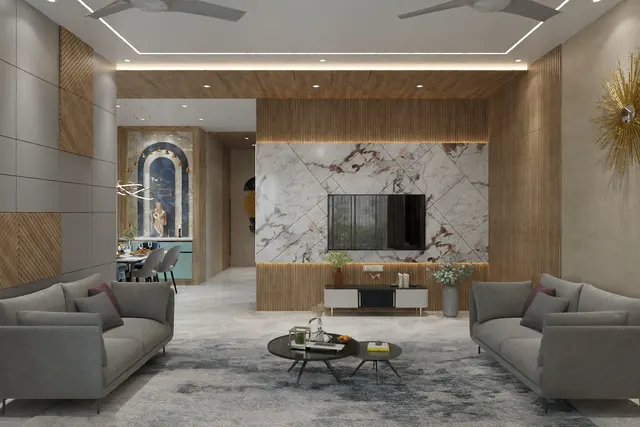
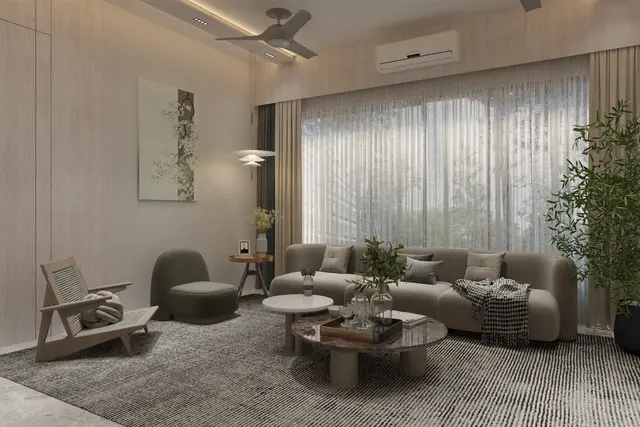
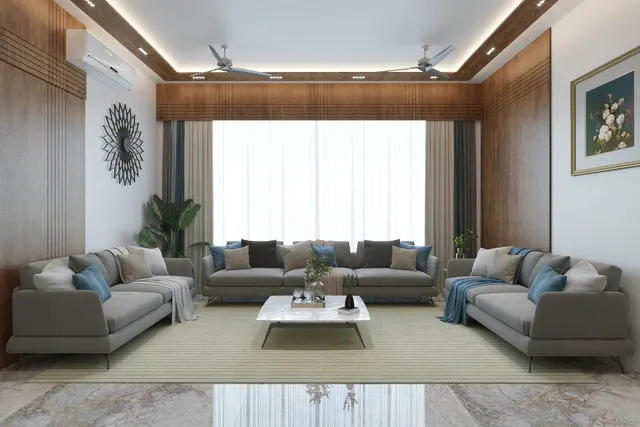
Most Indian homes are lit at a single colour temperature chosen once, at the hardware shop, and never thought about again. A tray of identical LED panels or bulbs goes up across the living room, kitchen, bedrooms and bathrooms, all of them the same cool white because that is what was on the shelf, and the house then runs at that one note from six in the morning to midnight. The light that helps a student concentrate at a desk at nine is the same hard, bluish light pouring over the family at dinner and glaring beside the bed at bedtime, when the body is trying to wind down.
The vocabulary is part of the problem. Homeowners ask for warm white or cool white, or quote a wattage, when the number that actually sets the mood of a room is its colour temperature in Kelvin — how yellow or how blue the white light is. Fixed lamps commit to one Kelvin value for life. Tunable white fittings carry two sets of LEDs, one warm and one cool, and mix them on a dimmer or an app so the same fixture can be a crisp 5000 K for cooking and a soft 2700 K for relaxing. It is the single upgrade that makes one room behave like several.
This article separates the words, traces how domestic white light arrived at this point, and turns the idea into the numbers an Indian project needs: the Kelvin scale and where each value belongs, the colour rendering a home should insist on, how tunable fittings are wired and controlled, room-by-room settings in Kelvin and lux, and indicative October 2026 costs. It treats lighting as a service to be designed, not a bulb to be bought.
Colour temperature, CRI and lux: the words untangled
Three measurements describe light, and confusing them is behind most lighting mistakes. Colour temperature, measured in Kelvin, says how warm or cool the white looks: low numbers around 2200 to 2700 K are the amber of a flame or an old bulb, 3000 to 4000 K is a neutral white, and 5000 to 6500 K is the blue-white of a cloudy sky at noon. It is counter-intuitive that the higher, cooler-looking numbers are called the hotter temperatures, but that is the physics of a heated object, and the scale is universal across every brand.
Colour rendering, the CRI, is a separate and equally important figure between 0 and 100 that says how truthfully the light shows colours. A lamp can be a pleasant 3000 K yet render skin, food and fabrics poorly if its CRI is low, which is why a cheap warm bulb can still make a room look sickly. A home should insist on CRI 90 or above for living spaces, wardrobes and bathrooms where colour is judged, and accept nothing below 80 anywhere. Light level, finally, is measured in lux — the quantity of light landing on a surface — and is set by how much light a room needs for its task, independent of the colour temperature.
| Kelvin (K) | Appearance | Feels like | Best for at home |
|---|---|---|---|
| 2200-2400 K | Deep amber | Candlelight, late evening | Night-lights, mood lamps, restaurants |
| 2700 K | Warm white | Old incandescent bulb | Bedrooms, living rooms at night, dining |
| 3000 K | Soft white | Halogen, relaxed | Living rooms, lobbies, hospitality |
| 4000 K | Neutral white | Morning daylight indoors | Kitchens, studies, bathrooms, offices |
| 5000 K | Cool white | Overcast noon | Task lighting, garages, utility, mirrors |
| 6500 K | Daylight | Bright blue sky | Workshops, display, clinical tasks only |
A short history of white light in the home
Domestic light began warm and dim because fire is warm and dim. Oil lamps and candles glowed at roughly 1800 to 2000 K, a deep amber that reading strained against but that flattered skin and food. The carbon-filament and later tungsten incandescent bulb, which lit the twentieth-century home, settled at about 2700 K — close to the fire it replaced, which is why that value still reads as cosy and "homely" to most people. For a century the home had exactly one colour of electric light, and nobody chose it; it came with the technology.
The compact fluorescent lamp broke that in the 1990s and 2000s by being efficient but, in its common Indian form, cool and often harsh — a bluish 6500 K tube light became the default ceiling fitting in millions of homes and offices, and a generation grew up associating "white light" with that cold, slightly green glare. Early LEDs repeated the pattern: cheap, cool and fixed. Only in the last decade has the LED matured into warm, high-CRI and, crucially, tunable forms, so that for the first time an ordinary household can change the colour of its light at will rather than living with whatever the lamp was born as.
The modern Indian home sits mid-way through this shift. A great many ceilings still carry a fixed cool panel bought on price, while newer and renovated homes increasingly specify warm or neutral fittings and, at the premium end, tunable white throughout. The jump from fixed to tunable is no longer expensive or exotic; it is a driver choice and a control choice, and understanding those two is the whole of the subject.
The daily cycle: why one colour is never enough
Light does more than let people see; its colour and brightness cue the body's sense of time. Bright, cooler light in the morning and through the working day supports alertness, while warm, dim light in the evening signals that the day is ending and lets the body settle towards sleep. A room held at a single cool temperature all evening works against that, and one held warm all day can feel sleepy and flat when sharp task light is wanted. This is the reasoning behind "human-centric" or circadian lighting, and it is simply the intuition that daylight itself is cool and bright at noon and golden at dusk.
In practice a home does not need a complicated automated system to benefit. Three or four scenes covering the day are enough: a bright neutral-to-cool morning and working setting, a comfortable neutral evening, a warm and dimmed night setting for relaxing, and a very warm, very dim late-night or bathroom setting that does not jolt the eyes awake. The table later in this article gives the working Kelvin and lux values; the figure below shows the shape of a sensible day.
How tunable white is wired and controlled
A tunable fitting is, electrically, two light engines in one body — a string of warm LEDs around 2700 K and a string of cool LEDs around 6000 to 6500 K — and the control system decides the ratio between them, which sets the apparent colour, and the total power, which sets the brightness. There are three common ways to run this in a home, and the choice is mostly about how much control and how much wiring the owner wants.
Dim-to-warm
The simplest and often the most pleasing is dim-to-warm, which is not fully tunable but linked: as the fitting is dimmed on an ordinary dimmer it also grows warmer, mimicking the way an old incandescent bulb turned golden as it was turned down. It needs only normal two-wire dimmable wiring and a single control, suits living rooms, bedrooms and dining where people want "bright and neutral" down to "dim and cosy" on one knob, and removes any need for an app. Its limit is that colour and brightness cannot be set independently.
Two-channel tunable drivers
Full tunable white uses a driver with two output channels and a protocol — commonly 0-10 V, DALI or a wireless standard — that lets colour and brightness be set separately. This is the specification for a serious installation: a wall keypad or a panel selects scenes, and each scene stores a Kelvin value and a level. It needs the right driver and, for wired control, an extra conductor, so it is planned at the wiring stage rather than retrofitted casually.
Smart tunable bulbs and strips
For a retrofit without rewiring, self-contained smart bulbs, downlights and strips with tunable LEDs and a built-in wireless radio are the practical route. They screw or clip into existing points and are controlled by app, voice or a battery remote, storing scenes in the cloud or a hub. They are the quickest way to add tunable white to a finished home, with the caveats common to all smart devices: dependence on an app and network, and occasional firmware quirks.
| System | How it works | Tunable? | Indicative cost per point | Best for |
|---|---|---|---|---|
| Fixed LED | One colour temperature, dimmable or not | No | ₹150-600 | Utility, stores, where mood is fixed |
| Dim-to-warm | Warms as it dims, one dimmer | Linked only | ₹500-1,500 | Bedrooms, living, dining on one knob |
| Two-channel driver | Separate colour and brightness control | Full | ₹1,200-3,500 | Whole-home designed installations |
| Smart tunable bulb | Wireless radio in the lamp, app control | Full | ₹600-2,500 | Retrofit without rewiring |
| Smart strip / cove | Two-colour LED tape plus controller | Full | ₹250-900 per metre | Cove, under-cabinet, accent |
Room by room: settings that actually work
A home does not need every room tunable, and spending is best concentrated where people spend varied hours — the living room, the main bedroom, the kitchen and any room that doubles as a study. Bathrooms benefit from a warm night setting, utility and storage areas rarely need anything but fixed neutral light. The guide below reflects how Aaditya Interior sets white light in Indian homes, matching the colour and level to what the room is doing at each hour rather than repeating one fitting everywhere.
| Room | Day setting (K) | Evening / night (K) | Target level (lux) | Note |
|---|---|---|---|---|
| Living room | 3500-4000 | 2700-3000 | 100-300 | Scenes for TV, reading, gathering |
| Kitchen (task) | 4000-5000 | 3500-4000 | 300-500 | Cooler over the counter and hob |
| Study / desk | 4000-5000 | 4000 | 300-500 | Keep cool and steady for focus |
| Main bedroom | 3000-3500 | 2200-2700 | 50-150 | Very warm and dim near sleep |
| Dining | 3000 | 2700 | 150-300 | Warm flatters food and faces |
| Bathroom | 4000 | 2200-2700 | 150-300 / low | Cool at the mirror, warm night-light |
Driver quality and flicker
The part of a tunable fitting that most often decides whether the light is pleasant or tiring is the one nobody looks at: the driver, the small box that converts mains alternating current into the smoothed low-voltage power the LEDs need. Two kinds are common. A constant-current driver holds a fixed current and is used for integrated downlights and LED modules, where the array is built for a set drive current; a constant-voltage driver holds a fixed 12 V or 24 V and is used for LED strip and cove tape that carries its own current-limiting on the board. A two-channel tunable fitting simply uses a driver of the right kind with two outputs, one feeding the warm string and one the cool.
Flicker is the hidden quality problem. Indian mains runs at 50 Hz, so a cheaply rectified supply leaves a 100 Hz ripple that makes the LED pulse in brightness. The eye may not consciously see it, yet high flicker is linked to eye strain, headaches and, in sensitive people, worse — and it shows up at once as rolling bands when a room is filmed on a phone. It is measured as percent flicker (how deep the brightness dip is, from 0 to 100 per cent) and the flicker index; a good residential driver keeps percent flicker low and runs any dimming by high-frequency pulse-width modulation, well above the few hundred hertz at which flicker becomes a problem, rather than crude low-frequency switching.
Buying well is mostly about the driver, not the LED. Favour fittings and drivers from established lighting brands that publish or claim low-flicker or flicker-free performance across the dimming range, match the driver type to the load, check that the driver's wattage and dimming protocol suit the fitting, and run a thirty-second phone-camera test on a sample before buying in bulk: visible bands on the screen are a reason to reject the lot, however attractive the price.
| Driver type | Holds constant | Suits | Watch for |
|---|---|---|---|
| Constant-current | Current (mA) | Downlights, integrated modules | Match the rated drive current |
| Constant-voltage | Voltage (12/24 V) | LED strip, cove, under-cabinet | Size the wattage with headroom |
| Low-flicker rated | Smoothed output | Any living space | Verify with a phone-camera test |
What tunable white costs in India
Tunable white is now a modest premium over plain LED rather than a luxury. A self-contained smart tunable bulb or downlight typically costs a few hundred to a couple of thousand rupees per point above an equivalent fixed lamp; a wired two-channel installation adds the cost of better drivers, keypads and an extra control conductor, planned in at the wiring stage. The figures below are indicative October 2026 supply ranges for residential-grade product in metro and tier-2 cities, and should be confirmed with a local supplier before budgeting, as brand, CRI and control grade move the numbers considerably.
| Item | Spec | Indicative cost (Oct 2026) | Note |
|---|---|---|---|
| Smart tunable bulb | 9-12 W, CRI 90, app or remote | ₹600-2,500 each | Quickest retrofit, no rewiring |
| Tunable downlight | 10-15 W, 2700-6500 K | ₹900-3,000 each | Recessed, needs driver or built-in |
| Two-channel driver | DALI or 0-10 V, per fitting | ₹1,200-3,500 | Wired control, best uniformity |
| Tunable LED strip | Dual-colour tape, per metre | ₹250-900 / metre | Cove and under-cabinet accent |
| Scene keypad / controller | Wall keypad or hub | ₹2,500-12,000 | Stores whole-room scenes |
| Dim-to-warm bulb | 9-12 W on existing dimmer | ₹400-1,200 each | Simplest warm-as-dim effect |
Where domestic lighting is going
Three shifts are shaping the next few years. The first is that tunable and high-CRI LEDs are becoming the default rather than the upgrade, as prices fall and buyers learn to ask for Kelvin and CRI instead of only wattage. The second is sensor-led automation — fittings that shift colour and level with the time of day or with daylight coming through the window, so the circadian benefit arrives without anyone touching a switch. The third is better integration, where lighting, blinds and air-conditioning share scenes so that "evening" dims the lights, warms them, lowers the blinds and sets the temperature together.
What will not change is the underlying logic. A home is a place that is lived in differently at nine in the morning and nine at night, and its light should be able to follow. The technology to make one fitting do the work of several is now ordinary and affordable; the design discipline — choosing sensible Kelvin values, insisting on good colour rendering, and keeping each room coherent — is what still separates a considered scheme from a bag of smart bulbs. Aaditya Interior treats that discipline, not the gadgetry, as the real service.
Eight rules for specifying tunable white
- Specify colour temperature in Kelvin and colour rendering in CRI, not just wattage, on every fitting.
- Never accept below CRI 90 where skin, food or fabric is seen; below 80 nowhere in the home.
- Keep all fittings within one sightline on the same scene so the ceiling does not read as a fault.
- Use dim-to-warm where one knob and a cosy evening are all that is wanted; save full tunable for rooms used at varied hours.
- Plan two-channel wired control at the wiring stage; use smart bulbs only for retrofits.
- Set the day scene cool and bright (4000-5000 K) for kitchens and desks, warm and dim (2200-2700 K) for late bedrooms.
- Target the task, not the fashion: 300-500 lux on a work surface, 50-150 lux for bedroom calm.
- Build three or four scenes for the day rather than chasing a fully automated system on day one.
Frequently asked questions
What colour temperature is best for an Indian home?
There is no single best value, which is the whole point of tunable white. For fixed fittings, 3000 to 3500 K suits most living and bedroom spaces and 4000 K suits kitchens, studies and bathrooms. With tunable fittings, run the cooler end (4000 to 5000 K) for daytime and task work and the warmer end (2700 K and below) in the evening and near sleep.
Is tunable white worth it over a plain warm bulb?
In rooms used at varied hours — a living room that is also where people read and relax, a bedroom that is also a study — yes, because one fitting then does the work of two or three. In a room with one fixed use, such as a utility area or a store, a single good fixed lamp at the right Kelvin is enough and cheaper.
Does tunable white need special wiring?
Wired two-channel tunable fittings need the correct driver and usually an extra control conductor, so they are planned at the wiring stage. Self-contained smart tunable bulbs and strips need no new wiring and work on existing points, controlled wirelessly, which is why they are the usual retrofit choice.
What is dim-to-warm and how is it different?
Dim-to-warm fittings grow warmer as they are dimmed on an ordinary dimmer, copying the glow of an old incandescent bulb turned down. They are simpler than full tunable white but link colour to brightness, so the two cannot be set independently. They suit living, dining and bedrooms where one cosy knob is all that is wanted.
Will cool white at night harm sleep?
Bright, cool light in the evening works against the body's wind-down and can make settling to sleep harder for some people, which is the reasoning behind warming and dimming the light at night. It is a sensible comfort measure rather than a guaranteed medical outcome; keeping late-night light warm and dim is good practice regardless.
Sources & standards
- Bureau of Indian Standards — IS 3646 (interior illumination, code of practice) for recommended light levels in lux
- National Building Code of India 2016, Part 8 (Building Services), Section 1 Lighting and Ventilation — illumination guidance
- Bureau of Energy Efficiency (BEE) — LED and luminaire star-labelling and efficiency guidance
- International standard CIE / IEC definitions of correlated colour temperature (CCT) and colour rendering index (CRI)
- Ernst Neufert, Architects' Data — lighting levels and room-by-room illumination recommendations
- Manufacturer technical data for tunable and dim-to-warm LED drivers and lamps (DALI, 0-10 V), described generically
- Price ranges: indicative October 2026 estimates for supply and installation — confirm with a local supplier before budgeting