Walk into any laminate gallery in Surat, Ahmedabad or Mumbai and the dealer will hand over three or four catalogues, each with several hundred shades. Most families choose from those books by colour alone, and most of the problems that follow have nothing to do with colour. A kitchen shutter warps because only one face was laminated. A wardrobe in a sunlit bedroom shows every fingerprint because it was finished in a dark high gloss. A bathroom vanity swells because a 1 mm decorative sheet was asked to do the work of a 12 mm compact panel. The catalogue never warned anyone, because a catalogue sells shades, not specifications.
A laminate is not one product. Under the same everyday word — and in Indian homes the word is still often Sunmica, a brand name that became a generic term — sit decorative high-pressure sheets, thin liners for the inside of cabinets, flexible post-forming grades, self-supporting compact panels, fire-retardant and chemical-resistant grades, and boards that come pre-laminated from the factory. Each has its own thickness, its own job and its own price. On top of that sits the surface: gloss, suede, super-matte, textured, embossed-in-register, metallic, digital-printed. Choose the type for the job, then the thickness for the type, and only then the shade and finish.
This article sorts the whole family into a clear order. It explains how a laminate is made, the types and thicknesses that matter in Indian homes and offices, how each surface finish behaves in real light and real use, how to balance a shutter so it stays flat, what each grade costs in October 2026, and where the product is heading. Prices and finishing costs are kept consistent with the shutter-finish, veneer and wardrobe guides elsewhere on this site.
Where the laminate came from
The decorative laminate started life as an electrical insulator. In 1913 two engineers in the United States set up the Formica company to make a laminated substitute for mica, the mineral then used to insulate electrical parts — hence the name, for mica. Those early sheets were layers of paper or cloth bonded with phenolic resin: strong and heat-resistant, but brown and plain. The material became decorative only when manufacturers learned to put a printed paper on top and protect it with a clear, hard resin. Melamine-formaldehyde resin, developed in the 1930s, made that possible, and by the middle of the twentieth century laminate kitchen tops and diner counters had become a symbol of the modern, wipe-clean home.
In India, laminates entered homes with the modular-furniture boom of the late twentieth century. Before that, furniture was polished teak, painted plywood or veneer; afterwards, the carpenter's plywood box with a laminate face became the standard wardrobe and kitchen. The word Sunmica spread so widely that many homeowners still use it for any laminate, whatever the brand. Indian manufacturers now produce in very large volumes, export widely, and make their products against IS 2046, the Bureau of Indian Standards specification for decorative thermosetting synthetic-resin-bonded laminated sheets, alongside international references such as EN 438 and the NEMA LD 3 standard.
How a decorative laminate is made
A standard decorative high-pressure laminate (HPL) is a sandwich of resin-soaked papers fused into one hard sheet. At the bottom are several layers of kraft paper — a strong brown paper — impregnated with phenolic resin; they give the sheet its body and are the reason the edge of a cut laminate looks brown. Above them sits the decorative paper, printed with a solid colour, a wood grain, a stone or a pattern, and impregnated with melamine resin. On top of that, many grades add a thin overlay paper, also melamine-soaked, which turns transparent under heat and pressure and adds wear and scratch resistance. The stack is placed against a steel press plate that carries the surface finish — mirror-polished for gloss, etched or textured for matte and embossed finishes — and is pressed at high temperature and pressure until the resins cure into one rigid sheet. The back is then sanded so that adhesive can grip it.
Two numbers explain most of a laminate's behaviour: the number of kraft layers, which sets the thickness and stiffness, and the press plate, which sets the finish. That is why one shade can be offered in several finishes and thicknesses, and why a heavier, thicker sheet of the same shade costs more. Pre-laminated boards — commonly called prelam — are different. Their melamine-impregnated decorative paper is pressed directly onto particle board or MDF at much lower pressure, with no kraft layers in between. Prelam is economical and quick, but the surface is thinner and softer than an HPL, and it cannot be post-formed around an edge.
The main types of laminate
Indian dealers group laminates in several overlapping ways — by thickness, by finish, by brand range — which is why conversations at the counter get confusing. It is clearer to group them by how they are made and what job they do. The table below covers the types that appear in almost every home and office project. Thickness and use are typical industry practice; individual brands vary slightly, so always read the thickness printed on the back of the sheet or in the catalogue.
| Type | How it is made | Typical thickness | Main use | Watch out for |
|---|---|---|---|---|
| Decorative HPL (general purpose) | Kraft + decor + overlay, high pressure | 0.8–1.0 mm (1.0 mm standard) | Visible faces of shutters, wardrobes, tables, panelling | Must be bonded to a stable board and balanced on the back |
| Liner / backer laminate | Fewer kraft layers, plain or simple decor | 0.6–0.8 mm | Inside faces of shutters and carcasses, to balance and protect | Not meant for heavy-wear visible surfaces |
| Post-forming laminate | Thinner, more flexible HPL grade | 0.6–0.8 mm | Rounded edges of tables, counters and shutters bent with heat | Needs a post-forming machine or skilled heat bending |
| Pre-laminated board (prelam) | Melamine paper pressed directly on particle board or MDF | Board 8–25 mm with paper face | Budget carcasses, office furniture, ready-made units | Softer surface; edges chip; not for wet zones |
| Compact laminate | HPL with many kraft layers, no substrate needed | Commonly 3–25 mm (6, 12, 13 mm frequent) | Toilet cubicles, washroom vanities, lockers, lab tops, wet areas | Heavy; cut and drilled with carbide tools; needs specific hardware |
| Exterior compact (UV-stable) | Compact laminate with weather-resistant surface | Commonly 6–12 mm | Facade cladding on aluminium sub-frames, outdoor panels | Requires engineered fixing and expansion gaps |
| Fire-retardant (FR) laminate | HPL with fire-retardant treatment | 0.8–1.5 mm | Commercial interiors, hotel corridors, offices, hospitals | Ask for the test report; the substrate matters as much as the sheet |
| Chemical-resistant laminate | HPL with special resistant surface | 1.0 mm sheet or compact | Laboratories, hospital work surfaces, salon counters | Check the resistance list against the actual chemicals used |
| Speciality faces | Metallic foil, acrylic-faced, door skins, writable or magnetic | 0.8–1.5 mm (varies) | Feature shutters, doors, office pin-up and marker walls | Scratch and heat behaviour differs from standard HPL |
HPL versus prelam: the decision most people do not know they are making
When a quotation says laminated furniture, it may mean plywood with HPL pasted on site, or a factory board with a melamine face already fused on. Both are legitimate, but they are not the same product. Site-laminated plywood or HDHMR with a 1.0 mm HPL has a harder, thicker wear surface and can be re-laminated if damaged. Prelam particle board is cheaper and faster but its surface is a single melamine paper; a deep scratch or chipped edge exposes the core, and the board underneath is sensitive to moisture. Prelam is fine for dry, low-wear carcasses and office furniture; for kitchen shutters, wardrobe faces and anything near water, HPL on BWR plywood or HDHMR is the safer specification.
Compact laminate: when the laminate becomes the board
Compact laminate is made the same way as a decorative sheet but with so many kraft layers that it becomes a solid, self-supporting panel. Because it contains no wood board, it does not swell when wet, which is why it has become the standard material for commercial toilet cubicles, shower partitions, school lockers and laboratory tops. In homes it is increasingly used for bathroom vanity shelves, balcony storage and kitchen sink bases. It is heavy — far denser than plywood — and needs carbide tooling, through-bolted or specially designed hardware and edges that are machined and polished rather than banded. The edge shows the dark core as a fine line, unless a colour-through grade is chosen.
Thickness: which mm for which job
Thickness is where many site problems begin. A thinner sheet is cheaper and easier to bend, but it shows every ripple in the board below and is more easily cracked at corners; a thicker sheet is tougher but costs more and is harder to post-form. For decorative sheets, the useful range in homes runs from 0.6 mm to 1.5 mm, and the default for visible faces is 1.0 mm. Liners on the inside are 0.6–0.8 mm. Compact panels start at about 3 mm for wall lining and go up to 12–13 mm for cubicles and 18–25 mm for heavily loaded worktops. The ladder in Fig. 2 shows the common steps drawn to one scale.
| Thickness | Common name | Best use | Avoid using it for | Indicative material price (Oct 2026) |
|---|---|---|---|---|
| 0.6 mm | Thin liner | Inside of carcasses, back panels, low-cost lining | Visible faces, table tops | ₹12–20 per sq ft |
| 0.8 mm | Liner / backer; post-forming grade | Inside face of shutters (balancing), rounded edges | Kitchen counters, heavily used tops | ₹15–25 per sq ft (₹500–800 per sheet) |
| 1.0 mm | Standard decorative | Shutters, wardrobes, beds, TV units, panelling, desks | Wet areas without edge sealing | ₹42–56 per sq ft (₹1,350–1,800 per sheet), branded |
| 1.0 mm premium faces | Super-matte, textured, embossed-in-register, metallic | Feature shutters, high-touch kitchens and wardrobes | Budget-sensitive secondary rooms | From the top of the ₹42–56 band to about ₹95 per sq ft — verify locally |
| 1.25–1.5 mm | Heavy-duty / horizontal grade | Desk and table tops, reception counters, shop counters | Tight post-formed curves | Above 1.0 mm rates — verify locally |
| 6–8 mm compact | Thin compact | Wall lining in wet areas, facade panels (exterior grade) | Self-supporting doors without frames | Verify locally — priced per sheet or per sq ft |
| 12–13 mm compact | Cubicle grade | Toilet cubicles, shower partitions, vanity shelves, lockers | Light domestic shutters on ordinary hinges | Roughly ₹200–400 per sq ft material — verify locally |
Finishes and textures: what the surface does
A laminate's finish is the shape of its surface at a microscopic scale, and that shape decides how it handles light, fingerprints, scratches and cleaning. A mirror-polished press plate gives a flat surface that reflects light like a mirror — beautiful, but every fingerprint and fine scratch shows. An etched plate gives a surface of tiny peaks and valleys that scatters light, hiding marks but looking softer. Gloss is measured in gloss units (GU) with a glossmeter, usually at a 60° angle; manufacturers publish the value for many ranges, and it is a far more reliable guide than the catalogue name, because one brand's satin is another brand's suede.
Gloss and high gloss
High-gloss laminates bounce light around a room and make colours look deep and saturated. They suit small or dark kitchens and wardrobes that need to feel larger, and they pair naturally with handle-less profiles and lacquered glass. The trade-off is maintenance: fingerprints, water spots and fine scratches are visible from across the room, especially on dark shades and under downlights. A high-gloss laminate is still a laminate, not an acrylic — it reaches a high gloss but rarely the deep mirror finish of a 1.5 mm acrylic sheet or a polished PU, which is why a mixed kitchen with gloss laminate beside acrylic can look mismatched.
Suede, satin and matte
Suede finishes — called satin, matte or soft-touch by different brands — are the everyday workhorse of Indian interiors. Their fine texture scatters light, so small marks disappear and the surface reads calm and even. They are the safest choice for children's rooms, rental flats, offices and secondary wardrobes. Their weakness is on dark colours: a dark ordinary matte surface can show the oils from hands as darker patches around handles, which is the problem super-matte surfaces were developed to solve.
Super-matte and anti-fingerprint surfaces
Super-matte laminates have a very low gloss and a velvety feel. Many are sold as anti-fingerprint, using surface technologies that resist the marks hands leave and, in some ranges, allow light surface scuffs to be reduced with gentle warmth as directed by the manufacturer. They have become the default premium choice for kitchen shutters and handle-less wardrobes in dark and neutral shades. They cost more than standard suede, they need the cleaning method on the data sheet (harsh scrubbers can polish the surface and leave shiny patches), and their performance varies by brand — which is why a physical sample with a fingerprint test in the showroom is worth more than the catalogue description.
Textured and embossed-in-register finishes
Textured laminates carry a three-dimensional surface: wood grain, stone, slate, linen, leather, brushed metal. On a standard textured sheet, the texture is generic — a wood-grain emboss pressed over any wood print, so the ridges do not follow the printed grain exactly. Embossed-in-register (EIR), also called synchronised texture, aligns the texture with the print, so the fingertip feels the grain exactly where the eye sees it. EIR is the most convincing imitation of real veneer in the laminate family and is increasingly used where clients want a wood look without veneer's polishing and fading risks. Deep textures hide wear well but can hold grime in kitchens; for cooking zones, a fine texture is easier to clean.
| Finish | Look | Fingerprints | Scratch visibility | Cleaning | Best for | Avoid |
|---|---|---|---|---|---|---|
| High gloss | Bright, reflective, deep colour | High | High — fine scratches show | Easy but frequent | Small dark kitchens, feature wardrobes, low-touch display | Children's rooms, dark shades near handles |
| Suede / satin | Soft, calm, even | Low–moderate | Low | Easy | Whole-home value, offices, rentals | Very dark colours if hands touch often |
| Super-matte (anti-fingerprint) | Velvety, deep, modern | Very low (grade-dependent) | Low; some scuffs reducible as directed | Soft cloth, mild cleaner only | Handle-less kitchens, premium wardrobes | Abrasive cleaning, very tight budgets |
| Textured (wood, stone, linen) | Tactile, natural | Low | Very low | Moderate — grain can hold grime | Wardrobes, wall panelling, beds, TV units | Cooking zones with heavy grease |
| Embossed-in-register (EIR) | Closest to real veneer | Low | Very low | Moderate | Feature walls, master wardrobes, veneer alternative | Projects that need the lowest cost |
| Metallic / foil-faced | Brushed or mirror metal look | Moderate–high | Moderate–high | Careful | Accent strips, bar units, retail | Large areas in kitchens |
| Digital-print / custom | Any image or pattern | Depends on finish | Depends on finish | As per finish | Children's rooms, brand walls in offices | Long runs needing perfect batch match |
Balancing, edges and the full shutter build-up
A laminate is not neutral. As room humidity changes, the sheet and the board below move by different amounts, and a sheet pasted on one face only pulls that face more than the other. The result is the classic bowed shutter that will not close flush — often blamed on the plywood, but usually caused by an unbalanced build-up. The rule fabricators follow is simple: laminate both faces of every panel that is free to move, with the same or a similar laminate on the hidden face. On shutters, that is a 1.0 mm decorative face outside and a 0.8 mm liner inside as the minimum; for tall wardrobe shutters and large panels, many workshops use 1.0 mm on both faces to be safe.
Edges matter as much as faces. A raw board edge drinks moisture and swells; a chipped edge exposes the brown kraft line of the laminate and the board. The standard Indian practice is PVC or ABS edge banding, 0.8 mm on hidden and internal edges and 2 mm on visible and handled edges, applied by an edge-banding machine with hot-melt adhesive and trimmed with a small radius. Hand-applied laminate strips on edges are cheaper but lift more readily. In kitchens, the bottom edge of sink and dishwasher-zone shutters deserves the best banding in the house, because that is where water collects first.
| Element | Recommended specification | Why |
|---|---|---|
| Visible face | 1.0 mm decorative HPL | Wear, impact and heat resistance; hides board ripples |
| Hidden face of shutters | 0.8 mm liner (1.0 mm on tall or wide shutters) | Balances the pull of the face sheet so the shutter stays flat |
| Carcass inside faces | 0.6–0.8 mm liner, or prelam where dry | Cleanable interior, protects the board, balances side panels |
| Visible and handled edges | 2 mm PVC or ABS banding, machine-applied | Absorbs knocks, seals the board edge |
| Hidden edges | 0.8 mm banding | Seals the board against humidity at low cost |
| Board under laminate | BWR plywood (IS 303) or HDHMR; BWP (IS 710) at the sink | A flat, stable, moisture-tolerant base |
| Adhesive | Synthetic resin or PVA adhesive pressed evenly; contact adhesive for site repairs | Uneven pressing causes bubbles and later peeling |
| Pressing | Hot press or cold press for several hours | Pressure, not glue quantity, makes the bond |
What laminates cost in October 2026
Laminate pricing has two layers: the sheet itself, and the finished shutter or panel that includes the board, both faces, edge banding, pressing and labour. Comparing a dealer's sheet price with a carpenter's per-square-foot finishing rate is comparing two different things. The bands below are indicative October 2026 market ranges, excluding GST, and are consistent with the shutter-finish and veneer comparisons on this site. A standard sheet is 8 × 4 ft (2440 × 1220 mm), or 32 sq ft; some ranges are also offered in larger formats, which reduce joints on tall panels but must be checked for availability.
| Item | Indicative price (Oct 2026, excl. GST) | Basis | Note |
|---|---|---|---|
| Liner laminate 0.6–0.8 mm | ₹12–25 per sq ft | Material, per sheet of 32 sq ft | Plain or simple decor; inside faces |
| Decorative laminate 1.0 mm, branded (suede, gloss) | ₹42–56 per sq ft (₹1,350–1,800 per sheet) | Material | The reference band for most homes |
| Premium 1.0 mm faces (super-matte AFP, EIR, metallic) | Top of the standard band up to about ₹95 per sq ft | Material | Wide variation by brand and range — verify locally |
| Laminate-finished shutter (complete finishing) | ₹350–650 per sq ft | Finished face area | Same band as the shutter-finish guide |
| Membrane shutter (comparison) | ₹500–850 per sq ft | Finished face area | For routed and curved designs |
| Acrylic shutter (comparison) | ₹900–1,500 per sq ft | Finished face area | Mirror gloss; roughly double laminate |
| Compact laminate 12–13 mm | Roughly ₹200–400 per sq ft | Material | Hardware and machining extra — verify locally |
| Edge banding 2 mm PVC/ABS | Priced per running metre | Material + machine time | Usually included in factory shutter rates |
A worked example shows the arithmetic. A 7 × 7 ft hinged wardrobe has about 49 sq ft of shutter face. In a branded 1.0 mm laminate with a liner inside, the finished shutter cost falls roughly between ₹17,000 and ₹32,000 at ₹350–650 per sq ft; the same shutters in acrylic would be roughly ₹44,000–74,000. Moving from a standard suede to a premium super-matte face usually adds only a few thousand rupees to a single wardrobe, because the sheet is a small share of the finished cost — which is why it is often worth upgrading the face on the most-touched shutters and leaving the rest standard.
Choosing laminates room by room
The best laminate specification for a home is rarely one laminate. Kitchens, wardrobes, children's rooms, bathrooms and offices make different demands, and a sensible plan mixes finishes so that money goes where hands and water go. The table below is a starting specification of the kind Aaditya Interior uses at the material-selection stage; it should be adjusted for the family's habits, the light in each room and the colour palette.
| Location | Type and thickness | Recommended finish | Reason |
|---|---|---|---|
| Kitchen shutters | 1.0 mm HPL on BWR ply / HDHMR (BWP at sink), 0.8 mm liner | Suede or super-matte; gloss only on wall units | Daily touch, steam and oil; edges near water need 2 mm banding |
| Kitchen carcass interior | 0.8 mm liner or prelam inside | Plain light colour | Easy to clean and see inside |
| Master wardrobe | 1.0 mm HPL, 1.0 mm both faces if over 1800 mm tall | EIR wood, textured or super-matte | Large flat areas show bowing; feature face |
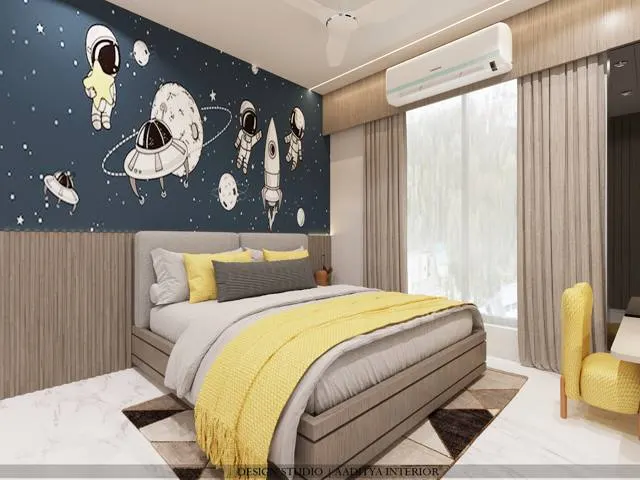
| Children's room | 1.0 mm HPL | Suede or textured, mid-tone colours | Hides knocks and marks; easy to re-laminate later |
| TV unit, panelling | 1.0 mm HPL or EIR | Textured or wood grain | Low touch, high visibility |
| Bathroom vanity | Compact laminate 12 mm or BWP ply with full edge sealing | Suede or textured | Standing water ruins wood-based boards |
| Study and office desks | 1.25–1.5 mm or 1.0 mm heavy-use grade | Suede, light colour | Writing and mouse wear; low glare for screens |
| Commercial toilets and lockers | Compact 12–13 mm; FR grades where specified | Textured or suede | Water, impact and frequent cleaning |
Where laminates are heading
Three developments are reshaping the category. The first is the surface: anti-fingerprint super-matte finishes have moved from a premium novelty to a mainstream expectation, and synchronised textures keep closing the gap with real veneer and stone. The second is printing: digital printing allows short runs, custom images and very large non-repeating patterns, which suits hotels, offices and children's rooms. The third is substance: manufacturers are offering thinner compact boards for wall lining and furniture, colour-through cores that hide the brown edge line, and grades certified for low emissions and fire performance — increasingly asked for in commercial projects pursuing IGBC or GRIHA ratings.
What will not change is the basic logic of the material. A laminate is a thin, hard skin; it is only as good as the board below it, the balance sheet behind it, the edges around it and the adhesive and pressure that hold it. The next generation of finishes will feel better and resist marks better, but a warped, unbalanced or unsealed shutter will still fail in the same way.
Rules for specifying laminates
- Choose the type first (HPL, prelam, compact, FR), then the thickness, and only then the shade and finish.
- Use 1.0 mm decorative HPL on every visible face that is touched; keep 0.6–0.8 mm for inside faces.
- Balance every shutter and free panel with a laminate on the hidden face — 1.0 mm both sides on tall or wide shutters.
- Specify 2 mm machine-applied PVC or ABS edge banding on visible edges and every edge near water.
- Use compact laminate, not a decorative sheet on plywood, wherever panels stand in water or are hosed down.
- Ask for the gloss value and do a fingerprint test on a real sample before choosing dark or glossy shades.
- Order all sheets of one shade for a room in one batch, and check thickness and batch number on delivery.
- Follow the manufacturer's cleaning method — abrasive pads leave shiny patches on matte and super-matte faces.
Frequently asked questions
Which laminate thickness is best for kitchen cabinets?
Use 1.0 mm decorative laminate on the outside of kitchen shutters and a 0.8 mm liner on the inside, on BWR plywood or HDHMR, with BWP plywood under the sink. Thinner 0.8 mm sheets on visible faces dent more easily and show board ripples; 1.25–1.5 mm grades are better reserved for counters and desk tops.
Is 0.8 mm laminate good enough?
For inside faces, back panels and post-formed edges, yes — 0.8 mm is the normal liner and post-forming thickness. For visible shutter faces that are touched daily, 1.0 mm is the safer choice because it resists impact and scratches better and hides small unevenness in the board.
What is the difference between laminate and Sunmica?
There is no difference in product. Sunmica began as a brand name and became the everyday Indian word for decorative laminate. What matters is the type, thickness, finish and brand range printed on the sheet, not the name used at the counter.
Which laminate finish does not show fingerprints?
Super-matte laminates with an anti-fingerprint surface show the fewest marks; suede and textured finishes are the next best. High gloss and ordinary dark matte shades show fingerprints most. Performance varies by brand, so press a finger on a sample and wipe it before choosing.
Can laminate be used in bathrooms?
A decorative laminate on ordinary plywood should not be used where it will stay wet. In bathrooms, use compact laminate panels, or BWP plywood with laminate on both faces and every edge sealed with banding, kept away from standing water. Compact laminate is the material commercial washrooms use for cubicles and vanities for exactly this reason.
What is the size of a laminate sheet?
The standard sheet is 8 × 4 ft, or 2440 × 1220 mm (32 sq ft). Some brands offer larger formats for tall panels; check availability before designing around them, and plan shutter widths so that pieces nest efficiently within the sheet.
Sources & standards
- Bureau of Indian Standards — IS 2046: Decorative thermosetting synthetic resin bonded laminated sheets — Specification
- European Standard EN 438 — High-pressure decorative laminates (HPL): sheets based on thermosetting resins
- NEMA LD 3 — High-Pressure Decorative Laminates (National Electrical Manufacturers Association, USA)
- Bureau of Indian Standards — IS 303 (plywood for general purposes) and IS 710 (marine plywood)
- Manufacturer technical data sheets for standard decorative, compact, post-forming and fire-retardant laminate ranges (described generically)
- IGBC and GRIHA green building rating systems — guidance on low-emitting interior materials
- Price ranges: indicative October 2026 estimates — confirm locally before budgeting