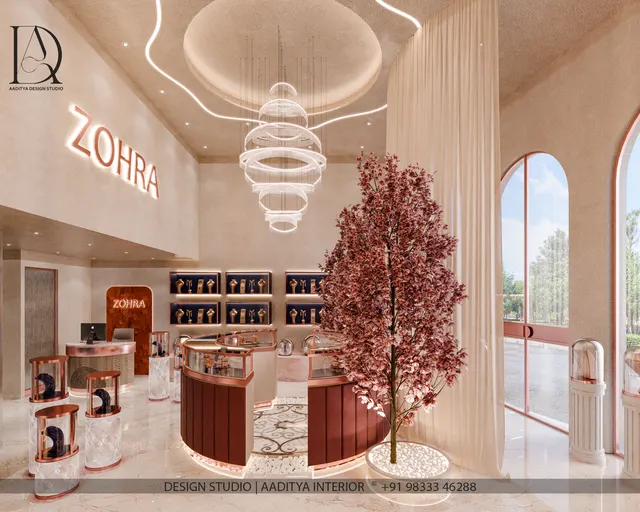
A jewellery shop is among the most carefully planned of all retail spaces, and in India it is also among the most closely guided by vastu. The reasons are practical as much as traditional: a jeweller is dealing in high-value, light-sensitive goods that must be shown off brilliantly and secured absolutely, with a billing point that handles large sums and a strongroom or safe whose position is a serious decision. Vastu shastra has long been consulted on exactly these questions — where the valuables rest, where the owner sits, which way the gold faces the light — and a jeweller fitting out a new showroom will almost always want the layout checked against it. A designer who understands both the tradition and the display and security needs can satisfy the client and the shop at once.
As with any shop, much vastu advice for jewellers arrives as structural commands that a leased showroom cannot follow, leaving the owner anxious that the unit is wrong. In truth the strongest effects come from placement, light and order — where the safe sits, which way the cashier faces, how the gold is lit — none of which needs a wall moved. This article sets out the traditional directional guidance for a jewellery shop plainly, alongside the display, lighting and security logic that a jeweller needs, and then gives the non-structural remedies that let the guidance be honoured in a fixed or rented unit.
It is offered as cultural and design guidance. Vastu is a traditional belief system, and nothing here promises wealth, profit, protection from loss or any effect on health or fortune — those rest on the jeweller's buying, pricing, service, security measures and location. What good orientation, lighting and layout can genuinely do is make the gold look its best, make the shop feel ordered and trustworthy, and make the billing and the security work smoothly. That is reason enough to plan it well.
Where jewellery-shop vastu comes from
Vastu shastra arranges a building on a grid of directions, each tied to an element and associated with light, weight or stillness. The scheme favours the north and east for light, growth and openness, and the south and west for weight, stability and rest. Mapped onto a jewellery shop — a building type the ancient texts never knew — this becomes a simple logic: the bright, welcoming, outward-facing activity goes north and east, and the heavy, still, protected things go south and west. The safe, the most weighted and most guarded object in the shop, belongs in the south-west, the quarter of stability and rest; the owner, overseeing all, sits in the same stable corner facing the light. Much of this coincides neatly with how a jeweller would plan the shop anyway: the strongroom in the solid, controlled rear corner, the dazzling display towards the bright front.
That overlap is why the guidance is worth following rather than fighting. A jewellery display reads best under bright, even, cool-to-neutral light, which is exactly what a north and east aspect encourages; a safe is most securely placed in a solid, enclosed, well-overseen corner, which is exactly where the south-west falls. Read the directions below as a tradition that, for a jeweller, mostly points the same way as good display design and sound security.
The entrance and the owner's position
The favoured directions for a jewellery shop's entrance are north, east and north-east — bright, auspicious and, in practice, welcoming and well-lit, which matters for a shop that lives on walk-in confidence. Where the unit faces south or west, vastu offers remedies rather than refusal, and a busy-road south frontage can be commercially strong. The owner's seat and the main cash and billing point belong in the south-west, the stable quarter, with the owner and cashier facing north or east and a solid wall behind them, overseeing the entrance, the display and the floor. For a jeweller this command position is also a security position: the person handling money and valuables sees the whole shop and the door. The counter is kept out of direct line with the entrance and clear of overhead beams.
The safe and the valuables
For a jeweller the position of the safe is the decision vastu is most often consulted on, and the traditional answer is the south-west — the quarter of weight, stability and rest, the most solid and most controlled corner of the shop. A safe placed there is held to be secure and settled, and in security terms the south-west rear corner is indeed where a strongroom or safe is best placed: against solid walls, away from the frontage and the glass, in the part of the shop most easily overseen and hardest to reach from outside. Tradition commonly adds that the safe should open towards the north or the east, the directions of prosperity, which is a harmless placement choice easily honoured. The valuables, the heavy stock and the owner's cabin all sit comfortably in this same stable quarter, leaving the bright front for the display.
| Element | Traditional direction | Owner / staff faces | Practical reason it also works |
|---|---|---|---|
| Main entrance | North, east or north-east | — | Bright, welcoming frontage; walk-in confidence |
| Safe / strongroom | South-west | Opens to north or east | Solid, controlled, overseen rear corner |
| Owner's cabin / cash | South-west | North or east | Command and security position |
| Main gold display | North and east | — | Bright, even light flatters the gold |
| Billing counter | South or south-west | North or east | Oversees the door, display and floor |
| Centre of the shop | Kept open | — | Clear circulation and sightlines |
| Reception / waiting | North-east | — | Bright, calm, near the entrance |
Lighting and the gold display
Nothing matters more to a jewellery shop than light, and here vastu and display design agree completely. The main display belongs towards the north and east, where bright, even, cool-to-neutral light falls — and good jewellery lighting is exactly that: high in colour rendering so that gold, diamonds and gemstones show their true colour and fire, bright on the pieces themselves and controlled to avoid glare off the glass. In practical terms that means display lighting with a high colour-rendering index, typically above 90, at a neutral-to-cool colour temperature around 3500 to 4000 kelvin for white metals and diamonds, with warmer accents where gold is shown; crisp, focused spotlights inside the showcases; and general lighting kept even so the eye is drawn to the pieces, not the fittings. A north-and-east-facing display catches the steady daylight the tradition favours and the bright, true light the gold needs, at the same time.
When the unit cannot be changed
A jewellery shop is almost always a fixed or leased unit with a set entrance and shape, and this is where owners wrongly conclude that vastu is out of reach. The remedies that matter most are non-structural: placing the safe in the south-west corner within the given walls, orienting the counter so the cashier faces north or east, keeping the bright display to the north and east, lighting any dead corner, and keeping the centre and the frontage clear. A south or west entrance is simply kept bright, clean and welcoming. None of this requires demolition, and a jeweller should be wary of any advice that demands breaking walls or blocking the only entrance — it is rarely necessary and never a substitute for real security measures, which are a separate, professional matter.
| Situation (fixed unit) | Non-structural remedy | What it actually does |
|---|---|---|
| Entrance faces south or west | Keep it bright, clean, welcoming; strong lighting and signage | An inviting frontage, whatever the direction |
| Safe cannot go in exact SW | Place it in the most solid, overseen rear corner available | Secure, settled, away from the glass front |
| Counter near the door | Shift it within the unit; angle so staff face north/east | Billing oversees the door, display and floor |
| Dark display corner | Add high-CRI spotlights; a mirror to spread light | Lifts the corner; shows the gold better |
| Cluttered centre | Clear the middle; fixtures to the side walls | Circulation and sightlines for security too |
| Beam over the counter | Relocate the counter from under the beam | A more comfortable, open billing point |
Fit-out costs for a jewellery shop
Aligning a jewellery shop with vastu adds little to the fit-out, which is dominated by display showcases, lighting and the safe — all needed whatever the orientation. The figures below are indicative October 2026 ranges for Indian metros and tier-2 cities and should be confirmed with a local supplier before budgeting; jewellery display and lighting vary widely with quality. The specifically vastu-related items — repositioning the safe or counter, a mirror, better light in a corner — are small against the whole. The safe itself is a security purchase whose rating and installation matter far more than its direction, and Aaditya Interior plans jewellery fit-outs so the directional guidance is met inside the given unit without compromising display or security.
| Fit-out element | Indicative cost (October 2026) | Notes |
|---|---|---|
| Display showcases (glass, lit) | ₹1,500–6,000 per running ft | High-CRI lighting inside each case |
| Jewellery display lighting | ₹150–500 per sq ft of floor | CRI 90+, around 3500–4000 K, focused spots |
| Safe / locker (rated) | ₹25,000–1,50,000+ | A security decision; rating matters most |
| Billing counter (built-in) | ₹20,000–70,000 | South-west; cashier faces the floor |
| Vitrified / stone flooring | ₹80–300 per sq ft | Light, reflective tones suit the display |
| Vastu remedies (mirror, repositioning) | ₹500–5,000 | Placement and light, not structural change |
The showcase and the billing point
The showcase is where the gold meets the customer, and its design decides whether a piece dazzles or disappoints. A display counter is comfortable to lean over and look into at a height of about 900 to 1050 mm, with the viewing glass tilted slightly towards the customer and lit from inside by focused, high colour-rendering spotlights that bring out the fire of a diamond and the warmth of gold. Glare is the enemy: a bright fitting reflected in the glass hides the piece, so the light sources are tucked above and in front of the pieces, out of the line of sight. The showcase section below shows the proportions and the light position that work. Placing the main showcases towards the north and east, the vastu-favoured and best-lit side, lets the steady daylight and the display lighting work together.
| Showcase element | Recommended figure | Why |
|---|---|---|
| Counter / viewing height | 900–1050 mm | Comfortable to lean over and look into |
| Internal lighting | CRI 90+, about 3500–4000 K | True colour and fire in gold and diamonds |
| Spotlight position | Above and in front, out of sight line | Light on the pieces, no glare off the glass |
| Glass | Clear, slightly tilted to the customer | Reduces reflection, draws the eye in |
| General floor lighting | Even, lower than the showcases | Eye drawn to the pieces, not the fittings |
The billing point completes the pair. Placed in the south or south-west, with the cashier facing north or east and a solid wall behind, it oversees the entrance, the display and the whole floor — the vastu command position and the security position at once. It is kept clear of the direct line of the door and out from under any beam, and it carries its own good light so that counting and checking are easy. The plan detail below shows the orientation; it is the same discipline a jeweller would arrive at for security alone, which is why the tradition and the practical layout sit so comfortably together here.
Where jewellery-shop vastu is going
Jewellery retail is moving towards brighter, more open showrooms with better colour-accurate lighting and more experiential display, and these trends sit comfortably with the vastu emphasis on light to the north and east and an open centre. Standardised mall units and leased high-street shops leave little room to choose a direction, so the emphasis has shifted, as with all retail vastu, to placement and light within a fixed shell — the safe in the solid rear corner, the counter overseeing the floor, the gold under true light. Security technology advances independently of all this and should always be treated as a separate, professional matter. The likely future is quiet integration: a bright, ordered, true-lit showroom that happens to honour the directions, with its security designed by security experts rather than by orientation.
Rules for a vastu-aligned jewellery shop
- Make the entrance bright, clean and welcoming, whatever direction it faces.
- Place the safe and valuables in the south-west — the solid, controlled, overseen rear corner.
- Seat the owner and cashier in the south-west facing north or east, overseeing the door and display.
- Keep the main gold display towards the north and east, under bright, high-CRI, colour-accurate light.
- Keep the centre open for circulation and clear sightlines, which helps security too.
- Do not place the counter in direct line with the door or under a beam.
- Treat the safe's rating, alarms, CCTV and insurance as separate professional security decisions.
- Follow vastu through placement and light, not demolition, and make no promise about profit or fortune.
Frequently asked questions
Where should the safe be placed in a jewellery shop as per vastu?
Traditional vastu places the safe in the south-west — the quarter of weight and stability — ideally opening towards the north or east. This also happens to be sound security practice, because the south-west rear corner is the most solid, controlled and easily overseen part of the shop, away from the glass frontage. The direction, though, is never a substitute for a properly rated safe, alarms, CCTV and insurance, which are separate professional decisions.
Which direction should a jewellery shop entrance face?
North, east or north-east are the favoured directions, associated with light and prosperity and, in practice, making for a bright, welcoming frontage that supports walk-in confidence. A south or west entrance is not considered unworkable; it is kept bright, clean and well-lit, and on a busy road it can be a strong commercial position in its own right.
How should jewellery be lit and displayed?
Towards the north and east, under bright, even light with a high colour-rendering index — typically CRI above 90, at a neutral-to-cool colour temperature around 3500 to 4000 kelvin for white metals and diamonds, with warmer accents for gold. Focused spotlights inside the showcases make the pieces sparkle, while general lighting is kept even so the eye is drawn to the jewellery, not the fittings. This is both the vastu-favoured aspect and the best display practice.
Does vastu guarantee profit or protection from loss for a jeweller?
No. Vastu is a traditional belief system, and this guidance makes no promise about profit, protection from theft or loss, or fortune, all of which depend on the jeweller's buying, pricing, service, security measures and location. Security in particular — a rated safe, grilles, alarms, CCTV and insurance — is a separate professional matter that stands entirely apart from the direction anything faces.
Can vastu be followed in a rented jewellery showroom?
Yes. Most jewellery shops are leased units, and the strongest vastu effects come from placement and light, which a tenant can control: the safe in the solid south-west corner, the counter oriented so staff face north or east, the display bright towards the north and east, the centre kept open. These follow the spirit of the guidance without any structural change, which is rarely necessary and should be treated with caution.
Sources & standards
- Traditional Indian vastu shastra principles for commercial buildings, as commonly documented in standard texts on vastu and architecture
- Ernst Neufert, Architects' Data — retail, showroom and display planning dimensions and circulation
- Time-Saver Standards for Building Types — retail and store layouts, lighting for display
- Bureau of Indian Standards — IS codes for interior and display illumination in commercial spaces, including colour rendering guidance
- National Building Code of India 2016, Part 4 (Fire and Life Safety) and Part 8 (Building Services) — mercantile occupancies, lighting and ventilation
- Price ranges: indicative October 2026 estimates — confirm locally before budgeting