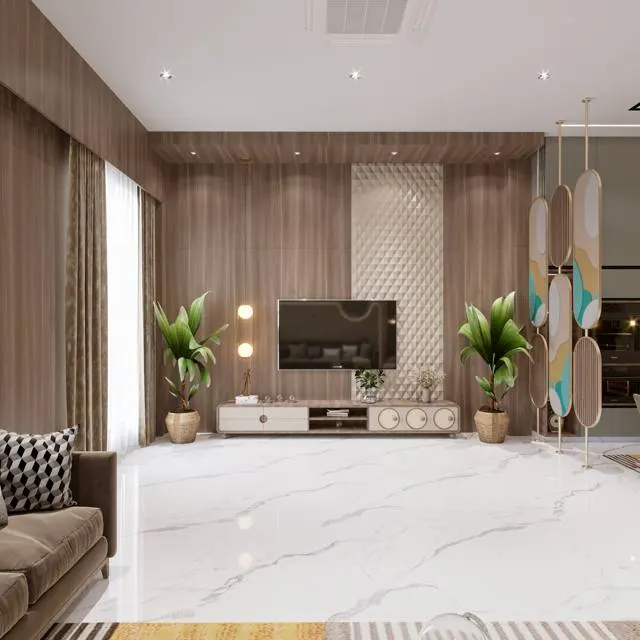
The air conditioner is one of the newest things in an Indian home, and it is the one most often added after the room is finished — a hole drilled through the wall, a unit screwed up wherever the pipe reaches most easily, and a condenser hung on the nearest ledge. Because it arrives late and unplanned, it is also the fitting most likely to break both the look of a room and, for the many families who care about it, the vastu of the house. A split unit mounted above the head of the bed, blowing cold air straight down onto sleeping people, with its outdoor unit roasting in the north-east corner, manages to offend comfort, health and tradition all at once.
Vastu Shastra, the traditional Indian system that assigns qualities to directions, has plenty to say about air, heat and water, and air conditioning touches all three. The indoor unit moves air; the outdoor unit makes heat; the drain carries water. Classical vastu did not know the machine, but it did map the directions to elements — fire to the south-east, water and lightness to the north-east, air to the north-west — and practitioners today read the air conditioner against that map. The useful thing, for a designer, is that most of the commonly cited vastu guidance for an AC lines up neatly with how the machine actually wants to be installed. Where they agree, follow both; where they clash, physics has to win, because a badly placed condenser will fail whatever the compass says.
This guide sets out the commonly cited vastu directions for the indoor and outdoor units, explains the airflow, drainage and service reasons that sit behind them, and then works room by room — bedroom, living room, pooja room, kitchen and home office — before listing the fixes that respect tradition without demolishing a finished wall. It treats vastu as cultural guidance that many clients value, not as a technical code, and it never lets a direction override safety or the manufacturer's clearances.
Where vastu guidance on air comes from
Vastu Shastra grew out of older Indian treatises on building and settlement, and its core idea is simple: a building sits within a field of directions, each carrying an element and a quality, and a well-made house works with that field rather than against it. The eight directions are paired with elements and guardians — fire with the south-east, water and openness with the north-east, the wind or air principle with the north-west, heaviness and earth with the south-west. Light and water were to be welcomed from the north-east, where the morning sun is gentle; heat and fire were assigned to the south-east, where the kitchen and the electrical heart of the house traditionally sit. These were practical observations about sun, wind and water in a hot climate as much as they were metaphysics.
An air conditioner does not appear in any classical text, so everything said about it is interpretation by modern practitioners reasoning from those element-direction pairings. The indoor unit is treated as a mover of cool air; the outdoor unit, which expels heat and hums with a compressor, is treated as a source of heat and mechanical disturbance and is therefore kept away from the calm, light north-east and placed where heat already belongs. Because the reasoning is interpretive, different practitioners differ in detail, and a sensible designer presents the widely agreed points, flags where opinions vary, and never pretends a modern machine is governed by an ancient rule. What follows is the commonly cited consensus, offered as cultural guidance.
The vastu logic for AC direction
The commonly cited guidance can be summarised in a few lines. The indoor unit is best placed on the north or the west wall of a room, so that it blows across the space rather than from the disturbed southern or heat-bearing south-eastern side; the east is considered acceptable. The outdoor condenser is best placed to the south-east or the north-west — the fire and air zones — and is specifically kept out of the north-east, which vastu asks to be left light, open and cool, and out of the heavy south-west, which should stay solid and undisturbed. The figure below maps these onto a simple room. None of it is a safety requirement; it is a tradition that happens, for the most part, to point the same way as good practice.
| Direction | Vastu element / note | Indoor unit | Outdoor unit |
|---|---|---|---|
| North | Kubera, prosperity; cool side | Preferred | Acceptable |
| North-east | Water, light; keep open | Avoid | Avoid |
| East | Sunrise; positive | Acceptable | Acceptable |
| South-east | Fire zone (Agni) | Avoid for indoor | Preferred |
| South | Yama; heat | Avoid | Acceptable |
| South-west | Earth; heavy, solid | Avoid | Avoid |
| West | Varuna; acceptable | Preferred | Acceptable |
| North-west | Air (Vayu); movement | Acceptable | Preferred |
The indoor unit: height, throw and the bed
Vastu fixes the wall; comfort fixes the height and the throw, and this is where most installations go wrong whatever the compass says. A wall-mounted split unit should sit near the top of the wall, with about 150–300 mm of clear space above it to the ceiling so it can draw return air freely, which usually puts the top of the unit at roughly 2200–2400 mm from the floor in a standard room. The single most important rule — more important than any direction — is that the unit must not blow cold air straight onto the bed or the main seating. Air thrown directly and continuously onto a sleeping body dries the throat, stiffens the neck and wakes people; thrown across the room to mix before it falls, the same air cools comfortably. Mount the unit on a side wall so its throw runs along the length of the bed, not on the wall behind the headboard pointing down at the pillows.
The drain matters as much as the direction. A split unit's indoor tray collects condensate that must run outside under gravity, so the drain pipe needs a continuous fall from the unit to the discharge point — a common cause of a dripping, smelly indoor unit is a drain that sags or runs uphill. Plan the core hole through the wall to sit slightly below the indoor unit and to slope outwards, and keep the copper pipe run short and gently bent; long, kinked runs lose efficiency. These are the details that decide whether the machine is pleasant to live with, and no direction compensates for getting them wrong.
The copper pipe between the two units has its own quiet limits that affect where each can go. Most split systems are happy with a run of a few metres and a modest height difference between indoor and outdoor units; longer runs and larger vertical separations reduce efficiency and, past the manufacturer's stated maximum, need extra refrigerant and oil traps. In practice this means the preferred vastu wall and the preferred condenser corner should not be at opposite ends of a long, twisting pipe route. When the air conditioning is planned on the drawings, the pipe path is drawn too, so that the indoor unit, the core hole, the drain fall and the outdoor bracket form one short, clean line rather than a compromise stitched together on site after the plaster has set.
The outdoor unit: the placement that matters most
If one part of an air conditioner must be placed well, it is the outdoor unit — the condenser — because it is the part that fails when placed badly, and replacing a burnt-out compressor is expensive. The condenser rejects the heat the system removes from the room, so it needs to breathe: cool air in through its coil, hot air out through its fan, with nothing recirculating. Vastu's preference for the south-east or north-west is easy to honour because those are usually external walls or terraces; what vastu cannot relax is the clearance the machine needs. Crammed into a tight duct or a boxed-in balcony with no airflow, a condenser in the most auspicious corner of the house will still overheat, trip and shorten its own life.
| Condenser clearance | Minimum | Why it matters |
|---|---|---|
| Fan / discharge face to any obstruction | 500–1000 mm | Hot air must escape or it recirculates and the unit trips |
| Coil / air-intake side to wall | 150–250 mm | Starves the coil of cool air if tighter |
| Rear to wall | 100–150 mm | Allows air and service access |
| Above the unit to a soffit or ledge | 500 mm or more | Hot exhaust rises; a close soffit traps it |
| Between two condensers facing each other | 1000 mm or more | Stops one unit eating the other's hot air |
| Service access on at least one side | about 600 mm | Needed to clean the coil and check the gas |
Room by room
The general rules bend a little by room, because each room has a different thing that must not be blown on and a different wall available. The table below gives the commonly cited vastu preference and the comfort priority together, so the two can be weighed. In every case the comfort priority is the one that must not be broken; the vastu preference is honoured where the room allows it.
| Room | Vastu preference (indoor unit) | Comfort priority | Outdoor unit |
|---|---|---|---|
| Master bedroom | North or west wall | Not over the headboard; throw along the bed | South-east or north-west terrace |
| Living room | North or west wall | Not straight onto the main sofa | External wall, well ventilated |
| Pooja room | Avoid a unit here if possible | Keep the space calm; a vent is better | Not applicable |
| Kitchen | West wall if cooled | High up, away from the hob's heat and grease | South-east, away from the flue |
| Home office | North or west wall | Not onto the screen-facing seat | Shaded external wall |
The pooja room deserves a note. Many families prefer not to place an air conditioner in or blowing into the pooja room at all, treating it as a quiet, undisturbed space; where the room is part of a larger hall that is cooled, a gentle indirect flow that does not blow on the deities or the seated worshipper is the usual compromise. In the kitchen, the priority is entirely practical: a unit placed low or near the hob will foul its filter with grease and fight a losing battle against the cooking heat, so it goes high and well away from the flame, if it is fitted at all.
When vastu and engineering disagree
Sometimes the only external wall faces north-east, or the only place the condenser can hang is the forbidden corner, or the single sensible wall for the indoor unit is the one vastu would avoid. When tradition and the machine disagree, the machine wins, because a condenser that cannot breathe or a drain that cannot fall will fail regardless of the compass, and a failed air conditioner serves nobody. The honest way to handle it is to tell the client plainly where the conflict is, offer the best available compromise, and apply the symbolic remedies that practitioners accept — a different corner within the permitted zone, a small screen, a plant — rather than forcing an unworkable installation. Aaditya Interior's approach on such projects is to plan the air conditioning on the drawings early, so that the preferred vastu direction and the engineering clearances are reconciled before the walls are built, when both can usually still be satisfied.
Practical fixes without breaking walls
Most AC-vastu problems appear after the room is finished, when moving the unit means re-plastering and repainting. Several fixes respect the tradition without that upheaval. If the indoor unit blows onto the bed, redirecting the louvres and using the fan's swing to throw air upward and across often solves the comfort problem without moving anything. If the unit cannot be moved off a less-preferred wall, practitioners commonly accept keeping the north-east of the room clutter-free and light as a balancing measure. A condenser in a tight spot can be lifted onto a taller stand or turned slightly to clear its own exhaust. The table below pairs the common complaint with a fix that does not involve demolition.
| Problem | Low-disruption fix | When to rebuild instead |
|---|---|---|
| Cold air blows onto the bed | Angle louvres up and across; use swing mode | If the unit is directly over the pillows |
| Indoor unit on a less-preferred wall | Keep north-east light and open as a balance | During a full renovation only |
| Condenser trips in hot weather | Raise on a stand, turn to clear its exhaust | If no clearance can be won in place |
| Drain drips indoors | Re-slope the drain pipe for continuous fall | If the core hole slopes inward |
| Unit too low, fouls with dust or grease | Shift up at the next service with a new bracket | If the wall cannot take a higher core hole |
Where this is going
Air conditioning in Indian homes is moving towards inverter units that run continuously at low speed rather than cycling on and off, towards quieter condensers, and towards systems planned into the building from the start instead of bolted on afterwards. As homes are designed with the air conditioning drawn in from the beginning, the old conflict between vastu and engineering largely dissolves, because the preferred direction and the required clearances are reconciled on paper while the walls are still lines on a drawing. The tradition will keep being consulted, as it is for every other element of the Indian home, but the best outcome — a unit that cools well, drains properly, lasts long and sits where the family is comfortable with it — comes from planning, not from apology after the fact.
Rules for placing an air conditioner
- Plan the air conditioning on the drawings before the walls are built, so vastu and clearances are reconciled early.
- Never mount the indoor unit over the headboard blowing down; put it on a side wall and throw the air along the bed.
- Give the indoor unit 150–300 mm of clear space above it for return air, with its top near 2200–2400 mm.
- Slope the condensate drain continuously from the indoor unit to outside, with the core hole falling outward.
- Give the condenser at least 500–1000 mm of free air at its fan face and never box it into a dead pocket.
- Keep the commonly cited vastu preferences — indoor on north or west, outdoor in south-east or north-west — where the room allows.
- Keep the north-east light and open, and avoid loading the heavy south-west, as a traditional balance.
- When tradition and the machine conflict, let the machine win and apply an accepted symbolic remedy instead.
Frequently asked questions
Which direction should an air conditioner face as per vastu?
Commonly cited vastu places the indoor unit on the north or west wall so it blows across the room, with east acceptable, and keeps it off the south and south-east. The outdoor condenser is preferred in the south-east or north-west and kept out of the north-east. These are cultural preferences; the comfort rule that the air must not blow onto the bed matters more than the compass.
Can an AC outdoor unit be installed in the north-east?
Vastu generally advises against it, asking that the north-east be kept light, open and cool rather than loaded with a hot, humming machine. If the north-east is the only workable spot, honour the engineering clearances first, keep the rest of that corner open, and apply an accepted balancing remedy. A condenser that cannot be placed well anywhere else should still be placed where it can breathe.
Is it bad vastu to have an AC in the bedroom?
No — a bedroom is one of the most common and accepted places for an air conditioner. Vastu guidance is about where within the room the units sit, not whether a bedroom may be cooled. Place the indoor unit on the north or west wall, throw the air along the bed rather than onto it, and site the condenser outside in a preferred zone with proper clearance.
Why should the AC not be placed above the bed?
Partly comfort and partly tradition. Cold air falling continuously onto a sleeping body dries the throat and stiffens the neck, and many people sleep poorly under a downward draught. Vastu also discourages a heavy machine over the head of the bed. Mounting the unit on a side wall so the throw runs along the bed solves both concerns at once.
Does the direction of the AC really affect anything?
The direction of the outdoor unit genuinely affects performance — a condenser that cannot breathe or drain will fail wherever it is placed. The vastu direction of the indoor unit is cultural preference rather than a technical factor, but because the preferred walls also happen to give a better throw across the room, following the guidance usually improves comfort too. Treat the engineering as non-negotiable and the vastu as valued guidance.
Sources & standards
- Traditional Vastu Shastra principles on the eight directions and their associated elements (Agni south-east, water north-east, Vayu north-west), as commonly cited by practitioners
- Bureau of Indian Standards — National Building Code of India 2016, Part 8 (building services) for ventilation and air-conditioning provisions
- Bureau of Energy Efficiency (BEE) star-rating guidance for room air conditioners and inverter units
- Manufacturer installation manuals for split and VRF air conditioners — standard indoor mounting heights and outdoor-unit clearances (described generically)
- Neufert, Architects' Data — guidance on air movement, comfort and mechanical services in rooms
- Price ranges: indicative October 2026 estimates — confirm locally before budgeting