Once the carcass of a wardrobe or a kitchen is built, one decision does more than any other to set how it looks, how it wears and what it costs: the finish on the visible surfaces, the shutters and panels that the eye and the hand actually meet. In Indian homes the choice most often comes down to two materials that look superficially similar on a sample board but behave very differently in use — natural veneer, a thin slice of real wood bonded to the board and then polished, and laminate, a printed decorative sheet bonded under heat and pressure. Buyers routinely choose between them on the showroom sample alone, swayed by a grain they like, and are surprised later when the veneer scratches or the laminate looks less rich than the wood they imagined.
The two materials are not competing to be the same thing. Laminate is a hard, resin-bonded sheet printed with a pattern — a wood grain, a solid colour, a stone, a fabric — that is tough, water-resistant and almost maintenance-free, which is why it dominates Indian kitchens and value furniture. Veneer is the real thing: a slice of genuine timber, each sheet unique in its grain, giving a warmth and depth that a print cannot match, at the cost of being softer, needing care, and costing more. Choosing well is not about which is better in the abstract; it is about matching each material to the room and the surface, so the finish survives what that surface has to endure while looking the way its owner wants.
This article compares veneer and laminate for Indian wardrobes and kitchens: how each is made and applied, how they differ in durability, water resistance, repairability and appearance, what each costs in indicative October 2026 terms, and a clear rule for where to use which. The aim is to let a homeowner or designer specify the finish by the demands of the surface — the heat and splash of a kitchen, the touch and gaze of a wardrobe — rather than by a sample seen under showroom lights.
What each material actually is
A laminate is a decorative sheet, usually around a millimetre thick, made of layers of paper impregnated with resin and fused under heat and pressure: a printed decorative layer carrying the pattern, protected by a clear wear layer, over a backing of kraft paper. It is manufactured flat in standard sheets and bonded to the board — plywood, MDF or particle board — with adhesive, and its edges are closed with a matching edge band. Because the surface is a cured resin, it is hard, water-resistant, resists scratches and heat far better than wood, and needs no polishing; the pattern is a print, so it can imitate anything from teak to marble to linen, consistently and cheaply. A veneer, by contrast, is a genuinely thin slice of real wood — often around half a millimetre — peeled or sliced from a log and bonded to the board, then sanded and finished on site with a clear coat such as melamine, PU or lacquer. The grain is real and every sheet differs, which is the whole point of it.
Both veneer and laminate come in several forms, and knowing the main ones avoids buying the wrong product on the strength of a single sample. Among laminates, high-pressure laminate is the familiar tough decorative sheet of about a millimetre used for shutters and worktops, low-pressure laminate is fused directly to a board and used for carcass liners and interiors, and the newer matt and textured laminates add an anti-fingerprint, grain-textured surface for premium fronts. Among veneers, natural veneer is the real sliced timber prized for its unique, variable grain, reconstituted or engineered veneer gives a consistent, repeatable grain across a long run, and the choice of species — teak, walnut, oak and the rest — sets the colour and the figure of the wood. The table lays out the common types and where each is used, so a buyer can ask for the right one by name.
| Type | Description | Typical use |
|---|---|---|
| High-pressure laminate (HPL) | Tough decorative sheet, about 1 mm | Kitchens, shutters, busy surfaces |
| Low-pressure laminate | Fused to the board, thinner | Carcass liners and interiors |
| Matt / textured laminate | Anti-fingerprint, grain texture | Premium shutter fronts |
| Natural veneer | Real sliced timber, unique grain | Feature fronts and panels |
| Reconstituted veneer | Engineered, consistent grain | Long runs needing a match |
| Teak / walnut / oak veneer | Species of natural veneer | Chosen for the look wanted |
How they compare in use
The differences that matter show up in daily use, not on the sample. On hardness and scratch resistance, laminate wins clearly — its cured resin surface shrugs off the knocks, abrasion and cleaning that a kitchen or a busy wardrobe delivers, while veneer, being real wood under a clear coat, is softer and scratches more easily. On water and heat, laminate again leads, resisting the splash of a kitchen and the heat near a hob far better than a polished wood surface, which can mark, swell at the edges or lose its finish if water sits on it. On appearance, veneer wins decisively for anyone who wants real wood — the grain has depth, variation and warmth that a print, however good, cannot fully reproduce, and no two veneer panels are identical. On repair, the two differ in kind: a scratched laminate cannot be mended and the panel is usually replaced, whereas a scratched or dulled veneer can often be sanded and re-polished, so a veneer surface can be refreshed over the years while a laminate is essentially permanent until replaced.
| Measure | Laminate | Veneer |
|---|---|---|
| What it is | Printed resin-bonded sheet | Thin slice of real wood |
| Hardness / scratch | Very good | Softer; scratches more easily |
| Water and heat | Resists both well | Can mark, swell, lose finish |
| Appearance | Good print; uniform | Real grain, depth, every sheet unique |
| Repairability | Replace the panel | Can sand and re-polish |
| Maintenance | Wipe clean; none | Needs care and occasional polish |
| Cost | Lower | Higher |
One more difference is easy to miss on a sample board but matters over the life of the furniture: how each ages. A laminate looks on the last day much as it did on the first, because its printed surface does not change — which is a strength on a hard-working shutter and a limitation on a surface meant to grow richer with time. Veneer, being real wood, ages and mellows, its colour deepening and its grain gaining character over the years, and it can be sanded back and re-polished if it dulls, so a veneer surface can be renewed rather than replaced. Neither behaviour is better in the abstract; a kitchen wants the finish that stays the same, and a feature wall often wants the one that matures. Choosing with ageing in mind is part of matching the finish to the surface.
Why laminate rules the kitchen
The kitchen is the most punishing surface environment in the home, and it plays to every one of laminate's strengths. Shutters are splashed with water and oil, wiped down daily with cleaners, knocked by pans and crockery, and exposed to the heat and steam of cooking, and a finish there must take all of that for years without complaint. Laminate does exactly this: the hard resin surface resists the water, the heat, the scratches and the cleaning, and because it is a sealed print it does not stain or swell the way a polished wood surface can. It is also far cheaper, which matters across the large area of shutters a kitchen has, and it comes in every colour and pattern, so a kitchen can have any look — including a convincing wood grain — at a fraction of veneer's cost and care. For the overwhelming majority of Indian kitchens, laminate on a moisture-resistant board is simply the right answer, and veneer is reserved, if used at all, for a feature panel well away from the wet and hot zones.
Why veneer belongs on a feature wardrobe
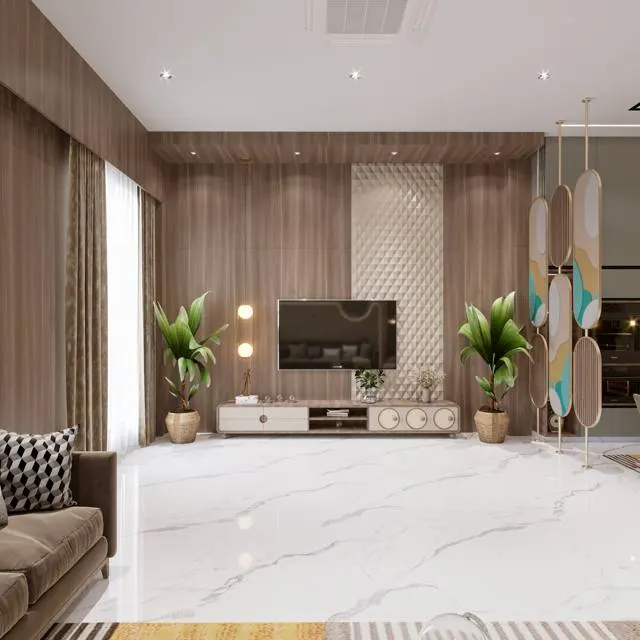
Where laminate is chosen for what it endures, veneer is chosen for how it looks and feels, and the right home for it is a surface that the eye lingers on and the hand treats gently. A feature wardrobe front in a bedroom, a wall of panelling in a living room, a headboard, a study desk, a television unit, a pooja-room surround — these are surfaces where the warmth and depth of real wood lift the whole room, and where the gentle wear means the softer finish survives easily. Veneer rewards this use richly: the genuine grain gives a character no print matches, the panels can be book-matched so the grain flows across a run, and the surface can be sanded and re-polished years later to look new again. The care it needs — wiping spills promptly, keeping it out of wet and hot zones, occasional polishing — is no burden on a wardrobe or a living-room panel, which is exactly why veneer belongs there rather than on a kitchen shutter. The sensible instinct is to spend on veneer where it will be seen and admired, and to let laminate do the hard, unglamorous work elsewhere.
| Zone | Recommended finish | Why |
|---|---|---|
| Kitchen base and wall shutters | Laminate | Water, heat, oil, daily cleaning |
| Kitchen tall unit near hob | Laminate | Heat and splash; needs a sealed surface |
| Wardrobe daily shutters | Laminate | Frequent touch and knocks; low maintenance |
| Feature wardrobe front | Veneer | The eye lingers; a real-wood look is wanted |
| TV unit, headboard, panelling | Veneer | Gentle wear; warmth lifts the room |
| Pooja / study feature surface | Veneer | A showcase surface, treated with care |
What each finish costs
Cost is a real part of the decision, especially across the large surface area of a kitchen or a wall of wardrobes. The indicative October 2026 ranges below are per square foot of finished shutter surface, material plus application, excluding GST, for metros and tier-2 cities, and should be confirmed locally before budgeting. Laminate is the value choice and the reason it dominates; veneer costs more in material and, because it is finished and polished on site, more in skilled labour too. The other common finishes are included for comparison, since a buyer choosing between veneer and laminate is often weighing membrane, acrylic and PU as well.
| Finish (shutter, per sq ft) | Indicative cost (October 2026) | Notes |
|---|---|---|
| Laminate shutter finishing | ₹350–650 | Best value; sheet material alone about ₹42–56 per sq ft |
| Natural veneer shutter | ₹600–1,100 | Real wood, polished on site; book-matching possible |
| Membrane / foil shutter | ₹500–850 | Budget route to routed and curved fronts |
| Acrylic shutter | ₹900–1,500 | Mirror gloss; premium over laminate |
| PU paint shutter | ₹1,000–1,800 | Seamless colour; slow multi-coat process |
| Edge banding (per running ft) | Verify locally | Closes laminate and veneer edges neatly |
How to choose, surface by surface
The cleanest way to decide is to forget the showroom and ask what each surface has to endure. If the surface meets water, heat, oil or constant hands — a kitchen shutter, a bathroom vanity, a daily wardrobe door — choose laminate, because it will take the punishment and wipe clean for years, and choose a convincing wood-grain laminate if a timber look is wanted there. If the surface is admired more than it is abused — a feature wardrobe front, a living-room panel, a headboard, a desk — and a real-wood look is worth a little care, choose veneer, and treat it gently. Many well-designed homes use both deliberately: laminate across the kitchen and the everyday wardrobe shutters, veneer on the one or two feature surfaces that set the tone of a room. That is not a compromise but the correct answer, spending the finish budget where it shows and saving it where it only has to work.
- Decide each surface by what it endures — water, heat, hands — not by the showroom sample.
- Choose laminate for all kitchen shutters and surfaces near water and heat.
- Choose laminate for daily, high-touch wardrobe and furniture fronts for low maintenance.
- Choose veneer for feature wardrobe fronts, TV units, headboards and panelling.
- Keep veneer out of wet and hot zones, and wipe spills on it promptly.
- Use a convincing wood-grain laminate where a timber look is wanted on a hard-working surface.
- Bond either finish to a moisture-resistant board — BWR ply or HDHMR — not plain MDF near water.
- Close every exposed edge with a matching edge band so the finish does not lift.
- Budget for veneer only where it is seen and admired, and let laminate do the rest.
Where surface finishes are heading
The finish market is widening at both ends, which makes matching the finish to the surface easier rather than harder. Laminates keep improving — anti-fingerprint and matt-textured surfaces, deeper and more convincing wood and stone prints, and synchronised textures where the surface feel follows the printed grain — so a laminate can now mimic real wood closely enough that the eye is often fooled, at a fraction of veneer's cost and care. Veneers are moving towards reconstituted and engineered options that give a consistent, sustainable grain, alongside the traditional natural slices prized for their uniqueness. Alongside both, membrane, acrylic and PU finishes compete for the surfaces in between. The underlying logic will not change, because it comes from physics, not fashion: a surface that meets water, heat and hands wants the hard, sealed resilience of laminate, and a surface admired for the beauty of real wood wants veneer. The widening palette simply means a home can now get closer to exactly the look it wants on each surface while still respecting that rule.
Frequently asked questions
Is veneer or laminate better for a kitchen?
Laminate, for almost every kitchen. A kitchen surface meets water, oil, heat and constant cleaning, and laminate's hard resin surface resists all of that and wipes clean for years, while veneer is softer, can mark or swell near water and heat, and needs care. Laminate is also much cheaper across the large area of kitchen shutters, and a good wood-grain laminate gives a timber look without the vulnerability of real wood. Veneer, if used in a kitchen at all, is kept to a feature panel away from the wet and hot zones.
Does veneer scratch easily?
More easily than laminate, because veneer is real wood under a clear coat rather than a cured resin sheet. On a feature wardrobe front or a living-room panel, where wear is gentle, this is rarely a problem and the surface stays beautiful for years. The advantage is that a scratched or dulled veneer can often be sanded and re-polished to look new again, whereas a scratched laminate cannot be mended and the panel is usually replaced.
Can laminate look like real wood?
Increasingly, yes. Modern laminates use deep, high-resolution wood prints and synchronised textures, where the surface feel follows the printed grain, so a good wood-grain laminate can look and feel convincingly like timber, especially in a matt finish. It will not have the genuine depth and the sheet-to-sheet variation of real veneer, which is what a discerning eye looks for, but for a hard-working surface a wood-look laminate is often the sensible choice over vulnerable real wood.
Which is more expensive, veneer or laminate?
Veneer, generally by a clear margin. Indicative October 2026 ranges put laminate shutter finishing at about ₹350 to 650 per square foot and natural veneer at about ₹600 to 1,100 per square foot, material plus application. Veneer costs more both in material, being real wood, and in labour, because it is sanded and polished on site by a skilled finisher, whereas laminate is a factory-made sheet simply bonded and edge-banded. Confirm current local rates before budgeting.
Can veneer and laminate be used in the same home?
Yes, and it is often the best approach. Many well-designed homes use laminate across the kitchen and the everyday wardrobe shutters, where durability and low maintenance matter, and veneer on one or two feature surfaces — a wardrobe front, a TV unit, a headboard — where the warmth of real wood sets the tone of a room. Using both deliberately spends the finish budget where it shows and saves it where the surface only has to work hard.
Sources & standards
- Bureau of Indian Standards — IS 2046 (decorative laminated sheets) and IS 1328 (veneered decorative plywood), described generically
- Bureau of Indian Standards — IS 303 (plywood) and IS 710 (marine plywood) for the boards finishes are bonded to
- Neufert, Architects' Data — furniture surfaces, finishes and detailing
- Time-Saver Standards for Interior Design and Space Planning — materials and finish selection
- Decorative laminate and veneer manufacturers' standard product ranges, described generically
- Price ranges: indicative October 2026 estimates — confirm locally before budgeting