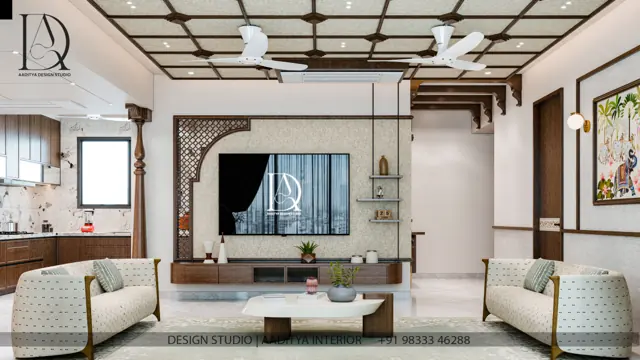
Few material debates in an Indian home are as confused as putty versus POP versus gypsum. The three names are thrown around as if they were competing brands of the same thing, when in fact they do related but different jobs on a wall or ceiling. Putty is a thin finishing skim that prepares a plastered surface for paint. POP — plaster of Paris — is a plaster that smooths, builds cornices and forms false ceilings. Gypsum arrives either as a factory-made board screwed to a frame or as a machine-friendly plaster. Treating them as interchangeable is how homeowners end up with POP cornices peeling in a bathroom or putty cracking over a badly set wall.
The confusion has real cost consequences because the three are priced differently and fail differently. A contractor who quotes POP punning where the surface really needed gypsum board, or putty where the plaster was never cured, is setting up a defect that shows within a year — hairline cracks, damp patches, a cornice that sags. The right choice depends on three things the showroom conversation usually skips: whether the surface is a wall or a ceiling, whether it is dry or exposed to moisture, and how flat the base already is. Get those three answers first and the material almost chooses itself.
This article separates the three cleanly: what each one actually is and how it is made, where it belongs and where it must never go, how thick it goes and how much it covers, how each behaves with water, what each costs in indicative October 2026 terms, and the defects each one throws when misused. The aim is to let any homeowner read a quotation and know whether the material named against each wall and ceiling is the right one — and to know which questions to ask when it is not.
What each material actually is
Wall putty is a fine white powder — either white-cement based or acrylic based — mixed with water to a paste and troweled over plaster in a thin 1 to 2 mm skim. Its only job is to fill the fine pores and level the minor undulations of a cement-plastered wall so that paint goes on smooth and uses less material. White-cement putty is the common, economical choice and has some water tolerance; acrylic putty is smoother, more flexible and slightly more water-resistant, and suits premium finishes. Putty is not a structural layer and not a crack-bridger; it is a primer surface, no more and no less.
Plaster of Paris, POP, is gypsum that has been heated to drive off most of its water and ground to a powder; mixed with water it sets quickly into a hard, smooth white plaster. On walls it is applied as punning — a thin finishing plaster over cement that gives a glass-smooth surface without separate putty. It is also the traditional material for cornices, mouldings and ornamental work, cast in moulds or run in place, and for false ceilings built up on a chicken-wire mesh. POP sets fast and finishes beautifully, but it is a gypsum product at heart, which means it does not like water. The third material, gypsum, is the same mineral in two modern forms: gypsum plaster, a bagged, ready-mix plaster applied by machine or hand straight onto brick or block, and gypsum board, a factory panel of gypsum core faced with paper, screwed to a galvanised-steel frame for walls and false ceilings.
| Property | Wall putty | POP (plaster of Paris) | Gypsum (plaster / board) |
|---|---|---|---|
| Base material | White cement or acrylic | Calcined gypsum | Gypsum (mineral) |
| Form | Powder, mixed on site | Powder, mixed on site | Bagged plaster or factory board |
| Typical thickness | 1–2 mm | 6–12 mm (punning) | 11–20 mm plaster; 12.5 mm board |
| Main job | Smooth plaster for paint | Punning, cornices, ceilings | Straight walls, false ceilings |
| Finish | Matt, paint-ready | Glass-smooth white | Smooth, paint-ready |
| Water tolerance | Low–moderate (acrylic better) | Low — avoid wet zones | Low — keep off wet walls |
Where each one belongs
Putty belongs on every dry internal wall and ceiling that will be painted, over cured cement plaster. It is the standard preparation coat and is usually quoted as part of the painting rate rather than separately. Two thin coats, sanded between, give the smoothest base for emulsion. The one place putty does not belong is a wall that still has active damp or salt — putting putty and paint over a wet wall simply traps the moisture and restarts the problem. On exterior walls a weather-grade exterior putty or a direct exterior coating is used instead of ordinary interior putty, because the ordinary product is not built for sun and rain.
POP punning belongs on dry internal walls and ceilings where a very smooth, seamless finish is wanted and where cornices or mouldings are part of the design. It is the traditional choice for decorative plasterwork and for false ceilings in living rooms and bedrooms. POP must be kept out of bathrooms, open balconies, parapet-side walls and any surface that gets wet or stays damp, because gypsum softens and crumbles with repeated wetting. Gypsum board belongs where a dead-flat wall or a crisp false ceiling is needed quickly and with minimal wet work — partition walls, feature walls, and the vast majority of modern false ceilings — but it, too, is a dry-zone material and should never face a wet wall or an exposed soffit without protection.
| Surface | Best finish | Avoid | Reason |
|---|---|---|---|
| Dry internal wall (painted) | Putty, or POP punning | — | Smooths plaster for paint |
| Living / bedroom ceiling | Gypsum board, or POP | — | Flat, crisp, carries lighting |
| Partition / feature wall | Gypsum board on GI frame | POP over mesh | Dead-flat, fast, dry work |
| Cornice / moulding | POP (cast or run) | Gypsum board | POP casts fine detail |
| Bathroom / wet wall | Waterproof putty + tile / paint | POP, gypsum board | Gypsum softens when wet |
| Exterior wall | Exterior putty + weather coat | Interior putty, POP | Sun and rain degrade them |
Thickness, coverage and build-up
The three materials sit at very different thicknesses, and that difference explains most of their behaviour. Putty is the thinnest at 1 to 2 mm across two coats, which is why it cannot correct an uneven wall — it follows the surface it is laid on, so a wavy plaster stays wavy under smooth putty. POP punning runs 6 to 12 mm and can therefore both smooth and straighten a wall to a degree, filling the undulations that putty only coats. Gypsum plaster is applied at 11 to 20 mm as a direct plaster over brick, replacing cement plaster entirely, while gypsum board is a 12.5 mm panel whose flatness comes from the factory and the frame, not from the plasterer's skill.
Build-up order matters as much as thickness. A correctly finished painted wall is brick or block, then 12 to 15 mm of cement plaster allowed to cure, then 1 to 2 mm of putty in two coats, then primer, then two coats of emulsion. Where POP punning is used, it replaces the putty layer with its own 6 to 12 mm finishing plaster directly over the cement, and the wall is then primed and painted. A gypsum-plastered wall skips cement plaster altogether — gypsum plaster goes straight onto the masonry and is finished smooth, ready for primer. Confusing these sequences is a frequent site error: putty laid on uncured plaster, or paint rushed onto a POP surface before it has dried, both guarantee early failure.
| Material | Thickness | Indicative coverage | Coats / build-up |
|---|---|---|---|
| Wall putty (white cement) | 1–2 mm | 12–16 sq ft per kg (2 coats) | Two thin coats, sanded between |
| Wall putty (acrylic) | 1–2 mm | 10–14 sq ft per kg (2 coats) | Two coats; smoother, flexible |
| POP punning | 6–12 mm | Site-mixed by area | One finishing plaster over cement |
| Gypsum plaster | 11–20 mm | Bag yield by thickness | Direct on masonry, no cement plaster |
| Gypsum board | 12.5 mm panel | Panel 1200 × up to 3600 mm | Screwed to a GI frame, joints taped |
How each behaves with water
Water is the single dimension that decides most wrong-material failures, and the rule is simple: gypsum in any form — POP, gypsum plaster or gypsum board — dislikes water. In a dry living room or bedroom this never matters, but in a bathroom, on a parapet-facing wall, under a leaking slab or in a humid, salt-laden coastal climate, repeated wetting softens the gypsum, blows the finish and leaves a crumbling, stained patch that no repaint will fix until the water is stopped. This is why POP cornices in bathrooms sag and gypsum ceilings under a terrace leak stain and collapse. The material did not fail; it was put where it could not survive.
Putty sits in a middle position. White-cement putty has modest water tolerance and copes with ordinary interior humidity, while acrylic putty is more flexible and a little more water-resistant, which is why it suits kitchens and premium work. Neither is a waterproofing layer, though — a waterproof putty is used specifically before tiling or painting a wet wall, but even then the real water defence is the waterproofing membrane behind it, not the putty itself. For any wet zone the honest approach is to stop the water first with proper waterproofing, keep gypsum products out, and use a water-tolerant finish over a sound, cured cement surface. In Surat and other humid, monsoon-heavy regions this discipline matters more than in a dry inland city.
What each finish costs in India
Costs follow the labour and the wet work more than the powder. Wall putty is usually folded into the painting rate rather than billed on its own: economy emulsion with putty, primer and two coats lists at an indicative ₹12–18 per sq ft of paintable area in October 2026, premium emulsion at ₹20–30, and distemper at ₹7–12 — the putty is the preparation inside those all-in figures. Where putty is quoted separately it is a small line, a few rupees per square foot for two coats. POP punning is a skilled wet trade and runs an indicative ₹18–28 per sq ft of wall as punning, more for cornices and run mouldings which are priced per running foot by profile.
For ceilings the comparison is cleaner because both materials are quoted as finished false ceilings. Plain gypsum board with painting installs at an indicative ₹60–80 per sq ft, POP false ceiling at ₹70–100, PVC panels at ₹50–90, and designer gypsum ceilings with coves and multiple levels at ₹80–180 — all installed, with painting. The lesson in those numbers is that the material debate is almost a distraction: plain gypsum and POP price within shouting distance of each other, and what actually moves a ceiling from ₹70 to ₹180 is the design complexity and the lighting built into it, not the choice between a board and a bag of plaster.
| Work | Indicative cost (Oct 2026) | Unit | Note |
|---|---|---|---|
| Putty + economy emulsion (2 coats) | ₹12–18 | per sq ft | Putty folded into the painting rate |
| Putty + premium emulsion (2 coats) | ₹20–30 | per sq ft | Smoother base, better paint |
| POP punning on walls | ₹18–28 | per sq ft | Skilled wet trade; cornices extra |
| Gypsum board false ceiling | ₹60–80 | per sq ft | Plain, with painting |
| POP false ceiling | ₹70–100 | per sq ft | Plain, with painting |
| Designer gypsum ceiling with cove | ₹80–180 | per sq ft | Driven by levels and lighting, not material |
The defects each one throws when misused
Every one of these materials fails in a recognisable way, and the failure usually points straight back to a wrong choice. Putty that flakes or shows a map of hairline cracks was almost always laid on uncured plaster or over a wall with active damp — the putty is innocent, the base was wrong. POP that crumbles, stains or sags is nearly always POP that met water: a bathroom cornice, a ceiling under a leaking terrace, a parapet-facing wall. Gypsum board that bows, stains or grows a soft patch was either used in a wet zone or left exposed to a slab leak. Reading a defect backward to its cause is the fastest way to stop repeating it.
The diagnostic value of this is practical. When a homeowner sees a finish failing, the instinct is to repaint or re-skim the same surface with the same material, which simply restarts the clock. The honest repair is to read the defect to its cause first — a damp meter on a flaking putty wall, a look above a crumbling POP cornice for the leak feeding it — and fix the cause before touching the finish. Only then does the choice of material matter, and even then the rule is the same: match the finish to the exposure. A wall that keeps failing is a wall whose water problem has never been addressed, and no amount of better putty or finer POP will change that.
- Use putty only over cured, dry cement plaster — never on a wall with active damp or salt.
- Apply putty in two thin coats and sand between; it levels, it does not bridge cracks or correct waviness.
- Use POP punning for a seamless smooth wall and for all cornice and moulding work in dry rooms.
- Keep POP, gypsum plaster and gypsum board out of bathrooms, balconies and any wet or leak-prone surface.
- Use gypsum board on a GI frame for flat partitions, feature walls and the bulk of false ceilings.
- On exterior walls use weather-grade exterior putty and a weather coat, not interior putty or POP.
- Stop water first with proper waterproofing; no finish survives over an unaddressed leak.
- Judge a ceiling quote by its section drawing and lighting, not by the POP-versus-gypsum label.
Where wall finishes are heading
Indian practice is steadily shifting from site-mixed cement plaster plus putty toward ready-mix gypsum plaster and dry board systems, because they are faster, cleaner, need less water and give a flatter result with less dependence on a single plasterer's skill. Gypsum board partitions and false ceilings are already the default in offices and in most new flats, and gypsum plaster is replacing cement plaster on internal walls in many projects. The trades are moving the same way the market moved on plywood and laminate — toward factory consistency and speed on site.
What is not changing is the water rule. Every one of these newer systems is still a gypsum product at heart, so the discipline of keeping gypsum out of wet zones becomes more important, not less, as it spreads. The practices that handle this well — Aaditya Interior among the studios working across humid regions like Surat — specify the material by exposure on a surface-by-surface basis rather than defaulting to one finish for the whole home. The future of wall finishes in India is faster and flatter, but it still rests on the oldest rule in the trade: match the material to the water.
Frequently asked questions
Is wall putty the same as POP?
No. Putty is a thin 1–2 mm skim of white-cement or acrylic powder that smooths cured plaster before paint. POP is plaster of Paris applied 6–12 mm thick for punning, cornices and false ceilings. Putty only levels the surface it is laid on, while POP can both smooth and straighten a wall and can be cast into detail. They overlap on a dry wall but are not the same material.
Which is better for a false ceiling, POP or gypsum board?
Both work in dry rooms and price within a narrow band — POP false ceiling at an indicative ₹70–100 per sq ft, gypsum board at ₹60–80. Gypsum board is faster, drier to install and flatter; POP is better where cast cornices and curved detail are wanted. The design complexity and lighting move the cost far more than the material choice does. Neither belongs in a wet or leak-prone ceiling.
Can POP or gypsum be used in a bathroom?
No. POP, gypsum plaster and gypsum board are all gypsum products that soften and crumble with repeated wetting, so they fail in bathrooms, balconies and any damp zone. Use a cured cement surface with waterproof putty and a water-tolerant paint or tile instead, and stop the water with proper waterproofing first. The finish is only as good as the water defence behind it.
Is putty still needed if the wall has POP punning?
No. POP punning is itself the finishing layer and replaces putty — it gives a glass-smooth surface ready for primer and paint. Putty and POP punning are alternative ways to smooth a wall, not layers to stack. Using putty over POP, or POP over putty, is wasted material and can cause adhesion problems.
Which putty is best, white cement or acrylic?
White-cement putty is the economical, widely used choice with modest water tolerance and suits most dry internal walls. Acrylic putty is smoother, more flexible and a little more water-resistant, so it suits kitchens, premium paint finishes and walls that may flex slightly. Neither is a waterproofing layer; for wet walls use a dedicated waterproof putty over sound plaster.
Sources & standards
- National Building Code of India 2016, Part 5 (Building Materials) — plasters, boards and finishes
- Bureau of Indian Standards — IS 2547 (gypsum building plaster) and IS 2095 (gypsum plaster boards)
- Bureau of Indian Standards — IS 2542 (methods of test for gypsum plaster) and allied finishing references
- Neufert, Architects' Data — wall build-up, plaster and dry-lining systems
- Time-Saver Standards for Building Types / Interior Design — interior finishes and partitions
- Price ranges: indicative October 2026 estimates — confirm locally before budgeting