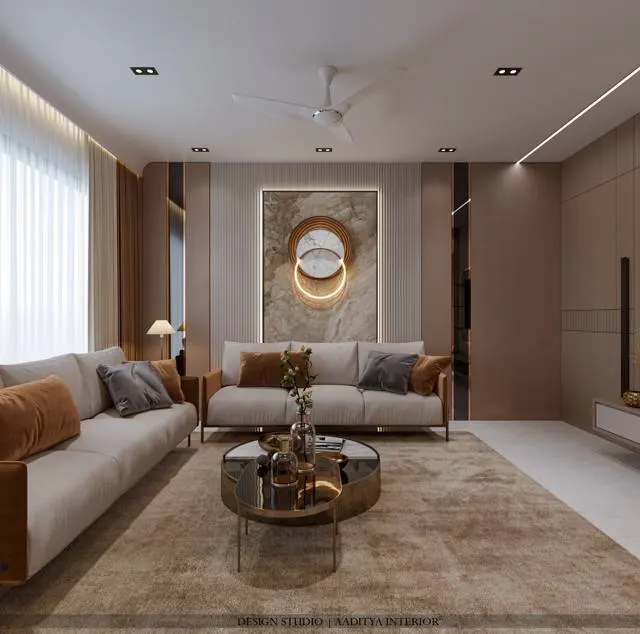
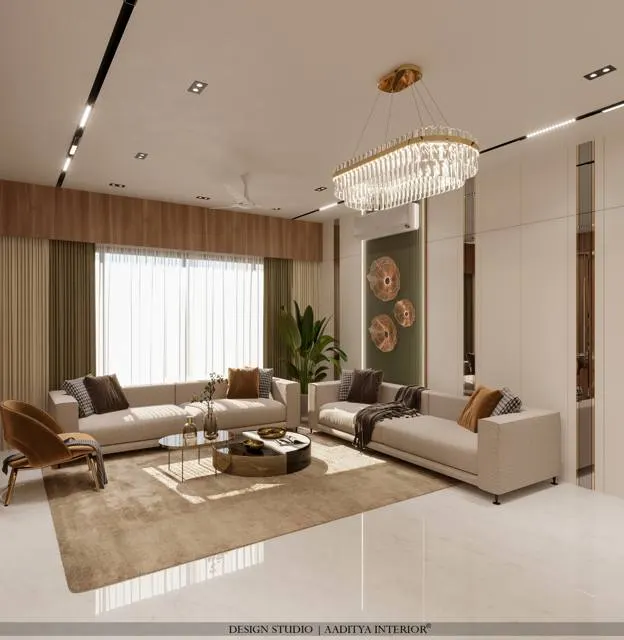
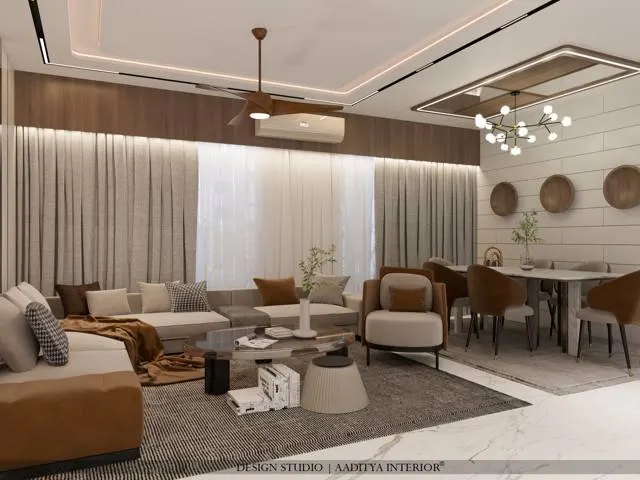
A wall washer is a light fitting designed to throw an even wash of light across a wall, rather than a pool of light on the floor. It comes from galleries and museums, where paintings must be lit evenly without glare, and it has become one of the most useful fittings in Indian homes, where feature walls are now common in living rooms, bedrooms and entrance foyers. A well-washed wall can carry a whole room; a badly lit one can spoil the most expensive cladding.
The difference between a wall washer and an ordinary downlight is not the bulb but the optics. A downlight throws a cone of light straight down and leaves a scalloped pattern on the wall. A wall washer uses an asymmetric reflector that pushes the light towards the wall, so the wall is lit evenly from top to bottom and the fitting itself is often hidden in the ceiling. The viewer sees the lit wall, not the source of the light, which is the aim of good lighting design.
This article explains how a wall washer works, the setback, spacing and beam angle that decide whether it succeeds, the types available in India, how to size and set out a scheme, which wall materials suit washing, the costs in October 2026, a practical installation method, and a maintenance checklist. It is written for a homeowner planning a feature wall, and for anyone who has seen a scalloped wall and wondered why it looks wrong.
Wall washing: an old gallery idea for Indian homes
A wall washer is a light fitting designed to throw an even wash of light down or across a wall, rather than a pool of light on the floor. The idea comes from galleries and museums, where paintings must be lit evenly from top to bottom without glare, and it has spread into homes because the same even light makes a feature wall, a stone cladding, a wood panel or a row of photographs look far better than a single downlight ever could. In Indian homes, where feature walls are now common in living rooms, bedrooms and entrance foyers, the wall washer has become one of the most used fittings in a lighting plan.
The difference between a wall washer and an ordinary downlight is in the reflector and the lens. A downlight throws a cone of light straight down, which gives a bright circle on the floor and a scalloped pattern on the wall. A wall washer uses an asymmetric reflector that pushes the light towards the wall, so the wall is lit evenly from the top to the bottom. The fitting itself is often hidden in the false ceiling, so the viewer sees the lit wall, not the source of the light, which is the whole point of good lighting design.
In India the fitting has become practical only in recent years, because LED sources made it small, cool and cheap to run. An old halogen wall washer was hot, large and expensive to run, and it needed a deep ceiling. A modern LED washer is 7 to 20 watts, fits in a standard false ceiling, and lasts for years. That change has put wall washing within reach of an ordinary home, not just a hotel or a gallery, and this article explains how to use it well.
How a wall washer works: beam, setback and spacing
Three numbers decide whether a wall washer works: the setback, the spacing and the beam angle. The setback is the distance from the wall to the fitting, measured along the ceiling. The spacing is the distance between one fitting and the next along the wall. The beam angle is the spread of the light as it leaves the fitting. Get these three right and the wall is lit evenly; get any one wrong and the wall shows scallops, dark bands or a bright patch at the top and darkness at the bottom.
For a normal room with a ceiling 2,700 mm high, a setback of 450 to 600 mm and a spacing of 750 to 900 mm is a good starting point. A closer setback gives a brighter wash at the top of the wall and a scalloped pattern, because each fitting lights a narrow patch. A further setback gives a softer, more even wash, but the light is dimmer and more of it is wasted on the room. The table of setbacks in this article gives starting points for different wall heights, and the figure shows the geometry in elevation and in plan.
The beam angle should be wide, usually 40 to 60 degrees, for washing a wall, and narrower, 24 to 36 degrees, for lighting a single picture or object on the wall. The colour temperature should usually be warm, 2700 to 3000 K, in a home, because warm light suits wood, stone and skin tones, and it makes a living room feel welcoming in the evening. A cooler 4000 K can suit a workspace or a gallery wall, but it can make a bedroom feel clinical, so it should be chosen deliberately rather than by default.
| Wall washer type | Form | Best use | Indicative cost |
|---|---|---|---|
| Recessed LED washer | Fits in false ceiling | Living rooms, bedrooms | ₹1,500–₹6,000 each |
| Surface wall washer | Fixed on ceiling or wall | No false ceiling | ₹1,200–₹5,000 each |
| Track wall washer | On a track, aimable | Art walls, retail | ₹2,000–₹8,000 each |
| Linear LED washer bar | Long bar, even wash | Long walls, coves | ₹2,500–₹12,000 per metre |
| Outdoor wall washer | Sealed, IP65 | Facades, gardens | ₹3,000–₹15,000 each |
| Mini washer, 3–7 W | Small recessed spot | Niches, small walls | ₹800–₹3,000 each |
Types of wall washers and where each one belongs
The most common type in Indian homes is the recessed LED washer, which fits into a false ceiling and is almost invisible when it is off. It suits living rooms, bedrooms and dining rooms, and it is the right choice wherever a false ceiling already exists or is planned. The fitting needs a cut-out in the ceiling, a driver, and enough clear space above it for heat, so it must be planned before the ceiling is built, not added afterwards as an afterthought.
Where there is no false ceiling, a surface-mounted washer or a track washer is the answer. A surface washer fixes directly to the ceiling or the wall and is visible, so it should be chosen in a finish that matches the room. A track washer sits on a track, can be aimed and moved, and suits art walls, retail spaces and homes where the pictures change often. Linear washer bars, which are long strips of LED, suit very long walls and coves, and they give the most even wash of all, because the light comes from a continuous line rather than from separate points.
Outdoor wall washers are a separate category. They are sealed to IP65, which means they are protected against dust and water jets, and they are used to wash facades, garden walls and entrance features. They need proper earthing, a weatherproof driver, and a fitting that can be serviced without a scaffold, so their position should be planned with the electrician and the facade contractor together. An indoor washer used outdoors will fail within a monsoon, and the failure is usually expensive to repair.
Sizing and setting out a wall washer scheme
Setting out starts with the wall, not with the fitting. The designer should measure the wall, note its height, its material and what is on it, and then decide how many fittings are needed. A 5-metre wall in a room with a 2,700 mm ceiling will usually need four washers spaced about 900 mm apart, set back about 500 mm from the wall. The first and last fittings should sit about half a spacing from the ends of the wall, so the wash reaches the corners without a dark patch at either end.
The ceiling height matters more than most homeowners expect. A low ceiling of 2,400 mm needs a closer setback and a lower wattage, or the top of the wall will be too bright and the bottom too dark. A double-height wall of 3,600 mm or more needs a further setback, a higher wattage, and sometimes a second row of fittings at a higher level. The table in this article gives starting points, but the final check should always be a mock-up: one fitting installed and switched on at night, before the rest are ordered.
Wattage should be chosen by the effect wanted, not by the brightest fitting in the shop. A 10-watt LED washer gives a gentle wash that suits a bedroom, while a 20-watt fitting suits a double-height wall or a dark stone that absorbs light. Dark materials need more light than pale ones, because they reflect less of it, so a dark wood or stone wall needs a higher wattage than a white painted wall of the same size. A dimmer is almost always worth fitting, because it lets the wash be turned down for a quiet evening and up for a party.
| Wall height | Setback from wall | Spacing between fittings | Typical wattage |
|---|---|---|---|
| 2,400 mm | 300–450 mm | 600–750 mm | 7–12 W each |
| 2,700 mm | 450–600 mm | 750–900 mm | 10–15 W each |
| 3,000 mm | 600–750 mm | 900–1,200 mm | 12–20 W each |
| 3,600 mm double height | 750–1,000 mm | 1,200–1,500 mm | 20–30 W each |
| Niche 600 mm high | 150–250 mm | 300–450 mm | 3–7 W each |
| Facade 6,000 mm high | 1,000–2,000 mm | 1,500–2,500 mm | 30–50 W each |
Materials, colour and glare: what the wall is made of
The wall material decides how the light will look. Stone, laterite and textured plaster come alive under a wall washer, because the raking light picks out every bump and shadow and the wall gains depth. Wood panelling looks warm and rich under a warm washer, though a highly polished wood can reflect the fitting and cause glare, so a matte or satin finish is better where washing is planned. A plain matte painted wall takes a wash evenly and is the easiest surface to light well.
Glass, mirror and high-gloss paint are the materials to avoid washing, because they reflect the fitting straight back into the eyes of anyone sitting opposite, and the result is glare rather than beauty. Art and photographs need a narrower beam aimed at the work itself, not a general wash, and the light should be warm and free of ultraviolet, which is one reason LED is preferred over older halogen sources. The table in this article matches common wall materials to colour temperature and beam angle.
Glare is the most common complaint about wall washers, and it is almost always a fitting position problem rather than a fitting quality problem. If a person sitting on the sofa can see the lamp itself, the fitting is too far from the wall, or it has no baffle, or it is aimed wrongly. The check is simple and should be done at handover: sit in every seat in the room at night, look at the wall, and check that the light is seen on the wall and not in the eye. A fitting with a deep baffle or a honeycomb louvre costs a little more and solves the problem at source.
Costs and budgeting for wall washer lighting in India
Wall washers are a mid-priced lighting choice. A recessed LED washer of good quality costs roughly ₹1,500 to ₹6,000 per fitting, depending on the brand, the wattage and the finish, while a linear washer bar costs ₹2,500 to ₹12,000 per metre. The driver and dimmer add ₹2,000 to ₹8,000 per circuit, and the ceiling cut-out and wiring add ₹500 to ₹1,500 per point. The cost table in this article gives the indicative October 2026 ranges in full, and the standard price disclaimer appears with the sources at the end of this article.
A realistic budget for washing one feature wall in a living room, with four recessed washers, a driver and a dimmer, is in the region of ₹15,000 to ₹35,000 including fitting, excluding the false ceiling itself. A whole-home scheme with washers in the living room, the dining room and two bedrooms can run to ₹60,000 to ₹1,50,000. Outdoor facade washing is more expensive, because the fittings are sealed and the installation needs scaffolding, and a small facade can cost ₹50,000 to ₹2,00,000 depending on the height and the number of fittings.
The cheapest way to buy wall washers is rarely the cheapest way to own them. A low-priced fitting often has a poor driver, which flickers, hums or fails within a year, and replacing a driver in a finished ceiling is disruptive and expensive. A mid-priced fitting from a known brand, with a proper driver and a warranty, costs more at the start and less over five years. The budget should also include a dimmer, because a washer without a dimmer is either too bright or too dim for half the occasions it is used.
| Item | Unit | Indicative range, October 2026 |
|---|---|---|
| Recessed LED wall washer | Per fitting | ₹1,500–₹6,000 |
| Linear washer bar | Per metre | ₹2,500–₹12,000 |
| Track + washer head | Per fitting | ₹2,000–₹8,000 |
| Driver and dimmer | Per circuit | ₹2,000–₹8,000 |
| False ceiling cut-out and wiring | Per point | ₹500–₹1,500 |
| Outdoor IP65 washer | Per fitting | ₹3,000–₹15,000 |
How to plan and install wall washers: a practical method
Planning should happen before the false ceiling is built. The lighting plan should mark the position of every washer, its setback from the wall, its spacing, its wattage and its circuit, and the ceiling contractor should be given the cut-out sizes before the boards go up. The driver position should also be marked, and it should be somewhere reachable, such as above a removable ceiling panel or inside a cupboard, because a driver buried in a sealed ceiling cannot be serviced without breaking the ceiling open.
Installation should be done by a licensed electrician, and the work should be checked at night before the ceiling is painted. The check is to switch on one circuit, sit in the seats, and look for scallops, dark bands and glare. If the wash is uneven, the setback or the spacing can still be adjusted by moving the fitting in its cut-out or by changing the beam angle, but once the ceiling is painted and the furniture is in, adjustment becomes much harder. A photograph of the lit wall at handover is a useful record for later maintenance.
The homeowner should also be shown how the system works: which switch controls which wall, how the dimmer works, and where the drivers are. That handover takes ten minutes and prevents years of confusion, because a wall washer circuit that no one understands is a circuit that is never used. The positions of the drivers and the fittings should be noted on a copy of the lighting plan and kept with the house documents, so that a future electrician can find them without guesswork.
Care, maintenance and common mistakes
Wall washers need very little maintenance. The lens should be wiped with a dry cloth every six months, because dust on the lens dims the light and makes the wash patchy. The driver should be checked once a year for humming or flickering, which are the usual signs that it is failing, and it should be replaced before it fails completely, because a failed driver can damage the fitting. LED fittings themselves usually last for many years, and when they do fail it is usually the driver, not the LED, that has gone.
The most common mistakes are all made at the planning stage. The first is putting the fitting too close to the wall, which gives a scalloped pattern that no dimmer can fix. The second is spacing the fittings too far apart, which leaves dark bands between them. The third is choosing a cool white colour temperature for a bedroom, which makes the room feel clinical. The fourth is burying the driver in a sealed ceiling, which makes a simple repair into a ceiling repair. The fifth is washing a glass or mirror wall, which gives glare instead of beauty. Each of these is easy to avoid and hard to fix.
A subtler mistake is over-lighting. A wall washer that is too bright washes out the texture it was meant to show, and it makes the rest of the room feel dark by comparison. The remedy is a dimmer and a lower wattage than the shop suggested, because a wall that is lit gently looks better than a wall that is lit harshly. The checking table in this article gives a handover checklist that catches all of these problems while they are still cheap to fix.
| Feature wall material | Light colour | Beam | Note |
|---|---|---|---|
| Stone or laterite | 3000 K warm | Wide, 40–60 deg | Shows texture best |
| Wood panelling | 2700–3000 K warm | Wide, 40–60 deg | Avoids glare on polish |
| Painted wall, matte | 3000 K warm | Wide | Even wash, no hot spots |
| Art and photographs | 3000–4000 K | Narrow, 24–36 deg | Aim at the art, not the wall |
| Glass or mirror | Avoid washing | Not advised | Reflections cause glare |
| Textured plaster | 3000 K warm | Wide | Grazing light shows texture |
Where wall washer lighting is heading
Wall washing is becoming smarter and more flexible. Tunable white fittings, which can shift from warm to cool white, are now available at a reasonable price, and they let one wall serve as a warm backdrop in the evening and a cooler, brighter surface during the day. Smart drivers that connect to a phone or a voice assistant let the wash be dimmed and scheduled, and they are becoming standard in new homes. These features add cost, but they also add control, and they are worth considering where the budget allows.
The fittings themselves are getting smaller and more efficient. Miniature washers of 3 to 7 watts can now wash a niche, a shelf or a small wall that a larger fitting would overwhelm, and linear bars are getting thinner, so they can be hidden in a shadow gap or a cove without a visible fitting. The light quality is also improving, with higher colour rendering that shows the true colour of stone, wood and art, which is the whole point of washing a wall in the first place.
The direction of travel is clear: wall washing is moving from a special effect for hotels and galleries to a standard part of a good home lighting plan. As LED fittings get cheaper and smarter, more Indian homes will wash their feature walls, and the difference between a home that is lit well and one that is not will increasingly be the difference between a wall that is washed and a wall that is merely lit. Aaditya Interior has used wall washers in this way in living rooms and entrance foyers, and the walls that were mocked up at night before ordering are the ones that clients notice first.
| Check | When | What to look for | Fix |
|---|---|---|---|
| Evenness of wash | At handover, at night | No scallops or dark bands | Adjust setback or spacing |
| Glare from seating | At handover, seated | No direct view of lamp | Add a baffle or move fitting |
| Colour match | At handover | All fittings same colour | Replace the odd fitting |
| Dimmer working | At handover | Smooth dimming, no flicker | Change driver or dimmer |
| Dust on lens | Every 6 months | Dim or patchy light | Wipe with a dry cloth |
| Driver access | Every year | Driver reachable | Note its position on plan |
Rules for a wall washer that washes evenly
- Plan the washers before the false ceiling is built, not after.
- Set the fitting back 450 to 600 mm from the wall for a 2,700 mm ceiling.
- Space the fittings 750 to 900 mm apart and keep the ends half a spacing in.
- Use a wide beam of 40 to 60 degrees for washing and a narrow beam for art.
- Choose warm white, 2700 to 3000 K, for living rooms and bedrooms.
- Fit a dimmer on every wall washer circuit.
- Keep the driver reachable, above a removable panel or inside a cupboard.
- Mock up one fitting at night and check for scallops, bands and glare.
- Never wash a glass, mirror or high-gloss wall.
Frequently asked questions
How far from the wall should a wall washer be placed?
For a room with a ceiling 2,700 mm high, a setback of 450 to 600 mm from the wall is a good starting point. A lower ceiling needs a closer setback, around 300 to 450 mm, and a higher wall needs a further setback, up to 750 to 1,000 mm for a double-height wall. Too close gives a scalloped pattern, too far gives a dim, soft wash. The setback should be checked with a mock-up at night before the rest of the fittings are ordered.
How many wall washers do I need for one wall?
It depends on the length of the wall and the spacing. For a 5-metre wall in a normal room, four washers spaced about 900 mm apart is a typical scheme, with the first and last fittings about half a spacing from the ends of the wall. The spacing should be 600 to 900 mm for a normal ceiling, and wider for a higher wall. The aim is an even wash with no dark bands between fittings and no scallops at the top of the wall.
What colour temperature is best for a wall washer?
Warm white, 2700 to 3000 K, suits most homes, because it flatters wood, stone and skin tones and makes a living room feel welcoming in the evening. A cooler 4000 K can suit a workspace, a gallery wall or a retail space, but it can make a bedroom feel clinical. Tunable white fittings, which shift from warm to cool, are a good choice where one wall must serve different purposes during the day and the evening.
Can wall washers be used without a false ceiling?
Yes. Surface-mounted washers fix directly to the ceiling or the wall, and track washers sit on a track that can be fixed to a concrete ceiling. Both are visible, so they should be chosen in a finish that matches the room. A linear washer bar can also be fixed to the ceiling or hidden in a pelmet. The light quality is the same as a recessed fitting; only the appearance of the fitting itself is different.
Do wall washers use a lot of electricity?
No. A modern LED wall washer uses 7 to 20 watts, and a typical living-room scheme of four fittings uses about 40 to 80 watts in total, which is less than a single old halogen fitting. The running cost is therefore very low, and the fittings last for many years. The main cost is the fitting, the driver and the installation, not the electricity. A dimmer reduces the running cost further and extends the life of the fitting.
Sources & standards
- National Building Code of India 2016, Part 3 (Development Control Rules and General Building Requirements) and Part 8 (Building Services)
- Neufert, Architects’ Data, standard dimensions and clearances for rooms, furniture and services
- Time-Saver Standards for Architectural Design Data, material, lighting and service planning chapters
- National Building Code of India 2016, Part 8, Section 1: Lighting and Natural Ventilation
- Bureau of Indian Standards, IS 3646 (Part 1): Code of Practice for Interior Illumination
- Bureau of Indian Standards, IS 10322 (Part 5): Luminaires — Particular Requirements
- Energy Conservation Building Code 2017, lighting power and controls
- Bureau of Energy Efficiency, star labelling programme for LED lamps
- Price ranges: indicative October 2026 estimates — confirm locally before budgeting