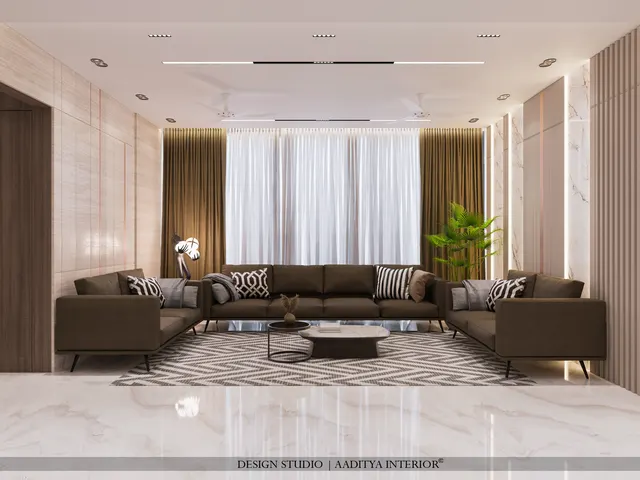
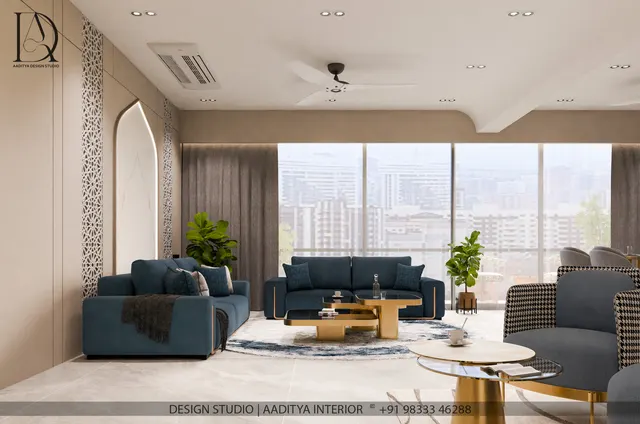
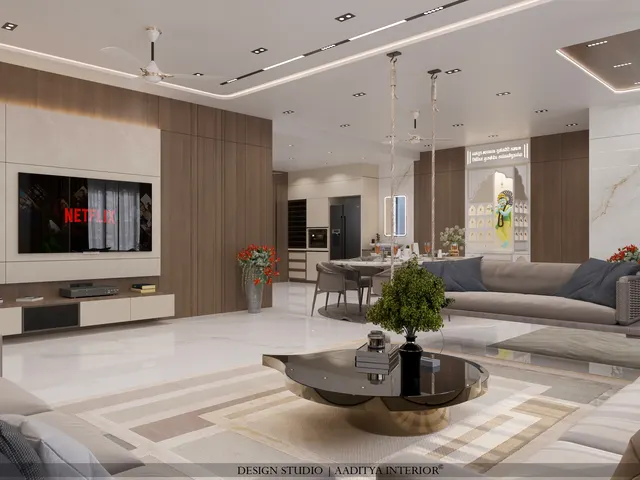
Modern Indian rooms are built from materials that reflect sound almost perfectly: vitrified tiles, plastered and painted brick, gypsum ceilings, glass windows and, increasingly, stone and marble feature walls. Furnish such a room lightly and every voice, every television dialogue and every clatter of a spoon bounces around for one to two seconds. The family talks louder, the television goes up, video calls sound hollow and the room feels tiring without anyone knowing why. Acoustic panels and fabric walls are the finishing materials designed to fix exactly this.
They are also among the most misunderstood products in interiors. Homeowners buy thin foam tiles online to stop a neighbour's television and are disappointed; contractors stick decorative fabric panels on a wall and call it acoustic treatment; restaurant owners install beautiful slatted walls whose felt backing is too thin to absorb the clatter they were meant to tame. Panels are bought by look and price per square foot, while the things that decide whether they work — thickness, core material, air gap, coverage, placement and fire behaviour — go unasked.
This article explains how acoustic panels and fabric walls work, compares the main types available in India with their absorption ratings and indicative October 2026 costs, details how fabric-wrapped panels and stretch fabric wall systems are built, shows where to place panels and how many are needed, and covers fire safety, humidity and maintenance. It builds on this site's article on home sound and acoustics, which covers the separate problem of blocking noise between rooms, and keeps its absorption figures and prices consistent with it.
Absorption is not soundproofing
Sound causes two different problems in buildings, and they have opposite solutions. Sound passing between spaces — a neighbour's music, traffic, voices from the next room — is stopped by insulation: mass, airtightness and decoupled construction, such as heavy walls, sealed windows and doors, and double-layer partitions with an isolating cavity. Sound bouncing around inside a room — echo or reverberation — is reduced by absorption: soft, porous surfaces that soak up sound energy instead of reflecting it.
Acoustic panels are absorbers. They are light and porous by design, which is why they are so poor at stopping sound passing through a wall: sound energy goes through a porous panel almost as easily as air does. A panel on a party wall will make the room itself sound calmer and may make the neighbour's music feel slightly less intrusive, because the room no longer amplifies it, but it will not stop the music. For noise from outside or next door, the fixes in this site's acoustics article — sealing the window, a solid-core door with seals, a partition built to the slab — come first. Panels are the tool for a room that sounds harsh, echoey or hollow from within.
A short history of soft walls
Long before anyone measured sound, people lined rooms with textiles. Tapestries and woven hangings in European halls, carpets laid on floors and hung on walls in Persian and Central Asian homes, and the richly embroidered canopies and textile walls of Indian courts all softened hard stone and plaster rooms. The Mughal encampment, with its tents and textile screen walls known as qanats, was in effect an entire palace made of fabric. These textiles were chosen for warmth, privacy, colour and status, but they also made rooms quieter and speech clearer.
The science arrived at the end of the nineteenth century. Wallace Clement Sabine, a young physicist at Harvard, was asked to fix a lecture hall in which speech was unintelligible. By bringing seat cushions in and out of the hall and timing how long a sound took to die away, he worked out the relationship between a room's volume, the absorption of its surfaces and its reverberation time — the formula still used today — and applied it to the design of Boston's Symphony Hall, which opened in 1900. Through the twentieth century, absorbent ceiling tiles, mineral-fibre and glass-wool boards and fabric-wrapped panels became standard in offices, schools, auditoriums and studios. The most recent arrivals are felt panels made from recycled polyester (PET), wooden slat-and-felt panels and seamless stretch fabric systems, which have brought acoustic treatment into homes, cafés and salons as a visible design material rather than a hidden technical one.
How a porous absorber works
A porous absorber — felt, mineral wool, glass wool, open-cell foam, thick fabric — is a tangle of fibres or cells with air between them. When a sound wave enters it, the air molecules are forced to move back and forth through the narrow passages, rubbing against the fibres. That friction turns a small part of the sound energy into a tiny amount of heat. The deeper the material, the more friction the sound meets before it reaches the wall and bounces back, and the more energy is lost.
Thickness matters most for low sounds. A porous absorber works best where the air particles are moving fastest, and for a sound reflecting off a hard wall that is about a quarter of a wavelength away from the wall. At 2,000 Hz — the hiss and clatter of a room — the wavelength is about 170 mm, so a quarter wavelength is about 43 mm and even a thin panel works well. At 250 Hz — the body of a male voice, the boom of a television — the wavelength is about 1.37 m and a quarter wavelength is about 340 mm. A 9 mm felt panel stuck flat to the wall is nowhere near that zone, which is why thin panels make a room sound less bright but leave it boomy. Thicker cores, and an air gap behind the panel, push absorption down to lower frequencies.
NRC and αw: reading the ratings
Two single-number ratings summarise a panel's absorption. The Noise Reduction Coefficient (NRC), from the American test method ASTM C423, is the average of the absorption coefficients at 250, 500, 1,000 and 2,000 Hz, rounded to the nearest 0.05. The weighted sound absorption coefficient (αw), from the international standards ISO 354 (measurement) and ISO 11654 (rating), is a single value with absorption classes from A (best, αw of 0.90 or more) to E. A rating of 0 means a perfect reflector and about 1.0 means almost everything is absorbed. Both depend on the mounting: the same panel tested flat on a wall and with a 50 mm air gap gives different numbers, and a supplier's best-case figure may come from a mounting the installer will not use. Ask for the test report, not just the brochure figure, and check that the tested mounting matches the installation.
Types of acoustic panels and fabric walls
The Indian market offers eight main families of absorbent finishes. They differ in what they absorb, how they look, how they behave in fire and humidity, and what they cost. The absorption figures below are typical ranges for the type, consistent with this site's acoustics guidance; individual products vary. Costs are indicative October 2026 ranges for supplied and installed work in metro and tier-2 cities, excluding GST.
| Type | Typical thickness | Typical NRC (mounting dependent) | Indicative installed cost (₹/sq ft) | Best for | Watch out for |
|---|---|---|---|---|---|
| PET felt panels (recycled polyester) | 9–12 mm | ≈ 0.2–0.4 flat; higher with an air gap | ₹150–400 | Homes, offices, cafés; pinboards; colour feature walls | Little effect on low frequencies; check fire report |
| Thick PET or polyester fibre panels | 24–50 mm | ≈ 0.6–0.9 | ≈ ₹300–700 | Studies, media rooms, meeting rooms | Bulkier; edges need finishing |
| Fabric-wrapped panels (mineral or glass wool core) | 25–50 mm | ≈ 0.7–1.0 | ≈ ₹350–900 | Home theatres, conference rooms, auditoriums | Fabric must be FR; core must be sealed at edges |
| Stretch fabric wall system (track + infill) | 25–50 mm infill behind fabric | ≈ 0.7–1.0 with absorbent infill | ≈ ₹400–900 | Seamless walls in media rooms, hotels, offices, salons | Specialist installation; dust on light fabrics |
| Wooden slat panels on felt backing | 18–25 mm overall | ≈ 0.4–0.85, depends on backing and gap | ≈ ₹450–1,200 | Living rooms, restaurants, lobbies | Thin backing and no gap give low absorption |
| Perforated or slotted gypsum or wood with wool behind | 12–18 mm board + 25–50 mm wool | ≈ 0.5–0.7 | ≈ ₹180–350 (gypsum ceiling) | Ceilings in living rooms, restaurants, offices | Perforation area and backing decide performance |
| Upholstered decorative panels (foam and fabric) | 25–50 mm | ≈ 0.3–0.6 — often not tested | ₹600–1,500 | Headboards, bed walls, luxury feature walls | Bought for looks; foam fire behaviour |
| Open-cell acoustic foam | 25–75 mm | ≈ 0.4–0.8 | ≈ ₹60–200 | Small recording booths, temporary treatment | Fire risk if not FR-rated; degrades; looks temporary |
Two patterns stand out. First, thickness drives performance: a 9 mm felt panel and a 50 mm fabric-wrapped panel may look similar on the wall, but the thicker panel absorbs two to three times as much of the speech range and far more of the low end. Second, decorative products are often sold as acoustic without a test report. An upholstered headboard wall makes a bedroom softer and more pleasant, but if a room has a genuine echo problem, it should be specified with tested panels.
How a fabric-wrapped panel is built
The fabric-wrapped panel is the workhorse of serious acoustic treatment. Its core is a rigid board of mineral wool, glass wool or dense polyester fibre, typically 25 mm or 50 mm thick and of a density chosen by the maker for stiffness and absorption. The edges of the core are hardened or framed — with resin, a thin timber or aluminium frame — so that the panel keeps a crisp edge and fibres cannot escape. An acoustically transparent fabric is stretched over the face and wrapped around the edges, and the panel is hung on the wall with interlocking cleats, impaling clips or magnetic fixings, often with a 25–50 mm air gap behind to improve low-frequency absorption.
Choosing the fabric
The fabric on an acoustic panel or wall has two jobs that pull against each other: it must look good and survive cleaning, and it must let sound through to the absorbent core. Open, breathable weaves are acoustically transparent; tightly woven, coated, laminated or backed fabrics act as a skin that reflects much of the sound before it reaches the core, wasting the panel. A simple test is to hold the fabric to the mouth and breathe through it: if air passes easily, sound will too. Fire behaviour is the second filter: in any commercial space, and wisely at home, the fabric should be inherently flame-retardant (such as many FR polyester grades) or treated, with a test certificate.
| Fabric | Acoustic transparency | Fire behaviour | Cleaning and wear | Use |
|---|---|---|---|---|
| Inherently FR polyester (acoustic grade) | High | Good — FR built into the fibre; does not wash out | Durable; vacuum and spot clean | Default for panels and stretch walls |
| Wool and wool blends | High | Naturally resists ignition better than many fibres; check test | Rich, warm; costlier; can attract moths if neglected | Premium homes, hotels, theatres |
| Cotton and linen | Medium to high | Burns readily unless treated; FR treatment can wash out | Creases and stains; sags in humidity | Small decorative panels only |
| Velvet and plush | Low to medium (pile is dense) | Depends on fibre and treatment | Shows marks; heavy | Upholstered feature walls, not primary absorption |
| Vinyl, leatherette, coated fabrics | Very low — reflect sound | Depends on product | Wipeable | Not for acoustic faces; can be used on perforated panels only with open area |
| Printed acoustic fabric (digital print) | High if printed on acoustic grade | As base fabric | Fade-resistant inks for sunlit walls | Murals and branding in cafés and salons |
Stretch fabric walls: seamless acoustic surfaces
A stretch fabric wall system turns an entire wall into a soft, seamless surface. An aluminium or PVC perimeter track, typically 20–40 mm deep, is screwed to the wall around the edges and around every opening, switch and socket. The space inside the tracks is filled with an absorbent infill — usually 25–50 mm of mineral wool, glass wool or polyester fibre board — and a fabric is stretched across the face and tucked into the jaws of the track, giving a clean, tight finish with no visible fixings. Because the fabric can be removed and replaced, the wall can be re-covered years later or opened for access to services.
Stretch walls need careful setting out. Fabric widths are limited by the roll — commonly about 1.4–3.2 m depending on the product — so wide walls need intermediate tracks at seams, which should be planned on the elevation like joints in panelling. Every socket, switch, AC pipe, speaker and light must have its own tracked frame, so services should be fixed before the system is set out. A hardwood or MDF skirting of 75–100 mm protects the bottom track from vacuum cleaners and shoes. In media rooms, the same system can hide in-wall speakers behind acoustically transparent fabric, giving a clean wall with no visible equipment.
How much to treat, and where
The amount of absorption a room needs comes from Sabine's formula: reverberation time RT60 ≈ 0.161 × V ÷ A, where V is the room volume in cubic metres and A is the total absorption in square-metre sabins (each surface's area multiplied by its absorption coefficient, plus furniture and people). This site's acoustics guide recommends roughly 0.4–0.6 seconds for living rooms, a little less for bedrooms, studies and media rooms. Most hard Indian rooms start well above one second. The worked example below shows the calculation for a typical home theatre.
| Step | Home theatre, 5.0 × 4.0 m, 2.85 m clear height | Result |
|---|---|---|
| Volume | 5.0 × 4.0 × 2.85 | 57 m³ |
| Tile floor (20 m² × 0.02) | Vitrified tile | 0.4 sabins |
| Gypsum ceiling (20 m² × 0.07) | Plain gypsum | 1.4 sabins |
| Walls and door (≈ 51 m², mostly plaster at 0.03; door 0.1) | Painted plaster | ≈ 1.7 sabins |
| Sofa, recliners, small furniture (estimate) | Upholstered seating | ≈ 3.0 sabins |
| Untreated total and RT60 | A ≈ 6.5 | 0.161 × 57 ÷ 6.5 ≈ 1.4 s |
| Target for a media room | RT60 ≈ 0.4 s | A needed ≈ 23 sabins |
| Add a rug on underlay (8 m² × 0.4) | Soft floor | + 3.2 sabins |
| Add fabric-wrapped 50 mm panels (NRC ≈ 0.85) | ≈ 15.5 m² (≈ 167 sq ft, about 30 % of walls) | + 13.2 sabins → RT60 ≈ 0.4 s |
The same room treated with 9 mm felt at an effective coefficient of about 0.3 would need around 44 m² of panels — nearly every wall — to reach the same target, and would still be boomy at low frequencies. That is the practical case for thicker panels in rooms where acoustics really matter. At this site's indicative rates, 167 sq ft of fabric-wrapped panels costs roughly ₹58,000–1,50,000 at ₹350–900 per sq ft. In a living room, where the target is 0.5–0.6 seconds and a sofa, rug and curtains already contribute, two to four panels at the reflection points are often enough.
| Room | Target RT60 (approximate) | Typical treatment | Share of wall area treated |
|---|---|---|---|
| Living room (furnished) | 0.4–0.6 s | Rug, curtains, two to four panels at reflection points | ≈ 5–15 % |
| Bedroom | ≈ 0.4–0.5 s | Upholstered headboard wall, curtains, rug | ≈ 5–10 % (often furniture alone) |
| Home office for video calls | ≈ 0.4 s | Panels behind and beside the speaker, rug | ≈ 10–20 % |
| Home theatre or media room | ≈ 0.3–0.4 s | Fabric-wrapped or stretch walls, bass traps, ceiling cloud | ≈ 25–40 % |
| Restaurant or café | ≈ 0.6–0.9 s | Absorbent ceiling, slat walls with thick backing, upholstered booths | Ceiling plus ≈ 10–20 % of walls |
| Meeting room | ≈ 0.5–0.7 s | Panels on two adjacent walls, absorbent ceiling | ≈ 15–25 % |
Placement follows a few principles. Spread absorption over different surfaces — two side walls, the rear wall and the ceiling — rather than lining one wall completely, because sound bounces between parallel hard surfaces (a flutter echo) and one dead wall opposite one live wall does not stop it. Treat the first reflection points, where sound from the speakers or a talker bounces once off a side wall towards the listener. Put thicker panels or purpose-made bass traps in corners, where low frequencies build up. And in rooms with a hard floor and a hard ceiling, deal with that vertical pair too: a rug below and an absorbent cloud or ceiling above stop the floor–ceiling flutter that wall panels alone cannot.
Fire safety, humidity and maintenance
Fabric walls and panels add combustible material to a room's surfaces, and that matters. The National Building Code of India 2016, Part 4, classifies interior finish materials by their surface spread of flame and restricts the classes permitted on walls and ceilings of escape routes and assembly, business and mercantile occupancies; the classification method is set out in IS 12777. Restaurants, salons, offices, cinemas and hotels should use panels and fabrics with test certificates showing an appropriate class, and the fit-out should be checked by the fire consultant or the local fire authority. At home the law is lighter, but the logic is the same: inherently flame-retardant fabrics, mineral-wool or tested polyester cores rather than untreated foam, and no fabric walls close to hobs, diyas, heaters or exposed lamps.
Humidity is the Indian complication. In coastal cities such as Surat, Mumbai and Chennai, a panel fixed tight against an external wall that gets damp in the monsoon can trap moisture, stain the fabric and grow mould. Fix panels to dry, sound, primed walls; keep a ventilated gap of 10–25 mm or more behind panels on external walls; prefer mineral wool, glass wool and polyester cores, which do not absorb water like cotton or natural fibre boards; and never fix panels over an untreated seepage patch — fix the seepage first.
| Check | What to ask for or do | Why |
|---|---|---|
| Absorption | Test report (ISO 354 or ASTM C423) for the panel and mounting quoted | Brochure figures may assume an air gap the installer will not use |
| Fire | Surface spread of flame class (IS 12777 or equivalent such as EN 13501-1) for panel and fabric | Required in commercial spaces; sensible at home |
| Fabric | Acoustic-grade, breathable, FR fabric; colour-fast if sunlit | Coated fabrics reflect sound; cheap FR treatments can wash out |
| Substrate | Dry, primed wall; seepage fixed; gap on external walls | Monsoon damp causes stains and mould |
| Fixing | Mechanical cleats or clips into masonry; no adhesive on fabric faces | Panels can be removed for cleaning or services |
| Services | Sockets, switches, AC lines and speakers set out before panels | Avoids cutting panels on site |
| Cleaning | Vacuum with a soft brush attachment monthly; spot clean as fabric maker advises | Dust settles on top edges and light fabrics |
Where acoustic finishes are going
Acoustic treatment is turning into an ordinary interior finish. Felt panels in dozens of colours, fluted and slatted wooden panels on felt, printed fabric murals, acoustic plasters that look like smooth plaster, and furniture with absorption built in — upholstered booths, felt-lined bookcases, acoustic pendant lights — let designers add absorption without the look of a studio. Recycled PET has made panels cheaper and has given them a sustainability story, though thin PET's limited low-frequency performance is still often oversold. As work from home, open-plan living and hard, minimal finishes continue, Aaditya Interior expects acoustic comfort to be planned with the lighting and the air-conditioning from the first drawing, rather than added when the family notices that the new living room echoes.
Rules for acoustic panels and fabric walls
- Diagnose first: panels fix echo inside a room, not noise coming through walls, windows or doors.
- Choose thickness by the problem: 9–12 mm felt for brightness and clatter, 25–50 mm cores for speech and media rooms.
- Ask for a test report with NRC or αw for the exact panel and mounting, not a brochure figure.
- Use acoustically transparent, inherently flame-retardant fabric — breathe through it to check.
- Spread treatment over side walls, rear wall, corners and ceiling; avoid one dead wall opposite a hard one.
- Treat roughly 5–15 % of wall area in living rooms and 25–40 % in media rooms, then add rugs and curtains.
- Keep panels off damp walls, leave a ventilated gap on external walls, and fix seepage first.
- In shops, salons, restaurants and offices, use fire-classified panels and fabrics and confirm with the fire consultant.
Frequently asked questions
Do acoustic panels block noise from neighbours?
No. Panels absorb sound inside a room and reduce echo, but they are too light and porous to stop sound passing through a wall. To block a neighbour's noise, a room needs mass, sealed gaps and ideally decoupled construction — sealed windows, solid-core doors with seals, and partitions built to the slab.
Which is better, PET felt or fabric-wrapped panels?
PET felt panels of 9–12 mm are cheaper (about ₹150–400 per sq ft), colourful and easy to fix, but absorb mainly higher frequencies. Fabric-wrapped panels with a 25–50 mm mineral-wool or polyester core (about ₹350–900 per sq ft) absorb far more of the speech and music range. Use felt for brightness and clatter in homes and offices, and thicker fabric-wrapped panels where acoustics really matter, such as media rooms and meeting rooms.
How many acoustic panels does a room need?
Calculate with Sabine's formula, or use rules of thumb: about 5–15 % of the wall area for a furnished living room, 10–20 % for a home office used for video calls, and 25–40 % for a home theatre, together with a rug and curtains. A 5 × 4 m media room typically needs about 15 m² (around 160–170 sq ft) of 50 mm fabric-wrapped panels.
What is a good NRC for an acoustic panel?
For panels meant to control speech and media echo, look for an NRC of about 0.7 or more (or αw of 0.7 or more, class C or better) in the mounting that will actually be used. Thin decorative felt panels typically test around 0.2–0.4 when fixed flat to the wall.
Are fabric walls safe in a restaurant or salon?
They can be, if the panels and fabrics carry fire test certificates showing a suitable surface spread of flame class under NBC 2016 Part 4 and IS 12777 (or equivalent), and the fit-out is approved by the fire consultant or authority. Keep fabric away from heat sources and use mechanical fixings so panels can be removed for cleaning.
Sources & standards
- Bureau of Indian Standards — National Building Code of India 2016, Part 4 (Fire and Life Safety): interior finish and surface spread of flame; IS 12777 (classification of flame spread)
- Bureau of Indian Standards — IS 2526: Code of practice for acoustical design of auditoriums and conference halls; National Building Code of India 2016, Part 8, Section 4 (Acoustics, sound insulation and noise control)
- ISO 354 — Measurement of sound absorption in a reverberation room; ISO 11654 — Rating of sound absorption (αw and absorption classes)
- ASTM C423 — Sound absorption and sound absorption coefficients by the reverberation room method (NRC)
- EN 13501-1 — Fire classification of construction products and building elements (reaction to fire)
- Sabine, W. C. — Collected Papers on Acoustics (Harvard University Press), origin of the reverberation formula
- Manufacturers' published test data for PET felt, fabric-wrapped mineral-wool and stretch fabric wall systems (described generically)
- Price ranges: indicative October 2026 estimates — confirm locally before budgeting