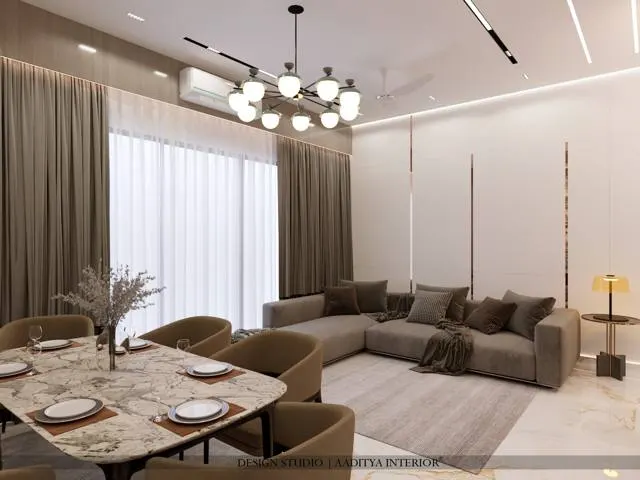
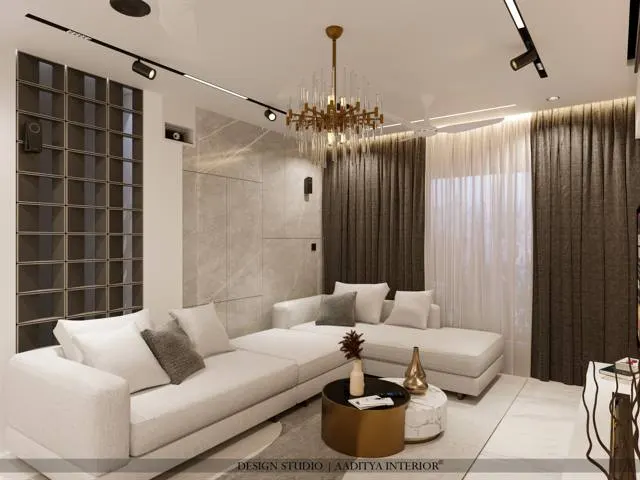
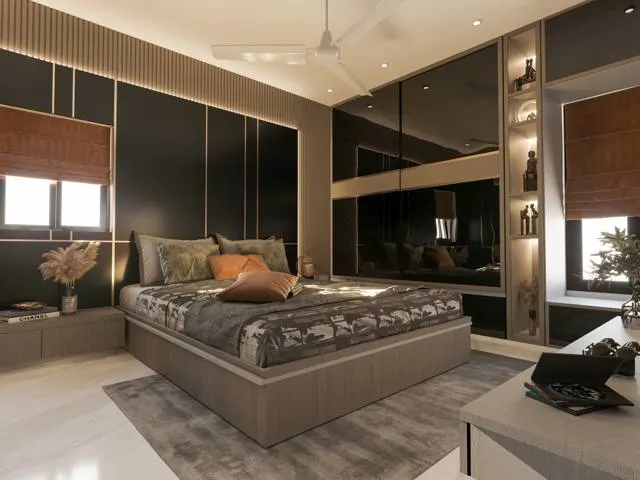
A rented bedroom in India is designed twice: once by the landlord, who paints the walls white, fits a basic ceiling fan and a tube light, and writes "no drilling, no painting, no structural change" into the leave-and-licence agreement; and once by the tenant, who has to sleep, dress, work and unwind in that room for two or three years. The two designs rarely agree. The landlord wants the flat back exactly as it was handed over, so that the next tenant sees the same clean walls. The tenant wants a room that feels like home, not a waiting room. Between those two aims sits a whole discipline of design that Indian renters are learning fast: everything in the room must be freestanding, reversible or held in place without a hole in the wall.
The mistake most tenants make is to treat the restriction as a ban on design itself, and to live for years with bare walls, a mattress on the floor and clothes in suitcases. The opposite mistake is just as common: drilling anyway for a television bracket, a shelf or a curtain rod, and then discovering at the time of vacating that the deposit deduction for patching, repainting and "damage" is far larger than the cost of the fitting. A single drilled hole is cheap to fill; thirty holes across four walls, plus the repainting a landlord insists on for the whole room, is not. The sensible middle path is to design as though every object in the room must be able to leave with its owner in a single day, with nothing left behind but clean paint.
This article sets out that middle path for a typical Indian rented bedroom of about 3000 × 3600 mm — the second bedroom of a 2BHK or the master bedroom of a compact 1BHK. It explains what a no-drilling clause actually covers, compares the five fixing systems that need no holes, plans the room around a freestanding bed and wardrobe, and prices three complete budgets, from a first-job setup of about ₹37,500–70,000 to a comfortable family setup of about ₹85,000–1,72,000. The ideas come from rented flats in Surat, Ahmedabad, Pune and Bengaluru, where tenants move every two or three years and carry their furniture with them.
A short history of the rented Indian bedroom
Rented housing in Indian cities is not new, but the way tenants furnish it has changed sharply in one generation. In the chawls and wadas of Mumbai and Pune, and in the pol houses of old Ahmedabad, a tenant's furniture was inherited, heavy and permanent: a wooden diwan, a steel almari, a dressing table that stayed in one house for decades. The landlord and the tenant were often neighbours for life, and small changes to a room — a nail here, a shelf there — were settled with a conversation, not a clause. The bedroom was furnished once and rarely rearranged, because the furniture itself was too heavy to move.
Three changes broke that pattern. First, the growth of the IT, BPO and services economy from the 1990s onwards created a large population of young professionals who moved cities every two or three years for a new job, carrying a laptop, a suitcase and little else. Second, the rise of flat-pack and modular furniture — and later of furniture rental services — made it possible to furnish a room in a weekend and dismantle it in an afternoon. Third, the leave-and-licence agreement, now the standard rental document in Maharashtra and increasingly used in other cities, began to carry explicit clauses about drilling, painting and alterations, with deposit deductions written in to enforce them. The modern rented bedroom is therefore a temporary room by design: the tenant is expected to arrive, live well, and leave without a trace.
Designers have responded with what the trade now calls renter-friendly or landlord-friendly design: a way of working in which the wall is treated as a surface to lean things against, hang things from with removable adhesive, or cover with a freestanding panel — never as a surface to screw into. The same logic has quietly spread to owned homes too, because a freestanding wardrobe or a leaning headboard panel is easier to change than a built-in one. The rented bedroom, in other words, has become a testing ground for a lighter, more flexible way of furnishing Indian homes in general.
What "no drilling" actually means in a rental agreement
Most Indian leave-and-licence agreements carry a clause along these lines: the licensee shall not make any structural alteration, shall not drive nails or screws into the walls, and shall not paint the premises in a different colour without the licensor's written consent. The practical meaning of that clause is narrower than many tenants fear and wider than many assume. It forbids holes, because a hole is damage that has to be repaired; it does not forbid hanging, leaning, standing or sticking, provided nothing is damaged when the object is removed. The test a landlord applies at handover is simple and visual: does the wall look the way it did on the day the keys were handed over?
That test has three consequences worth knowing before spending money. First, adhesive products are only safe if they remove cleanly from the landlord's paint. A good removable hook leaves nothing behind on a sound emulsion-painted wall; the same hook can peel a patch of distemper or a poorly bonded coat of paint, and the tenant then pays for the patch. Second, anything that presses hard against a wall — a leaning shelf, a tall wardrobe, a headboard panel — can leave a scuff or a pressure mark over two years, especially on a freshly painted surface. A thin felt pad, a strip of foam tape or a small gap of 10–15 mm between the object and the wall prevents it. Third, the deposit is the landlord's leverage, and the usual Indian deposit of two to six months' rent makes even a modest deduction worth avoiding. A written note from the landlord permitting a small number of holes for a curtain rod, if one can be obtained, is worth more than any argument at handover.
There is also the question of what counts as a fixture. A curtain rod fixed with a tension rod or a command-strip bracket is a fitting the tenant takes away. A rod screwed into the wall becomes, in the landlord's eyes, part of the flat — and the tenant has damaged the wall to install it. The same logic applies to a television bracket, a wall-mounted shelf and a bathroom fitting. The rule that keeps a tenancy peaceful is straightforward: if it cannot be removed in minutes without a tool and without leaving a mark, it does not belong in a rented bedroom.
| What the tenant wants to do | Usually allowed without drilling | Needs the landlord's written OK | Risk at handover |
|---|---|---|---|
| Hang pictures or a mirror | Adhesive hooks and strips rated for the weight; leaning a large mirror | Screwing a picture rail or a heavy mirror bracket | Peeling paint if the adhesive is wrong for the surface |
| Fix curtain rods | Tension rods inside the window reveal; adhesive brackets | Screwing brackets into the wall or the lintel | Holes above every window; repainting the wall |
| Mount a television | A TV on a low freestanding stand or a wheeled trolley | Any wall bracket, even a small one | Holes plus a patch that never quite matches the paint |
| Add shelves | Freestanding ladder shelves; leaning shelves; over-door racks | Wall-mounted floating shelves | Multiple holes in a line; the most visible damage |
| Change the wall colour | Removable wallpaper; fabric panels; a large tapestry | Repainting, even in the same shade, without consent | Repainting the whole room at the tenant's cost |
| Add lighting | Floor lamps; plug-in wall lights on adhesive mounts | Chasing a new point into the wall | Damage to the wall and the electrical circuit |
The layer method: design a bedroom in four layers
A rented bedroom is best designed in layers, from the floor upwards, because each layer can be changed or removed without touching the one below it. The first layer is the floor: a rug, a flat-weave dhurrie or interlocking foam tiles that cover the landlord's vitrified tile or marble and set the room's colour. A rug of 1500 × 2100 mm beside the bed changes the feel of a white room more than any wall treatment, it costs less than a single wall of paint, and it rolls up and travels to the next flat. In a cold-climate city or a ground-floor flat, a rug also takes the chill off a stone floor in winter.
The second layer is the bed itself, which is the room's anchor. Everything else — the wardrobe, the side tables, the reading light, the rug — is positioned in relation to the bed, because the bed is the largest object and the one that is hardest to move once placed. A queen bed of 1524 × 1981 mm needs a room at least 3000 mm wide to leave a 600 mm walkway on one side and a 750 mm wardrobe clearance on the other; a king bed of 1829 × 1981 mm needs 3300 mm or more. Choosing the bed first and the room's layout second is the single decision that decides whether the room works.
The third layer is storage, and the rule is that storage in a rented room must be furniture, not carpentry. A freestanding wardrobe, a chest of drawers, a trunk and an under-bed box are all furniture; a sliding wardrobe built into the wall is carpentry, and it belongs to the landlord the day it is installed. The fourth layer is the wall itself: pictures, a mirror, a fabric panel, a string of warm lights — all held by adhesive, tension or gravity, and all removable in minutes. Designed in this order, the room can be dismantled in a day, which is exactly what a tenant needs when the notice period arrives.
Walls without holes: five fixing systems compared
Five systems do almost all the no-drilling work in a rented bedroom, and each has a clear limit. Removable adhesive strips and hooks are the most useful: a good strip holds about 1–2 kg per pair (large strips: up to 7 kg per 4 pairs), a hook holds up to about 3.5 kg, and a pair of hooks holds a framed print, a small mirror or a string of lights. The rule is to match the strip to the wall surface — smooth emulsion paint holds well, textured paint and distemper hold poorly — and to follow the removal instruction exactly, pulling the tab straight down rather than peeling the strip off the wall. A strip removed wrongly can take a patch of paint with it, which defeats the purpose.
Tension rods are the second system, and they are the answer to curtains. A spring-loaded rod wedged inside the window reveal holds a sheer or a light cotton curtain without a bracket, and a second rod inside a wardrobe or an alcove becomes a hanging rail. The limit is weight: a tension rod holds a light curtain, not a blackout curtain with a heavy lining. For heavier curtains, an adhesive curtain-rod bracket or a ceiling-mounted track held by adhesive pads is the next step, but the honest answer for a very heavy curtain in a rented flat is a freestanding room divider or a floor-length sheer that needs no rod at all.
The remaining three systems are leaning, standing and hanging over. A leaning object — a ladder shelf, a large mirror, a headboard panel — is held by gravity and by the friction of its feet, and it works because it never asks the wall to carry a load. A standing object — a floor lamp, a plant stand, a screen — needs no wall at all. An over-door hook or rack uses the door leaf, which is the one surface in a rented flat that is designed to carry a load and can be replaced cheaply. Together the five systems cover almost everything a bedroom needs, and the table below puts their limits in one place so that nothing is hung that is heavier than its fixing.
| Fixing system | Holds safely | Indicative cost | Best for | Watch out for |
|---|---|---|---|---|
| Removable adhesive strips | about 1–2 kg per pair (large strips: up to 7 kg per 4 pairs) | ₹300–600 per pack | Framed prints, fairy lights, small mirrors | Distemper and textured paint peel; follow the pull-tab removal |
| Adhesive hooks (large) | up to about 3.5 kg per hook (jumbo); use two hooks for heavier items | ₹400–900 per pack | Hanging plants, bags, a robe, a light mirror | Heat and steam weaken the bond; check the weight rating |
| Tension rod | Light curtains up to about 2 kg | ₹300–900 per rod | Sheer curtains, a hanging rail inside an alcove | Heavy blackout curtains will sag and fall |
| Leaning furniture | Its own weight only | No fixing cost | Ladder shelves, large mirrors, headboard panels | Needs a non-slip foot; keep children from climbing |
| Over-door hooks and racks | 5–15 kg per rack | ₹500–1,500 | Towels, robes, belts, scarves, extra hanging | A thick door may not close; check the door clearance |
| Freestanding screen / divider | Its own weight only | ₹3,000–12,000 | Hiding a work corner, a dressing area, a messy wall | Needs a stable base; anchor with a low bookcase if it wobbles |
The bed is the anchor: headboards, side tables and layout
The bed is where a rented bedroom either feels designed or feels temporary, and the headboard is the detail that decides it. A drilled headboard is forbidden, but a headboard does not need a screw. Three freestanding answers work well. The first is a leaning upholstered panel, 1200–1500 mm high and the width of the bed, which stands on the floor behind the bed and is held in place by the bed itself; it gives the room the look of a hotel bed and costs far less than a built-in panel. The second is a tall cushion or a bolster arrangement against the wall, which is softer, cheaper and easily washed. The third is to let the bed stand alone and put the design effort into the bedding: a good bedspread, two sleeping pillows and two cushions in a colour that repeats in the rug and the curtains give a bed a finished look with no headboard at all.
Side tables follow the same logic. A bedside table of 450 × 450 mm with a drawer is the standard, and in a rented room it should be a light piece of furniture that can be carried out by one person, not a wall-hung shelf. A small stool, a stack of two books and a clip-on reading light can stand in for a second side table on the far side of the bed. The reading light matters more than it seems: the landlord's tube light is usually in the centre of the ceiling, which throws the reader's own shadow onto the book. A bedside lamp or a clip-on light at 2700–3000 K warm white, placed at about 500–600 mm above the mattress, turns the bed into a place to read, and it plugs into the existing socket without any wiring work.
Storage that moves with you
Storage is the hardest problem in a rented bedroom, because Indian families own more than a rented room can easily hold: winter blankets, festival clothes, suitcases, books, a sewing kit, a child's school things. The answer is to buy storage as furniture, in pieces that can be carried out by two people, and to use the dead spaces of the room — under the bed, behind the door, above the wardrobe — rather than asking the landlord for a built-in. A freestanding wardrobe of 1200–1800 mm width and 600 mm depth is the main piece; a two-door wardrobe suits one person, a three-door or a 1800 mm sliding wardrobe suits a couple, and a wardrobe with a loft box on top adds a full cubic metre of seasonal storage without a single screw.
Under-bed storage is the second-best space in the room and the most often wasted. A bed with a hydraulic lift or with simple drawers underneath holds two large suitcases' worth of blankets and out-of-season clothes; a low bed on a simple frame can take flat under-bed boxes of 600 × 400 × 150 mm that slide in and out. The third space is the door: an over-door rack with five or six hooks holds robes, belts, scarves and the next day's clothes, and a slim shoe rack of 300 mm depth behind the door holds six to eight pairs without blocking the swing. The fourth is the top of the wardrobe, where labelled boxes hold what is needed twice a year. Together these four spaces hold a family's clothes without a built-in wardrobe, and every piece of it travels to the next flat.
| Storage piece | Typical size | Indicative cost | What it holds | Moves? |
|---|---|---|---|---|
| Freestanding 2-door wardrobe | 1200 × 600 × 2100 mm | ₹15,000–30,000 | One person's clothes and linen | Yes, dismantles flat |
| Freestanding 3-door wardrobe | 1800 × 600 × 2100 mm | ₹25,000–45,000 | A couple's clothes plus a loft box | Yes, dismantles flat |
| Chest of drawers, 4-drawer | 900 × 450 × 1100 mm | ₹8,000–18,000 | Folded clothes, linen, medicines | Yes, one person carries it |
| Under-bed boxes (set of 2) | 600 × 400 × 150 mm each | ₹800–2,000 | Blankets, out-of-season clothes | Yes, slides out |
| Over-door rack | 5–6 hooks | ₹500–1,500 | Robes, belts, next day's clothes | Yes, lifts off the door |
| Slim shoe rack behind door | 900 × 300 × 1100 mm | ₹2,000–5,000 | 6–8 pairs of shoes | Yes |
| Ladder shelf, leaning | 600 × 400 × 1800 mm | ₹4,000–10,000 | Books, plants, baskets, decor | Yes, leans and lifts away |
| Trunk / storage ottoman | 900 × 450 × 450 mm | ₹2,500–7,000 | Linen, toys, a footrest that stores | Yes |
Light, textiles and colour without paint
A white rented bedroom is a blank page, and the cheapest way to colour it is textiles, not paint. A bedspread in a deep colour, two cushion covers and a rug in the same family of colours give the room a palette in one shopping trip, and all three can be washed and carried to the next flat. Curtains do the same work on the window: a sheer in white or cream softens the daylight, and a heavier cotton curtain on a tension rod gives privacy at night and a wash of colour by day. The rule is to repeat one colour three times — bedspread, rug, one cushion — and keep everything else neutral, so the room reads as designed rather than as a collection of separate purchases.
Lighting is the second lever, and it matters more than colour because the landlord's tube light is designed for a workroom, not a bedroom. A rented bedroom needs three layers of light: a soft general light, a reading light at the bed, and a low warm accent. The general light can stay as the ceiling tube, fitted with a warmer tube if the landlord allows a simple tube swap. The reading light is a bedside lamp or a clip-on light at 2700–3000 K. The accent is a floor lamp in a corner, or a string of warm fairy lights along a tension wire or an adhesive hook line — the one use of fairy lights that designers defend without embarrassment, because in a rented room they give a warm glow for a few hundred rupees and leave no mark. A dimmer plug, which fits between the socket and the lamp, lets the tenant lower the light at night without touching the wiring.
The third lever is the wall itself, treated as a gallery rather than a surface to paint. A large fabric panel or a tapestry, hung from a tension rod or adhesive hooks, covers a whole wall in colour and texture and comes down in minutes. Three framed prints in a row, hung on adhesive strips, give the wall a rhythm. A leaning mirror, 1200–1500 mm high, doubles the light in the room and gives the dressing area a mirror without a screw. The common mistake is to hang many small things at random heights; the rule that works is one large thing, or three things in a straight line at eye level, about 1500 mm from the floor to the centre of the arrangement.
| Light layer | Fixture | Indicative cost | No-drill install |
|---|---|---|---|
| General | Warm tube swap in the existing fitting | ₹300–800 | Swap the tube only, with the landlord's OK |
| Reading, bedside | Bedside lamp, 2700–3000 K | ₹1,500–6,000 each | Sits on the side table, plugs into the socket |
| Reading, clip-on | Clip-on LED on the headboard panel | ₹800–2,500 | Clips to the panel, no fixing |
| Accent, corner | Floor lamp, 1500–1700 mm high | ₹2,000–8,000 | Stands on the floor, plugs in |
| Accent, wall | Fairy lights on adhesive hooks | ₹500–2,000 | Hooks peel off cleanly at vacating |
| Control | Dimmer plug for the lamp | ₹600–1,500 | Fits between socket and plug |
What it costs: three budgets for a rented bedroom
A rented bedroom can be furnished well at three very different budgets, and the difference between them is mostly the quality of the bed and the wardrobe, not the number of objects. The first-job budget, around ₹37,500–70,000, covers a basic queen bed frame with a mattress, a two-door wardrobe, a rug, a floor lamp and curtains on a tension rod — everything a single person needs to live well, and everything that can be sold or carried onward in a day. The family budget, around ₹85,000–1,72,000, adds a good mattress, a three-door wardrobe, a chest of drawers, bedside tables with lamps, a leaning headboard panel and a proper rug. The premium renter budget, around ₹1,79,000–3,25,000, buys solid-wood or upholstered pieces, a designer rug, a good reading chair and layered lighting — furniture that will serve for a decade across three flats.
Two spending rules keep the money safe. First, spend the most on the mattress and the bed frame, because they decide sleep, and buy the cheapest acceptable version of everything decorative, because decor is the first thing to be replaced in the next flat. Second, prefer furniture that dismantles flat and reassembles without a carpenter: a wardrobe that needs a carpenter to dismantle costs ₹2,000–4,000 every time it moves, and after two moves it has cost more in shifting than the wardrobe is worth. Flat-pack wardrobes from the large Indian furniture brands are designed for exactly this, and their fittings are standard enough that a local carpenter can repair them anywhere.
| Item | First-job budget | Family budget | Premium renter budget |
|---|---|---|---|
| Bed frame, queen | ₹8,000–15,000 | ₹15,000–30,000 | ₹35,000–70,000 |
| Mattress, queen | ₹6,000–12,000 | ₹15,000–30,000 | ₹30,000–60,000 |
| Wardrobe | ₹15,000–25,000 (2-door) | ₹25,000–45,000 (3-door) | ₹50,000–90,000 (solid wood) |
| Headboard panel, leaning | ₹3,000–6,000 | ₹6,000–15,000 | ₹15,000–30,000 |
| Bedside tables + lamps | ₹2,000–4,000 | ₹8,000–15,000 | ₹15,000–30,000 |
| Rug 1500 × 2100 mm | ₹2,000–5,000 | ₹5,000–12,000 | ₹12,000–30,000 |
| Curtains + tension rod | ₹1,500–3,000 | ₹3,000–7,000 | ₹7,000–15,000 |
| Chest of drawers | — | ₹8,000–18,000 | ₹15,000–30,000 |
| Total for the room | ₹37,500–70,000 | ₹85,000–1,72,000 | ₹1,79,000–3,25,000 |
The future: renter-friendly design in India
The rented bedroom is changing faster than any other room in the Indian home, because the tenants are changing. Furniture rental services now deliver a full bedroom — bed, wardrobe, side tables and a television — for a monthly rent of roughly ₹1,500–3,000, and take it back when the tenant moves, which suits a professional who may leave the city in a year. Modular furniture brands sell wardrobes and beds that dismantle with an Allen key and reassemble in a new flat without a carpenter. Adhesive technology is improving too: the newest removable strips hold more weight on more surfaces, and magnetic and suction fixings are appearing for bathroom and kitchen use. The direction of travel is clear: the bedroom is becoming a kit of parts that arrives in boxes and leaves in boxes, and the wall is increasingly left alone.
There is also a quiet regulatory shift. As more Indian cities adopt standard leave-and-licence formats and as deposits come under clearer rules, the handover inspection is becoming more predictable, which rewards tenants who keep records: photographs of every wall on the day of moving in, the agreement's clause about alterations, and receipts for adhesive products that claim clean removal. A tenant who can show the move-in photographs has a much stronger position than one who argues from memory. In Aaditya Interior's experience, the tenants who lose the least deposit are not the ones who did the least to their rooms, but the ones who documented the room best and chose reversible design from the start.
- Photograph every wall on the day of moving in, and keep the photos until the deposit is returned.
- Test every adhesive on a hidden patch for 24 hours before hanging anything visible.
- Never hang more than the strip or hook is rated for — two strips for a frame, four for a mirror.
- Keep a 10–15 mm gap or a felt pad where any tall piece of furniture touches the wall.
- Choose furniture that dismantles flat; a wardrobe that needs a carpenter to move costs money every time it moves.
- Spend the most on the mattress and the bed frame; buy the cheapest acceptable version of everything decorative.
- Repeat one colour three times — bedspread, rug, one cushion — and keep the rest neutral.
- Light the room in three layers with plug-in lamps; never touch the landlord's wiring.
Frequently asked questions
Can I hang a heavy mirror in a rented bedroom without drilling?
A small mirror up to about 3 kg can hang on two large adhesive strips rated for the weight, on a smooth emulsion-painted wall. A large mirror should not be hung at all: lean it against the wall on a non-slip mat, with its top edge resting on the wall and a felt pad behind it. A leaning mirror is safer than a hung one, it makes the room look larger, and it moves to the next flat without a mark.
Will command strips damage the paint when I remove them?
On a sound coat of emulsion paint, a good removable strip comes off cleanly if the pull tab is pulled straight down slowly, exactly as the instructions say. On distemper, on flaking paint or on a wall painted less than a month ago, the same strip can peel a patch. Test one strip on a hidden patch behind the wardrobe first, wait a day, and only then hang anything visible.
How do I hang curtains in a rented flat without drilling?
Use a tension rod wedged inside the window reveal for sheer or light cotton curtains, which is the usual case in a bedroom. For heavier curtains, use adhesive curtain-rod brackets rated for the rod's weight, or ask the landlord in writing for permission to fix two small brackets — many landlords agree, because a curtain rod is a standard fitting. A floor-length sheer on a tension rod gives privacy at night and needs no permission at all.
What is the best wardrobe for a rented bedroom?
A freestanding wardrobe of 1200 mm width for one person or 1800 mm for a couple, 600 mm deep, 2100 mm high, with a loft box on top and flat-pack fittings so it dismantles and reassembles without a carpenter. Avoid built-in sliding wardrobes in a rented flat: they cannot move, they belong to the landlord once installed, and they cost several thousand rupees to dismantle.
Can I use peel-and-stick wallpaper in a rented bedroom?
Yes, on one accent wall, provided the wall is smooth emulsion paint and the product is a genuine removable vinyl. Apply it in a cool room, press out the air with a flat card, and test a corner after a week to check it peels cleanly. Avoid it on distemper, on textured paint and in a damp room, where it can trap moisture and peel the paint underneath. A large fabric panel is the safer alternative on a doubtful wall.
Sources & standards
- National Building Code of India 2016, Part 3 — Development Control Rules and General Building Requirements (minimum room sizes and heights)
- Real Estate (Regulation and Development) Act, 2016 — carpet area definition
- Neufert, Architects' Data — bedroom clearances, bed sizes and wardrobe depths
- Time-Saver Standards for Interior Design and Space Planning — bedroom planning and lighting layers
- Bureau of Indian Standards — IS 303 (plywood for general purposes), IS 12406 (medium density fibreboard)
- Price ranges: indicative October 2026 estimates — confirm locally before budgeting