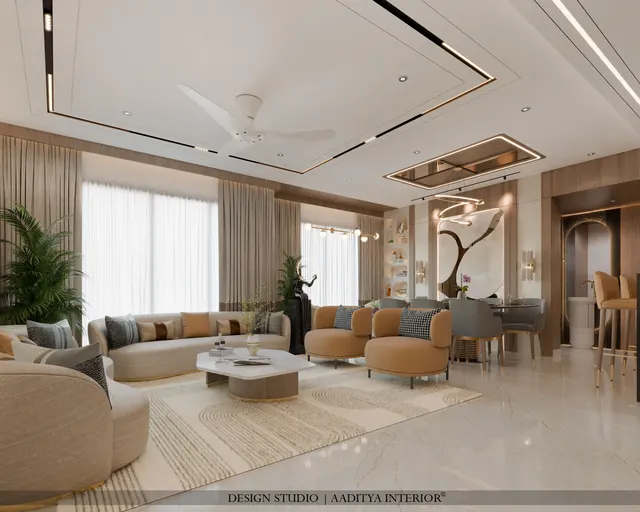
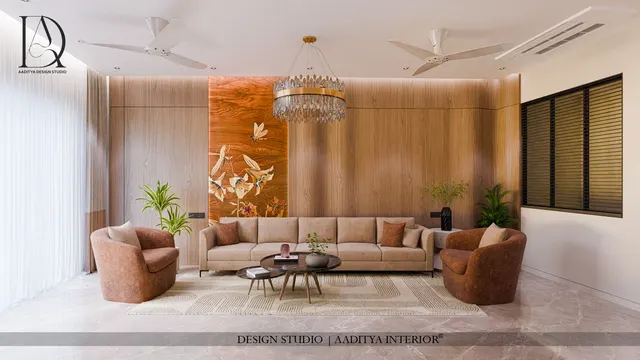
In most Indian homes there is one room where the family is most itself, and during cricket season it is the living room. An IPL evening or a World Cup match gathers three generations on one sofa — grandparents who have watched cricket for fifty years, parents who follow every ball, children who know the players' statistics better than their school lessons — and the room has to hold them all, keep them comfortable for four hours, and let everyone see the screen. It is a demanding brief, and most living rooms fail it in the same quiet ways: a television too small for the distance, a sofa that seats three when five people want to watch, a window behind the television that turns the screen into a mirror at 4 p.m., and sound that is either too quiet to hear the commentary or so loud it echoes off the bare walls.
The good news is that a cricket living room is not a matter of taste or budget. It is a matter of numbers: the size of the television against the distance to the sofa, the height of the screen against the eye level of a seated person, the width of the seating against the number of people, and the position of the windows against the screen. Get those numbers right and almost any living room — a 3BHK flat in Surat, a bungalow in Ahmedabad, a rented flat with a single wall to work with — becomes a good match-day room. Get them wrong and even the most expensive television disappoints.
This article works through the room in order: the television wall, the seating, the sound, the light, the match-day furniture and the costs. It gives the viewing distances for every common television size, the seating layouts that fit a family of five or six, and the small decisions — a snack table within reach, a mini-fridge in the corner, a phone-charging point by the sofa — that decide whether the family watches the whole match together or drifts away to separate rooms.
The television wall: size, distance and height
The first decision is the size of the television, and it is decided by one measurement: the distance from the screen to the eyes of the people on the main sofa. The rule used by television makers and by cinema standards is based on the viewing angle — the width of the screen as seen from the sofa — and for a 4K television the comfortable range is a viewing angle of about 30–40 degrees, which works out to a distance of roughly 1.3–1.7 times the screen's diagonal. A 55-inch television suits a sofa at 1.8–2.4 metres; a 65-inch suits 2.1–2.7 metres; a 75-inch suits 2.4–3.0 metres; and an 85-inch suits 2.7–3.6 metres. A television smaller than the range leaves the family squinting at the score bug; a television larger than the range forces the eyes to travel across the screen and makes fast cricket — a ball in flight, a run-out — harder to follow, not easier.
Height matters as much as size. The centre of the television should sit at the eye level of a seated person, which for an average adult on a sofa with a seat height of about 450 mm is roughly 1000–1100 mm from the floor. In practice that means a 55-inch television, which is about 700 mm tall, mounts with its centre at about 1050 mm and its bottom edge about 700 mm from the floor — lower than most people expect, and much lower than the televisions mounted high on a wall above a console, which force the neck up for four hours. The test is simple: sit on the sofa, look straight ahead, and the middle of the screen should be where the eyes rest. If the family watches from recliners, which tilt the viewer back, the screen can sit 100–150 mm higher; if children watch from the floor, it can sit lower.
The wall behind the television deserves the same care as the screen. A plain wall in a mid-tone — warm grey, deep green, dark wood panelling — makes the picture look better than a white wall, because the eye is not distracted by a bright frame around the screen. A backlit panel or a laminate backdrop in the ₹350–650 per sq ft range gives the wall a finished look and hides the cables; a simple cable channel does the same job for less. The television should never face a window, and a window should never sit behind the television: either way the light lands on the screen or in the viewers' eyes. If the only wall faces a window, the window needs a blackout curtain or a blind that can be closed for a day match.
| Television size | Screen width (approx.) | Comfortable viewing distance | Room it suits |
|---|---|---|---|
| 43 inch | 950 mm | 1.5–2.0 m | Bedroom, small living room, second TV |
| 50 inch | 1110 mm | 1.7–2.2 m | Compact living room, 2BHK flat |
| 55 inch | 1230 mm | 1.8–2.4 m | The standard Indian living room |
| 65 inch | 1440 mm | 2.1–2.7 m | Large living room, 3BHK and above |
| 75 inch | 1660 mm | 2.4–3.0 m | Big living room, dedicated match room |
| 85 inch | 1880 mm | 2.7–3.6 m | Very large room or home theatre |
| 98 inch | 2170 mm | 3.0–4.0 m | Home theatre only; needs a 4500 mm+ room |
Seating for the whole family
A cricket living room is judged by its seating, and the arithmetic is simple: count the people who will watch together on a big match day, and seat them all at the same height, at the same distance, with a clear view. A family of five — two parents, two children and a grandparent — needs about 3000 mm of seating width if everyone sits on sofas, which is why the standard Indian combination is a three-seater sofa of about 2100 mm along one wall plus a two-seater of about 1500 mm on the adjoining wall in an L-shape, or a three-seater plus two armchairs — the corner is shared in the L-shape, so the pair seats five within roughly 3000 mm of wall. A family of six or seven on a World Cup final needs more: a second row. The second row can be floor seating — thick cushions or a low diwan 150–200 mm high — which keeps children's heads below the adults' sightlines, or a pair of recliners set slightly behind and to the side.
Comfort over four hours is a matter of dimensions. A sofa seat should be about 550–600 mm deep and 450 mm high, with a backrest that supports the lower back and armrests at about 600–650 mm from the floor. A seat shallower than 500 mm forces people to perch; a seat deeper than 650 mm leaves shorter family members with their feet dangling. Recliners are popular for cricket because they let the viewer tilt back and put their feet up, but they need space: a recliner needs about 900 mm of depth when open and 600 mm behind it for the mechanism, so two recliners in a row need a room at least 3600 mm deep. A bean bag or a floor cushion is the cheapest extra seat in the house — about ₹1,500–4,000 each — and children prefer them to any chair.
The arrangement matters as much as the furniture. The main sofa should face the television squarely, not at an angle: a viewer sitting 30 degrees off-centre sees a distorted picture and misses the edge of the screen. The second sofa or chairs should sit at no more than 20–25 degrees off the centre line. A coffee table between the sofa and the television should be low — 400–450 mm high — and set back at least 450 mm from the sofa front, so that legs can stretch and feet can rest without the table blocking the bottom of the screen. And the room needs a place for the people who are not watching: a reading chair in the corner, a small desk, or a balcony door that lets someone step out without walking in front of the screen.
| Seating | Size | Seats | Indicative cost (₹) |
|---|---|---|---|
| Three-seater sofa | 2100 × 900 mm, seat 450 high | 3 adults | ₹25,000–80,000 |
| Two-seater sofa | 1500 × 900 mm, seat 450 high | 2 adults | ₹18,000–60,000 |
| L-shaped sectional | 2700 × 1800 mm overall | 5–6 | ₹45,000–1,50,000 |
| Recliner (single) | 900 × 900 mm, 900 deep when open | 1 adult | ₹25,000–70,000 each |
| Recliner sofa (three-seat) | 2100 × 1000 mm | 3 adults | ₹60,000–2,00,000 |
| Floor cushions / diwan | 600 × 600 mm each, 150–200 high | 1 child each | ₹1,500–4,000 each |
| Bean bags | 900 × 900 mm | 1 child or adult | ₹1,500–5,000 each |
| Armchair | 800 × 900 mm | 1 adult | ₹12,000–40,000 |
Sound: hearing the commentary over the cheering
Cricket is a game of sound as much as of pictures: the crack of the bat, the appeal, the commentator's voice, the crowd rising. A television's built-in speakers, which are small, downward-firing and easily drowned by a room full of people, are the weakest part of most Indian living rooms. A soundbar — a long, low speaker that sits under the television — is the simplest upgrade: it puts the dialogue in front of the viewer, it costs about ₹10,000–40,000 for a good one, and it needs only one cable. A soundbar with a separate subwoofer adds the crowd's roar and the thump of a boundary, and it is the right choice for most families.
A 5.1 surround system — five speakers and a subwoofer placed around the room — is better still, and it is the closest a living room comes to a stadium. The front three speakers sit under or beside the television, the two rear speakers sit behind the sofa at about 1200–1500 mm high, and the subwoofer sits in a corner. The cost is higher, about ₹40,000–1,50,000 for a good set, and the room needs the wiring: speaker cables run under the floor or in the wall, and the rear speakers need a shelf or a stand. The system is worth it only if the room is large enough — at least 3600 mm deep — and if the family watches together often enough to notice the difference. For a small flat, a good soundbar is the wiser spend.
The room itself is half the sound system. A living room with a marble floor, bare walls and a glass window is an echo chamber: sound bounces off every hard surface, dialogue blurs, and the family turns the volume up until the neighbours complain. The cure is soft surfaces: a rug under the coffee table, curtains on the windows, upholstered sofas, a fabric panel or two on the walls. A rug of about 2400 × 1800 mm under the seating area does more for sound than any speaker upgrade, and it also stops the cold floor in winter and the children's feet in summer. The television's sound settings matter too: most televisions have a "clear voice" or "dialogue" mode that lifts commentary above crowd noise, and it should be switched on for cricket.
| Sound option | What it is | Indicative cost (₹) | Best for |
|---|---|---|---|
| TV built-in speakers | Small downward-firing speakers in the TV | Included | Bedroom, quiet viewing, one person |
| Soundbar | Long speaker under the TV, one cable | ₹10,000–40,000 | Most living rooms: the best value upgrade |
| Soundbar + subwoofer | Soundbar plus a separate bass unit | ₹20,000–60,000 | Families who want the crowd's roar |
| 5.1 surround system | Five speakers + subwoofer around the room | ₹40,000–1,50,000 | Large rooms, regular match nights, home theatre |
| Ceiling speakers | Speakers set into the false ceiling | ₹30,000–1,00,000 for a pair + amplifier | New builds; invisible, even sound |
| Bluetooth speaker (portable) | One portable speaker, moved as needed | ₹3,000–15,000 | Balcony viewing, small gatherings |
Light control: beating glare on the screen
Glare is the enemy of a cricket afternoon. A day match starts at 2 or 3 p.m., when the western sun is low and strong, and a window on the west or south-west wall of a living room will throw light straight across the television screen or straight into the viewers' eyes. The answer is to control the light at the window, not at the screen: a blackout curtain or a roller blind on the window behind or beside the television, closed for the match and opened afterwards. A sheer curtain is not enough for a day match — it softens the light but leaves a bright patch on the screen — and a curtain that only covers half the window is worse than none, because the bright edge draws the eye.
The room's own lighting needs the same thought. A single bright ceiling light above the sofa reflects in the television screen and washes out the picture; the right light for match night is low and indirect — a dimmed ceiling light at 10–20 per cent, a floor lamp behind the sofa, or a bias light, which is a small LED strip fixed to the back of the television that throws a soft glow onto the wall behind it. Bias lighting, which costs about ₹800–2,500 for a strip, reduces eye strain more than any other single addition, because the eye no longer jumps between a bright screen and a dark room. A cove LED strip at ₹150–300 per running foot does the same work on a larger scale, and a dimmer on the main light — or a smart bulb dimmed by voice — lets the family set the level in seconds.
The direction the room faces decides how much of this is needed. A north-facing living room, which takes soft, indirect light all day, is the easiest room for television: it rarely needs blackout curtains and its light is even. An east-facing room is bright in the morning and calm by match time. A west-facing room is the hardest, and it needs the full treatment — blackout curtains, bias lighting, and a television with a matte or anti-glare screen rather than a glossy one. When choosing a new television for a bright Indian living room, the anti-glare coating matters more than a small difference in picture quality, and it is worth asking the dealer to demonstrate the set under the shop's lights before buying.
Match-day furniture: snacks, drinks and charging
A four-hour match is also a four-hour meal, and the furniture should admit it. The coffee table is the centre of match-day eating: it should be large enough for plates, bowls and glasses — about 1200 × 600 mm for a family of five — low enough not to block the screen, and easy to clean, because something will spill. A tray on the table keeps plates from sliding, and a side table or a small stool beside each end of the sofa holds a glass within reach without anyone standing up. The kitchen should be close enough that a fresh plate of snacks arrives in a minute, but not so close that the cooking smells and noise compete with the commentary.
A mini-fridge in the living room is the single most popular match-day addition in Indian homes, and it earns its place: cold drinks without a trip to the kitchen, and no one missing a wicket while fetching water. A small 90-litre bar fridge, about 500 mm wide and 850 mm high, fits in a corner or under a console, and it costs about ₹12,000–25,000. It needs a socket of its own — never a shared extension board — and a little ventilation space around it, about 50 mm on each side. A charging point by the sofa is the other essential: a phone checking the score, a tablet with statistics, a second screen for the fantasy league all need power, and a 6 A socket with two USB points set into the side table or the sofa's side panel keeps cables off the floor where feet trip on them.
Storage completes the room. Cricket brings its own clutter — the remote controls, the scorecards, the children's cricket bats and balls, the extra cushions that appear on match day and vanish after it. A low console under the television holds the set-top box, the router and the remotes; a basket or a lidded box beside the sofa holds the cushions and the throws; and a narrow shelf near the door holds the bats and balls so they do not migrate onto the sofa. The rule is that everything used during a match has a home within arm's reach of the sofa, and everything else has a home somewhere else in the room.
| Match-day item | Size or specification | Indicative cost (₹) |
|---|---|---|
| Mini-fridge (bar fridge, 90 litre) | 500 × 850 mm, own 6 A socket | ₹12,000–25,000 |
| Snack / coffee table | 1200 × 600 mm, 400–450 mm high | ₹8,000–30,000 |
| Side tables with charging | 450 × 450 mm, USB + 6 A socket | ₹4,000–12,000 each |
| Bias lighting strip (behind TV) | LED strip, USB powered, 2–3 m | ₹800–2,500 |
| Blackout curtains (west window) | Floor-length, 3000 mm wide pair | ₹6,000–20,000 |
| Rug under seating | 2400 × 1800 mm, low pile | ₹8,000–35,000 |
| Cushions and throws (set) | 5–6 cushions, 2 throws | ₹3,000–12,000 |
| Storage basket / lidded box | 600 × 400 mm, by the sofa | ₹1,500–5,000 |
What a cricket living room costs
A cricket living room can be built at almost any budget, because the room is assembled from parts the family may already own. The television is the largest single cost: a 55-inch 4K television costs about ₹35,000–70,000, a 65-inch about ₹55,000–1,20,000, and a 75-inch about ₹90,000–2,00,000, with the price rising steeply for better panels and anti-glare coatings. The soundbar adds ₹10,000–40,000, the seating — a three-seater and a two-seater — about ₹43,000–1,40,000, and the match-day extras, a mini-fridge, rug, curtains and tables, another ₹30,000–1,00,000. A family starting from an empty room should budget roughly ₹1,50,000–4,00,000 for a complete 65-inch setup, and a family upgrading a room that already has sofas and a television can transform it for ₹25,000–1,00,000 with a soundbar, bias lighting, blackout curtains and a rug.
| Element | Indicative cost (₹) | Notes |
|---|---|---|
| 55-inch 4K television | ₹35,000–70,000 | Anti-glare coating worth paying for in bright rooms |
| 65-inch 4K television | ₹55,000–1,20,000 | The standard choice for a 4800 mm living room |
| 75-inch 4K television | ₹90,000–2,00,000 | Needs a 2400 mm+ viewing distance |
| Soundbar (with subwoofer) | ₹20,000–60,000 | The best-value sound upgrade |
| 5.1 surround system | ₹40,000–1,50,000 | Only for rooms 3600 mm+ deep |
| Sofas (3-seater + 2-seater) | ₹43,000–1,40,000 | Seat 450 high, 550–600 deep |
| TV wall unit / backdrop panel | ₹25,000–80,000 | Laminate backdrop ₹350–650 per sq ft |
| Mini-fridge, rug, curtains, tables | ₹30,000–1,00,000 | The match-day extras, bought once |
| Complete 65-inch setup, empty room | ₹1,50,000–4,00,000 | Television, sound, seating and extras together |
Eight rules for a living room that watches cricket together
- Size the television to the sofa distance: 55 inch at 1.8–2.4 m, 65 inch at 2.1–2.7 m, 75 inch at 2.4–3.0 m.
- Mount the screen with its centre at 1000–1100 mm — seated eye level — not high on the wall.
- Seat everyone at the same height facing the screen squarely; keep second-row heads below adult sightlines.
- Put a rug of about 2400 × 1800 mm under the seating and curtains on the windows — the room's acoustics depend on it.
- Close the west window for day matches: a blackout curtain beats any screen brightness setting.
- Add bias lighting behind the television (₹800–2,500) — the cheapest cure for eye strain.
- Keep a snack table, a mini-fridge and a charging point within reach of the sofa, so nobody misses a wicket.
- Keep the remote controls, cushions and bats in fixed homes near the sofa — a tidy room is a room the family returns to.
Frequently asked questions
What size TV should I buy for my living room?
Measure the distance from the television wall to the front of the main sofa, then match it: 55 inch at 1.8–2.4 m, 65 inch at 2.1–2.7 m, 75 inch at 2.4–3.0 m and 85 inch at 2.7–3.6 m. In the standard Indian living room of about 4800 × 3600 mm, with the sofa about 2.4 m from the wall, a 65-inch television is the right choice for most families.
How high should the TV be mounted?
The centre of the screen should sit at seated eye level, about 1000–1100 mm from the floor for an adult on a sofa with a 450 mm seat height. A 55-inch television, about 700 mm tall, mounts with its bottom edge about 700 mm from the floor. Mounting a television high on the wall forces the neck up for four hours and is the most common mounting mistake in Indian homes.
Is a soundbar enough for cricket, or do I need surround sound?
A good soundbar is enough for most living rooms: it puts the commentary in front of the viewer and costs ₹10,000–40,000. A 5.1 surround system is better, but it needs a room at least 3600 mm deep, rear speakers behind the sofa and a budget of ₹40,000–1,50,000. For a small flat, spend the difference on a rug and curtains, which improve the sound more than extra speakers in an echoing room.
How do I stop glare on the TV during day matches?
Control the light at the window: a blackout curtain or roller blind on the west or south-west window, closed for the match. A sheer curtain is not enough. Add bias lighting — an LED strip behind the television for about ₹800–2,500 — and choose a television with a matte or anti-glare screen if the room faces west. Never put the television facing a window.
Can a small living room work for a family of five watching cricket?
Yes, with the right sizes: a 50- or 55-inch television at 1.7–2.4 m, a three-seater sofa of 2100 mm plus floor cushions for the children, and a coffee table no larger than 1200 × 600 mm. Keep the second row on the floor so children's heads stay below adult sightlines, and use the wall behind the sofa for storage rather than for extra chairs that block the walkway.
Where should the mini-fridge go in a living room?
In a corner or under a console, within a few steps of the sofa, with about 50 mm of ventilation space on each side and a socket of its own — never a shared extension board. A 90-litre bar fridge, about 500 mm wide and 850 mm high, is the right size for a living room; anything larger belongs in the kitchen. Keep it away from the television's heat and out of direct sun.
Sources & standards
- Society of Motion Picture and Television Engineers (SMPTE) and THX — recommended viewing angles and distances for home screens
- National Building Code of India 2016, Part 8 (Building Services — lighting and ventilation) and Part 4 (Fire and Life Safety)
- Ernst Neufert — Architects' Data, standard seating, viewing and living-room dimensions
- Time-Saver Standards for Interior Design and Space Planning — living-room planning, seating and television placement data
- Bureau of Indian Standards — IS 732 (electrical installation code of practice), IS 1293 (plugs and sockets)
- Indian television and audio manufacturers' published viewing-distance guidance for 4K televisions (55–85 inch)
- Price ranges: indicative October 2026 estimates — confirm locally before budgeting