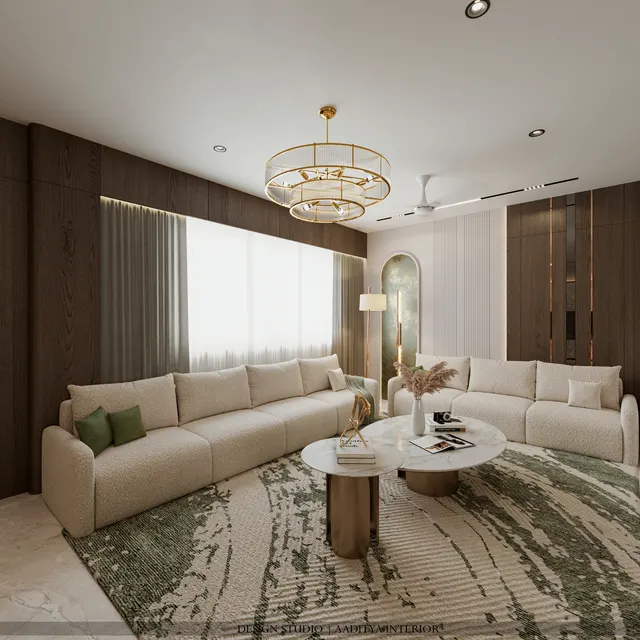
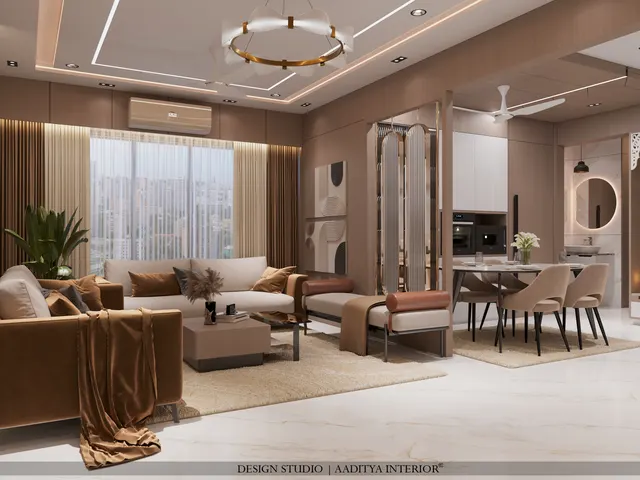
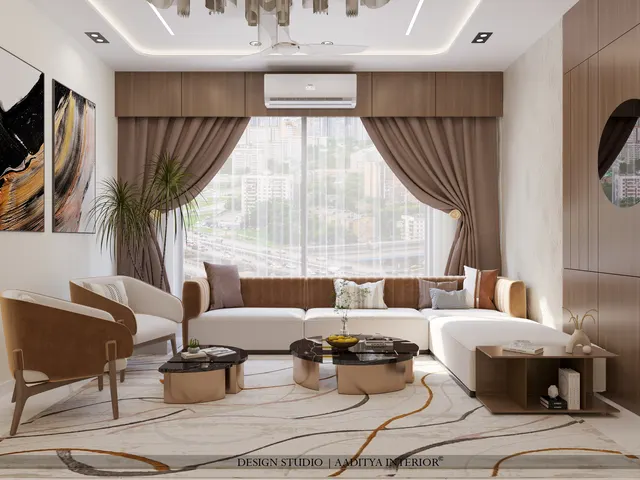
Brass has been part of Indian homes for as long as anyone can remember: the lota and the thali, the diya and the bell in the pooja room, the urli in the courtyard, the heavy door knocker and the hinges on a teak chest. In contemporary interiors it has returned in a new role. Instead of objects, brass now appears as lines and touch points — a thin gold line between two stones in a foyer, a brushed handle on a fluted wardrobe, a slim edge on a marble counter, a trim where wall panelling meets paint. Used well, a few metres of brass give a room warmth and precision that no other material quite matches.
Used carelessly, brass becomes the most common sign of a dated or over-decorated interior. Every handle, every lamp, every frame and every trim in shiny gold quickly looks like a showroom. Cheap zinc-alloy handles sold as brass lose their plating within a year. Brass strips laid into stone without allowing for movement lift at the joints. Unlacquered brass taps in a hard-water bathroom turn green and blotchy. And in a coastal city, the wrong brass finish can tarnish within months.
This article explains what brass is and how it differs from bronze, copper and brass-coloured finishes, traces its history in Indian homes, and then gives the dimensions, details, finishes, care routines and indicative October 2026 prices for its three main modern uses: inlay, handles and trims. Prices are kept consistent with the materials and style guides elsewhere on this site.
What brass is — and what it is not
Brass is an alloy of copper and zinc. Most brasses used in architecture and hardware contain roughly 60–70 per cent copper, with small additions of other metals that make them easier to machine or cast. More copper makes the colour redder and warmer; more zinc makes it yellower. Brass is easy to cast, machine, stamp and polish, it resists corrosion reasonably well indoors, and it develops a natural patina — a darkening of the surface — over time. Bronze, often confused with it, is mainly copper and tin; it is darker, harder and traditionally used for casting sculpture and bells. Copper is the pure metal: pinker, softer and quicker to tarnish.
Much of what is sold as brass in hardware shops is not solid brass at all. Many handles and fittings are die-cast zinc alloy or steel with a thin brass-coloured plating, which wears through at the edges and touch points. Separately, PVD (physical vapour deposition) coating applies a very thin, hard, brass-coloured layer onto stainless steel or other metals; it does not tarnish or patinate, and is widely used for bathroom fittings, kitchen handles and decorative trims. Both have a place, but they should be bought for what they are.
| Material | What it is | Look over time | Strengths | Weaknesses | Indicative cost (Oct 2026) |
|---|---|---|---|---|---|
| Solid brass | Copper–zinc alloy throughout | Darkens to a warm patina unless lacquered or polished | Can be re-polished; ages beautifully; heavy, solid feel | Tarnishes; dislikes acids, salt air and hard water | Inlay ≈ ₹150–450 per running ft; handles priced per piece |
| Bronze | Copper–tin alloy | Dark brown to green patina | Hard, durable; good for heavy hardware | Higher cost; darker colour | Generally above brass |
| Copper | Pure metal | Pink to brown, then green outdoors | Rich colour; easy to work | Soft; tarnishes quickly | Objects and sheets by weight |
| Zinc alloy or steel, brass-plated | Brass-coloured surface layer over another metal | Plating wears at edges and touch points | Cheap, many designs | Cannot be re-polished; looks worn quickly | Lowest; often sold as brass |
| Stainless steel with PVD brass finish | Thin, hard brass-coloured coating on SS | Constant colour; no patina | Humidity and coastal resistance; low care | Cannot be polished back if scratched through | Trims ≈ ₹300–900 per running ft; sheet ≈ ₹1,200–3,500 per sq ft |
| MS, laser cut, brass-tone powder coat | Painted steel imitating brass | Paint finish, not metal | Affordable for jaali and screens | Reads as paint up close | ₹450–1,000 per sq ft |
Brass in Indian homes: a short history
India has a long tradition of metalwork in copper alloys. Brass and bronze vessels, lamps, bells, images and ritual objects have been made across the subcontinent for many centuries, and brass became the everyday metal of the Indian kitchen and pooja room — valued because it was durable, could be re-polished, and was believed in many households to be good for storing water and food. Traditional homes used brass for lamps such as the tall nilavilakku of Kerala, for urlis, for door studs and knockers, for the corner fittings of wooden chests, and for the chains of swings.
Distinct craft centres grew around the metal. Moradabad in Uttar Pradesh is so closely associated with brassware that it is often called the brass city, and it remains a major centre for decorative and export brassware. Jamnagar in Gujarat has a large industry making brass parts — fittings, components and hardware — for India and for export. Tarkashi, the inlay of fine brass wire into wood, is a traditional craft associated with Mainpuri in Uttar Pradesh. Bidriware from Bidar, often mistaken for brass work, is a different craft: silver inlaid into a blackened zinc-based alloy.
In the twentieth century, brass entered architecture as well as objects. Art Deco buildings in Mumbai used brass in railings, lift doors, signage and light fittings, and terrazzo floors were laid with brass or aluminium divider strips. In the late twentieth century, brass fell out of fashion in favour of chrome and stainless steel, which were seen as cleaner and more modern. Since the 2010s, warm metals have returned strongly — first as brushed brass and gold PVD in hospitality projects, then in homes — and they are now among the most requested finishes in Indian interiors.
Brass inlay: floors, walls and furniture
An inlay is a thin strip or shape of brass set into another material so that its top surface is flush. In floors, brass strips divide terrazzo panels, frame a stone medallion in a foyer, mark a threshold between two materials or trace a border around a rug zone. On walls, brass lines run between stone slabs, between veneer panels or within lime plaster. In furniture, brass is inlaid into dining tables, consoles and doors — sometimes as a strip, sometimes as fine wire in the tarkashi tradition.
The detail in Fig. 2 is the standard method for stone. A groove of the strip's width — typically 2–5 mm — is cut into the stone or along the joint between two stones, the strip is bedded in epoxy so that it stands slightly proud, and the floor is then ground and polished so the brass finishes exactly flush with the stone. In terrazzo, the divider strips are fixed into the base before the topping is poured; they form the joints that control cracking, and the floor is ground flush after curing. In wood and veneer, a routed groove takes a thinner strip glued in place, and the surface is sanded and finished over it.
Three practical points decide whether an inlay lasts. First, movement: brass expands and contracts with temperature differently from stone, so long continuous strips across large floors should stop at the floor's movement joints rather than run across them. Second, wear: a strip in a busy foyer polishes bright where people walk and darkens at the edges; that variation is part of its charm, but a client who wants a uniform gold line should choose a lacquered or PVD-coated strip — accepting that lacquer wears too. Third, cleaning: acidic cleaners that harm marble also harm brass; a neutral pH floor cleaner suits both. Floor inlay in wet areas, such as bathroom floors and kitchen sink zones, is best avoided.
| Inlay type | Strip size | Typical location | Indicative cost (Oct 2026) | Notes |
|---|---|---|---|---|
| Straight brass strip in stone | 2–5 mm wide, set 10–15 mm deep | Foyer borders, thresholds, stone-to-stone joints | ≈ ₹150–450 per running ft installed | Ground and polished with the floor |
| Curved strip or medallion | 2–5 mm | Foyer medallions, rug borders | Upper end of the range or above | Bending and fitting take skilled time |
| Terrazzo divider strip | 2–5 mm | Panel joints in cast terrazzo | ≈ ₹150–450 per running ft | Also controls cracking; aluminium cheaper |
| Brass strip in wood or veneer | 1–3 mm | Table tops, consoles, wall panels, doors | Quoted by the joiner | Thin strips need a clean routed groove |
| Brass line in wall stone or plaster | 3–10 mm face | Feature walls, TV walls, columns | ≈ ₹150–450 per running ft; PVD profile ₹300–900 | Fix to the substrate, not just into plaster |
| Tarkashi (brass wire inlay) | Fine wire | Boxes, panels, furniture details | Craft pricing by piece | Traditional craft; very fine detail |
As a worked example, the foyer layout in Fig. 2 uses a square border 300 mm from the walls of a 2400 × 2400 mm foyer — about 24 running ft — and a 1000 mm diameter medallion with a cross through it — about 17 running ft — for a total of roughly 41 running ft. At ₹150–450 per running ft that is about ₹6,000–18,500, with the curved medallion likely to push the cost towards the upper end. It is a small sum relative to the stone floor, for a detail that defines the entrance.
Brass handles: sizes, placement and quality
Handles are the brass people touch every day, and they are where the difference between solid brass and plated metal shows first. Cabinet handles in India, as in most of the world, are sized by the distance between their fixing screw centres, which follows the 32 mm system used for cabinet drilling: common centre-to-centre sizes are 96, 128, 160, 192, 224, 256 and 320 mm, with longer bar pulls of 448–600 mm or more for tall doors. Knobs are typically 25–40 mm in diameter.
Placement follows use. On kitchen base drawers and doors, handles are usually fixed horizontally near the top edge — about 40–60 mm below it — so they can be reached without bending; on wall cabinets they go near the bottom edge. On wardrobes, a long vertical bar pull centred at about 1000–1100 mm from the floor suits most adults, with a length of 320–600 mm on 2100–2400 mm tall doors. On room doors, lever handles are commonly fixed at about 900–1050 mm. For a family that includes elders or wheelchair users, levers and D-shaped pulls that can be operated with a closed hand are easier than small knobs.
| Cabinet | Typical handle | Centre-to-centre size | Position |
|---|---|---|---|
| Kitchen drawer up to 450 mm wide | Bar or D pull | 96–160 mm | Horizontal, 40–60 mm below the top edge |
| Kitchen drawer 600–900 mm wide | Bar pull, or two handles | 192–320 mm | Horizontal, centred |
| Kitchen wall cabinet | Small pull or knob | 96–128 mm, or knob 25–40 mm | Near the bottom edge |
| Wardrobe door 2100–2400 mm tall | Long bar pull | 320–600 mm or more | Vertical, centred about 1000–1100 mm high |
| Bedside or console drawer | Knob or short pull | Knob 25–35 mm; pull 64–128 mm | Centred |
| Main door | Large pull handle or lever set | Pull 300–1200 mm | Lever about 900–1050 mm; pull centred near 1000–1100 |
| Sliding wardrobe | Recessed flush pull or profile | Flush cup or full-height profile | At a comfortable reach height |
Telling solid brass from plated
Solid brass handles are noticeably heavier than plated zinc-alloy handles of the same size; a scratch on the underside shows yellow metal rather than grey; and a reputable seller will state the material and finish in writing. Solid brass handles cost more, but they can be re-polished, they age evenly, and their threads hold better in repeated use. Indicative October 2026 prices: a full kitchen set of brushed brass handles typically costs about ₹3,000–8,000, consistent with this site's kitchen guides; individual solid brass handles of good quality commonly range from about ₹300 to ₹2,500 per piece depending on size and finish, and large main-door pulls cost considerably more. PVD-coated stainless steel handles in brass colours fall in a similar band and suit humid kitchens and coastal homes.
Trims and edges
A trim is a thin metal profile that finishes an edge or a junction: the nosing of a step, the edge of a stone counter, the corner of a wall panel, the line between a veneer panel and painted wall, a reveal at the base of a wall in place of a skirting, or a strip framing a mirror. Brass trims give interiors precision: they protect vulnerable edges and draw a clean line where two materials meet. In practice, most trims in Indian projects are now PVD-coated stainless steel profiles in brass, champagne or bronze colours, because they are available in standard lengths and shapes, keep their colour and suit humid rooms. Solid brass profiles are used where patina is wanted or a custom shape is needed.
| Trim | Typical size | Use | Material choice | Indicative cost (Oct 2026) |
|---|---|---|---|---|
| L-edge or corner profile | Face 10–20 mm | Counter edges, wall corners, panel ends | PVD SS for kitchens and baths; brass for dry rooms | PVD ≈ ₹300–900 per running ft |
| T-profile inlay | Face 5–10 mm | Joints between wall panels, veneer or stone | PVD SS or brass | ≈ ₹300–900 per running ft (PVD) |
| Reveal or shadow-gap skirting | Channel 10–20 mm, height 30–80 mm | Base of walls instead of a skirting | Aluminium or PVD SS | Profile plus installation; quoted per running ft |
| Stair nosing | Face 20–40 mm | Edges of treads | Grooved brass or PVD with anti-slip insert | Quoted per running ft by profile |
| Mirror or frame trim | Face 10–30 mm | Mirror edges, wall frames | PVD SS or brass | ≈ ₹300–900 per running ft |
| Furniture leg caps and bands | By design | Table and sofa legs, console bases | Solid brass or PVD | Quoted per piece |
Fixing matters as much as finish. A trim is a long thin piece of metal that will move slightly with temperature and will be knocked by people, trolleys and cleaning equipment. It should be fixed mechanically or with a suitable structural adhesive into a sound substrate — plywood, stone, blockwork — not just pressed into wall putty. Joints between lengths should fall at corners, panel lines or doors, and the cut ends should be deburred so they cannot cut a hand. Where brass meets aluminium in a wet area, the two metals can corrode each other, so mixed-metal junctions should be kept dry or separated.
Finishes and how brass ages
Brass is described by its finish as much as by its alloy, and each finish ages differently. Polished brass is mirror-bright and very formal; brushed or satin brass has fine parallel lines that soften the colour and hide fingerprints; antique and aged finishes are chemically darkened to look old from the start. Any of these can be lacquered — sealed with a clear coat that slows tarnishing — or left unlacquered, a so-called living finish that darkens and develops a patina with handling and air. PVD finishes are a separate family: the colour is in a hard coating, and it does not change.
| Finish | Look | How it ages | Care | Best for |
|---|---|---|---|---|
| Polished, lacquered | Bright gold | Stays bright until the lacquer wears, then spots | Wipe with a soft damp cloth; no abrasives or polishes on the lacquer | Formal rooms, Deco and classic styles |
| Polished, unlacquered | Bright gold at first | Darkens steadily; patchy where touched | Re-polish regularly if brightness is wanted | Objects, lamps, traditional pieces |
| Brushed or satin, lacquered | Soft, warm gold | Stable; lacquer wears at touch points | Mild soap and water, dry well | Kitchen and wardrobe handles, trims |
| Brushed, unlacquered (living) | Soft gold to brown | Even patina; brighter where handled | Let it age, or polish occasionally | Handles, inlay, contemporary rooms |
| Antique or aged | Dark brown-gold | Changes little; lightens where rubbed | Gentle cleaning only | Traditional, rustic and heritage interiors |
| PVD brass on stainless steel | Constant brass colour | Does not tarnish; scratches can expose steel | Mild soap; avoid scouring pads | Bathrooms, kitchens, coastal cities |
Traditional Indian households clean unlacquered brass with tamarind, lemon and salt, or with commercial brass-cleaning powders; these work by mildly dissolving the tarnish, and they also remove the protective lacquer from lacquered brass, so they should be used only on unlacquered pieces. Lacquered brass and PVD finishes need nothing more than a soft cloth, mild soap and water, and thorough drying. In bathrooms, hard water leaves white deposits on any finish; wiping fittings dry after use is the simplest prevention. In coastal cities such as Mumbai, Surat or Chennai, salt-laden air tarnishes unlacquered brass quickly and can pit it over time — for exposed or humid locations, PVD-coated stainless steel or well-lacquered brass is the practical choice.
How much brass, and where to avoid it
The most useful rule is to treat brass as an accent with a job. In a typical room, choose one or two brass families — for example, the handles and a single inlay line, or the trims and one lamp — and keep everything else in a supporting palette of timber, stone, plaster and fabric. Match the tone across a room: brushed brass, antique brass and gold PVD side by side look like three different golds, not one considered choice. And repeat it in at least two places so it reads as intended rather than accidental.
| Location | Brass suitability | Better choice where unsuitable | Why |
|---|---|---|---|
| Foyer floor inlay | Very good | — | Defines the entrance; ages well with foot traffic |
| Living room trims and wall lines | Very good | — | Dry, low-touch; patina is slow |
| Kitchen handles | Good if lacquered or PVD | PVD SS in humid kitchens | Grease, steam and frequent touch |
| Bathroom fittings and accessories | Only branded brass with chrome or PVD | PVD-coated brass or SS fittings | Water, soap and hard-water deposits |
| Bathroom or wet-area floor inlay | Avoid | Stainless steel or no inlay | Constant wetting, cleaning chemicals |
| Outdoor steps, balconies in coastal cities | Avoid unprotected brass | SS 316 or PVD; anti-slip profiles | Salt air, rain and slip risk |
| Pooja room | Very good | — | Traditional; polishable objects |
| Railings and handrails | Possible as a cap or detail | SS or MS with brass-finish cap | Structural rail must meet safety design; brass as finish |
Where brass in interiors is going
Three directions are clear in current work. The first is the thin line: brass inlay of 2–5 mm in stone, terrazzo and timber, and slim trims that outline rather than decorate. The second is honesty about material: clients increasingly ask whether a handle is solid brass or plated, and designers specify PVD where constant colour and low care are needed and living brass where patina is wanted. The third is mixing warm metals with natural materials — brushed brass with limewash, fluted timber, terrazzo and handloom — rather than with high-gloss lacquer and mirror. Recycled metal content and longer-lasting, re-polishable hardware also fit the wider move towards durable, low-waste interiors. Aaditya Interior's approach is to specify brass as part of the detailing drawings, with its finish and fixing named, rather than as a last-minute hardware choice.
Rules for using brass well
- Use brass as lines and touch points — inlay, handles, trims, one lamp — not as a coating on everything.
- Pick one finish family per room and match its tone across handles, trims and lights.
- Ask in writing whether hardware is solid brass, plated zinc alloy or PVD-coated stainless steel.
- Set floor inlay strips of 2–5 mm in a cut groove with epoxy, ground flush, and stop them at movement joints.
- Size handles on the 32 mm module — 96 to 320 mm centres for cabinets, longer bars for tall doors — and fix wardrobe pulls centred at about 1000–1100 mm.
- Use PVD-coated stainless steel or well-lacquered brass in bathrooms, humid kitchens and coastal cities.
- Never use smooth polished brass as a stair nosing; choose grooved or anti-slip profiles.
- Clean lacquered brass and PVD with mild soap only; keep tamarind, lemon and brass powders for unlacquered pieces.
Frequently asked questions
Is brass inlay in marble or granite flooring a good idea?
Yes, in dry areas such as foyers, living rooms and around dining zones. Strips of 2–5 mm are set into cut grooves with epoxy and polished flush with the stone. Avoid inlay in wet areas, stop strips at movement joints, and use neutral pH cleaners that are safe for both stone and brass.
What is the difference between brass and PVD gold finish?
Brass is a solid copper–zinc alloy that tarnishes and develops a patina, and can be re-polished. PVD gold or brass finish is a thin, very hard coloured coating applied to stainless steel or another metal; it keeps a constant colour and resists humidity, but cannot be polished back if it is scratched through.
Do brass handles turn black?
Unlacquered brass darkens naturally with air and handling, becoming brown and, in humid or salty air, sometimes greenish. Lacquered brass stays bright until the lacquer wears. If a constant colour is wanted, choose lacquered brass or PVD finishes; if a natural patina is welcome, choose unlacquered solid brass.
How do I clean brass fittings at home?
For lacquered brass and PVD finishes, use only a soft cloth, mild soap and water, and dry thoroughly. For unlacquered brass, traditional tamarind or lemon-and-salt cleaning or a brass cleaner restores the shine; rinse and dry afterwards. Never use these acidic cleaners on lacquered or PVD surfaces.
How much does brass inlay cost per foot in India?
Indicatively, about ₹150–450 per running ft installed in stone or terrazzo in October 2026, with curves, medallions and thicker strips at the upper end. PVD-coated stainless steel trim profiles cost about ₹300–900 per running ft. Always ask whether grinding and polishing are included.
Sources & standards
- Copper Development Association and international copper alloy designations — composition of common brasses and bronzes (described generally)
- Bureau of Indian Standards — IS 319 (free-cutting leaded brass bars, rods and sections) and other IS standards for copper-alloy products
- Bureau of Indian Standards — National Building Code of India 2016, Part 4 (Fire and Life Safety) and Part 3 (stairs) — general requirements for safe stairs and nosings
- Office of the Development Commissioner (Handicrafts), Ministry of Textiles — notes on Moradabad brassware, tarkashi and Bidriware
- Geographical Indications Registry, Government of India — registered GI entries for Moradabad metal craft and Bidriware
- Hardware manufacturers' catalogues — 32 mm system hole spacing and handle centre-to-centre ranges (described generically)
- Price ranges: indicative October 2026 estimates — confirm locally before budgeting