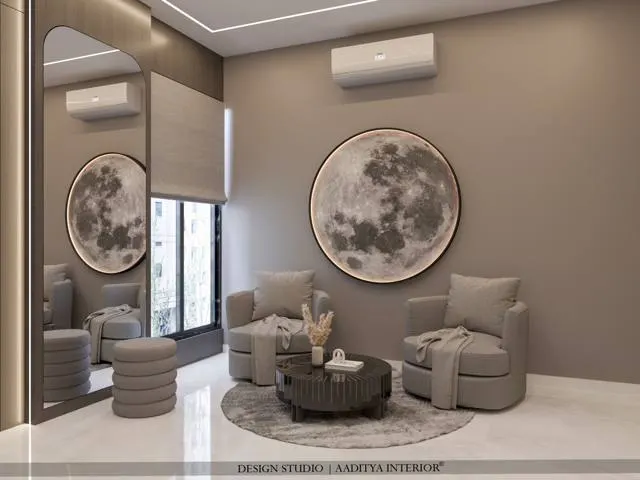
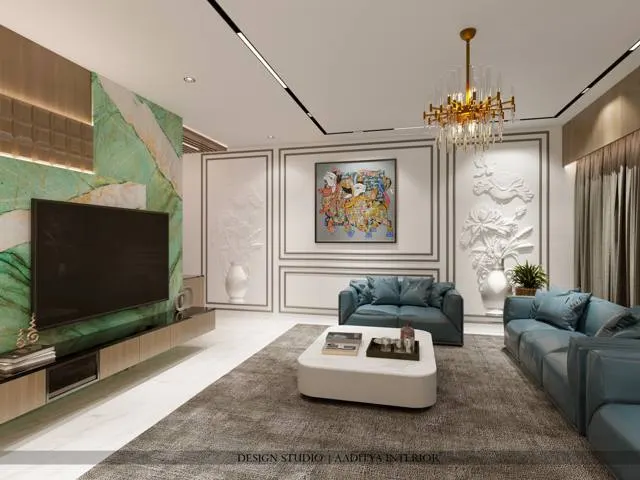
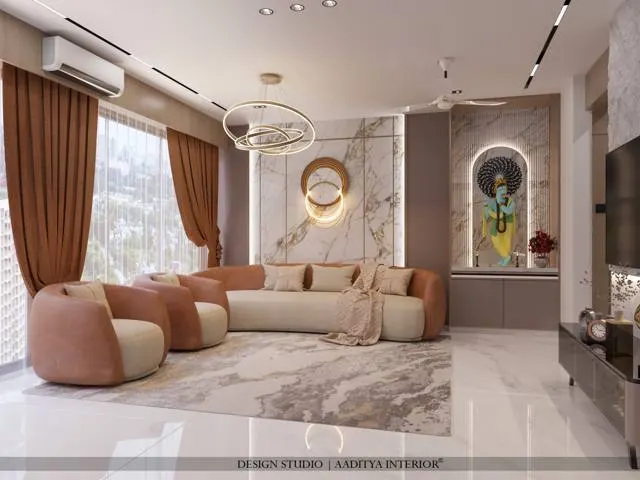
Metal has quietly become one of the main materials of the Indian interior. A gold strip runs through a marble floor, a black frame holds a fluted-glass partition, a champagne profile edges a wardrobe, a rose-gold jaali screens a pooja room, and a brushed-steel backsplash sits behind a hob. Outside, there are railings, gates, grilles, pergolas and facade fins. Each of these is a piece of metal with a finish on its surface, and in almost every case the finish, not the metal, is what the client chose. "Gold", "black matte", "antique bronze" and "satin silver" are colours; the real decision is how that colour is put onto the metal, and on which metal.
This is where most metal work in Indian homes goes wrong. A "gold" trim turns out to be spray-painted mild steel that rusts at the cut ends within a monsoon. A powder-coated railing blisters along every weld because the steel was coated straight over mill scale. A "stainless steel" kitchen panel shows brown spots because it was grade 202, not 304. A PVD handle looks perfect at handover and shows silver lines where rings rub it a year later, because the PVD was applied over a soft base or the wrong finish was chosen for a high-contact surface. None of these are failures of the material. They are failures of specification.
This article explains the three metal finishes Indian designers specify most — powder coat, PVD (physical vapour deposition) and brushed stainless steel — along with the base metals they sit on, the thickness of each film, how each behaves in humid cities such as Surat and Mumbai and on coastal sites, where each belongs in a home, what it costs, and how to check the work before it is fixed.
From gilding to vacuum chambers: a short history of metal finishes
People have always wanted metal to look like more expensive metal. Gilding — laying very thin gold leaf, or a gold amalgam, over copper, bronze, wood or stone — is thousands of years old, and Indian temples, palace ceilings and processional objects show its long use here. Brass and bronze were themselves the finish for much of Indian domestic life: lamps, door knockers, water vessels and hinges were cast or beaten in copper alloys and polished by hand, and their warm colour is the reference point that today's "gold" and "champagne" finishes still imitate.
The industrial age changed the method. Electroplating — depositing a thin layer of one metal on another using an electric current in a chemical bath — became commercial in the mid-nineteenth century, and chrome and nickel plating later became the standard finish for taps, door hardware and car parts. Stainless steel, developed in the 1910s, gave designers a metal that did not need a coating at all to resist rust, and its brushed and mirror finishes became the look of modern kitchens, hospitals and lifts. In the mid-twentieth century, powder coating appeared: instead of liquid paint with solvents, a dry powder is sprayed electrostatically and baked into a continuous film. It spread rapidly for aluminium windows, steel furniture and appliances.
Physical vapour deposition is the newest of the three. It was first used industrially to put very hard ceramic coatings on cutting tools and drill bits, where a few microns of titanium nitride made a tool last far longer. The same coating happens to be gold in colour, and decorative PVD followed: watch cases, sanitary fittings, door hardware, and eventually whole sheets of stainless steel in gold, rose gold, champagne, bronze and black. In India, PVD-coated stainless sheets, profiles and jaalis became widely available in the last decade or so and now appear in apartments as much as in hotels.
Start with the base metal, not the colour
Every finish sits on something, and the base metal decides most of the long-term behaviour. A perfect powder coat on poorly prepared mild steel will still rust from the edges; a beautiful PVD layer on grade 202 stainless will still show corrosion spots in a coastal flat. Before discussing colour, a designer should settle which metal the element is made of, and whether that metal can survive the room it is going into without help.
Mild steel (MS) is cheap, strong and easy to weld and laser-cut, which is why it is used for railings, grilles, gates, partition frames and laser-cut jaalis. It rusts readily, so it always needs a protective finish, and the protection is only as good as the preparation underneath. Galvanised steel is mild steel coated with zinc, either by hot dipping fabricated parts or by using pre-galvanised sheet and tube; the zinc protects the steel even where it is scratched. Aluminium does not rust in the way steel does — it forms a thin oxide layer — but it can pit and corrode in salty air if left bare, so it is normally powder coated or anodised. Stainless steel is an alloy of iron with chromium (and, in the common grades, nickel); the chromium forms a self-healing passive film, which is why it can be left uncoated.
Stainless steel grades: 202, 304 and 316
Not all stainless steel is equal, and the grade is the most common hidden saving in Indian fabrication. Grade 304 is the general-purpose austenitic stainless used for kitchens, sinks, railings and most PVD sheets; it performs well indoors and in most urban outdoor conditions. Grade 316 adds molybdenum, which improves resistance to chlorides — sea air, swimming-pool atmospheres and de-icing salts — and is the right choice on sea-facing balconies and pool surrounds. Grade 202 replaces much of the nickel with manganese; it is cheaper and looks identical when new, but it has noticeably lower corrosion resistance and tends to show rust spots in humid or coastal conditions. A magnet test is not a reliable way to tell the grades apart; a mill test certificate, or a simple spark or chemical test kit used by many fabricators, is better. Specify the grade in writing, and ask for it on the invoice.
| Base metal | Corrosion behaviour | Usual finishes | Typical uses in homes | Watch out for |
|---|---|---|---|---|
| Mild steel (MS) | Rusts quickly if unprotected | Primer + paint, or pre-treatment + powder coat | Railings, grilles, gates, frames, laser-cut jaalis | Coating over mill scale or rust; uncoated cut edges and welds |
| Galvanised steel (hot-dip or pre-galvanised) | Zinc protects even at scratches | Bare, or powder coat with a suitable primer | Outdoor frames, pergolas, gates, service ladders | Powder adhesion on zinc needs the right pre-treatment |
| Aluminium | Does not rust; can pit in salty air if bare | Powder coat, anodising, PVDF | Windows, louvres, facade fins, profiles, partitions | Soft — dents and scratches more easily than steel |
| Stainless steel 202 | Moderate; rust spots in humid or coastal air | Brushed, mirror, sometimes PVD | Budget kitchen racks, low-cost railings | Sold as 'SS' without grade; avoid near water and the coast |
| Stainless steel 304 | Good indoors and in most city exteriors | Brushed (No. 4, hairline), mirror, PVD | Kitchens, railings, trims, jaalis, handles, PVD sheets | Tea staining outdoors if not cleaned; grade fraud |
| Stainless steel 316 | Better against chlorides (sea air, pools) | Brushed, mirror, PVD | Sea-facing balconies, pool areas, coastal facades | Cost; still needs rinsing in severe marine sites |
| Brass and bronze | Tarnishes and patinates; does not rust | Natural, lacquered, PVD over brass | Handles, inlay strips, lamps, furniture details | Lacquer wears at contact points; patina is uneven |
Powder coating: a baked plastic skin
Powder coating is a paint without a liquid. Finely ground particles of resin, pigment and additives are sprayed from a gun that gives them an electrostatic charge; the earthed metal part attracts the powder, which wraps around edges and into corners. The part then goes into an oven, where the powder melts, flows and cross-links into a continuous film. Curing schedules are set by the powder manufacturer, typically somewhere around 180–200 °C for about 10–20 minutes of metal temperature. The result is a film that is much thicker and tougher than most liquid paints, with no solvents released, and it comes in practically any colour and in gloss, satin, matte, textured, metallic and wood-grain effects.
The single most important fact about powder coating is that its life is decided before the powder is sprayed. The steel must be clean: oil, rust and mill scale removed by chemical cleaning and, ideally, abrasive blasting; then a conversion coating (such as zinc or iron phosphate) applied to improve adhesion and slow under-film corrosion. For exterior mild steel, a zinc-rich primer — or hot-dip galvanising before coating — makes a large difference. Welds should be ground and cleaned, sharp edges slightly rounded so the film does not thin out on them, and drainage holes provided in hollow sections so water and pre-treatment chemicals do not stay trapped inside.
Epoxy, polyester and hybrid powders
The resin family decides where a powder can go. Epoxy powders are very hard and chemically resistant but degrade and chalk in sunlight, so they belong indoors — on equipment, under-counter frames and machinery. Polyester powders are UV-stable and are the usual choice for anything outdoors or near windows; "super-durable" polyester grades hold colour and gloss longer on facades. Epoxy-polyester hybrids are a common indoor general-purpose powder for furniture, racks and appliances. For aluminium windows and facades, many specifiers ask for coaters working to an international quality label such as Qualicoat, or to architectural performance specifications such as the AAMA 2603/2604/2605 series, and for very demanding exteriors a liquid PVDF (fluoropolymer) coating is used instead of powder. Indian powder coatings are covered by IS 13871, and a reputable coater can tell you which product and standard a job will follow.
Strengths and limits
Powder coat is tough, cheap per square foot, available in any colour and texture, and easily renewed: a tired railing can be stripped and recoated. Its limits are that it is a coating with a thickness, so it rounds off fine detail and can block very small holes in a fine jaali; it can chip if struck hard, exposing bare steel; and it cannot convincingly imitate a polished metal. Metallic "gold" powders read as painted gold, which is perfectly acceptable on a gate or a jaali seen from a distance, but not on a trim or handle that is seen and touched at close range.
PVD: a thin, hard metallic colour
PVD stands for physical vapour deposition. Parts — usually stainless steel sheets, tubes, profiles or fittings that have already been brushed or polished — are cleaned meticulously and loaded into a vacuum chamber. Inside, a source material such as titanium or zirconium is vaporised, by an electric arc or by sputtering, and reacts with gases admitted into the chamber, such as nitrogen or a carbon-bearing gas. The vapour condenses on the parts as a very thin ceramic film: titanium nitride gives a gold colour, and other compounds and process recipes give rose gold, champagne, bronze, copper, gunmetal and black. The coating is typically well under a few microns thick — far thinner than a human hair — yet it is very hard and bonds strongly to clean stainless steel.
Because the film is so thin, it takes on the texture of the surface below. PVD over a mirror (No. 8) finish gives mirror gold; PVD over a hairline or No. 4 brushed finish gives brushed gold or brushed champagne; PVD over a bead-blasted finish gives a soft, satin metallic. This is why PVD on stainless steel looks like real polished metal, which powder coat cannot. It also means that every scratch, dent or uneven grain in the steel before coating will show after coating; preparation is everything.
What PVD does well, and what it cannot do
Applied properly on stainless steel, PVD is colourfast, resists humidity and most household chemicals, does not tarnish like brass, and is hard enough to resist ordinary wiping and light contact. That makes it the finish of choice for trims, skirtings, profile strips in floors and walls, jaalis seen at close range, mirror frames, furniture legs, kitchen and bathroom details and hotel lobbies. Its limits are equally clear. The film is thin, so a deep scratch from a key, a ring or grit under a shoe reaches the steel below and shows as a silver line; it cannot be polished out or touched up locally. Colours can vary slightly between batches and between suppliers, so all sheets and profiles for one room should come from the same batch. Long or very large parts are limited by the size of the coating chamber, and joints must be planned. And PVD on a poor base — on 202 stainless, or on brass or zinc alloy without the right under-layers — can fail where the base corrodes beneath it.
A practical warning: in the market, "PVD" is sometimes used loosely for gold-coloured items that are actually electroplated, lacquered, or even powder coated with metallic powder. Ask the supplier for the base metal and grade, the coating method, and a sample that has been through a simple rub and scratch comparison with a known PVD sample. A reputable supplier will happily provide a datasheet.
Brushed stainless steel: a finish with no coating
Brushed stainless steel is not a coating at all. It is stainless steel whose surface has been abraded in one direction with belts or brushes to give a fine, uniform grain. The grain diffuses reflections, hides fingerprints and light scratches better than a mirror, and gives the soft, satin look of professional kitchens and lift cars. Because there is nothing on top of the metal, a brushed finish can be refreshed with the right abrasive pad, and small scratches can be blended out by a skilled fabricator — something neither powder coat nor PVD allows.
International practice describes stainless finishes with standard names, and Indian suppliers use the same terms. 2B is the dull grey mill finish straight from the rolling mill, used where appearance does not matter. No. 4 is the common brushed or satin finish with short, visible grain lines. Hairline (HL) has longer, continuous lines and a more refined look, often used for lifts, trims and PVD base. No. 8 is a mirror finish. Bead-blasted finishes give a uniform matte with no direction. For interiors, No. 4 and hairline are the workhorses; mirror finishes are spectacular but show every fingerprint and every ripple in the sheet.
Brushed steel in kitchens and bathrooms
Brushed SS 304 is the most practical metal surface in a hard-working Indian kitchen: it takes heat, it can be scrubbed, and it does not care about turmeric or oil. Used as a backsplash behind the hob, as a counter in a utility or as cladding on a tall unit, it reads as professional and clean. Its weaknesses are that it shows fine scratches from steel-wool scrubbers, water spots from hard water, and fingerprints on the lighter grains. Cleaning along the grain with a soft cloth and a mild detergent, followed by drying, keeps it looking right. In bathrooms, brushed steel accessories and grab bars should be 304 at the least, and 316 in steam rooms, near pools, and on the coast.
The three finishes side by side
The comparison below sets the three main finishes against each other on the points that matter in a home. It assumes good-quality work: properly pre-treated steel under powder coat, SS 304 or better under PVD, and a correctly specified grade for brushed steel. Poor work narrows every advantage.
| Property | Powder coat | PVD on stainless steel | Brushed stainless (uncoated) |
|---|---|---|---|
| What it is | Baked resin film over MS, galvanised steel or aluminium | Thin ceramic film bonded in a vacuum to SS | Stainless steel with a directional abraded grain |
| Typical thickness | 60–80 µm indoors; 110–150 µm with primer outdoors | About 0.2–2 µm (typical decorative) | No coating |
| Look | Paint: any colour, matte to gloss, textures | True metallic: gold, rose gold, champagne, bronze, black | Satin silver with grain |
| Scratch behaviour | Chips to bare metal on hard impact | Deep scratches show silver base | Scratches can be blended out |
| Humid and coastal sites | Good only with full pre-treatment and primer | Very good on 304; use 316 near the sea | Very good on 304; 316 near the sea; avoid 202 |
| Repair | Strip and recoat the whole piece | Not locally repairable; replace the piece | Re-grain with an abrasive pad |
| Best uses | Railings, gates, grilles, jaalis, frames, louvres | Trims, profiles, handles, jaalis, mirror frames, lobbies | Kitchens, backsplashes, lifts, grab bars, sinks |
| Relative cost | Lowest | Highest | Middle |
Which finish where: a room-by-room guide
The right finish is the one that matches three things: how close people get to the surface (seen from a distance, seen close, or touched daily), how wet or salty the air is, and whether the element can be easily replaced. A gate seen from the street and repainted every few years is a natural powder-coat job. A handle touched fifty times a day needs a hard, colourfast surface on a good base. A floor inlay strip that will be walked on for twenty years needs something that wears gracefully.
| Element | Recommended finish | Base metal | Why | Avoid |
|---|---|---|---|---|
| Door and wardrobe handles | PVD or solid brass with PVD | SS 304 or brass | Touched daily; colourfast | Painted or plated zinc alloy in humid rooms |
| Floor and wall inlay strips, skirting trims | PVD (brushed or mirror) | SS 304 | Stable colour, matches handles | Painted aluminium strips that scuff |
| Glass partition and shower frames | Powder coat (matte black) or PVD | Aluminium or SS 304 | Slim sections; consistent colour | MS frames near showers |
| Internal stair railings | Powder coat or brushed SS | MS (primed) or SS 304 | Cost versus maintenance | Untreated MS welds |
| Balcony railings and grilles, city | Powder coat over zinc primer, or SS 304 | MS, galvanised or SS | Weather and UV | Single-coat powder on bare MS |
| Balcony railings, sea-facing | Brushed or PVD SS 316, or powder-coated aluminium | SS 316 or aluminium | Chloride resistance | SS 202; bare MS |
| Pooja and partition jaalis | PVD for close view; powder coat for budget | SS 304 or MS | Seen at close range, often backlit | Fine patterns in thick powder that clogs holes |
| Kitchen backsplash and utility counter | Brushed SS (No. 4 or hairline) | SS 304 | Heat, scrubbing, hygiene | Mirror finish; 202 grade |
| Gates, pergolas, facade fins | Powder coat (super-durable polyester) or PVDF on aluminium | Galvanised MS or aluminium | Large area, low cost, renewable | Interior-grade epoxy powders |
What metal finishes cost in October 2026
Metal work is priced per square foot, per running foot or per piece, and the finish is only part of it: the base metal, its thickness, the fabrication, the pattern and the fixing all count. The ranges below are indicative October 2026 rates for supplied and installed work in Indian metro and tier-2 cities, consistent with the rates used in this site's jaali, railing and ethnic-interior articles. They exclude GST and vary with quantity, pattern complexity and site conditions.
| Element and finish | Indicative installed rate | Unit | Notes |
|---|---|---|---|
| Laser-cut MS jaali, powder coated | ₹450–1,000 | per sq ft | Price rises with pattern density and frame |
| Laser-cut aluminium screen or louvre, powder coated | ₹550–1,200 | per sq ft | Light; good for facades and large screens |
| Stainless steel jaali, PVD gold, rose gold or bronze | ₹1,200–3,500 | per sq ft | Lobby and statement screens; climbs fast with area |
| PVD-coated SS wall or column cladding (bonded to board) | ₹800–1,800 | per sq ft | Depends on grade, thickness, finish and detailing |
| PVD trim and inlay profiles | ₹300–900 | per running ft | U, T, L and skirting profiles in SS 304 |
| Brass floor inlay strip | ₹150–450 | per running ft | Solid brass; tones and patinas over time |
| Brushed SS 304 sheet backsplash | ₹400–800 | per sq ft | On a backing board; 316 costs more |
| MS handrail, powder coated | ₹350–800 | per running ft per rail | Repaint or touch up every few years outdoors |
| SS 304 handrail, brushed | ₹700–1,500 | per running ft per rail | Low maintenance in coastal humidity |
Two cost truths follow. First, the finish is rarely the largest part of the bill; the steel grade, the thickness and the labour usually are. Downgrading SS 304 to 202 under a PVD finish saves money on day one and loses it to rust spots within a few years. Second, the cheapest finish over ten years is often not the cheapest on day one: a powder-coated MS railing on a sea-facing balcony needs recoating repeatedly, while brushed SS 316 needs only cleaning.
How metal finishes fail, and how to look after them
Each finish fails in its own characteristic way, and recognising the early signs allows a cheap fix before an expensive replacement. The table summarises the common problems seen in Indian homes.
| Problem | Finish | Likely cause | Prevention or fix |
|---|---|---|---|
| Blisters and rust bleeding along welds | Powder coat on MS | No blasting or primer; moisture trapped in hollow sections | Blast, phosphate, zinc-prime; drain holes; strip and recoat |
| Chalky, faded colour | Powder coat outdoors | Epoxy or interior-grade powder in sunlight | Specify UV-stable polyester for exteriors |
| Silver lines through gold | PVD | Deep scratches from rings, keys, grit | PVD on low-contact surfaces; replace the piece |
| Brown 'tea stains' or rust spots | Brushed or PVD stainless | Grade 202, salt deposits, iron contamination from steel tools | Use 304/316; rinse coastal surfaces; never use steel wool |
| Hazy white spots | All finishes | Hard-water marks dried on the surface | Wipe dry; mild vinegar solution, rinsed off, on stainless only |
| Darkened, uneven brass | Natural or lacquered brass | Lacquer worn through; oxidation | Accept patina, or re-lacquer; or use PVD-coated brass |
Cleaning is mostly about what not to use. All three finishes are best cleaned with a soft cloth, water and a mild pH-neutral detergent, then dried. Avoid scouring powders, steel wool and wire brushes on every finish — on stainless steel, particles of ordinary steel left behind will rust and look like the stainless is corroding. Avoid acidic toilet cleaners and bleach splashing onto PVD and stainless fittings. On the coast, rinse exterior stainless and powder-coated metal with fresh water every few weeks, especially in sheltered spots the rain does not wash.
Where metal finishing is going
Three trends are already visible in Indian projects. The first is the widening PVD palette: beyond gold and rose gold, there are now champagne, bronze, gunmetal, black and coloured finishes, often combined with patterns, etched textures and anti-fingerprint top layers that make dark and mirror finishes practical for handles and lifts. The second is better exterior coatings: super-durable polyester powders and PVDF coatings on aluminium are making facade fins, louvres and screens last longer in sun and coastal air, and duplex systems — hot-dip galvanising followed by powder coating — are becoming more common for steel gates and pergolas. The third is a move towards honest metal: natural brass that is allowed to patina, blackened or bronze-toned steel, and brushed stainless without colour, used for its own character rather than as an imitation of gold. In each case, the lesson of the last century holds: the base metal and the preparation still decide the life of the finish.
Eight rules for specifying metal finishes
- Specify the base metal and grade in writing — MS, galvanised, aluminium, SS 304 or SS 316 — and ask for it on the invoice; never accept just 'SS'.
- Avoid grade 202 stainless anywhere wet, humid or coastal; use 316 for sea-facing balconies, pools and coastal facades.
- For exterior powder coat on steel, require blasting, a conversion coat and a zinc-rich primer or hot-dip galvanising, then a UV-stable polyester topcoat.
- Ask the coater for dry-film thickness readings and a sample panel; check edges, welds and inside corners before installation.
- Use PVD where metal is seen and touched at close range; use powder coat where it is seen from a distance and can be recoated.
- Order all PVD sheets and profiles for one room from one batch, and keep the grain direction the same on every sheet.
- Keep one metal colour family per room and vary texture rather than colour.
- Write cleaning instructions into the handover: soft cloth, mild detergent, dry; no steel wool, acids or bleach.
Frequently asked questions
Is PVD better than powder coating?
They do different jobs. PVD gives a true metallic look and is harder and thinner, but it needs a stainless-steel base and cannot be repaired locally. Powder coat is thicker, cheaper, comes in any colour and can be stripped and renewed, but looks like paint rather than polished metal. Use PVD for trims, handles and close-up decorative metal; use powder coat for railings, gates, frames and large screens.
Does PVD gold fade or rust?
Good PVD on SS 304 or 316 does not fade in normal indoor use and does not tarnish like brass. It can be scratched through by hard, sharp contact, which exposes the steel as a silver line. If the base is low-grade stainless, the base can corrode under the coating, which looks like the PVD failing; the fix is to specify the right grade.
How long does powder coating last outdoors in India?
It depends almost entirely on preparation and exposure. A properly blasted, primed and UV-stable polyester system on steel can last many years in an inland city before it needs attention, while a single coat over unprepared mild steel can blister along welds within one or two monsoons. Coastal sites shorten every life; galvanising under the powder, or switching to aluminium or stainless, helps most.
How can you tell SS 304 from SS 202?
Not by eye and not reliably with a magnet. Ask for the mill test certificate or the grade on the invoice, and ask the fabricator to use a chemical test kit or a spectrometer check at the supplier for large orders. A price that seems too low for 304 often is.
Can a PVD finish be repaired if it is scratched?
Not locally. A scratched PVD trim, panel or handle has to be replaced or sent back for stripping and recoating, which is why PVD should be used on surfaces that are not scraped by shoes, furniture or tools, and why spare lengths from the same batch are worth keeping.
Sources & standards
- Bureau of Indian Standards — IS 13871, Powder coatings: specification
- Bureau of Indian Standards — IS 6911, Stainless steel plate, sheet and strip; IS 2062, Hot rolled structural steel
- Bureau of Indian Standards — IS 4759, Hot-dip zinc coatings on structural steel and allied products
- ASTM A480 — General requirements for flat-rolled stainless steel, including standard surface finishes (2B, No. 4, No. 8)
- Qualicoat — quality label specifications for coatings on aluminium for architectural use; AAMA 2603/2604/2605 performance specifications
- National Building Code of India 2016, Part 6 (Structural Design) and Part 7 (Constructional Practices and Safety) — general guidance on steel work and protection
- Manufacturer technical datasheets for decorative PVD-coated stainless steel sheet and architectural polyester powders, described generically
- Price ranges: indicative October 2026 estimates — confirm locally before budgeting