The ceiling fan runs for more hours of the year in an Indian home than almost any other appliance, yet it is usually the least considered. A builder fixes one hook in the middle of every room, an electrician hangs whatever fan the shop had in stock, and no one asks whether the sweep suits the room, whether the blades clear the walls, or whether the fan is even over the bed where the air is actually needed. The result is familiar: a fan that whirs hard but moves little air in a large hall, a fan that buffets a small study, or a fan hung so high under a lofty ceiling that the breeze never reaches the floor.
Two decisions settle whether a fan performs: the sweep size relative to the room, and the mounting height and position relative to the people using it. Both are simple to get right once the numbers are known, and both are expensive to fix later because the ceiling point, wiring and often the false ceiling are already set. A wrongly placed point means either living with poor air or cutting open a finished ceiling.
This guide sets out how fans came to be standardised, how they are chosen and mounted in India today against IS and BEE norms, the shift to energy-saving BLDC motors, and a practical method any homeowner can use to pick and place a fan room by room. Dimensions are given in millimetres and prices as indicative October 2026 ranges.
A short history of the ceiling fan in India
The electric ceiling fan arrived in Indian cities in the early twentieth century as mains power spread, and for decades it was a near-luxury found in offices, courtrooms and the homes of the well-off. The heavy induction-motor fan with three metal blades became the standard pattern and changed very little for two generations: a robust, repairable machine that most households eventually owned. For a hot country without widespread air-conditioning, the ceiling fan became the single most important tool of thermal comfort, and it remains so — a fan cools people by moving air across the skin, which costs a fraction of what cooling the whole room with an air-conditioner costs.
Standardisation followed. The Bureau of Indian Standards codified electric ceiling-type fans under IS 374, fixing how sweep, air delivery and safety are measured so that a buyer could compare like with like. Sweep — the diameter of the circle the blade tips trace — became the defining size, quoted in millimetres (and loosely in inches in the market, where 1200 mm is sold as the 48-inch fan). More recently the Bureau of Energy Efficiency brought fans under its star-labelling scheme, rating them on service value: the air delivered for each watt consumed.
From induction to BLDC
The biggest change in a century came with the brushless DC (BLDC) motor. A conventional induction fan draws roughly 70–80 watts; a BLDC fan of the same sweep and air delivery draws about 28–35 watts because the motor is far more efficient and the fan comes with electronic speed control. The air on the floor feels the same, but the meter turns at less than half the rate. BLDC fans also run on remote control, hold speed better at low voltage, and are the reason five-star fans now exist on the market at all.
Choosing the sweep size for each room
Sweep is matched to the longest clear span of the room, not to its area alone, because a fan throws air in a circle and that circle must comfortably cover the occupied floor. As a working rule, a 900 mm fan suits a small study or box room up to about 2.5 m across; a 1050 mm fan suits a children's room; the 1200 mm fan covers the great majority of Indian bedrooms and living rooms up to roughly 3.6 m; and a 1400 mm fan is for a large hall. When a room runs longer than about 5.5 m — a combined living-dining, a long drawing room — two correctly sized fans spaced along the room beat a single huge fan, which only stirs the air under itself and leaves the ends still.
Sweep is not the whole story. Air delivery, measured in cubic metres per minute (CMM), tells how much air the fan actually moves: a good 1200 mm fan delivers around 210–230 CMM. A larger sweep at low speed can feel gentler and quieter than a small fan straining at full speed, which is why under-sizing is a common and uncomfortable mistake — a small fan pushed hard to cool a big room is noisy and still inadequate.
| Room / span | Recommended sweep | Typical air delivery | Notes |
|---|---|---|---|
| Study, box room (up to 2.5 m) | 600–900 mm | ~130–180 CMM | Small sweep avoids buffeting a desk |
| Children's room (2.5–3.0 m) | 1050 mm | ~190–210 CMM | Gentler than a full 1200 over a small bed |
| Bedroom / living (up to 3.6 m) | 1200 mm | ~210–230 CMM | The default Indian size, best value |
| Large room (3.6–5.5 m) | 1400 mm | ~250–270 CMM | One fan if the span stays under 5.5 m |
| Long hall / living-dining (> 5.5 m) | Two × 1200 mm | per fan as above | Two fans give even air end to end |
| High verandah, open terrace | 1200–1400 mm, outdoor-rated | as above | Use a weatherproof fan with sealed motor |
Mounting height and the clearance that makes a fan work
A fan cools by moving air past skin, so the blades must sit at a height where the moving column of air reaches the people in the room. The widely used target is to set the blades 2400–2700 mm above the finished floor. Below about 2100 mm the blades are a safety hazard and in reach; above roughly 2700 mm the breeze weakens before it reaches a standing or seated person. Equally important is the gap between the blades and the ceiling: leave at least 250–300 mm so the fan can draw air from above freely. A fan clamped tight to a low ceiling or boxed into a shallow false ceiling starves for air and moves far less than its rating.
Most Indian rooms are 3000–3300 mm floor to slab, so a fan hung on the standard short downrod sits about right. Under a tall ceiling — a double-height living room or an old house with 3600 mm plus — a longer downrod is essential to bring the blades down to the comfort band; hanging the fan up near the slab wastes it. Under a false ceiling, the point must be planned so the blades clear the false ceiling soffit by the full 250–300 mm, which usually means dropping a proper fan hook box at slab level, not fixing to the gypsum board.
Where to place the fan in the plan
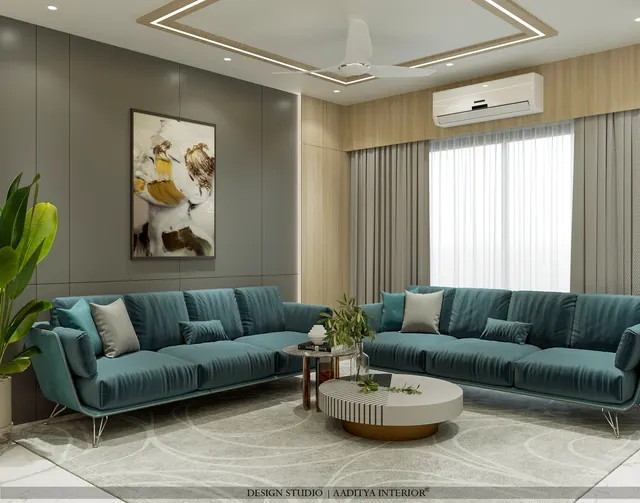
The default builder habit of centring the fan in the room is only right when the room is used evenly. In a bedroom the air is wanted over the bed, where people sleep for hours, not over the empty strip by the door. Aaditya Interior routinely shifts the fan point to sit over the centre of the bed, or between the bed and the main seating, even if that is off the geometric centre of the room. In a living room the fan belongs over the sofa cluster; in a dining area, over the table.
Clearance from the walls matters too: keep the blade tips at least 300 mm — ideally 450–600 mm — clear of every wall and of tall wardrobes, so the fan can draw and throw air without the wall killing the flow on one side. The fan should also be kept clear of the swing of a door and of ceiling beams, which block air and cause an uneven, thumping draught. Where a down-stand beam crosses the room, place the fan in the larger clear bay, not under or beside the beam.
Fans and lighting: avoiding shadow and strobing
A fan and a light fitting placed carelessly fight each other. A pendant or surface light directly beside a running fan casts moving blade shadows across the room — the flicker called strobing — which is tiring to sit under. The fix is planning: keep ceiling lights out of the direct line between a downlight and the floor under the blades, favour cove and perimeter lighting that washes the ceiling rather than a single central source, and never hang a decorative chandelier and a fan on the same patch of ceiling. Where a fan light (a fan with an integral lamp) is used, accept that it is a compromise — the light is dim and the position is fixed under the blades.
Reading the BEE star label
Fans now carry a BEE star label rating their service value — the air delivered per watt. A higher star rating means more air for less electricity. For a fan that runs eight to sixteen hours a day through a long Indian summer, the difference between a one-star induction fan and a five-star BLDC fan is real money over a year. The label is worth reading alongside the quoted air delivery in CMM: a fan with high air delivery and a high star rating is both effective and economical.
| Clearance / height | Recommended value | Why it matters |
|---|---|---|
| Blades above finished floor | 2400–2700 mm | Air reaches people; blades out of reach |
| Blades below ceiling / soffit | ≥ 250–300 mm | Fan draws air freely; keeps air delivery up |
| Blade tip to nearest wall | ≥ 300 mm (450–600 ideal) | Wall does not kill the airflow on one side |
| Fan to a down-stand beam | Clear of the beam | Beam blocks air and causes uneven draught |
| Two fans in a long room, spacing | 2.4–3.0 m centre to centre | Even air without the two sweeps fighting |
| Fan to a central light fitting | Offset, not in line | Avoids moving blade shadows (strobing) |
What fans cost to buy and run in India
A plain induction ceiling fan sells for an indicative ₹1,500–3,500, a good BLDC fan for ₹2,500–5,500, and a designer or large-sweep premium fan for ₹6,000–15,000 and up. Installation on an existing point is a small job at ₹300–800, but adding or shifting a ceiling point — chasing the slab, running wiring, making good — costs more and is best done before the ceiling is finished. The running cost is where BLDC earns its higher price: at sixteen hours a day a 75-watt induction fan uses far more units over a year than a 32-watt BLDC fan delivering the same air, so the extra outlay typically pays back within a couple of summers of heavy use.
| Item | Indicative cost | Unit | Note |
|---|---|---|---|
| Induction ceiling fan, 1200 mm | ₹1,500–3,500 | per fan | Robust, repairable, higher running cost |
| BLDC ceiling fan, 1200 mm | ₹2,500–5,500 | per fan | ~32 W; remote; big saving over a year |
| Premium / designer / 1400 mm fan | ₹6,000–15,000 | per fan | Large sweep or decorative finish |
| Installation on existing point | ₹300–800 | per fan | Simple fit, labour only |
| New or shifted ceiling point | ₹1,200–3,500 | per point | Wiring, chasing, making good |
| Longer downrod for tall ceiling | ₹300–1,200 | per piece | Drops blades into the comfort band |
Running cost, speed control and two-fan rooms
Over a long Indian summer the electricity a fan uses adds up, and the gap between an old induction motor and a modern BLDC motor is large. A conventional 1200 mm fan draws roughly 70–80 watts at full speed, while a BLDC fan of the same sweep and air delivery draws about 28–35 watts, so for the same breeze on the floor the BLDC fan uses well under half the units. Across several fans running many hours a day, that difference pays back the higher purchase price within a couple of seasons and keeps saving afterwards. The air felt on the skin is the same; only the meter behaves differently.
| Fan type | Typical power | Air delivery (1200 mm) | Running cost (relative) |
|---|---|---|---|
| Old induction, low star | 70–85 W | ~200–220 CMM | Highest |
| Induction, higher star | 55–65 W | ~210–230 CMM | Moderate |
| BLDC, standard | 28–35 W | ~210–230 CMM | Low, under half of old induction |
| BLDC, premium / large | 32–45 W | ~240–270 CMM | Low for the air delivered |
| Small sweep (900 mm) | 40–55 W | ~130–180 CMM | Low absolute, small room only |
| Fan with integral light | varies + lamp | as sweep | Added by the lamp; a compromise |
Speed control matters too. A conventional regulator throttles a fan but can waste a little energy and hum at low settings, while a BLDC fan carries electronic speed control, usually on a remote, that holds steady low speeds cleanly and even runs acceptably when the voltage sags, a real benefit where supply is weak. Label which switch or remote drives which fan in rooms with more than one, and keep a wall control accessible as a backup to a remote that can be mislaid.
For any room longer than about 5.5 m — a combined living-dining, a long drawing room — two fans beat one. Space them 2.4–3.0 m centre to centre and keep each the correct distance from its nearest wall; this gives even air from end to end without the two sweeps fighting in the middle. Wire them so each can run independently, because the dining end and the sofa end are rarely occupied at once, and running only the fan that is needed saves power while keeping comfort where people actually sit.
A planning checklist for fans
- Match the sweep to the room: 1200 mm for most bedrooms and living rooms, 1400 mm for large halls, two fans beyond about 5.5 m span.
- Set the blades 2400–2700 mm above the finished floor, not higher under a tall ceiling without a longer downrod.
- Leave at least 250–300 mm between the blades and the ceiling or false-ceiling soffit so the fan can breathe.
- Place the point over the bed or the main seating, not automatically in the geometric centre of the room.
- Keep blade tips 300 mm (ideally 450–600 mm) clear of every wall, wardrobe and down-stand beam.
- Plan the fan point before the false ceiling is closed, dropping a proper hook box at slab level.
- Offset ceiling lights from the fan line to avoid moving blade shadows (strobing).
- Choose a BLDC fan with a high BEE star rating for any fan that runs long hours, and check the air delivery in CMM.
- Use a weatherproof, outdoor-rated fan on open verandahs and terraces.
- Keep speed regulators accessible and label which switch drives which fan in multi-fan rooms.
Where fan design is heading
The direction is efficient, quiet and controllable. BLDC motors are becoming the default rather than the premium choice, and smart fans that integrate with home automation — scheduled speeds, temperature-linked control, voice and app operation — are spreading from high-end projects into mainstream flats. Aerodynamic blade profiles and better balancing are pushing air delivery up while bringing noise down. For the homeowner the practical lesson is unchanged: the cleverest motor cannot rescue a fan of the wrong sweep hung in the wrong place, so sizing and placement still come first, and the electronics come second.
Frequently asked questions
Which fan size is best for a normal Indian bedroom?
A 1200 mm (48-inch) sweep fan suits the great majority of Indian bedrooms and living rooms up to about 3.6 m across. Choose a smaller 1050 mm fan only for a small children's room, and step up to 1400 mm for a large hall. The 1200 mm size is the best balance of air delivery, cost and availability.
How high should a ceiling fan be from the floor?
Set the blades 2400–2700 mm above the finished floor. Lower than about 2100 mm is a safety hazard; higher than 2700 mm weakens the breeze before it reaches people. Under a tall ceiling use a longer downrod to bring the blades down into this band rather than hanging the fan up near the slab.
Is a BLDC fan worth the extra money?
For any fan that runs long hours, yes. A BLDC fan uses about 32 watts against roughly 75 watts for a conventional induction fan of the same air delivery, so it uses less than half the electricity. The higher purchase price, an indicative ₹2,500–5,500 in October 2026, typically pays back within a couple of heavy summers, and it comes with remote control and steadier low-voltage running.
Can one big fan cool a large living-dining room?
Only up to a point. A single fan throws air in a circle and leaves the ends of a long room still. For a room longer than about 5.5 m, two correctly sized 1200 mm fans spaced 2.4–3.0 m apart give even air far better than one oversized fan straining in the middle.
Why does my fan cast a flickering shadow?
That is strobing, caused by a ceiling light placed directly in line with the running blades so the moving blades chop the light. Offset the light from the fan, use perimeter or cove lighting that washes the ceiling instead of a single central downlight, and avoid putting a chandelier and a fan on the same patch of ceiling.
Sources & standards
- National Building Code of India 2016, Part 8 (Building Services) — electrical installations and comfort
- Bureau of Indian Standards — IS 374, electric ceiling type fans and regulators (sweep, air delivery, safety)
- Bureau of Energy Efficiency (BEE) — star labelling of ceiling fans by service value (air per watt)
- Neufert, Architects' Data — room heights, clearances and comfort planning
- Time-Saver Standards for Building Types / Interior Design — services and comfort planning
- Price ranges: indicative October 2026 estimates — confirm locally before budgeting