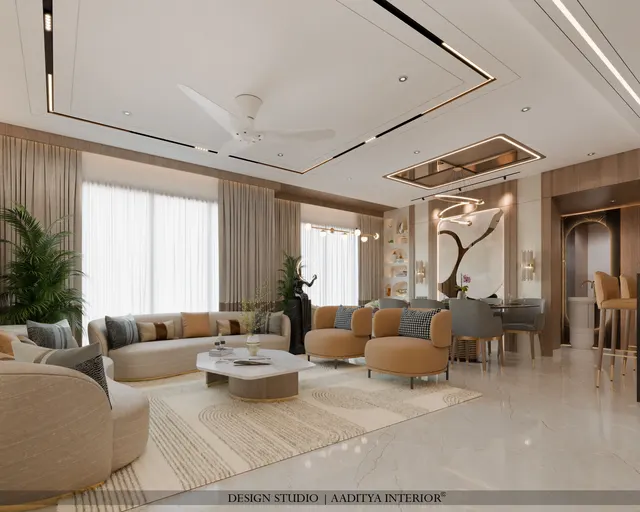
Most Indian homes are lit in a way that confuses the body. During the day, families sit deep inside flats with curtains half-drawn against the heat, under a few hundred lux of ceiling light — bright enough to read, but far dimmer than even a cloudy sky. In the evening, the same rooms switch to cool-white tube lights or 6500 K panels, and the brightest thing in the room until midnight is a phone held a few centimetres from the face. Then the family wonders why children cannot sleep before eleven, why work-from-home afternoons feel foggy, and why elders wake at four in the morning.
Circadian lighting is the design response. The term is often used as marketing for expensive smart bulbs, but the idea underneath is simple and well supported by research: light entering the eye does more than let people see; it also tells the brain's master clock what time it is. Getting that signal right — strong and blue-rich by day, weak and warm by night — can support sleep, alertness and mood. Much of it costs nothing, because it starts with daylight and with switching off. The rest is a matter of choosing the right fittings, placing them where they reach the eye, and programming them sensibly.
This site already explains colour temperature and CRI, smart lighting scenes and wellness architecture. This article goes deeper into the circadian part: how the eye's non-visual system works, which numbers matter (and why lux on the desk is the wrong one), what targets the current scientific recommendations give, and how to turn them into a lighting plan, a daily schedule and a budget for an Indian home.
How light sets the body clock
Almost every cell in the human body runs on a roughly 24-hour cycle — the circadian rhythm — coordinated by a master clock in a small region of the brain called the suprachiasmatic nucleus. Left alone, this clock drifts slightly from 24 hours, so it must be reset every day, and light is its strongest timing signal. The importance of the molecular clock was recognised by the Nobel Prize in Physiology or Medicine in 2017, awarded for discoveries of the molecular mechanisms that control circadian rhythm.
The surprise came from the eye. In the early 2000s, researchers established that the retina contains a third class of light-sensitive cells besides the rods and cones used for vision: intrinsically photosensitive retinal ganglion cells, or ipRGCs. They contain a pigment called melanopsin, which is most sensitive to blue-cyan light at around 480 nanometres. These cells send signals to the master clock and other brain regions, influencing the timing of sleep, the release of the hormone melatonin in the evening, alertness and pupil size. They respond slowly and add up light over time, which is why a whole evening of moderate light can matter more than a brief flash.
Two consequences follow for home lighting. First, the same light has different effects at different times: bright light in the morning tends to advance the clock (earlier sleep and waking), while bright light late in the evening tends to delay it and suppress melatonin. Second, what matters is not the light falling on the floor or the desk, but the light entering the eyes — and how much of it lies in the blue-cyan part of the spectrum that melanopsin responds to.
The numbers that matter: melanopic lux at the eye
Ordinary lighting design is measured in lux on a horizontal surface — 300 lux on a desk, 150 lux on a living-room floor, as given in IS 3646 and the NBC. Lux is weighted by the eye's visual sensitivity, which peaks in green-yellow light. It says almost nothing about the circadian effect. Two newer ideas fix that. The first is to measure light vertically, at the position of the eyes — about 1200 mm above the floor for a seated adult and 1600 mm for a standing one — facing the direction people actually look. A room can have 500 lux on the desk and only 150 lux at the eye if all the light comes from downlights.
The second idea is to weight the light by melanopsin's sensitivity instead of vision's. The CIE standard S 026:2018 defines this as melanopic equivalent daylight illuminance (melanopic EDI), often shortened to melanopic lux: the illuminance of daylight that would have the same effect on melanopsin. For any light source, the melanopic daylight efficacy ratio (melanopic DER) converts ordinary lux to melanopic lux. Daylight scores about 1.0; warm LEDs score much less, because they contain less blue-cyan light. That is the physics behind the familiar advice to use warm light at night: at the same brightness, a 2700 K lamp delivers less than half the circadian stimulus of daylight.
| Term | What it means | Why it matters at home |
|---|---|---|
| Circadian rhythm | The body's roughly 24-hour cycle of sleep, alertness, hormones and temperature | Lighting can support it or confuse it |
| ipRGCs and melanopsin | Light-sensitive retinal cells, most sensitive near 480 nm, that signal the body clock | Blue-cyan content of light matters, not only brightness |
| Melatonin | Hormone released in the evening in dim conditions; suppressed by bright light | Bright, cool evening light can delay sleepiness |
| Vertical illuminance | Lux measured at eye height, facing the line of sight | The light that actually enters the eyes |
| Melanopic EDI (melanopic lux) | CIE S 026 measure of light weighted for melanopsin | The number current recommendations are written in |
| Melanopic DER | Ratio converting ordinary lux to melanopic lux for a given source | Lets designers compare 2700 K and 6500 K fairly |
| Tunable white | Fittings that change colour temperature, typically about 2700–6500 K | One fitting serves day and evening |
| Dim-to-warm | Fittings that get warmer as they dim, like an incandescent lamp | Simple evening behaviour without an app |
Targets: how much light, and when
In 2022 an international group of researchers published consensus recommendations for daytime, evening and night-time light exposure in the journal PLOS Biology (Brown and colleagues). Expressed in melanopic EDI measured vertically at the eye, they recommend at least 250 melanopic lux during the daytime indoors; no more than 10 melanopic lux in the evening, starting at least three hours before bedtime; and no more than 1 melanopic lux in the sleeping environment. Building standards such as the WELL Building Standard also include circadian lighting criteria based on melanopic light at the eye. These are recommendations for healthy adults, not legal requirements, and individual needs vary — but they give designers useful, measurable targets.
Translating melanopic lux into ordinary lux needs the melanopic DER of the source. The values below are approximate and vary between products, but they show the pattern clearly: in the daytime, cool light reaches the target with fewer lux; in the evening, warm light allows a usable level of light while staying within the 10 melanopic lux limit. A family can read, cook and talk at 25–40 lux at the eye from 2700 K lamps — dim, but comfortable once the eyes adapt — whereas the same melanopic limit allows only about 10–12 lux of daylight-coloured light.
| Light source | Approx. melanopic DER | Ordinary lux at eye for 250 melanopic lux (day) | Ordinary lux at eye allowed for 10 melanopic lux (evening) |
|---|---|---|---|
| Daylight (overcast or clear sky) | ≈ 0.9–1.1 | ≈ 230–280 | ≈ 9–11 |
| LED 6500 K | ≈ 0.85–0.95 | ≈ 260–300 | ≈ 10–12 |
| LED 5000 K | ≈ 0.7–0.8 | ≈ 310–360 | ≈ 12–14 |
| LED 4000 K | ≈ 0.55–0.7 | ≈ 360–450 | ≈ 14–18 |
| LED 3000 K | ≈ 0.45–0.5 | ≈ 500–560 | ≈ 20–22 |
| LED 2700 K | ≈ 0.4–0.45 | ≈ 560–630 | ≈ 22–25 |
| Amber LED ≈ 1800–2200 K | ≈ 0.15–0.3 | Not used for daytime | ≈ 35–65 |
Daylight first: the free circadian light
No fitting matches a window. Even an overcast monsoon sky delivers far more light, with a far higher melanopic content, than a typical ceiling scheme. In Indian homes the challenge is that daylight comes with heat and glare, so windows are curtained and rooms are planned with the desk facing the wall. The circadian approach turns that around: shade the heat outside the glass (with chajjas, louvres, jaalis or external blinds), use light-coloured, matt inner surfaces that bounce daylight deeper into the room, and place the places where people spend their mornings — the breakfast table, the study desk, the work-from-home corner — within about 2–3 m of a window, with the window to the side rather than directly behind a screen.
Morning daylight is the most useful of all, because it helps anchor the clock early. Eating breakfast on a balcony or beside an east window, taking the first tea outdoors, or opening the curtains wide in the bedroom on waking are small habits with a real effect. For elders who spend most of the day indoors, a bright seat by a window is often the single most effective circadian intervention a family can make. NBC 2016 Part 8 sets minimum window areas for habitable rooms; designing beyond the minimum, as this site's wellness architecture article recommends, is what makes a home circadian-friendly by day.
Fittings: tunable white, dim-to-warm and smart bulbs
Artificial light has two jobs in a circadian scheme. In the daytime, it tops up daylight in rooms that cannot get enough, at cooler colour temperatures and with light that reaches the eye. In the evening, it must give enough light to live by while keeping the melanopic dose low — warm, dimmed, and placed low in the field of view rather than overhead. Several technologies do this, at very different costs and levels of complexity.
| Option | How it works | Best for | Indicative cost (October 2026) | Watch out for |
|---|---|---|---|---|
| Fixed warm white, dimmable | 2700–3000 K fittings on dimmers | Bedrooms, living rooms used mainly in the evening | Cove ₹150–300 per running ft; panels ₹400–1,200 each; dimmer ₹1,500–6,000 | Needs a separate cooler task light for daytime work |
| Two circuits: warm and neutral | Separate 2700 K and 4000 K circuits switched by time of day | Living rooms, kitchens, studies on a budget | Cost of a second circuit and fittings | Family must remember to switch |
| Dim-to-warm fittings | Colour warms automatically as the fitting dims | Dining, living, bedroom ambient light | Moderate premium over standard fittings; confirm per product | Not cool enough for daytime boost |
| Tunable-white strips and profiles | Two LED channels mixed by a controller, about 2700–6500 K | Coves, wall washers, study and living rooms | ≈ ₹350–700 per running ft installed | Strip, controller and driver must be one system |
| Tunable-white downlights and panels | Same principle in point fittings | Studies, home offices, kitchens | ≈ ₹1,500–4,000 per fitting, plus control | Quality of colour mixing and flicker varies widely |
| Smart tunable bulbs | Wi-Fi or Zigbee bulbs in existing holders, scheduled by app | Rentals, table and floor lamps, quick trials | ≈ ₹600–2,000 per bulb | Relies on app and network; light output limited |
| Whole-home scene control | Scheduled scenes across rooms on keypads | New homes and full renovations | ≈ ₹80,000–2.5 lakh for a 3BHK on Zigbee or Wi-Fi | Plan circuits, neutrals and drivers early |
For most Indian families, Aaditya Interior recommends a layered, mostly fixed approach rather than tunable fittings everywhere. Bedrooms need excellent warm, dimmable light and almost never need a cool boost. Living rooms benefit from a warm evening scheme plus a cooler daytime layer — which can be the same tunable cove or a separate 4000 K circuit. Studies and home offices are where tunable white earns its cost, because they are used both in the daytime and late in the evening. Bathrooms need a good 4000 K mirror light for the morning and a separate low, warm night light for after midnight.
Planning a circadian room: study-bedroom example
A teenager's or young adult's study-bedroom is the room where circadian lighting matters most, because it hosts morning wake-up, daytime study, late-evening screen work and sleep in one space. Fig. 4 shows a 3600 × 3300 mm room planned for this: desk beside the window, tunable cove on the wall the student faces, warm bedside lights, an amber night path and blackout curtains.
| Room | Daytime layer | Evening layer (2–3 h before bed) | Night layer | Priority |
|---|---|---|---|---|
| Bedroom | Daylight; open curtains on waking | 2700 K or lower, dimmed, lamps below eye level | Amber night light; blackout curtains | High — easiest win |
| Study / home office | Window beside desk; 4000–5000 K wall-wash or tunable | Tunable to 2700 K, dimmed; warm task lamp | Off | High — tunable earns its cost here |
| Living room | Daylight; 3500–4000 K layer if room is dark | Warm cove and lamps, 2700–3000 K, dimmed | Low warm path to bedrooms | Medium |
| Kitchen | 4000 K task light on counters | Warm ambient; task light only while cooking | Low under-cabinet glow if needed | Medium |
| Bathroom | 4000 K mirror light for grooming | Warm, lower light after dinner | Amber or very low sensor light | Medium — avoid bright light at 2 am |
| Elders' room | Bright seat by a window; extra daytime light | Warm and moderate; avoid glare | Continuous low amber path to bathroom | High — sleep and safety |
| Children's room | Daylight play and study | Warm and dim from about an hour after dinner | Very low amber if needed | High — routines form early |
Setting up the daily schedule
A schedule should follow the household, not a factory default. Start from the usual bedtime and work backwards: the evening phase — warm, dim, no cool overhead light — should start roughly two to three hours before sleep. In many Indian homes, dinner is late, so this often means switching to the evening scene at about 8 or 9 pm. Mornings are the other anchor. Opening curtains and, where daylight is poor, switching on a cooler, brighter layer for the first hours after waking reinforce the clock. A simple automatic schedule on a smart system, with manual override buttons on the wall, usually works better than an app that only one family member understands.
| Time (example: bedtime 11 pm) | Scene | Colour temperature | Target at the eye | How |
|---|---|---|---|---|
| 6:30–9:00 | Wake and breakfast | Daylight; 4000–5000 K top-up | ≥ 250 melanopic lux if possible | Curtains open; sit near a window |
| 9:00–17:00 | Day | Daylight; 4000–5000 K where needed | ≥ 250 melanopic lux at desks | Desk by window; wall-wash, not just downlights |
| 17:00–20:00 | Early evening | 3000–3500 K | Moderate | Cove and lamps; reduce overhead |
| 20:00–23:00 | Evening wind-down | 2700 K or lower, dimmed | ≤ 10 melanopic lux (≈ 20–25 lux at 2700 K) | Lamps below eye level; screens on night mode |
| 23:00–6:30 | Sleep and night path | Amber, ≤ 2200 K | ≤ 1 melanopic lux in the bedroom | Blackout curtains; low sensor lights to the bathroom |
What is proven, and what is not
It is well established that light at the eye affects the timing of the body clock, melatonin release and alertness, that the effect depends on intensity, spectrum, timing and duration, and that bright evening light can delay sleep. It is also well established that daylight exposure during the day is valuable. What is less certain is how large the benefit of a particular home lighting product is for a particular person. Individual sensitivity varies widely; age reduces the amount of light reaching the retina, which is why elders need more daytime light; and many studies are done in laboratories rather than homes. Lighting does not treat sleep disorders, which need medical advice.
For a homeowner, that means three things. Claims that a bulb will 'cure' sleep problems should be treated with caution. The most reliable benefits come from simple measures: more daylight by day, less and warmer light at night, a dark bedroom. And money spent on circadian technology should go first to the rooms used both by day and late at night — usually the study and the living room — rather than being spread across every fitting in the house.
Where circadian lighting is heading
The next few years are likely to bring melanopic data onto product datasheets as standard, as colour rendering and colour consistency data have arrived over the last decade. Tunable-white fittings are getting cheaper and their colour mixing better; drivers that dim smoothly without flicker are becoming common in mid-range products. Sensors that measure light at the eye, wearable light loggers and building-management software are moving from research into offices, and some will reach homes. In hospitality — hotels and resorts are an increasing part of the projects designers handle — circadian schemes in guest rooms are already used to help travellers adjust to new time zones. The principle will stay the same: bright days, dark nights, and light designed for the eye rather than the floor.
| Development | Where it is now | What it could mean at home |
|---|---|---|
| Melanopic data on datasheets | Some manufacturers publish melanopic ratios | Easier, honest comparison of fittings |
| Better tunable-white products | Mainstream in offices; growing in homes | Lower cost, better colour mixing, less flicker |
| Light sensors and wearables | Research and premium offices | Automatic adjustment to real light at the eye |
| Spectrally tuned LEDs | Specialist products | More circadian effect by day at lower lux, less at night |
| Daylight-linked controls | Common in commercial buildings | Artificial light that tops up, not replaces, daylight |
Rules for circadian lighting at home
- Start with daylight: put breakfast tables, desks and elders' seats within about 2–3 m of a window and shade heat outside the glass.
- Design for light at the eye: light the walls people face, not just the floor and desk.
- Aim for at least about 250 melanopic lux at the eye in daytime work areas — roughly 350–450 lux at 4000 K.
- Switch to warm, dim, low light 2–3 hours before bed: 2700 K or lower, around 20–25 lux at the eye.
- Keep bedrooms dark for sleep: blackout curtains, no standby LEDs facing the bed, amber night lights only.
- Spend on tunable white where rooms are used both by day and late evening — studies and living rooms first.
- Use scheduled scenes with simple wall buttons so every family member can use them.
- Ask for flicker-free dimming and, where available, melanopic data on every datasheet.
Frequently asked questions
What is circadian lighting?
It is lighting designed to support the body's 24-hour clock: brighter and cooler during the day, dimmer and warmer in the evening, and dark at night. It works through light-sensitive cells in the eye that respond most to blue-cyan light and signal the brain's master clock.
Which light colour is best before sleep?
Warm light of 2700 K or lower, kept dim and placed below eye level, for the last two to three hours before bed. Amber light of around 1800–2200 K is better still for night lights. Cool white of 5000–6500 K in the evening has the strongest effect on the body clock and is best avoided.
Is tunable white lighting worth the cost?
It is worth it in rooms used both in the daytime and late in the evening, such as studies, home offices and living rooms. In bedrooms, a good warm, dimmable scheme gives most of the benefit at lower cost. Tunable strips cost about ₹350–700 per running ft installed and tunable downlights about ₹1,500–4,000 each (indicative October 2026).
What is melanopic lux?
Melanopic lux, formally melanopic equivalent daylight illuminance (CIE S 026:2018), measures light weighted by the sensitivity of melanopsin, the pigment in the eye's circadian cells. It is measured vertically at eye level. Daylight converts almost one to one; a 2700 K LED delivers only about 40–45 melanopic lux for every 100 ordinary lux.
Do smart bulbs help with sleep?
They can, if they are scheduled to become warm and dim in the evening and the bedroom is kept dark at night. The bulb itself does nothing special; the benefit comes from the schedule and from avoiding bright, cool light late in the evening. Persistent sleep problems need medical advice, not only better lighting.
How much light do I need in the daytime indoors?
Current recommendations suggest at least 250 melanopic lux at the eye during the day, which is about 350–450 ordinary lux measured vertically at the eye with 4000 K light, or less if daylight from a window reaches the eye. Most homes fall well below this away from windows, which is why sitting near a window is the easiest improvement.
Sources & standards
- CIE S 026:2018 — CIE System for Metrology of Optical Radiation for ipRGC-Influenced Responses to Light (melanopic EDI and DER)
- Brown T. M. et al. (2022), Recommendations for daytime, evening, and nighttime indoor light exposure to best support physiology, sleep, and wakefulness in healthy adults, PLOS Biology
- Nobel Prize in Physiology or Medicine 2017 — official announcement on the molecular mechanisms controlling circadian rhythm
- International WELL Building Institute — WELL Building Standard v2, Light concept: circadian lighting design
- Bureau of Indian Standards — IS 3646 (Part 1), Code of practice for interior illumination; National Building Code of India 2016, Part 8 (Building Services), Section 1: lighting and natural ventilation
- Bureau of Energy Efficiency — Eco-Niwas Samhita and ECBC guidance on daylighting and lighting controls
- Price ranges: indicative October 2026 estimates — confirm locally before budgeting