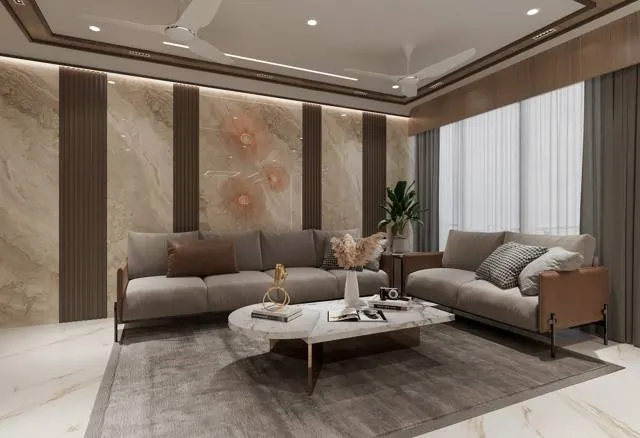
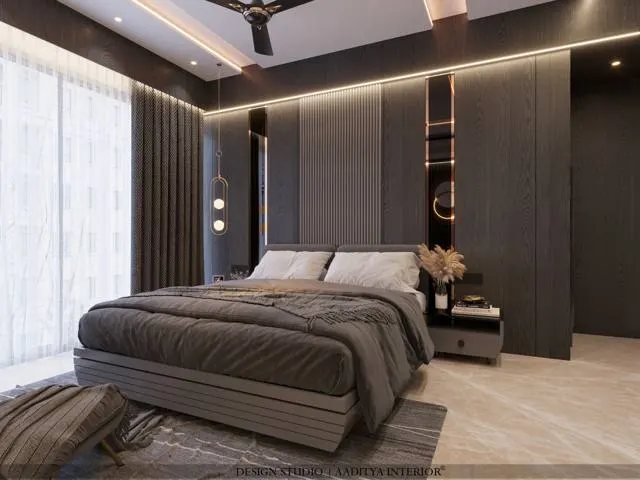
Curtains are the one piece of an interior that a homeowner is most tempted to order by eye, and the one that most punishes it. A beautiful fabric hung too narrow looks like a flat sheet pinned to the wall; hung too short it looks like trousers an inch too high; hung on a track screwed into a false ceiling it sags in a month. The fabric is rarely the problem. The problem is almost always the numbers behind it — how much wider than the window the curtain is cut, how far above the window the track sits, how long the drop is measured, and what the whole thing is fixed to.
Indian homes add their own twists. Ceilings are often a generous 2.7 to 3 metres, so a full drop is long and heavy. Windows frequently sit close to the ceiling with little wall above, which squeezes the pelmet. Air-conditioning and blockout needs push people toward double tracks — a sheer and a heavy layer. And a great many curtains are hung from a pelmet box or a false-ceiling pocket rather than an exposed rod, which changes every clearance. Getting the sizes right is not decoration; it is what makes the fabric hang in soft, even folds and clear the floor cleanly.
This article sets out the working dimensions — fullness, width beyond the reveal, height above it, drop and clearance, pelmet depth and projection — and the track and rod choices behind them, so a reader can brief a tailor and a carpenter precisely and know when a quotation has quietly skimped on fabric or fixing.
A short history of the pelmet and the track
Hanging cloth over an opening is ancient, but the hardware that controls it is surprisingly modern. For centuries curtains hung from simple poles and rings. The pelmet — a stiff horizontal board or fabric band across the top of the curtain — grew up in grand European interiors partly as decoration and partly to hide the mechanics of the hanging and to stop draughts spilling over the top. The soft fabric version, gathered or pleated, is called a valance; the rigid boxed-in version is the pelmet proper. Both did the same job: dress the top edge and conceal the fixings.
The track replaced the pole in the twentieth century. A traverse track with a cord or a wand let a heavy curtain be drawn smoothly across a wide window without manhandling fabric over rings, and the modern aluminium or uPVC track, with glides and a quiet runner, is its descendant. Indian interiors absorbed both traditions: the decorative rod made a comeback for lighter, show-piece curtains, while the concealed track inside a pelmet box or a false-ceiling pocket became the standard for apartments, where a clean, hardware-free ceiling line is wanted. Today most homes use one of three set-ups — an exposed rod, a track behind a pelmet, or a track in a ceiling pocket — and the sizing differs for each.
The vocabulary, settled quickly
A few words are worth fixing before the numbers, because quotations use them loosely. A curtain is the fabric panel; a sheer is the light, see-through layer, often hung as a second curtain behind the main one. The track or rod is what it slides on — a track is the channel with glides, a rod the visible pole with rings or eyelets. The pelmet is the rigid board that hides the top; a valance is a soft fabric version of the same thing. The drop is the finished vertical length of the curtain; the fullness is the ratio of the flat fabric width to the finished track width. The heading is how the top of the curtain is gathered — eyelet, pencil pleat, pinch pleat — and it decides both the fullness and the look of the folds.
Fullness: the number that makes curtains look like curtains
The single most common mistake is too little fabric. A curtain cut the same width as the window hangs flat and cheap. To fall in soft, even folds it must be cut wider than the track and gathered back — and how much wider is the fullness ratio. As a working rule, fabric should be cut two to two-and-a-half times the finished track width. A sheer, which needs to read as a soft haze, is cut fuller still, often 2.5 to 3 times. The heading sets the exact figure: eyelet curtains gather comfortably at about twice the width, pencil and pinch pleats want 2 to 2.5 times, and a very formal goblet or heavy pinch pleat can go higher. The table below is the working guide.
| Heading type | Fullness (flat fabric ÷ track width) | Fold character | Best for |
|---|---|---|---|
| Eyelet (ring top) | 2.0 – 2.2× | Deep, regular waves | Everyday living and bedroom curtains |
| Pencil pleat | 2.0 – 2.5× | Fine, uniform gathers | Versatile; most fabrics and tracks |
| Pinch / French pleat | 2.0 – 2.5× | Tailored, structured pleats | Formal living and dining rooms |
| Goblet pleat | 2.2 – 2.5× | Rounded, decorative tops | High-ceiling formal rooms |
| Sheer (any heading) | 2.5 – 3.0× | Soft, airy haze | Light layer behind a main curtain |
| Ripple / wave (track glides) | 2.0 – 2.3× | Even S-curves | Clean modern tracks, large windows |
A worked example makes it concrete. A window with a finished track width of 1800 mm, curtained in a pencil pleat at 2.2 times fullness, needs about 3960 mm of fabric across the top before hems — in practice three widths of standard 1.2 m curtain fabric joined, or one width of wide 2.8 m fabric railroaded, depending on the cloth. Under-ordering here is the usual reason a finished curtain looks thin, and it cannot be fixed later without re-stitching.
How high and how wide to set the track
Where the track sits matters as much as how much fabric hangs from it. Two extensions make a window look larger and a curtain hang better. First, height: setting the track 150 to 300 mm above the window head — or right up at the ceiling or pelmet line — lifts the eye and makes the drop read tall and the room generous. A track screwed tight to the window frame makes the window look squat. Second, width: extending the track 150 to 200 mm beyond each side of the reveal gives the open curtains somewhere to stack off the glass, so daylight is not blocked and the window frame is not hidden. These two extensions are added before fullness is calculated, because the finished track width — window plus both side extensions — is what the fabric is multiplied against.
In Indian apartments with little wall above the window, the track often goes straight onto the false-ceiling line or into a ceiling pocket, which solves the height question by taking the curtain to the ceiling. That is usually the most flattering option, but it demands that the pocket or batten be planned and fixed into the slab before the gypsum closes — retrofitting a ceiling track into finished plasterboard is where sags begin.
Drop and floor clearance
The drop — the finished length — is a decision, not a default, and it is set by where the curtain is meant to end. Four endings are common. Sill-length stops at the window sill, useful over a kitchen counter or a radiator. Below-sill hangs 100 to 150 mm past the sill, a tidy choice for bedrooms and bathrooms. Floor-length — the most common for living and bedrooms — is measured to clear the finished floor by about 10 to 20 mm so the curtain just kisses the floor without dragging. A deliberate floor puddle, where 20 to 50 mm or more of fabric pools on the floor, reads as formal and soft but collects dust and suits low-traffic, dress-up rooms. The table sets out the options and what each measures to.
| Drop style | Where the hem ends | Measure to | Best for |
|---|---|---|---|
| Sill length | At the window sill | Sill level | Kitchens, over counters, small windows |
| Below sill | 100–150 mm past the sill | Sill + 100–150 mm | Bedrooms, bathrooms, children's rooms |
| Floor clearance | Just off the floor | Finished floor − 10 to 20 mm | Living and bedrooms — the everyday default |
| Full floor (break) | Touching the floor | Finished floor + 0 to 10 mm | Tailored formal look with heavy fabric |
| Puddle | Pooled on the floor | Finished floor + 20 to 50 mm+ | Formal, low-traffic dress-up rooms |
Pelmet sizes and detailing
A pelmet does two jobs: it hides the track and the gathered heading, and it finishes the top of the window as a clean horizontal line. For it to do both it needs enough depth and enough projection. Depth — the face height of the pelmet — is typically 100 to 150 mm: enough to cover the track, the glides and the top of the curtain folds, scaled up a little for very tall rooms where a shallow pelmet looks mean. Projection — how far the pelmet stands off the wall — is typically 150 to 200 mm, enough to clear a double track and let the curtain hang in free folds without brushing the box. A pelmet box is usually built in 12 to 18 mm board, fixed to a batten anchored into the slab, and finished to match the ceiling or the wall.
In homes with a false ceiling the pelmet is often replaced by a curtain pocket — a recess formed in the gypsum into which the track is fixed, so the curtain appears to fall straight from the ceiling with no visible hardware. It is the cleanest look, but it is unforgiving: the pocket width must suit a single or double track, the slab fixing must be in before the boards close, and the wall above the window must be flawless because light grazes it. Both the pelmet and the pocket should be set out on the ceiling drawing, not improvised on site.
| Pelmet / pocket element | Typical dimension | Why |
|---|---|---|
| Pelmet face depth | 100 – 150 mm | Hides track, glides and the curtain heading |
| Pelmet projection from wall | 150 – 200 mm | Clears a double track; lets folds hang free |
| Pelmet board thickness | 12 – 18 mm | Rigid over the window span without sagging |
| Ceiling pocket width (single track) | 80 – 120 mm | Houses one track with running clearance |
| Ceiling pocket width (double track) | 150 – 200 mm | Houses sheer and main track side by side |
| Pocket / batten fixing | Into RCC slab | Carries the curtain weight; gypsum alone will sag |
Tracks, rods, brackets and fixing
The hardware splits into two families. A rod is the visible pole with rings or eyelets, chosen when the hardware is meant to be seen — a decorative metal or wooden pole across a feature window. A track is the concealed channel with glides, chosen when a pelmet or pocket hides it, when the window is wide and heavy, or when a smooth draw is wanted. For heavy or very wide curtains, a track with a cord or wand draws far more easily than rings on a rod. Double tracks carry a sheer and a main layer together and are standard in bedrooms and living rooms.
Whatever the choice, the fixing is what lasts or fails. Brackets for a rod should land on solid wall or on a batten plugged into masonry, spaced closely enough — roughly every 500 to 700 mm and at both ends — that a long pole does not bow under a heavy curtain. A track should be screwed to a timber batten anchored into the slab or solid wall, never into gypsum board alone, which cannot hold the weight of a full-drop curtain over time. This single detail — a proper batten into the slab — is the difference between a curtain that hangs crisply for a decade and one that droops in a season. Costs below are indicative October 2026 ranges and vary with material, width and finish; they should be confirmed with a supplier before budgeting.
| Item | Indicative Oct 2026 range | Notes |
|---|---|---|
| Aluminium / uPVC curtain track | ₹120 – ₹350 per running ft | Concealed in pelmet or pocket; smooth glides |
| Decorative metal / wooden rod | ₹200 – ₹700 per running ft | Visible hardware; brackets and finials extra |
| Motorised track system | ₹1,200 – ₹3,500 per running ft | App or remote draw; needs a power point planned |
| Pelmet box (board, built) | ₹250 – ₹600 per running ft | 12–18 mm board, finished; excludes fabric |
| Curtain stitching (per panel) | ₹150 – ₹500 per panel | By heading; lining and sheer extra |
| Curtain fabric | ₹250 – ₹1,500+ per metre | Wide range; sheers lower, heavy drapes higher |
Where curtain detailing is heading
Three shifts are visible in Indian homes. First, the ceiling pocket is quietly replacing the exposed pelmet as false ceilings become standard, so curtains increasingly fall straight from a crisp ceiling line with no visible hardware. Second, motorised tracks are moving from luxury to merely optional, drawn by a remote or an app and often tied into home-automation scenes — which only works if a power point is planned behind the pelmet at the design stage. Third, performance fabrics are spreading: blockout linings for bedrooms in bright climates, and dust- and stain-resistant weaves suited to Indian cities. None of this changes the geometry. Fullness, extension, drop and a slab fixing remain the four numbers that decide whether curtains look right, whatever draws them.
Rules for sizing and detailing curtains
- Cut pleated curtains 2 to 2.5 times the finished track width, and sheers 2.5 to 3 times — never the window width alone.
- Extend the track 150 to 200 mm beyond each side of the reveal so open curtains clear the glass.
- Set the track 150 to 300 mm above the window, or at the ceiling line, to make the drop read tall.
- Measure the drop to the finished floor after flooring and skirting are done, not to a bare slab.
- Give a pelmet 100 to 150 mm of depth and 150 to 200 mm of projection to hide the track and clear a double layer.
- Plan a ceiling curtain pocket and its slab fixing before the gypsum closes — never retrofit a track into finished board.
- Fix every track and rod to a batten anchored in the slab or solid wall, not into gypsum alone.
- Use a double track for a sheer plus a main curtain in bedrooms and living rooms, and a cord or motor for wide, heavy drops.
Frequently asked questions
How much fabric do I need for a curtain?
Cut the fabric two to two-and-a-half times the finished track width for a pleated heading, and two-and-a-half to three times for a sheer. For a 1800 mm track at 2.2 times fullness, that is about 3960 mm of fabric across the top before hems — then add the drop plus top and bottom hem allowances for the length. Under-ordering fullness is the commonest reason a finished curtain looks thin.
What is the standard pelmet size?
A pelmet is typically 100 to 150 mm deep on its face and projects 150 to 200 mm from the wall, built in 12 to 18 mm board. The depth hides the track and the top of the folds; the projection clears a double track and lets the curtain hang free. Scale the depth up a little in very tall rooms so the pelmet does not look mean.
How high above the window should a curtain track go?
Set the track 150 to 300 mm above the window head, or take it up to the ceiling line or a ceiling pocket. Lifting the track makes the drop read tall and the window look larger; fixing it tight to the frame makes the window look squat. In apartments with little wall above the window, the ceiling line is usually the most flattering option.
Should the curtain touch the floor?
For most living and bedrooms, measure the drop to clear the finished floor by about 10 to 20 mm, so the curtain just kisses the floor without dragging. A deliberate puddle of 20 to 50 mm or more looks formal and soft but collects dust and suits low-traffic rooms. Always measure to the finished floor after flooring and skirting are complete.
Track or rod — which is better?
Use a track where it will be concealed in a pelmet or pocket, where the window is wide or the curtain heavy, or where a smooth cord or motor draw is wanted. Use a rod where the hardware is meant to be seen as a decorative feature. Either way, fix it to a batten anchored in the slab or solid wall so a full-drop curtain does not pull it loose over time.
Sources & standards
- Ernst Neufert — Architects' Data: window treatments, curtain and pelmet dimensions, fullness ratios
- Time-Saver Standards for Interior Design and Space Planning: window coverings and hardware
- National Building Code of India 2016, Part 3 — Development Control Rules and General Building Requirements (window and opening sizing)
- National Building Code of India 2016, Part 8 — Building Services (lighting and ventilation context for window treatments)
- Bureau of Indian Standards — IS 2380: methods of test for wood particle boards (pelmet board reference)
- Curtain track and hardware manufacturer technical data (track load, bracket spacing and projection), described as typical ranges
- Price ranges: indicative October 2026 estimates — confirm locally before budgeting