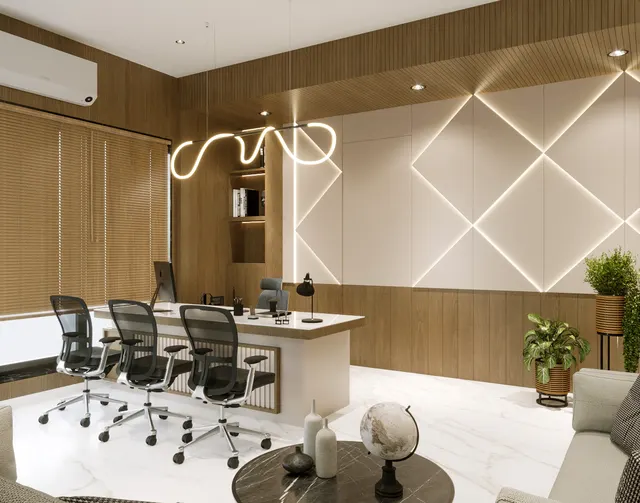
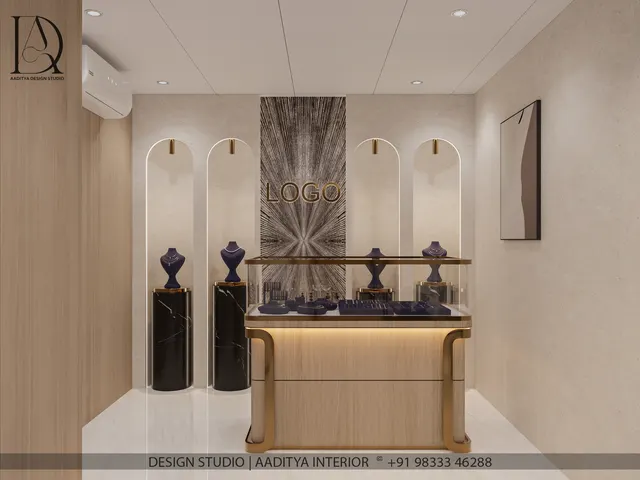
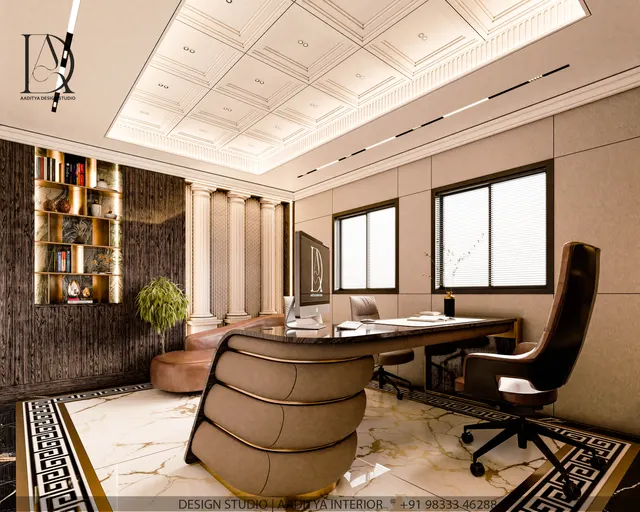
Inside the Surat Diamond Bourse, an office is only as good as the light that falls on the stones. The building is a vast grid of near-identical units, and each trading office has to do a surprising amount in a small footprint: receive clients, grade and sort diamonds under reliable light, give the owner a private cabin, and still feel considered enough to reassure a high-value visitor. Diamond Bourse Office 210 is a compact unit built around exactly that brief, and this case study walks through how the plan, the light and the materials were resolved.
The brief
The brief for a diamond office is narrow and demanding. Diamonds are graded for colour and clarity, so the lighting cannot be left to chance — it has to be consistent and glare-controlled at the desk, because the wrong light changes how a stone reads. The owner needs a private cabin for negotiation. Clients, often trading in high values, must feel the business is serious and established the moment they step in. And all of this has to happen in a unit measured in a few hundred square feet, where every wall does more than one job. The office also had to make room for a small mandir, as most family-run Surat trades do.
Constraints
Three constraints shaped the design. First, footprint: a bourse unit is compact, so circulation had to be tight and every wall earned its keep as storage, display or acoustic separation. Second, light: natural light is limited and inconsistent inside the building, so the scheme leans on layered artificial light — ambient plus dedicated task lighting at the desks — rather than daylight. Third, impression within a grid: because every unit starts identical, the character had to be built entirely from finishes and detailing, not from the shell.
Design moves
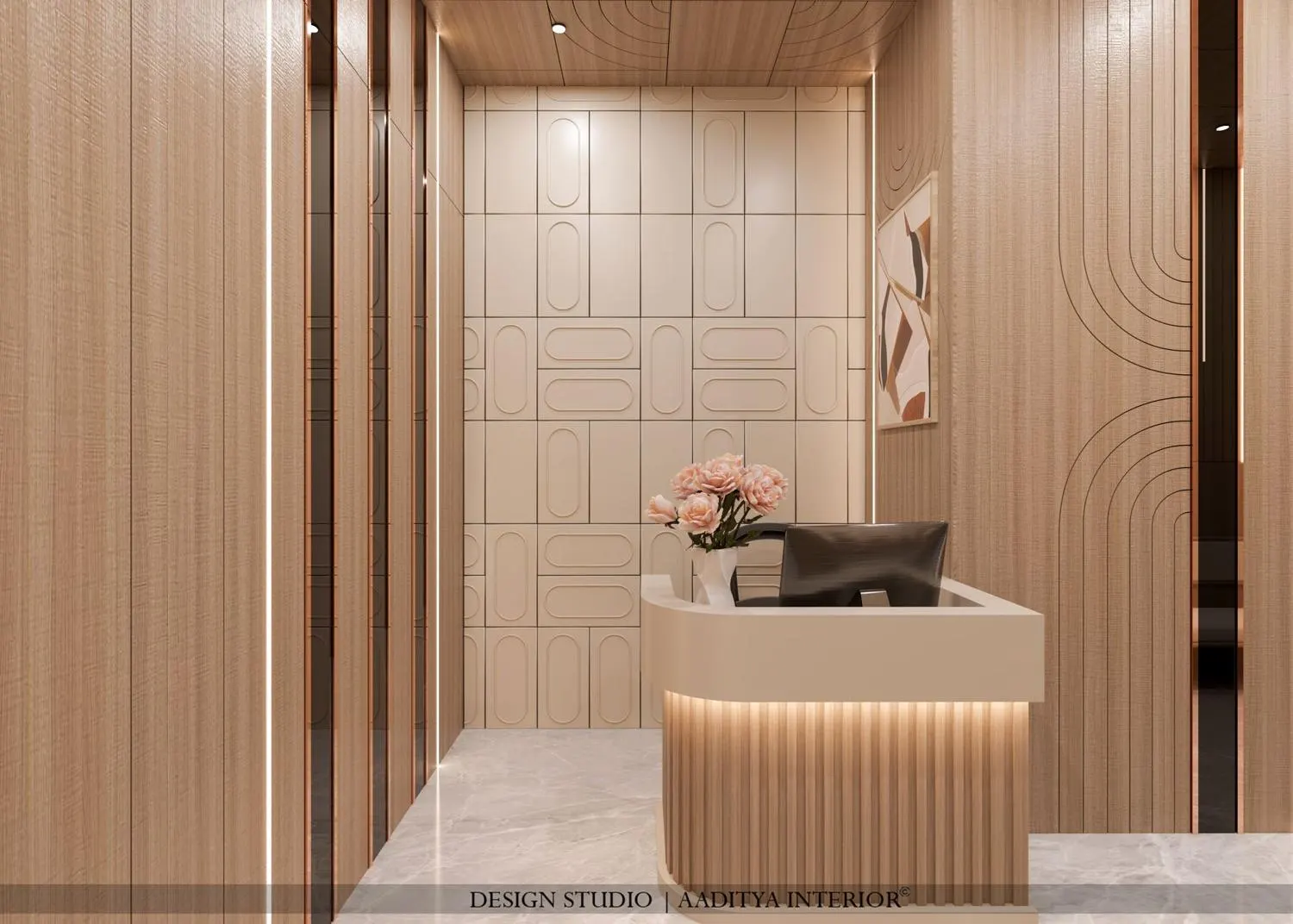
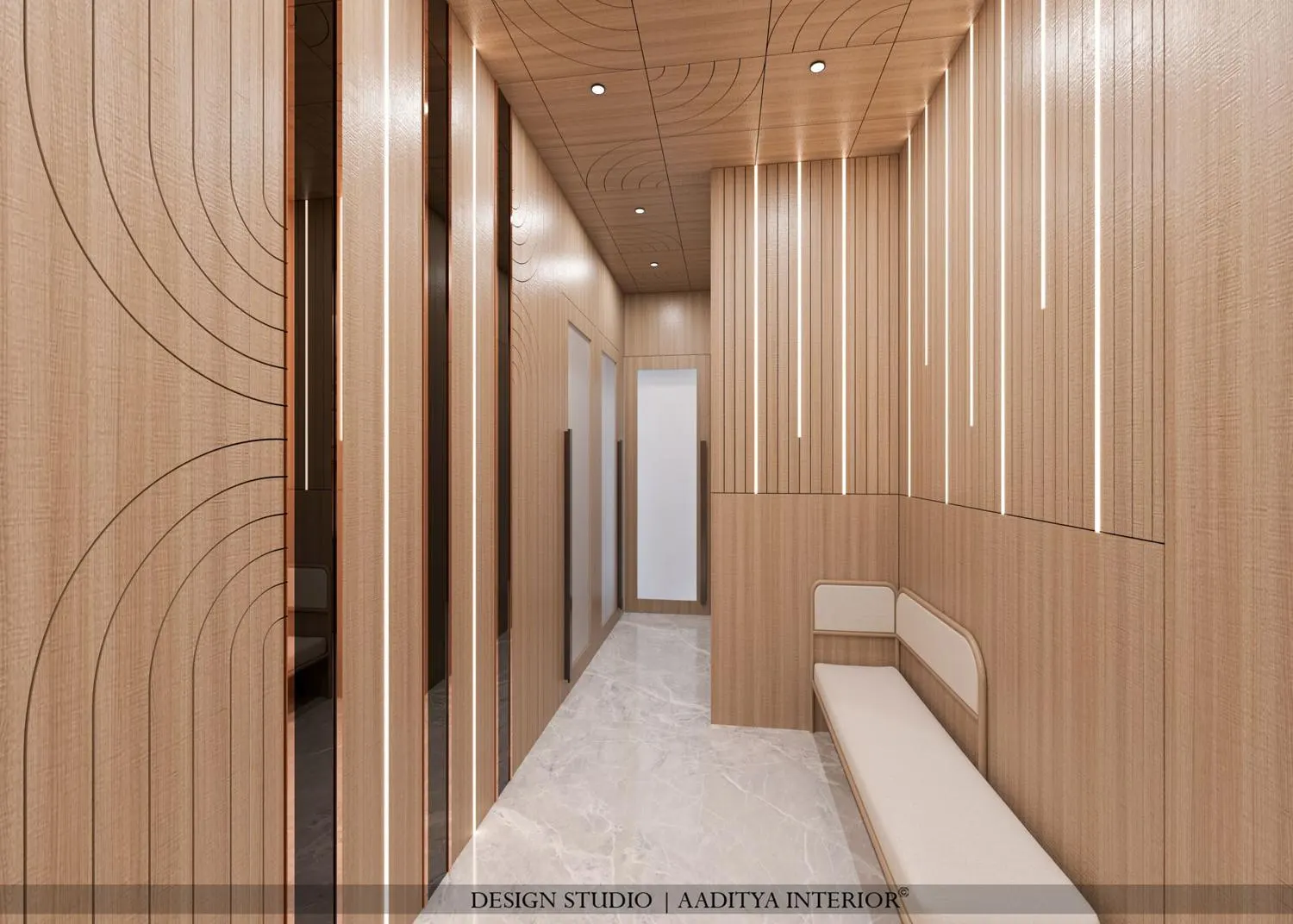
The plan reads as a short sequence: a sculpted reception at the entry, a slatted corridor that leads past the mandir, and the sorting and owner cabins off it. Keeping circulation to a single spine freed the walls on either side for storage, display and the task desks, which is how a small unit holds so much programme.
The sorting and owner cabins are the working heart of the office, and they are designed around the desk. Each cabin pairs a stone-topped desk with its own task lighting — a linear pendant or a desk lamp over the work surface — so grading light does not depend on the room's ambient layer. Feature walls behind the desks do the reassurance work: a backlit marble panel in one cabin, framed three-dimensional moulded panels in another, and the studio's own identity wall in a third, each giving the room a focal point without clutter.
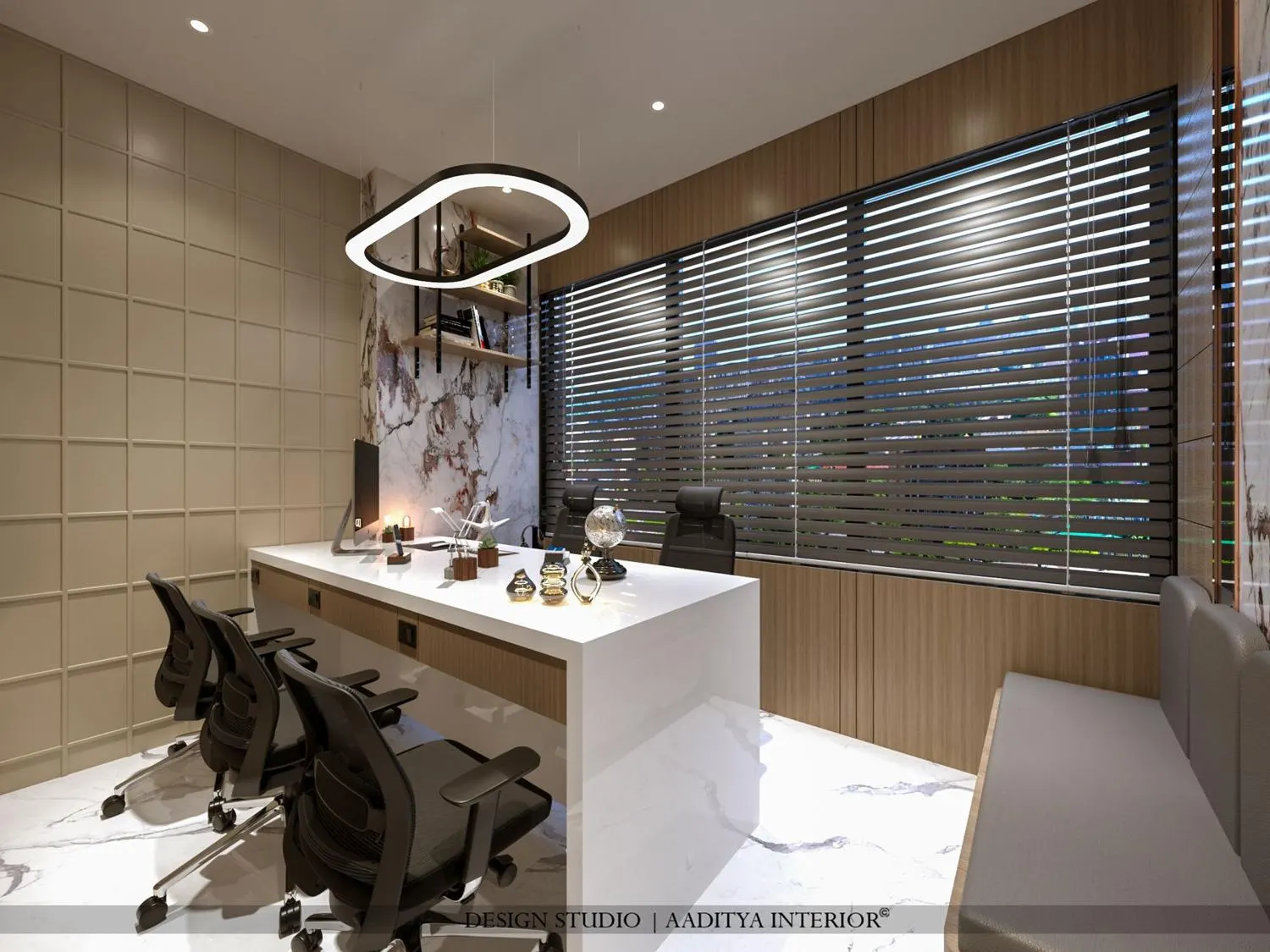
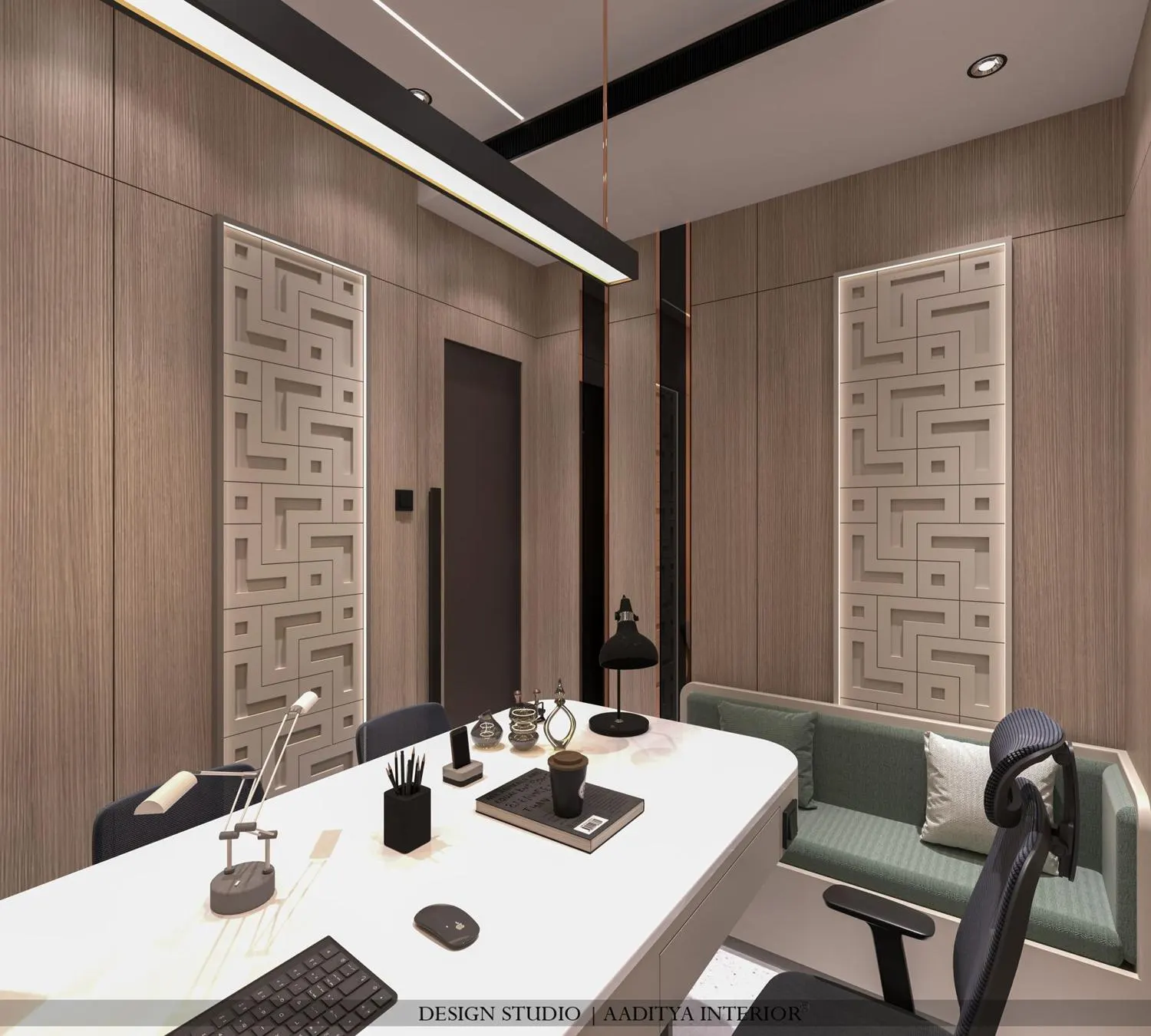
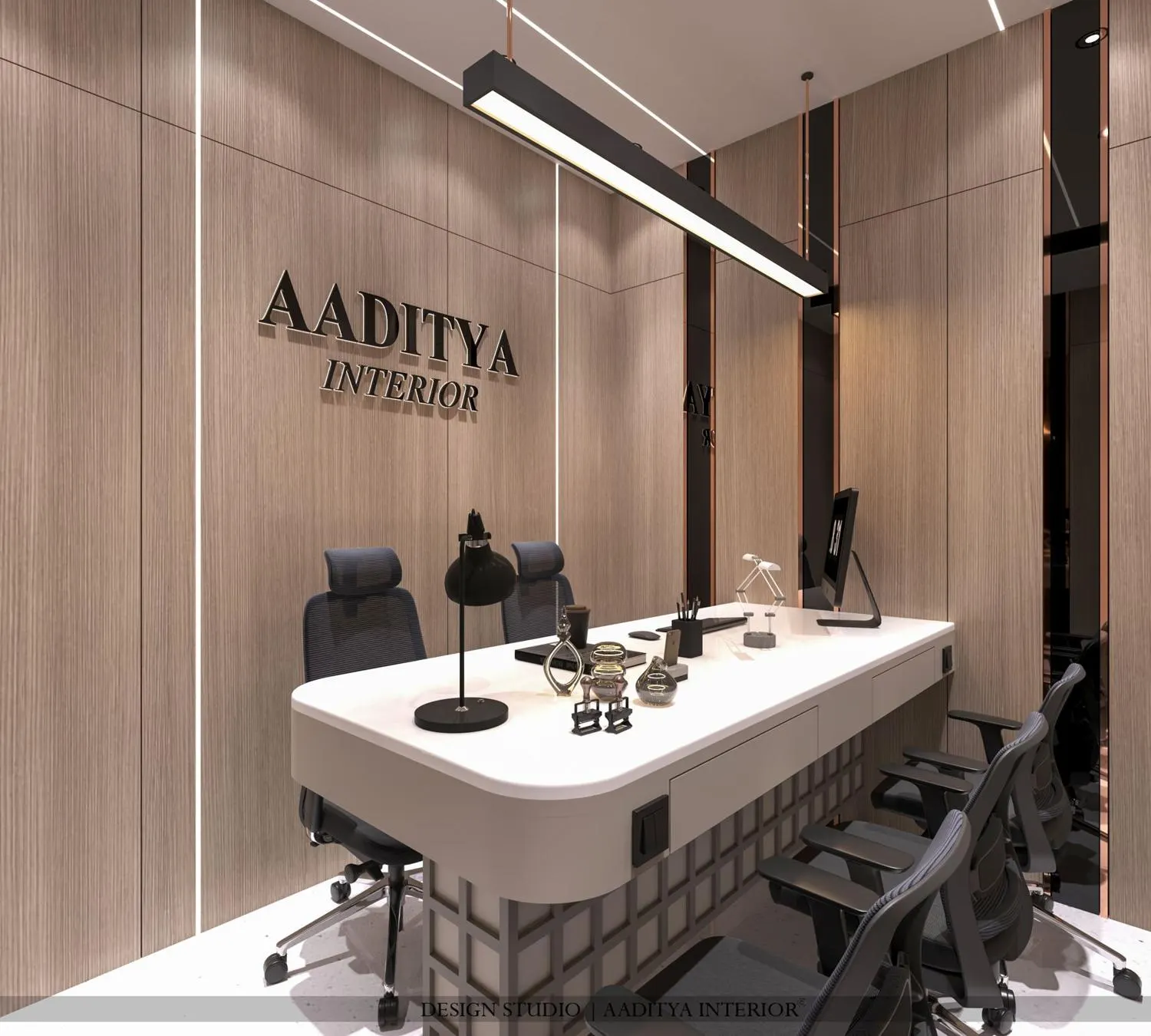
Each cabin is a variation on the same idea rather than a new theme: a stone-topped desk, a dedicated pendant over it, a single quiet focal wall, and a place for a visitor to sit. Repeating that discipline across the rooms is what lets a small office feel composed rather than busy, and it keeps the client's attention on the desk, where the business is actually done.
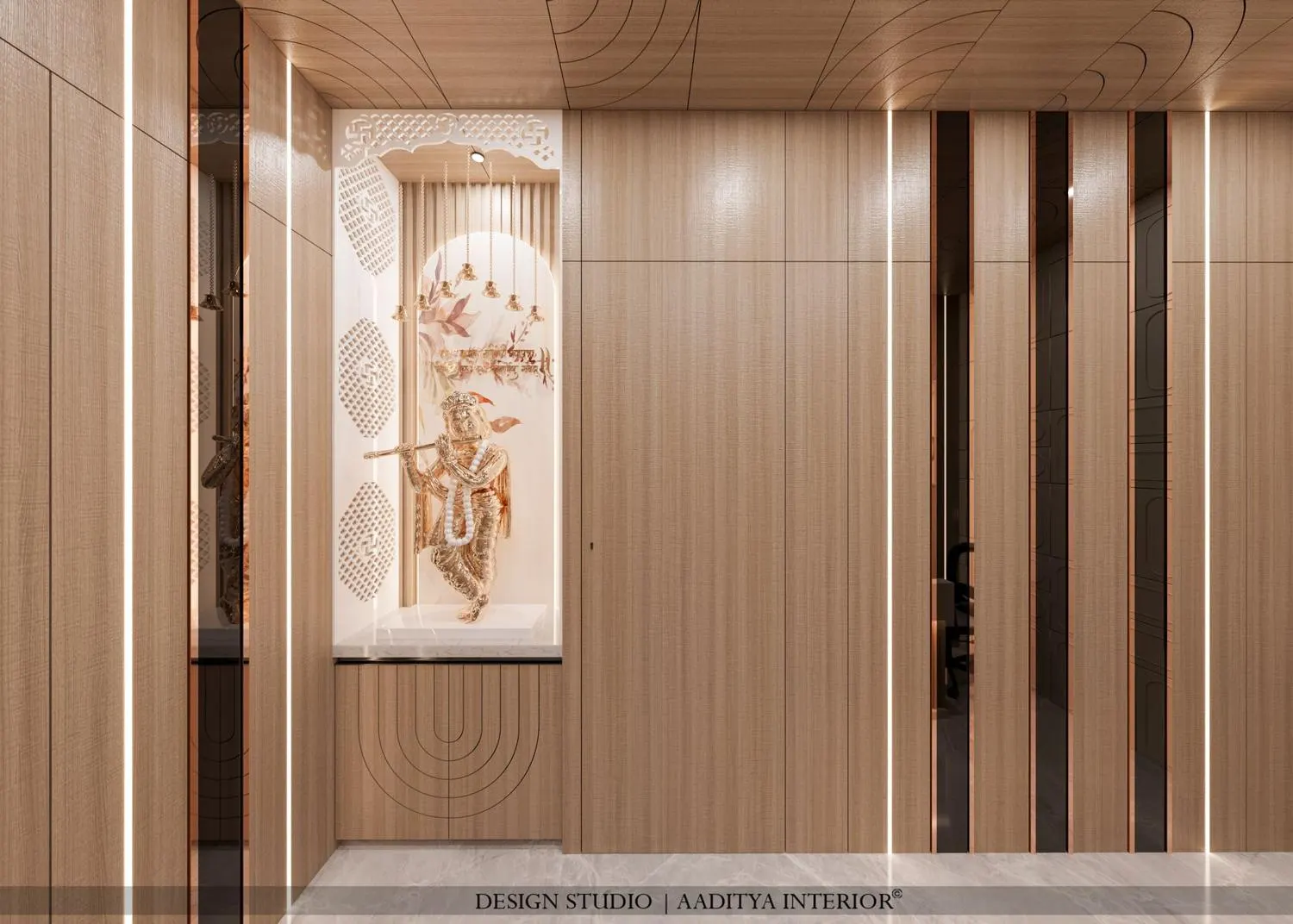
Material and colour are deliberately quiet and warm — wood veneer, soft beige, stone and copper reveals — so the diamonds, not the walls, are what catch the eye. The in-office mandir is given a proper backlit niche on the corridor, so the family's daily ritual has a dignified place without intruding on the trading rooms.
Materials
| Element | What the renders show | Role |
|---|---|---|
| Wall panelling | Wood veneer, vertical fluting, copper/rose-gold reveals | Warm, quiet backdrop; builds character in a bare shell |
| Feature walls | Backlit veined marble; framed 3D moulded panels | Focal point behind desks without clutter |
| Reception desk | Curved form with a backlit reeded front | Premium first impression at the entry |
| Desk tops | White stone / solid-surface work surfaces | Durable, light-reflecting grading surface |
| Flooring | Large-format marble-look vitrified tiles | Bright, easy-clean, premium feel |
| Mandir | Backlit niche with white carved jaali panels | Dignified place for the family's daily ritual |
| Lighting | Layered: ambient spots plus task pendants/lamps | Reliable grading light independent of daylight |
Indicative budget band
Costs are not disclosed for the project, so the figures below are indicative planning bands, not the actual contract value. Office interiors on this site are priced at about ₹800–1,200 per sq ft of carpet area for a basic fit-out, ₹1,200–1,600 mid-range and ₹1,600–2,000 or more premium (indicative October 2026). Specialist offices such as diamond sorting offices sit at or above the upper end, because they carry security construction, premium finishes and dedicated task lighting rather than ordinary workstation lighting. For a compact bourse unit of this finish level, a planning band of roughly ₹1,600–2,200+ per sq ft is reasonable, before GST, loose furniture, air-conditioning and IT.
| Line | Indicative basis (Oct 2026) | Note |
|---|---|---|
| Diamond office fit-out | ₹1,600–2,200+ per sq ft carpet | At or above the premium office band |
| Task and feature lighting | Part of fit-out; a dedicated line | Grading light is non-negotiable |
| Air-conditioning, IT, security | Quoted separately | Depends on unit and operator |
| GST and professional fees | Added on the above | As applicable |
Lessons
- In a compact unit, a single circulation spine frees every wall for desks, storage and display — plan the route first.
- Design grading light as a dedicated task layer at each desk; never rely on ambient ceiling light alone for sorting.
- When the shell is generic, character comes entirely from finishes and detailing — fluting, reveals and backlit panels do the work.
- Keep wall colour quiet and warm so the product, not the interior, holds the eye.
- Give the mandir a proper niche rather than squeezing it into a corner — it reads as respect and costs little.
- Control the window with timber blinds so daylight supports, rather than fights, the grading light.
Frequently asked questions
Why does a diamond office need special lighting?
Because diamonds are graded for colour and clarity, and the light source changes how a stone appears. A consistent, glare-controlled task light at the sorting desk — independent of the room's ambient light and of daylight — lets graders judge stones reliably. This is why the budget for a diamond office sits above an ordinary office.
How small can a diamond trading office be?
Bourse units are compact by design, often a few hundred square feet. The key is tight circulation: a single spine with cabins and storage off it, as in this project, lets a small unit hold a reception, one or two cabins, storage and a mandir without feeling cramped.
What finishes suit a diamond office?
Quiet, warm materials — wood veneer, soft neutrals, stone and metal reveals — that give a premium feel without competing with the product. Durable, light-reflecting desk tops and marble-look flooring keep the space bright and easy to maintain, while backlit feature walls provide a focal point behind each desk.
Sources & standards
- National Building Code of India 2016, Part 8 (lighting and ventilation) — task and ambient lighting principles
- Bureau of Indian Standards — IS 3646 (interior illumination) for task lighting levels at work surfaces
- Studio project: Diamond Bourse Office 210, Surat Diamond Bourse — project photographs
- Price ranges: indicative October 2026 estimates, consistent with this site's office fit-out bands — confirm locally before budgeting