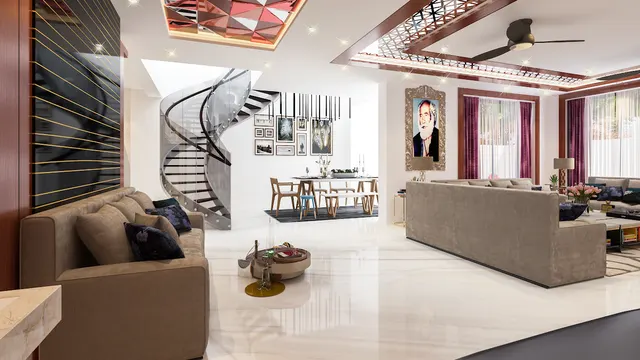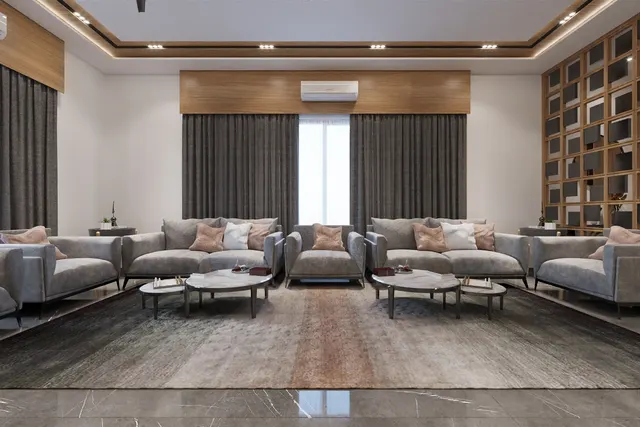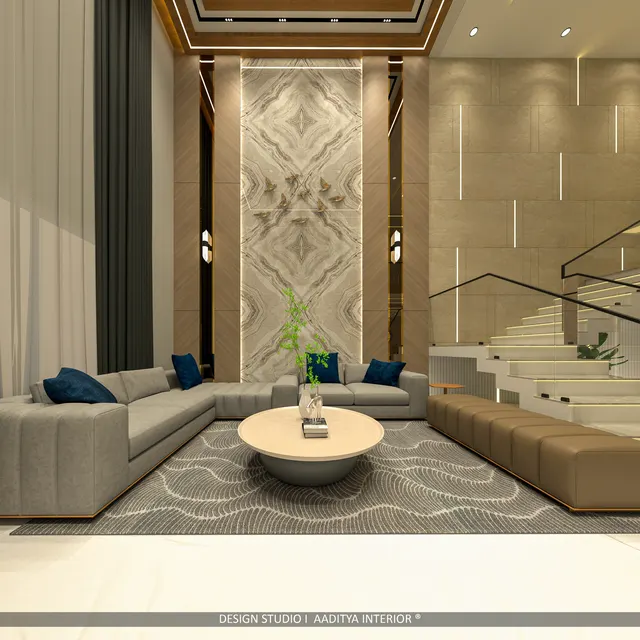

The false ceiling is one of the most common and most misunderstood line items in an Indian home interior. It is loved for what it does - it hides wiring, air-conditioning pipes and uneven slabs, it carries concealed and cove lighting, and it makes a room feel finished - but it is quoted in a confusing mix of units and materials, and two quotations for the same room can differ by a factor of three for reasons the homeowner cannot see. The honest way to read a false-ceiling quote is per square foot of ceiling area, by material, with a clear understanding of what pushes the rate up: the drop, the coves, the curves and the lighting.
This guide sets out the 2026 per-square-foot rates for the four ceiling systems used in Indian homes - gypsum board, plaster of Paris, PVC panel and the grid or mineral-fibre tile - explains exactly what each rate includes and excludes, and works a real room-by-room example so a family can estimate a whole flat before calling a contractor. It also explains the technical detail behind the price: how a suspended ceiling is actually built, why the drop matters, and how a cove light pocket is detailed so the LED strip glows evenly instead of showing as dots. The emphasis throughout is on the decisions that move the number, so a homeowner can specify sensibly rather than simply accept a rate.
Prices here are indicative October 2026 ranges for the Indian market, material plus labour, excluding GST and excluding the lighting fixtures themselves, which are a separate line. Rates vary with city, drop, design complexity and quantity, and should always be confirmed with a local contractor before budgeting. Where Aaditya Interior is named it is to describe project practice; the rates are market rates, not one firm's price list.
The quick answer: rates by material
A false ceiling is priced per square foot of its own area - the flat area of the ceiling, measured the same way as a floor - and the rate depends mostly on the material and the design. In 2026 a plain gypsum-board false ceiling costs about sixty to eighty rupees per square foot; plaster of Paris seventy to a hundred; a PVC-panel ceiling fifty to ninety; and a grid or mineral-fibre tile ceiling fifty-five to ninety. A designer gypsum ceiling with coves, curves, multiple levels and recesses runs eighty to a hundred and eighty, because the extra framing, cutting and finishing multiply the labour. These rates are material plus labour, finished and painted where paint applies, but they exclude the light fittings.
What the rate includes - and what it does not
A false-ceiling rate quoted per square foot should cover a defined scope, and confusion arises when two contractors include different things. For a gypsum ceiling the rate properly includes the galvanised-iron frame - the perimeter channel, intermediate channels and the ceiling sections - suspended from the slab on rods and cleats, the twelve-and-a-half-millimetre gypsum board screwed to it, the jointing tape and compound, two coats of putty, a primer and the finishing emulsion. What it does not include is the lighting - the cove LED strip, the panel and spot lights, and the wiring and drivers - which is a separate electrical line, nor any electrical point-shifting, nor the cost of a deeper drop to conceal large ducts.
The grid or mineral-fibre system is different in both build and scope. Here a visible aluminium grid is suspended from the slab and lightweight mineral-fibre tiles simply drop into it, so there is no jointing, putty or painting, and a tile can be lifted at any time to reach the services above - which is why it is the default in offices and shops rather than homes. PVC panels interlock over a light frame and need no finishing either, which makes them cheap and water-tolerant but visually plain. Plaster of Paris is formed wet over a frame and chicken mesh, hand-finished and painted; it allows fluid, curved shapes a board cannot, but it is heavier, slower and prone to hairline cracks if the mix or curing is poor.
| System | Rate per sq ft | What the rate includes | Best for |
|---|---|---|---|
| Gypsum board (plain) | Rs 60-80 | GI frame, board, jointing, putty, primer, paint | Clean modern ceilings in homes |
| Gypsum board (designer) | Rs 80-180 | Above, plus coves, curves, multiple levels | Living rooms, feature ceilings |
| Plaster of Paris (POP) | Rs 70-100 | Frame, mesh, wet plaster, hand finish, paint | Curved and moulded shapes |
| PVC panel | Rs 50-90 | Light frame and interlocking panels | Bathrooms, balconies, wet areas |
| Grid / mineral fibre | Rs 55-90 | Aluminium grid and drop-in tiles | Offices, shops, service access |
What pushes the rate up: drop, coves and curves
Within a single material the rate moves a long way, and three things drive it. The first is the drop - the distance the ceiling hangs below the slab. A shallow peripheral ceiling that drops a hundred to a hundred and fifty millimetres uses little frame and board; a deep ceiling that drops three or four hundred millimetres to conceal a large air-conditioning duct uses far more material and labour, and it also lowers the room, which is a design cost as well as a money one. The second is the cove - every cove is an extra fascia, an extra ledge and extra cutting, and a room ringed with coves can carry half as much framing again as a flat ceiling of the same area.
The third driver is shape. A flat rectangular ceiling is the cheapest thing a contractor can build; every curve, every change of level, every circular recess and every island adds cutting, jointing and finishing time, which is labour, which is money. This is why the designer-gypsum band is so wide: a single-level flat ceiling with a simple peripheral cove sits near eighty rupees per square foot, while a multi-level ceiling with curved islands, concealed and profile lighting and recessed niches sits near a hundred and eighty. The useful discipline for a homeowner is to spend the ceiling budget where it is seen and felt - the living room and the main bedroom - and to keep secondary rooms to a plain peripheral ceiling or none at all.
A worked example: a whole flat
The way to budget a false ceiling for a flat is room by room, because few homes ceil every room and almost none ceil them the same way. A sensible mid-range 2 BHK ceils the living-dining room with a designer gypsum ceiling carrying a cove, the two bedrooms with plain peripheral gypsum, and the kitchen and bathrooms with PVC where moisture is a concern - or leaves the bedrooms and service rooms bare. The table below works a typical flat, taking the ceiling area of each room and applying the rate for the chosen system. The cove LED is added separately at a hundred and fifty to three hundred rupees per running foot, because it is lighting, not ceiling.
| Room | Ceiling area | System | Rate per sq ft | Room cost |
|---|---|---|---|---|
| Living-dining | 150 sq ft | Designer gypsum + cove | Rs 80-180 | Rs 12,000-27,000 |
| Master bedroom | 120 sq ft | Plain gypsum peripheral | Rs 60-80 | Rs 7,200-9,600 |
| Bedroom 2 | 100 sq ft | Plain gypsum peripheral | Rs 60-80 | Rs 6,000-8,000 |
| Kitchen | 60 sq ft | PVC or none | Rs 50-90 | Rs 3,000-5,400 |
| Bathrooms (two) | 50 sq ft | PVC panel | Rs 50-90 | Rs 2,500-4,500 |
Add those rooms and a typical mid-range 2 BHK carries roughly thirty to fifty-five thousand rupees of false ceiling before the lighting, with the living-room designer ceiling and its cove taking nearly half. The cove LED on top - say forty running feet across the living room at a hundred and fifty to three hundred rupees - adds six to twelve thousand, and the panel and spot lights another few thousand. The figure that reaches the family's quotation is therefore not one rate times one area; it is a sum of rooms, each with its own system, plus a separate lighting line. A quote that gives a single lump sum for the whole flat is hiding exactly the room-by-room choices that a family should be making.
Cove lighting: the detail that makes or breaks the look
The cove is the single most popular false-ceiling feature in Indian homes, and the one most often detailed badly. A cove is a pocket at the edge of the ceiling that hides an LED strip behind a fascia lip and lets its light wash up and out across the ceiling or down the wall, so the source is never seen directly, only its glow. The detail that decides whether the glow is even or dotty is the gap between the strip and the surface it lights: too little, and the individual LEDs show as a row of bright spots; too much, and the light is weak and spread thin. A gap of fifty to a hundred millimetres between the strip and the ceiling or wall it washes is the practical sweet spot.
The fascia lip that hides the strip needs height too - about sixty to ninety millimetres - so that someone standing in the room cannot see the strip over the lip, while the strip itself sits on a ledge angled slightly towards the surface it lights. Good cove detailing also keeps the strip accessible for the day a segment fails, usually by making the tray reachable from below or leaving a service point. The cove LED is costed by running foot, not by area, because it follows the perimeter of the room: a hundred and fifty to three hundred rupees per running foot installed covers the strip, the aluminium channel and the driver, but not the designer-grade strips or the colour-changing systems, which cost more.
How long a false ceiling lasts and what can go wrong
A false ceiling is not a one-time cost to forget; how it is built decides whether it lasts fifteen years untouched or starts to show problems within two. A well-made gypsum or POP ceiling on a properly galvanised-iron frame, kept dry, routinely lasts the life of the interior, and the common failures almost all trace back to one of a handful of avoidable causes. The most frequent is water - a leak from the slab above, a bathroom overflow or a seeping air-conditioning drain pipe - which stains gypsum board permanently and can swell and sag it; this is exactly why moisture-prone rooms are better served by PVC or moisture-resistant board. The second is a poorly mixed or badly cured POP, which develops hairline cracks along the joints as it dries unevenly.
The other recurring problems are mechanical and electrical rather than material. A ceiling loaded with a heavy chandelier or a bulky fan on inadequate framing will sag at the fixing point, so heavy fittings need their own anchor back to the slab, not just the board. A cove sealed flush with no service access turns a failed LED segment into a demolition job, because the only way to the strip is through the finished fascia. And a frame screwed up with ungalvanised fasteners, or hung on rusting rod in a damp coastal flat, will weep rust stains through the paint within a year or two. None of these is expensive to prevent at the building stage; all of them are expensive to cure afterwards, which is the real argument for specifying the frame, the board grade and the service access in writing before work starts.
| Common problem | Usual cause | How to prevent it |
|---|---|---|
| Brown water stains on the board | Slab leak or AC drain seepage | Fix leaks first; use PVC in wet rooms |
| Hairline cracks along joints | Poorly mixed or fast-cured POP | Proper mix, slow cure, good jointing tape |
| Sag at a fixing point | Heavy fitting on light framing | Anchor chandeliers and fans to the slab |
| Dotty, uneven cove glow | Strip too close to the surface | Keep a 50-100 mm wash gap |
| Rust stains bleeding through paint | Ungalvanised frame or fasteners in damp air | Specify a GI frame and galvanised screws |
What is not in the false-ceiling rate
The false-ceiling rate is narrow by trade convention, and several related costs sit outside it. The light fittings - cove LED, panel lights, spotlights, pendants - and their wiring and drivers are an electrical line, not a ceiling line. Electrical point-shifting to put a light where the design wants it is separate again. A deeper drop to conceal a large duct, extra framing to carry a heavy chandelier, fire-rated or moisture-resistant board for specific rooms, and GST are all extras. The most honest way to read a ceiling quote is to insist that it states the system, the area per room, the number and length of coves, and then, on a separate line, the lighting - so that the ceiling and the light it carries are never confused into a single untraceable number.
| Extra outside the per-sq-ft rate | Typical cost | Note |
|---|---|---|
| Cove LED (strip, channel, driver) | Rs 150-300 / running foot | Lighting, not ceiling; costed by perimeter |
| LED panel and spot lights | Rs 400-1,200 each | Per fitting; pendants cost more |
| Electrical point-shifting | Varies | To place a light where the design wants it |
| Deeper drop for a large duct | Adds to the rate | More frame and board, and a lower room |
| GST | 18% | Added on top of the finished ceiling line |
- Price every ceiling per square foot of ceiling area, by room and by system - never as one lump sum for the flat.
- Keep the drop shallow where you can; a deeper drop costs more material and lowers the room.
- Spend the designer-ceiling budget on the living room and main bedroom; keep secondary rooms plain or bare.
- Use PVC or moisture-resistant board in kitchens and bathrooms; plain gypsum belongs in dry rooms.
- Budget cove LED separately by running foot (Rs 150-300), not inside the per-square-foot ceiling rate.
- Keep 50-100 mm between an LED strip and the surface it washes, or the individual LEDs show as dots.
- Give the cove fascia 60-90 mm of height so the strip is hidden from someone standing in the room.
- Confirm the quote states system, area per room and cove length; refuse a single untraceable lump sum.
- Add light fittings, point-shifting, a deeper drop and GST as separate lines before comparing quotes.
- Keep a service point to reach a failed LED segment; a sealed cove means breaking the ceiling to repair it.
Frequently asked questions
How much does a false ceiling cost per square foot in India in 2026?
A plain gypsum-board false ceiling costs about sixty to eighty rupees per square foot, plaster of Paris seventy to a hundred, PVC panels fifty to ninety, and a grid or mineral-fibre tile ceiling fifty-five to ninety. A designer gypsum ceiling with coves and curves runs eighty to a hundred and eighty. Rates are material plus labour, excluding GST and the light fittings.
Which is cheaper, gypsum or POP?
A plain gypsum-board ceiling is usually a little cheaper and faster than plaster of Paris, and gives cleaner, flatter surfaces for a modern look. POP costs seventy to a hundred rupees per square foot and comes into its own for curved and moulded shapes that a flat board cannot make. For a plain level ceiling, gypsum; for fluid curves, POP.
Does the false-ceiling rate include lighting?
No. The per-square-foot rate covers the frame, board or tiles, jointing and finishing, but the light fittings - cove LED, panels, spotlights - and their wiring and drivers are a separate electrical line. Cove LED is costed by running foot at a hundred and fifty to three hundred rupees, so always read the ceiling and the lighting as two lines.
How much ceiling height does a false ceiling take?
A shallow peripheral gypsum ceiling drops about a hundred to a hundred and fifty millimetres below the slab. A deeper ceiling to conceal a large air-conditioning duct can drop three to four hundred millimetres. Because it lowers the room, keep the drop as shallow as the services allow, especially in flats with modest slab-to-slab heights.
Is a false ceiling necessary in every room?
No. It is most useful in the living room, where it carries cove and concealed lighting and hides services, and in the main bedroom. Secondary bedrooms can take a plain peripheral ceiling or none; kitchens and bathrooms are better with moisture-tolerant PVC or nothing. Ceiling every room equally is a common way to overspend.
Sources & standards
- False ceiling rates 2026: plain gypsum Rs 60-80; designer gypsum Rs 80-180; POP Rs 70-100; PVC Rs 50-90; grid / mineral fibre Rs 55-90 per sq ft
- Cove LED Rs 150-300 per running foot installed (strip, channel and driver); LED panels Rs 400-1,200 each; designer pendants Rs 2,000-15,000 each
- Gypsum board 12.5 mm on a GI frame suspended from the slab; typical drop 100-150 mm, deeper for ducting
- Bureau of Indian Standards - IS 2095 (gypsum plaster boards) and IS 2547 (gypsum building plaster)
- National Building Code of India 2016, Part 8 - building services, lighting and ventilation
- IndiaMART / TradeIndia dealer and contractor listings, October 2026 (indicative, excluding GST and light fittings)
- Price ranges: indicative October 2026 estimates - confirm locally before budgeting