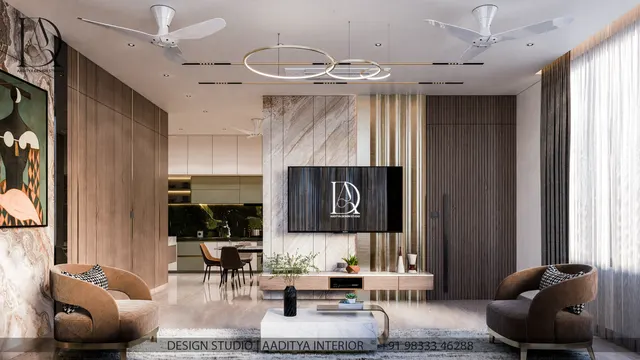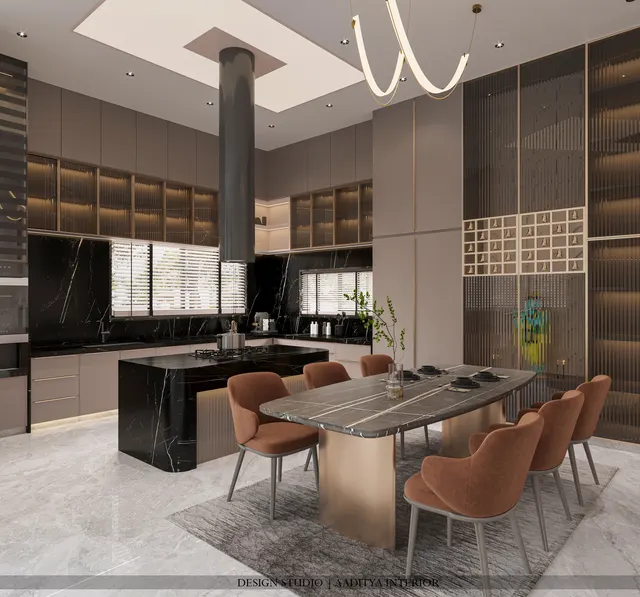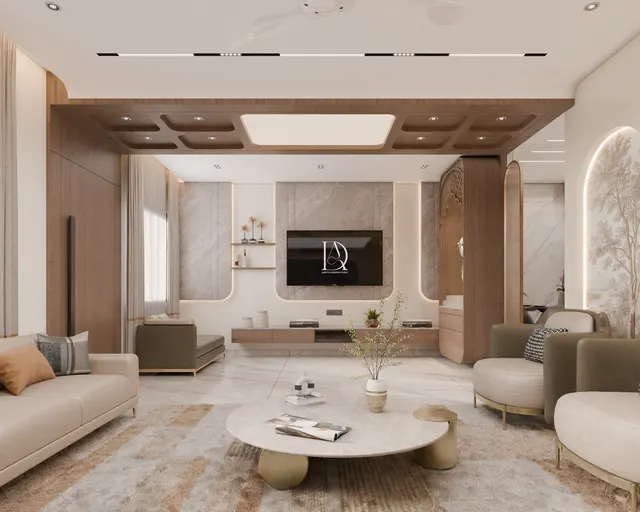

The keys to a new flat arrive with a strange feeling: the home is finished, and yet nothing in it works. There is nowhere to hang clothes, nowhere to sit, nowhere to eat and nowhere to keep shoes at the door. Furniture is the line that turns an empty 2BHK into a home, and it is also the line that families most often underestimate. They remember the sofa and the dining table, forget that two wardrobes and two beds are the largest items in the list, and then discover at the end that mattresses, a study chair and a shoe cabinet still have to be bought.
In Indian cities the problem is sharpened by how furniture is sold. Fitted furniture — wardrobes, beds with storage, TV and crockery units — is usually made by a carpenter or a modular factory and priced per square foot of front elevation. Loose furniture — the sofa, the dining set, mattresses and chairs — is bought from showrooms and online stores at a price per piece. The two are quoted in different units, by different people, at different times, so very few families ever see the whole furniture budget on one page until the money has been spent.
This guide puts the whole list on one page for a typical new 2BHK of about 1,000 sq ft carpet area. It itemises every piece at basic, mid-range and premium levels, uses the same rates as this blog's Surat 2BHK interior cost guide and furniture budgeting guide so the numbers agree, explains what moves the price, and ends with a buying sequence that avoids the most expensive mistakes. All prices are indicative October 2026 estimates and should be confirmed locally before budgeting.
What counts as furniture in a 2BHK budget
The first job is to draw a boundary, because the same item can sit in different lines in different quotes. In this guide, furniture means two groups. Fitted furniture is built for the room and normally fixed to the wall or made to measure: wardrobes, beds with storage and their side tables, the TV unit, the crockery unit, the foyer shoe cabinet and a study desk. Loose furniture is bought ready-made and can move with the family: the sofa, coffee table, dining set, mattresses, chairs and rugs.
Three things are deliberately left out. The modular kitchen is the single most expensive piece of joinery in a flat and has its own budget — this blog's Surat 2BHK guide places an L-shaped mid-range kitchen at about ₹2.2–2.8 lakh. Appliances such as the refrigerator, washing machine and air-conditioners are equipment, not furniture. And the shell items — false ceiling, painting, lighting, curtains and bathroom fittings — are finishing work. Keeping these apart is not an accounting trick; it is the only way to compare one furniture quote with another.
| Group | Items included | How it is usually priced | In this guide? |
|---|---|---|---|
| Fitted furniture | Two wardrobes, two beds with side tables, TV unit, crockery unit, shoe cabinet, study desk | Per sq ft of front elevation, or per unit | Yes |
| Loose furniture | Sofa set, coffee table, dining set, two mattresses, study chair, rug and lamps | Per piece from showrooms or online | Yes |
| Modular kitchen | Base, wall and tall units, counter, hardware | Per running ft or per sq ft of elevation | No — separate kitchen budget |
| Appliances | Refrigerator, washing machine, ACs, TV, chimney, hob | Per piece, MRP and offers | No |
| Shell and finishes | False ceiling, paint, lights, curtains, bathroom fittings | Per sq ft or per point | No — see the 2BHK interior cost guide |
| Decor | Art, plants, cushions, accessories | Per piece; very elastic | Only a small rug and lamp allowance |
From carpenter's workshop to modular factory
For most of the twentieth century, an Indian family furnished a new home in two ways. Heavy pieces — the double bed, the dining table, the dressing table — were made by a local carpenter in solid timber such as teak or sheesham, or later in plywood with a laminate or veneer face, often on site over several weeks. Storage came as the steel almirah, a fireproof-feeling cupboard that stood in every bedroom and carried jewellery, documents and the best saris. Sofas were made by upholsterers to order, frequently copied from a picture in a magazine.
The shift came with engineered boards and factory machinery. Pre-laminated particle board and MDF, edge-banding machines, CNC panel saws and concealed hinges made it possible to manufacture wardrobes and beds as kits of panels, cut in a factory and assembled on site in days rather than weeks. Wardrobes moved from a freestanding almirah to a wall-to-wall, floor-to-ceiling unit with a loft. Pricing moved with them: instead of a lump sum for a cupboard, quotes began to be given per square foot of front elevation, which is how most Indian cities price fitted furniture today.
Loose furniture changed in parallel. Organised furniture retail and online marketplaces put standard sofas, dining sets and mattresses in front of buyers with fixed prices, delivery dates and warranties, and mattress brands began to sell foam, spring and latex mattresses with long trial periods. The result is today's hybrid: a family typically buys fitted furniture from one maker and loose furniture from several sellers, which is exactly why a single consolidated budget is so useful.
The 2BHK this budget is built for
Prices only mean something against a plan. The figures below assume a new 2BHK of about 1,000 sq ft carpet area, of the kind found in most new towers in Surat, Ahmedabad, Pune or Indore: a master bedroom of about 11 × 13 ft with an attached toilet, a second bedroom of about 10 × 11 ft, a living room of about 16 × 13 ft, a dining area of about 11 × 13 ft, a kitchen with a small utility, and a foyer at the main door. Fig. 1 shows the zoning and where each priced item sits.
Two decisions in this plan carry most of the money. The master wardrobe is assumed to be 7 ft wide and the second-bedroom wardrobe 6 ft wide, both 8 ft high including a loft, which gives 56 and 48 sq ft of front elevation — 104 sq ft in all. Both bedrooms get a bed with hydraulic or drawer storage, because storage beds replace a large amount of cupboard space in a flat. Everything else — TV unit, crockery unit, foyer cabinet and desk — is modest in size, and Fig. 1 shows that each fits the room with a clear walking path.
The mid-range list, item by item
Most families furnishing a new 2BHK land in the mid-range: BWR plywood or HDHMR carcasses, laminate or a mix of laminate and acrylic shutters, soft-close hinges and channels from a recognised hardware brand, a fabric sofa on a hardwood frame, an engineered-wood or solid-wood dining set and medium-firm mattresses. The table below prices every item at that level. Wardrobes use a mid-range all-in rate of ₹1,750–2,300 per sq ft of elevation, which sits inside the ₹1,200–2,200 hinged and ₹1,800–3,000 sliding bands used across this blog.
| Item | Size or specification | Basis | Low (₹) | High (₹) |
|---|---|---|---|---|
| Master wardrobe with loft | 2134 × 2438 mm (7 × 8 ft = 56 sq ft) | ₹1,750–2,300 per sq ft | 98,000 | 1,28,800 |
| Second wardrobe with loft | 1829 × 2438 mm (6 × 8 ft = 48 sq ft) | ₹1,750–2,300 per sq ft | 84,000 | 1,10,400 |
| Master bed with storage + 2 side tables | Queen or king, hydraulic lift | Per unit | 70,000 | 85,000 |
| Second bed with storage + 1 side table | Queen, drawers or hydraulic | Per unit | 60,000 | 75,000 |
| TV unit | 2400 mm wide, wall-hung with back panel | Per unit | 45,000 | 60,000 |
| Crockery unit | 1500 mm wide, glass shutters, drawers | Per unit | 35,000 | 50,000 |
| Foyer shoe cabinet with mirror | 1200 × 1000 × 350 mm, ventilated | Per unit | 25,000 | 35,000 |
| Study desk with wall shelf | 1200 × 600 mm in bedroom 2 | Per unit | 20,000 | 35,000 |
| Fitted furniture subtotal | 4,37,000 | 5,79,200 | ||
| Sofa set | 3+2 seater or compact L | Per piece | 70,000 | 1,00,000 |
| Coffee table + side table | Engineered wood or stone top | Per piece | 15,000 | 25,000 |
| Dining set | 6-seater, about 1800 × 900 mm table | Per set | 55,000 | 75,000 |
| Mattresses × 2 | Queen or king, medium-firm | Per piece | 40,000 | 80,000 |
| Ergonomic study chair | Adjustable, lumbar support | Per piece | 10,000 | 15,000 |
| Rug, bedside lamps, small items | One living rug, two lamps | Allowance | 10,000 | 25,000 |
| Loose furniture subtotal | 2,00,000 | 3,20,000 | ||
| Total furniture, mid-range | 6,37,000 | 8,99,200 |
The total of about ₹6.4–9 lakh is consistent with the rest of this blog's 2BHK figures. In the Surat 2BHK interior cost guide, a mid-range 1,000 sq ft flat costs ₹13–18 lakh in all, with wardrobes at ₹1.8–2.4 lakh, beds at about ₹1.5 lakh, the TV, crockery and foyer units at about ₹1.2 lakh, and the sofa and dining set at about ₹2 lakh. The table above uses the same bands; it simply adds the items that the overview groups or leaves implicit — the second side table, the study desk, two mattresses, a chair and a rug. Loose furniture at ₹2–3.2 lakh also sits inside the ₹2–3.5 lakh mid-range band for a 2BHK in this blog's furniture budgeting guide, and the core trio of sofa, coffee table and dining set comes to ₹1.4–2 lakh, matching the ₹1.5–2 lakh allowance used elsewhere.
Put simply, furniture is about half of a mid-range 2BHK budget. The kitchen, ceilings, paint, lighting, curtains and bathroom fittings make up most of the other half. That ratio is a useful check: if a quote shows furniture at less than a third of the total, something is probably missing; if it shows more than two-thirds, the specification has probably drifted upwards.
Basic, mid-range and premium compared
The same list can be bought at three very different levels. At basic level, carcasses are pre-laminated particle board or commercial plywood, shutters are plain laminate, hardware is unbranded, the sofa is a compact foam set and the dining table is four- to six-seat engineered wood. At premium level, carcasses are BWP plywood, shutters are PU lacquer, veneer or fluted glass, hardware is imported soft-close with lift-up mechanisms, beds have upholstered headboards, and the sofa and dining set are designer or solid-wood pieces. The table groups the list so the three columns can be compared quickly.
| Group | Basic (₹) | Mid-range (₹) | Premium (₹) | What changes |
|---|---|---|---|---|
| Wardrobes, 104 sq ft of elevation | 1,04,000–1,24,800 (₹1,000–1,200 / sq ft) | 1,82,000–2,39,200 (₹1,750–2,300) | 2,39,200–3,64,000 (₹2,300–3,500) | Board, shutter finish, sliding vs hinged, internal fittings |
| Two beds with side tables | 70,000–90,000 | 1,30,000–1,60,000 | 2,50,000–3,50,000 | Storage mechanism, headboard, veneer or upholstery |
| TV, crockery and foyer units | 60,000–80,000 | 1,05,000–1,45,000 | 2,00,000–3,00,000 | Back panels, stone, glass, profile lights |
| Study desk | 10,000–15,000 | 20,000–35,000 | 40,000–60,000 | Wall shelf, drawers, veneer, cable management |
| Loose furniture | 1,00,000–1,80,000 | 2,00,000–3,20,000 | 4,00,000–7,00,000 | Sofa frame and fabric, dining top, mattress type |
| Total furniture | 3,44,000–4,89,800 | 6,37,000–8,99,200 | 11,29,200–17,74,000 + | ≈ ₹3.4–4.9 L / ₹6.4–9 L / ₹11.3 L+ |
Two observations help families choose. First, the jump from basic to mid-range is mostly about durability — better board, better edge banding and branded hardware — and it is usually the best-value upgrade, because a wardrobe that sags or a hinge that fails in three years costs far more to fix than it saved. Second, the jump from mid-range to premium is mostly about finish and image: PU, veneer, upholstered beds and designer sofas. Those are legitimate choices, but they can be phased or limited to the living room, where guests see them, while bedrooms stay mid-range.
Sizes that make the furniture fit
A furniture budget fails as often on size as on price. A king bed in a 10 ft wide room leaves no space to open a hinged wardrobe; a 3+2 sofa in a 12 ft living room blocks the balcony door; a six-seat dining table in an 8 ft dining niche leaves no room to pull chairs back. The table gives the sizes Indian designers typically use for a 2BHK, and Fig. 3 shows the clearances that decide whether the living and dining pieces can be used comfortably.
| Piece | Typical size (mm) | Clearance it needs | Note for a 2BHK |
|---|---|---|---|
| Queen bed | 1500 × 2000 mattress; frame about 1650 × 2150 | 600–750 on the walking sides | Fits a 10 × 11 ft room with a hinged wardrobe |
| King bed | 1800 × 2000 mattress; frame about 1950 × 2150 | 600–750 on the walking sides | Best in an 11 ft or wider master |
| Hinged wardrobe | 600 deep, 2100 + loft to 2400–2700 high | 900 in front for shutter swing and standing | Shutters 450–600 wide each |
| Sliding wardrobe | 650–700 deep including track | 600–750 in front | Saves swing space in narrow rooms; costs more |
| 3-seater sofa | 1900–2200 × 850–950 | 400–450 to the coffee table | Seat height about 420–450 |
| 6-seater dining table | 1800 × 900 (or 1500 round) | 750–900 from each table edge | Needs about 3300 × 2400 clear |
| TV unit | 300–450 deep, 1800–2400 wide | Viewing distance about 2400–3000 for a 55-inch screen | Wall-hung units make cleaning easier |
| Shoe cabinet | 330–350 deep, 850–1000 high | 900 clear passage, 150 from the door edge | A 1200 mm unit holds about 20–28 pairs |
| Study desk | 1200 × 600, top at 740–760 | 900–1000 behind the chair | Place light from the left for right-handed users |
What moves the price of fitted furniture
Fitted furniture is priced per square foot of elevation because most of its cost scales with the front area: board, shutters, edge banding, hinges and labour. Inside that rate, four choices decide where a quote lands. The carcass board is the first: pre-laminated particle board is cheapest, MDF and HDHMR sit in the middle, and BWR or BWP plywood costs more but holds screws better and resists humidity in coastal cities such as Surat and Mumbai. The second is the shutter finish, which is the most visible surface and the widest price swing. The third is hardware: soft-close hinges, telescopic channels, hydraulic bed lifts and wardrobe accessories. The fourth is internal planning — drawers, trouser pull-outs, lofts and lighting — which adds cost per unit rather than per square foot.
| Shutter finish | Indicative rate (₹ per sq ft of shutter) | Look and behaviour | Effect on a 56 sq ft wardrobe |
|---|---|---|---|
| Laminate (1 mm) | ₹350–650 | Matte, gloss or textured; tough and easy to wipe | Keeps the wardrobe in the basic to mid band |
| Membrane (PVC foil on routed MDF) | ₹500–850 | Profiled, carved look; avoid near heat | Small rise over laminate |
| Natural veneer, PU lacquered | ₹600–1,100 | Warm real wood grain | Moves towards the upper mid band |
| Acrylic | ₹900–1,500 | High gloss, solid colours; shows fingerprints | Pushes the wardrobe towards premium |
| PU paint (duco) | ₹1,000–1,800 | Seamless matte or gloss in any colour | Premium band |
| Glass or fluted glass in aluminium frame | Quote per design | Light, display look; needs internal lighting | Premium; often only on a section |
The practical lesson is that the shutter finish, not the number of cupboards, usually decides whether a home is mid-range or premium. Moving every shutter in a flat from laminate to acrylic or PU can add lakhs without adding a single cupboard. Many designers therefore use the premium finish only where it is seen — the TV wall, the crockery unit, the master wardrobe — and keep laminate inside the second bedroom and behind closed doors.
Beds and storage mechanisms
A storage bed is the second-largest fitted item in each bedroom. Its price depends on the board, the headboard and the mechanism. Drawer beds are cheaper and easy to use daily but leave the middle of the bed space inaccessible; hydraulic lift beds open the whole base but need good gas struts rated to the weight of the mattress, and a cheap mechanism is the commonest complaint after a year. An upholstered or veneered headboard with integrated side tables moves a bed into the premium band. In a mid-range 2BHK, about ₹70,000–85,000 for the master bed with two side tables and ₹60,000–75,000 for the second bed with one side table is realistic.
Loose furniture: where quality hides
In a sofa, the price follows what cannot be seen: the frame timber, the density and grade of the foam, whether the seat has springs or webbing, and the fabric's rub rating. A mid-range 3+2 set of ₹70,000–1,00,000 should have a seasoned hardwood or engineered frame, high-resilience foam and removable covers. In a dining set, the top decides the price — engineered wood with veneer, solid sheesham, or a stone or ceramic top on a metal base. In mattresses, the type and thickness matter more than the brand name; mid-range queen or king mattresses commonly cost ₹18,000–45,000 each, so two land at about ₹40,000–80,000. These ranges come from this blog's furniture budgeting guide and are indicative October 2026 figures.
When to order each piece
Furniture timing matters as much as price. Fitted furniture should be measured only after plastering and flooring are finished, because a wardrobe made to a pre-plaster measurement will not fit. Electrical points for bed lights, TV wall and study desk must be fixed before the panels go up. Loose furniture should be ordered so that it arrives after the joinery and painting are done, but before the move-in date, because made-to-order sofas often take several weeks. The sequence below is the one Aaditya Interior uses for flats handed over by builders with flooring complete.
| Stage | What to do | Typical lead time | Why it matters |
|---|---|---|---|
| Week 0–2 | Final furniture layout, sizes and electrical points | 1–2 weeks of design | Every socket and light depends on the furniture position |
| Week 2–3 | Site measurement and approval of drawings | A few days | Wardrobes are made to measured, not drawn, sizes |
| Week 3–8 | Factory or on-site making of wardrobes, beds, units | 3–6 weeks factory; longer on site | The longest item in the programme |
| Week 5–8 | Order sofa and dining set | 2–6 weeks for made-to-order | Arrives after painting, before move-in |
| Week 8–10 | Installation and hardware adjustment | 1–2 weeks | Hinges and channels need a second visit |
| Week 9–10 | Mattresses, chairs, rug and lamps | Usually stocked; days | Buy last, after the beds are installed and measured |
| Move-in + 1 month | Snag list: doors, drawers, gaps, touch-ups | One visit | Settled shutters often need realignment |
Phasing the budget without regret
Not every family can or should buy everything at once. The rule is to buy first what is hard to change later and what is used every day. Wardrobes, beds and the foyer cabinet are fixed to walls and wired around; doing them later means dust, drilling and repainting in a lived-in home. Mattresses, the sofa and the dining set are used every day and affect sleep and health. Everything else — the crockery unit, the study desk, a premium coffee table, the rug and decor — can wait three to twelve months without harm.
A sensible first-phase list for a mid-range 2BHK is therefore the two wardrobes, two beds, the foyer cabinet, the TV unit, the sofa, the dining set and two mattresses. From the itemised table, that phase costs about ₹5.47–7.49 lakh at mid-range rates. The crockery unit, study desk and chair, coffee and side tables, rug and lamps — about ₹0.9–1.5 lakh — can follow, and the two phases together return the full ₹6.37–8.99 lakh. Keeping 5–10 per cent of the furniture budget as a reserve for delivery charges, an extra side table or a hardware upgrade avoids an awkward final month.
GST also needs a line of its own. Furniture and mattresses are commonly charged GST at 18 per cent, and some carpenters and smaller makers quote without it while factories and showrooms include it. When two quotes are compared, they must both be with or without GST. The same applies to delivery and lifting charges in high-rise towers, which are small individually but can add up across a dozen deliveries.
Where 2BHK furniture is heading
Three shifts are already visible in Indian cities and are likely to grow. First, more fitted furniture is made in factories with CNC panel saws and edge banders, which shortens site time and gives cleaner edges; the trade-off is that design changes after ordering become expensive. Second, compact flats are pushing multi-use pieces: storage beds have become standard, wall beds and fold-down desks appear in second bedrooms that double as studies, and extendable dining tables suit families who host occasionally. Third, buyers are paying more attention to what furniture is made of — low-emission boards, water-based finishes and fabrics that can be cleaned — partly because new flats are closed and air-conditioned for long hours.
Rental and subscription furniture also exists in larger cities, mainly for young professionals in rented flats. For a family that has bought a 2BHK and expects to live in it for years, owning fitted furniture remains the norm, and the itemised budget above is the right starting point.
Nine rules for budgeting 2BHK furniture
- Separate fitted furniture, loose furniture and the kitchen in every quote, so each can be compared like for like.
- Measure wardrobes in sq ft of elevation (width × height including the loft) and ask for the rate per sq ft in writing.
- Spend on carcass board and hardware before shutter finish; durability is the best-value upgrade.
- Use premium finishes only where they are seen — the TV wall, crockery unit and master wardrobe — and laminate elsewhere.
- Draw every piece to scale on the plan before buying; check clearances of 600–750 mm beside beds and 900 mm in front of hinged wardrobes.
- Fix electrical points for bed lights, TV wall and study before any panel is installed.
- Order made-to-order sofas and dining sets 4–6 weeks before move-in; buy mattresses last.
- Compare quotes with GST and delivery on the same basis.
- Keep 5–10 per cent of the furniture budget as a reserve, and phase decor and secondary pieces over 3–12 months.
Frequently asked questions
How much does it cost to furnish a 2BHK flat in India?
For about 1,000 sq ft, furniture alone costs roughly ₹3.4–4.9 lakh at basic level, ₹6.4–9 lakh mid-range and ₹11.3 lakh or more premium in October 2026. A complete mid-range interior including the kitchen, ceilings, paint, lighting, curtains and bathroom fittings is typically ₹13–18 lakh in Surat, with furniture making up about half.
Is carpenter-made furniture cheaper than modular furniture?
Sometimes, but the difference is smaller than it looks once the same board, finish and hardware are specified. On-site carpentry is flexible and can be cheaper for simple units; factory-made modular furniture is faster on site and gives cleaner edges and more consistent finish. Compare both on the same specification and rate per sq ft of elevation.
Which is better for a 2BHK: sliding or hinged wardrobes?
Hinged wardrobes cost less (about ₹1,200–1,800 per sq ft mid-range) and are easier to maintain. Sliding wardrobes (about ₹1,800–3,000) save the 450–600 mm swing zone and suit narrow bedrooms where the bed sits close to the wardrobe. In a 10 × 11 ft second bedroom with a queen bed, sliding can be worth the premium.
Should the sofa and dining set be bought before or after the interiors?
Decide their sizes during design, so the layout, lighting and sockets are planned around them, but order them so they arrive after joinery and painting are finished. Made-to-order pieces usually need 2–6 weeks, so place the order about a month before the planned move-in date.
How can furniture costs be reduced without losing quality?
Keep BWR plywood or HDHMR carcasses and branded hardware, and save on finishes: laminate instead of acrylic or PU in bedrooms, fewer internal accessories, and a simpler TV wall. Buy the crockery unit, decor and secondary tables in a second phase. Avoid saving on mattresses, hinges and bed mechanisms, which fail first.
Sources & standards
- National Building Code of India 2016, Part 3 (Development Control Rules and General Building Requirements) — minimum room sizes that bound furniture layouts
- Bureau of Indian Standards — IS 303 (plywood for general purposes), IS 710 (marine plywood), IS 12406 (medium density fibreboard)
- Neufert, Architects' Data — furniture sizes and clearances for bedrooms, living and dining rooms
- Time-Saver Standards for Interior Design and Space Planning — clearance and circulation guidance
- Manufacturer standard ranges for wardrobes, storage beds, sofas and mattresses, described generically
- Price ranges: indicative October 2026 estimates — confirm locally before budgeting