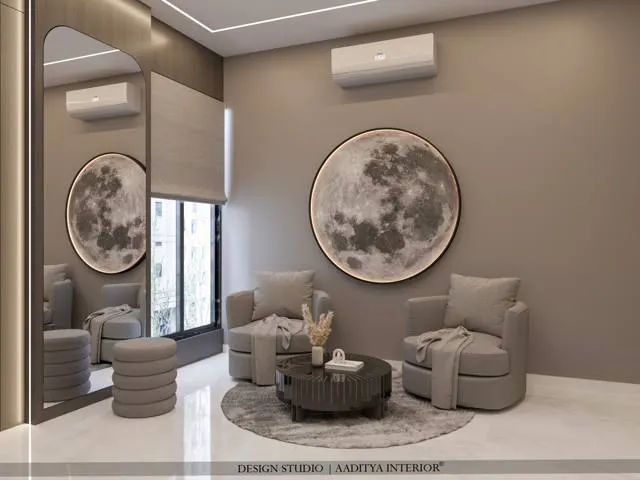
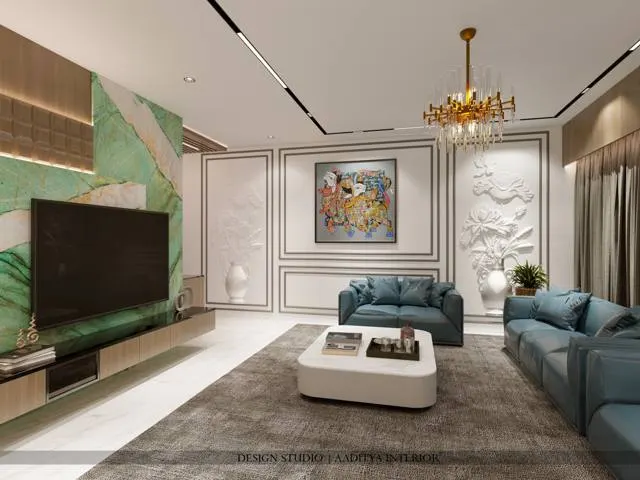
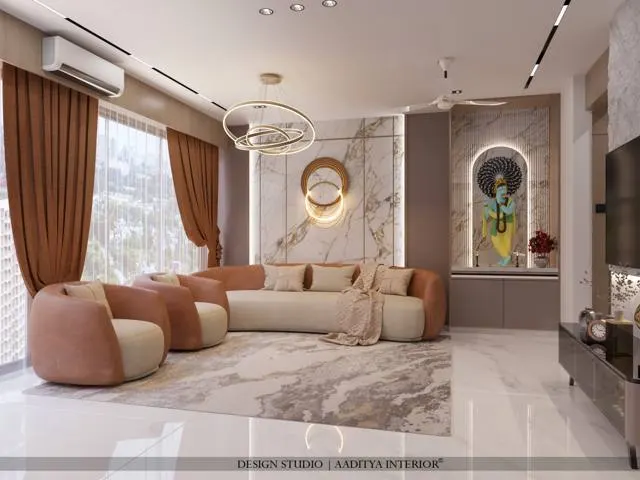
SG Highway — the Sarkhej–Gandhinagar corridor running up the western edge of Ahmedabad — is where much of the city's new housing has gone in the last two decades. Its towers and gated schemes, around Bodakdev, Thaltej, Prahlad Nagar and Gota, are filled with 2BHK and 3BHK flats whose owners face the same question the moment they take possession: what will the interior actually cost. The honest answer is a set of bands, not a single figure, because the number depends almost entirely on the level of finish chosen and the scope of work, not on the address alone.
The confusion that surrounds interior pricing is avoidable. Two quotations for the "same" flat can differ by ten lakh rupees and both be honest — one assuming a basic fit-out with laminate shutters and a builder's flooring left in place, the other a premium scheme with veneer, false ceilings throughout, imported sanitaryware and new stone floors. Until the board grades, shutter finishes, ceiling extent and flooring are named, a per-square-foot figure means nothing. This guide fixes the bands for SG Highway, shows the room-wise arithmetic beneath them, and lists the extras that every careful quote keeps separate, so a family can read any quotation line by line.
The figures here are indicative October 2026 ranges, consistent with the rates used across Indian metros and tier-1 cities, excluding GST. SG Highway sits at the mid-to-upper end of that spread: it is a premium corridor, demand is strong, and most owners finishing a flat here aim at the mid-range to premium bands rather than the basic one. The guide is written to help a family set a realistic budget before meeting any designer, and to judge the quotes that follow against a clear yardstick rather than against hope.
The cost bands for SG Highway
Interior cost is quoted per square foot of carpet area — the usable floor inside the walls — and for full-home interiors the bands are consistent across the metros: basic ₹800–1,200, mid-range ₹1,200–2,000, and premium ₹2,000–3,500 and above, with most complete homes landing around ₹1,400–1,800 per sq ft. On SG Highway, where the housing is newer and the owners' expectations higher, the centre of gravity sits a little above the all-India middle — most finished flats here land in the upper mid-range, roughly ₹1,500–2,200 per sq ft, with premium schemes climbing well beyond. The chart places the bands side by side.
Translating a rate into a total needs the carpet area, and this is where many budgets go wrong. A flat sold as 1,800 sq ft super built-up may have only about 1,250 sq ft of carpet; the interior rate applies to the carpet figure, not the larger one. At ₹1,600 per sq ft a 1,250 sq ft carpet 3BHK is roughly a ₹20 lakh interior, not the ₹29 lakh that the super built-up figure would wrongly suggest. Any quote that applies the per-square-foot rate to the super built-up area is inflating the total, often by a third or more, and the family should always confirm which area the rate is being applied to.
| Band | ₹ per sq ft (carpet) | Typical 1,000 sq ft carpet home | What it buys |
|---|---|---|---|
| Basic | ₹800–1,200 | ₹8–12 lakh | Laminate shutters, minimal ceiling, builder flooring kept |
| Mid-range | ₹1,200–2,000 | ₹12–20 lakh | Laminate/membrane, gypsum ceilings, branded hardware |
| SG Highway typical | ₹1,500–2,200 | ₹15–22 lakh | Where most finished flats here land |
| Premium | ₹2,000–3,500+ | ₹20–35 lakh+ | Veneer/acrylic/PU, full ceilings, new stone floors |
Because this single point causes more budgeting error than any other, it is worth drawing. The flat is sold on super built-up area, which includes a share of common spaces, but the interior is billed on carpet area, the usable floor inside the walls. The two can differ by a third, so a rate applied to the wrong figure inflates the total badly. The diagram shows the two areas and the rule that follows: always apply the per-square-foot rate to the inner, carpet figure, never to the outer one printed on the sale deed.
2BHK and 3BHK: what it costs here
Put into the BHK terms families actually use, the bands give clear figures for SG Highway's two common flat types. A 2BHK of about 1,000 sq ft carpet runs roughly ₹9–13 lakh basic, ₹14–20 lakh mid-range and ₹22 lakh and above for premium. A 3BHK of about 1,300–1,500 sq ft carpet runs roughly ₹12–18 lakh basic, ₹18–30 lakh mid-range and ₹32 lakh and above premium. These are full interiors — modular kitchen, wardrobes, beds, false ceilings, painting, lighting, and basic furnishings — and they assume the builder's flooring is kept unless new flooring is specifically added.
The single most useful thing to grasp is how much of the budget two elements consume. In a mid-range flat the modular kitchen and the bedroom wardrobes together take roughly a third to a half of the whole interior spend — the kitchen perhaps ₹2.2–3 lakh for an L-shape and the wardrobes ₹1.8–3 lakh across the bedrooms. This is why a family that pours money into a dramatic living room and then economises on the kitchen and wardrobes usually regrets it: the two costliest, most-used elements should be protected first, and the display spaces trimmed if the budget is tight.
The Ahmedabad climate quietly shapes some of these choices. The long, hot summer and the dusty months put a premium on finishes that stay cool and clean easily — light vitrified or large-format tile floors, washable paints, and shaded west and south glazing — while the short, intense monsoon rewards good waterproofing in bathrooms and balconies. Flats along the SG Highway corridor are mostly newer towers with sound builder shells, so civil work is usually light, but the high-rise setting means service shafts and structural walls are fixed and interiors must be planned around them. A good local designer prices these realities in from the first drawing rather than discovering them on site.
| Flat type | Basic | Mid-range | Premium |
|---|---|---|---|
| 2BHK (~1,000 sq ft carpet) | ₹9–13 lakh | ₹14–20 lakh | ₹22 lakh+ |
| 2.5BHK (~1,150 sq ft carpet) | ₹10–15 lakh | ₹16–23 lakh | ₹26 lakh+ |
| 3BHK (~1,350 sq ft carpet) | ₹12–18 lakh | ₹18–28 lakh | ₹30 lakh+ |
| 3BHK large (~1,550 sq ft carpet) | ₹14–20 lakh | ₹21–32 lakh | ₹35 lakh+ |
Room by room: where the money goes
Breaking the total into rooms makes a budget real and shows where a cut actually lands. The kitchen and wardrobes lead, followed by false ceilings and lighting across the home, painting of the full paintable area (which runs roughly three times the carpet area), the living-room television and seating wall, and the bathrooms if they are being upgraded beyond the builder's fittings. The table gives indicative October 2026 ranges for the main items in a mid-range SG Highway flat, excluding GST, so a family can see which line to protect and which to trim.
| Element | Indicative cost | Basis | Note |
|---|---|---|---|
| Modular kitchen (L-shape) | ₹2.2–3 lakh | HDHMR/BWR + laminate | Upgrade carcass at the sink to BWP |
| Bedroom wardrobes | ₹1,200–2,200 per sq ft elevation | Per wardrobe front | Sliding costs more than hinged |
| False ceiling + lighting | ₹60–180 per sq ft | Gypsum; designer with cove dearer | Priced on ceiling area covered |
| Painting | ₹12–30 per sq ft | Paintable ≈ carpet × 3 | Premium emulsion ₹20–30 |
| Living-room TV wall | ₹40,000–1,50,000 | Panelling + unit + lighting | Panelling ₹350–900 per sq ft |
| Bathroom upgrade | ₹30,000–75,000 per bath | Fittings + labour + tiling | Excludes premium sanitaryware brands |
These line items assemble back into the per-square-foot bands rather than contradicting them: add the rooms up for a given finish level and divide by the carpet area, and the result lands inside the band the flat was quoted at. That is the test of an honest quotation — the top-line rate and the room-wise detail should agree. A quote where they do not is either padded or hiding deleted items, and the family should ask for the arithmetic that reconciles the two before signing.
Finish tiers: what basic, mid and premium include
The bands are driven almost entirely by the finish tier, so it is worth being precise about what each includes. Basic uses HDHMR or commercial-ply carcasses with laminate shutters, standard hardware, minimal or no false ceiling, the builder's flooring kept, and economy emulsion paint. Mid-range moves to BWR-ply carcasses, laminate or membrane shutters, branded soft-close hardware, gypsum false ceilings in the main rooms, premium emulsion, and better lighting. Premium brings veneer, acrylic or PU shutters, full designer ceilings, imported or designer hardware and sanitaryware, new stone or large-format tile flooring, and bespoke joinery throughout.
The important insight is that the tier jump is about quality of the same items, not quantity. A premium kitchen is not a bigger kitchen than a mid-range one; it is the same layout in a better carcass, a costlier shutter finish and smarter hardware. This is why a family can often get the mid-range look at close to a mid-range price by spending premium money only where it shows and is punished — the kitchen shutters, the master wardrobe, the living-room floor — while keeping mid-range specification in the quieter rooms. A good designer helps place that spend where it earns its keep.
The extras every quote carries separately
A great deal of budget shock comes from items that sit outside the headline interior figure, and a careful family lists them from the start. Appliances — hob, chimney, refrigerator, washing machine and air-conditioners — are almost always separate. So are civil works such as wall-breaking, plumbing re-routing and floor levelling; electrical point-shifting beyond the builder's provision; curtains and blinds beyond a basic allowance; home automation; and GST on materials and services. None of these is a hidden cost if the quote states clearly that it excludes them; the danger is comparing a quote that includes appliances with one that does not.
| Extra | Typical range | Usually in the base quote? |
|---|---|---|
| Appliances (hob, chimney, fridge, AC) | ₹1.5–5 lakh | No — budget separately |
| Civil work (breaking, plumbing, levelling) | ₹50,000–3 lakh | No |
| Electrical point-shifting | ₹30,000–1.5 lakh | Only basic provision |
| Curtains and blinds | ₹30,000–1.5 lakh | Basic allowance only |
| Home automation | ₹1–5 lakh | No |
| GST on materials and services | As applicable | State inclusive or not |
The rule that protects a family is to normalise the scope before comparing quotes. A ₹16 lakh quote that excludes appliances, curtains and GST is not cheaper than a ₹20 lakh quote that includes them; it is simply quoting a smaller scope. Insisting that every quote itemise board grades, shutter finishes, hardware brands, ceiling extent and the exclusions list turns three incomparable totals into three comparable ones. Aaditya Interior, which works across Gujarat and beyond, prepares quotes this way precisely so a client can read them against each other without being misled by a headline number.
How costs are moving
The direction of interior costs on SG Highway is gently upward, in step with material and labour across the country, but the structure of the pricing is becoming clearer rather than cheaper. Factory-made modular cabinetry, pre-finished panels and better-organised contractors are making quotes more itemised and more comparable than they were a decade ago, which helps families judge value even as absolute numbers rise. Engineered and pre-laminated boards, large-format tiles and ready panel systems are also compressing site time, which matters in a corridor where many flats are fitted out in parallel.
For a family budgeting today, the practical takeaway is to plan against the bands with a sensible contingency, protect the kitchen and wardrobes, keep the extras list visible, and insist on itemised quotes. The address on SG Highway does not set the price; the finish tier and the scope do. A clear-eyed owner who fixes the band first and then shops finishes within it will get a home that fits both the family and the budget — which, in a market full of ten-lakh-wide quotation gaps, is the whole of the skill.
Rules for budgeting an SG Highway interior
- Fix the cost band first — basic, mid or premium — before shopping for finishes or designers.
- Apply the per sq ft rate to carpet area, never to the larger super built-up figure.
- Protect the kitchen and wardrobes; they carry a third to a half of the whole budget.
- Spend premium money only where it shows and is punished; keep quiet rooms mid-range.
- Price painting on the full paintable area, roughly three times the carpet area.
- List the extras — appliances, civil work, curtains, automation, GST — from day one.
- Normalise the scope before comparing quotes; a smaller quote may simply exclude more.
- Insist on itemised quotes naming board grade, shutter finish, hardware and ceiling extent.
- Keep a contingency of around 10 per cent for the surprises every fit-out finds.
- Confirm all prices locally before committing; these are indicative October 2026 bands.
Frequently asked questions
How much does a 3BHK interior cost on SG Highway?
For a typical 3BHK of about 1,350 sq ft carpet, the October 2026 bands are roughly ₹12–18 lakh basic, ₹18–28 lakh mid-range and ₹30 lakh and above for premium, excluding GST. Most flats here land in the mid-range to premium zone, around ₹1,500–2,200 per sq ft of carpet. The spread is wide because it depends on board grades, shutter finishes, ceiling extent and whether new flooring is added — so fix the finish tier before reading any quote.
Is the cost quoted on carpet or super built-up area?
On carpet area — the usable floor inside the walls — always. A flat sold as 1,800 sq ft super built-up may have only around 1,250 sq ft of carpet, and the interior rate applies to the smaller figure. Any quote that applies the per-square-foot rate to the super built-up area inflates the total, often by a third. Confirm which area the rate uses before accepting a total, because this single point causes most budgeting errors.
Why do two quotes for the same flat differ so much?
Because they are usually quoting different scopes and finishes under the same heading. One may assume laminate shutters, no false ceiling and the builder's flooring; the other veneer, full ceilings and new stone floors. Both can be honest. The only way to compare them is to normalise the scope — insist each names board grade, shutter finish, hardware brand, ceiling extent and the exclusions — and the real difference becomes clear.
Which rooms should get the biggest share of the budget?
The kitchen and the wardrobes, which together take a third to a half of the total and are the most used and most punished elements in the home. Spend the premium there — a good carcass, sound hardware, a durable shutter finish — and keep the display spaces simpler if money is tight. Pouring the budget into a dramatic living room while economising on the kitchen is the most common and most regretted mistake.
What is not included in an interior quote?
Typically appliances (hob, chimney, refrigerator, washing machine, air-conditioners), civil work such as wall-breaking and plumbing re-routing, electrical point-shifting beyond the builder's provision, curtains and blinds beyond a basic allowance, home automation, and GST. A careful quote states these exclusions plainly. The important discipline is to normalise them before comparing totals, so that a quote excluding appliances is not mistaken for a cheaper one.
Sources & standards
- Full-home interior cost bands 2026: basic ₹800–1,200, mid-range ₹1,200–2,000, premium ₹2,000–3,500+ per sq ft of carpet area — indicative dealer and contractor listings
- Modular kitchen reference: L-shape ₹1.5–3 lakh; cabinetry benchmark around ₹1,340 per sq ft (HDHMR + laminate)
- Wardrobe reference: ₹1,200–2,200 per sq ft of elevation (mid-range); sliding dearer than hinged
- Gypsum false ceiling ₹60–80; designer with cove ₹80–180; premium emulsion paint ₹20–30 per sq ft; paintable area ≈ carpet × 3–3.3
- National Building Code of India 2016, Part 3 — habitable room and kitchen minimum areas
- IndiaMART and TradeIndia dealer listings, October 2026 (indicative, excluding GST)
- Price ranges: indicative October 2026 estimates — confirm locally before budgeting