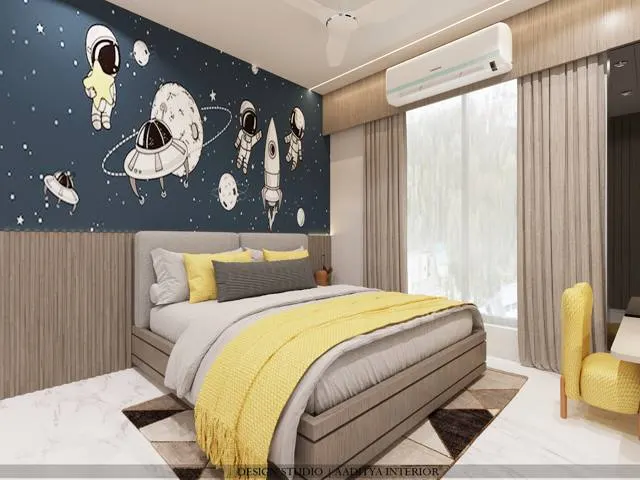
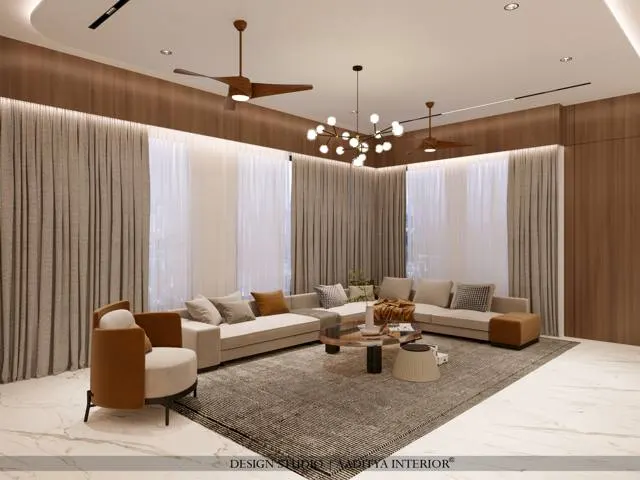
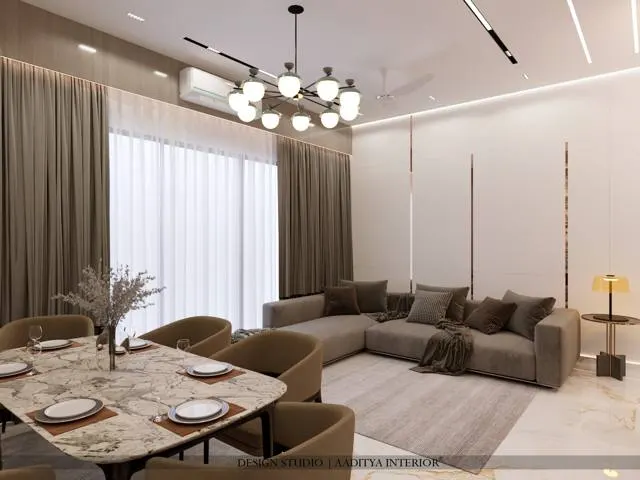
Every year brings a new list of interior trends, and every year many Indian homeowners face the same dilemma. They want a home that looks current when it is finished, but they are spending on joinery, flooring and ceilings that will stay in place for ten or fifteen years. A fashion that looks fresh in a showroom in 2026 can look tired by 2030, and unlike a sofa cover, a fluted wall panel or a glossy kitchen cannot simply be swapped out. The real question is not what is trending, but which trends are worth building into a home and which belong only in cushions and paint.
This article looks at the directions that Indian interior designers, material suppliers and furniture makers are moving towards as 2027 approaches. It is not a forecast based on surveys or market statistics — those numbers are rarely reliable for Indian residential interiors — but a reading of what is changing in client briefs, new product ranges and completed projects, including those Aaditya Interior is designing across Surat, Gujarat and beyond. For each direction, it explains why it is happening, what it looks like in an Indian flat, the dimensions and details that make it work, what it costs, and whether it is likely to last.
A useful rule runs through every section: a trend that solves a real problem — heat, glare, storage, noise, cleaning, flexibility — tends to last; a trend that is only a look tends to fade. The trends that follow are sorted with that test in mind.
How to read a trend: the life cycle
Design trends follow a fairly predictable life cycle. A few designers and early adopters try something new; it appears in magazines and on social media; manufacturers launch affordable versions; it becomes everywhere; and then it begins to look ordinary and slowly fades. The time from emerging to fading varies — for a paint colour it may be a few years, for a material like terrazzo it may be decades with long pauses — but the shape is similar. The most useful thing a homeowner can do is to recognise where a trend sits on that curve before committing permanent money to it.
| Direction for 2027 | What it looks like | Problem it solves | Likely to last? |
|---|---|---|---|
| Warm mineral walls | Limewash, lime plaster and mineral textures in earthy tones | Glare from stark white; walls that look flat and cheap | Yes — earthy neutrals age well; specific colours will change |
| Tunable, layered lighting | Warm-to-cool LED, dimming, concealed profiles | Harsh single-source lighting; poor sleep with cool light at night | Yes — driven by technology and comfort |
| Appliance-garage kitchens | Tall units, countertop appliances hidden behind doors | Cluttered counters from mixers, air fryers, kettles | Yes — a storage solution, not a look |
| Flexible rooms | Study-cum-guest rooms, fold-away beds, sliding partitions | Work from home in compact flats | Yes, while flats stay compact |
| Indian craft, modern forms | Cane, handloom, terrazzo, Athangudi-style tiles, brass | Sameness of catalogue interiors | Yes, if used sparingly |
| Soft curves | Rounded sofas, arched openings, pill mirrors | Hard, boxy rooms | Partly — extreme curves will date |
| Wet–dry bathrooms | Glass shower partition, wall-hung WC, niches | Wet floors, slippery bathrooms, cleaning | Yes — a functional upgrade |
| Healthier materials | Low-VOC paints, ventilation, acoustic panels | Indoor air and noise in sealed flats | Yes |
| Durable and repairable | Solid edges, stone, modular hardware, fewer fads | Interiors that need ripping out every decade | Yes |
1. Warm palettes and mineral walls
The single clearest shift in Indian interiors over the last few years has been from cool greys and bright whites towards warm, earthy neutrals: off-white with a hint of yellow or pink, sand, beige, greige, clay, terracotta, olive and muted sage. Going into 2027, the shift is moving from paint colour to wall texture. Limewash, lime plaster and mineral-based textured finishes give a soft, cloudy depth that flat emulsion cannot match, and they look especially good under warm, low-angle light. They also suit Indian traditions: lime plaster was the standard wall finish of havelis, Chettinad mansions and old bungalows for centuries.
In practice, true lime plaster is a specialist craft and needs a mason who understands it, while limewash and lime-based decorative paints can be applied over well-prepared cement plaster with a suitable primer. The effect is best kept to one or two walls — a living-room feature wall, a bedroom headboard wall, a foyer — rather than the whole flat, both for cost and because a whole home in heavy texture can feel busy. Decorative and texture finishes are priced in the ₹40–150-plus per sq ft range of paintable area (indicative October 2026), against ₹20–30 for premium emulsion, depending on the system and the applicator's skill.
Fluted and ribbed panels, which spread through Indian interiors in the early 2020s, are now at or near their peak. They are not going to disappear — fluting has a long history in architecture, from classical columns to Art Deco joinery — but the fine, all-over fluting seen on every TV wall and bed back will start to look dated. In 2027 the more durable use is restrained: a fluted section on a kitchen island, a fluted glass shutter, a single panel framing a door. Wider flutes are easier to clean and age better than very fine ribs.
2. Layered, tunable and circadian lighting
Lighting is the area where technology is changing interiors fastest. LED fittings that can change colour temperature — from warm white around 2700 K to cool daylight around 5000–6500 K — and dim smoothly are now available across mainstream brands, often controlled from a wall keypad or a phone. Designers describe the idea as circadian or human-centric lighting: brighter, cooler light during the working day, warmer and dimmer light in the evening, closer to how natural daylight changes. For Indian homes with work-from-home desks, children studying in the evening and elderly family members, the practical benefit is simple: the same room can be lit for focus at 11 in the morning and for rest at 10 at night.
Beyond tunable fittings, the larger change is that lighting is being designed into joinery and ceilings from the start rather than added afterwards. Recessed aluminium profiles with diffusers run inside wardrobes, under floating units, along shelves and as thin lines in the ceiling. Wall washers graze textured walls to bring out the mineral finishes described above. Track systems, long used in shops, are appearing in homes because they allow spotlights to be moved when furniture is rearranged. The practical requirement is planning: the electrician needs drawings showing every driver location, and drivers must be placed where they can be reached and replaced, not sealed inside a ceiling or a carcass.
| Room | Ambient layer | Task or accent layer | Colour temperature | Indicative cost |
|---|---|---|---|---|
| Living room | Cove or profile light, dimmable | Wall washer on feature wall, floor or table lamp | 2700–3000 K; tunable if used for work | Cove ₹150–300 per running ft; panels ₹400–1,200 each |
| Study / home office | Panel or downlights | Desk lamp or under-shelf strip | 4000 K for work, warm option for evenings | Panels ₹400–1,200 each |
| Kitchen | Downlights or panels | Under-cabinet strip over the counter | 3000–4000 K | Strips ₹150–300 per running ft |
| Bedroom | Cove, dimmable | Bedside lamps or wall lights | 2700 K; avoid cool light at night | Cove ₹150–300 per running ft |
| Wardrobe | — | Profile light with door sensor | 3000–4000 K for true colours | Priced with joinery; driver must stay accessible |
| Foyer / passage | Downlights or cove | Mirror light, niche light | 2700–3000 K | Panels ₹400–1,200 each; pendants ₹2,000–15,000 |
3. Kitchens with appliance garages and tall units
The Indian kitchen counter has filled up. A typical urban kitchen now holds a mixer grinder, a toaster or sandwich maker, an electric kettle, an air fryer, a microwave or oven, a water purifier and sometimes a coffee machine — all competing with chopping and cooking space. The design answer gaining ground is the appliance garage: a cabinet that sits on the counter or is built into a tall unit, with lift-up, pocket or roller shutters, where appliances stay plugged in and ready but out of sight. Alongside it, tall units that stack an oven, a microwave and pull-out larders are replacing rows of overhead cabinets. Handle-less shutters with gola (recessed) profiles, induction hobs, and better-planned chimney ducting complete the picture.
The dimensions in Figure 4 follow standard Indian kitchen practice: counter height 850–900 millimetres, base units 560–600 millimetres deep, overhead units 300–350 millimetres deep with 600–750 millimetres between counter and overhead, and tall units 600 millimetres deep running to 2100–2400 millimetres. An appliance garage 600–900 millimetres wide and about 450–600 millimetres high, recessed into the counter corner or the tall-unit block, takes four or five appliances. The cost follows the cabinetry rule used across this blog: BWR plywood or HDHMR carcasses with laminate finish are about ₹1,340–1,800 per sq ft of cabinetry (indicative October 2026), with lift-up or pocket-door hardware priced on top as a separate line.
4. Flexible rooms for working, studying and guests
The work-from-home years changed how Indian families use the third bedroom, or the second bedroom in a 2BHK. Rather than a guest room used a few weeks a year, it is increasingly planned as a study or office that converts for guests. The tools are fold-away (wall) beds, sofa-cum-beds, desks that fold or slide away, sliding or pocket partitions that let a study open to the living room by day and close at night, and acoustic treatment so that video calls do not echo. This direction will last as long as Indian flats stay compact, which, given land prices in large cities, is likely to be a long time.
5. Indian craft in modern forms
After a decade in which many Indian flats looked like international catalogue pages, there is a clear swing towards Indian materials and crafts used in simple, contemporary forms. Cane and rattan appear on wardrobe shutters, chair backs and headboards; handloom cottons, khadi and block prints on upholstery and curtains; terrazzo and hand-made cement tiles in the Athangudi tradition on foyer and balcony floors; brass and bell-metal in lamps and handles; jaali patterns in partitions and pooja-unit doors. What distinguishes the 2027 version from the heritage costume of the past is restraint: one craft per room, used in a clean frame, against calm walls.
The craft direction has practical value as well as cultural meaning. Cane breathes, which suits wardrobe shutters in humid cities like Surat and Mumbai. Terrazzo and cement tiles are durable and repairable. Natural fabrics are cooler to sit on in summer than synthetics. And buying from Indian craft clusters keeps traditional skills alive. The cautions are equally practical: cane needs a frame and protection from direct sun and water; hand-made tiles vary in size and colour and need an experienced layer; and authentic craft costs more than printed imitations.
6. Better bathrooms, healthier air and durable homes
Wet–dry bathrooms and wall-hung fittings
Indian bathrooms are steadily moving from the single wet floor to a clearly zoned plan: a dry zone with the basin and WC, and a wet zone for the shower behind a fixed toughened-glass partition, usually 8–10 millimetres thick. Wall-hung WCs with concealed cisterns make floors easier to clean; recessed niches in the shower wall replace corner racks; anti-skid matte tiles and linear drains improve safety. The minimum practical shower zone is about 900 × 900 millimetres, with 1000 × 1200 millimetres more comfortable. These are functional upgrades rather than fashions, and they are worth building in during any bathroom renovation, which typically involves waterproofing and retiling anyway.
Healthier, quieter and more durable homes
Three quieter directions are likely to matter more than any look. The first is indoor air: low-VOC and zero-VOC paints, better kitchen exhaust, trickle ventilation and air purifiers in sealed, air-conditioned flats. The second is acoustics: as more people work and attend classes from home, fabric panels, rugs, heavier curtains and solid-core doors are being specified to reduce echo and noise. The third is durability and repair: solid timber or thick edge-bands on high-wear edges, stone and quartz counters, branded hinges and channels that can be replaced individually, and a willingness to refinish rather than rip out. These directions connect with green-building frameworks such as IGBC and GRIHA ratings and BEE's residential energy code, Eco-Niwas Samhita, which are pushing Indian housing towards better envelopes, ventilation and efficient appliances.
Smart-home technology belongs in this group too, but in a modest form. Fully automated homes remain expensive and can be fragile when brands or apps change. The more lasting trend is selective intelligence: smart locks at the main door, motion sensors in passages and wardrobes, scene control for lighting, and app-controlled air-conditioning. The Matter standard, backed by major technology companies, aims to make devices from different brands work together, which reduces the risk of being locked into one ecosystem. The most important decision, however, is made before any device is bought: run neutral wires, deep switch boxes, data cabling and spare conduits during the electrical work, so that smart devices can be added later without breaking walls.
What is fading going into 2027
Some looks that dominated Indian interiors in the 2010s and early 2020s are clearly on their way out. Nothing here is wrong — a well-made glossy kitchen still works — but these are the elements most likely to date a home completed in 2027.
| Fading | Why it is fading | What is replacing it |
|---|---|---|
| High-gloss grey-and-white kitchens | Shows fingerprints and scratches; feels cold | Matte laminate, matte PU or veneer in warm tones |
| Heavy multi-level POP ceilings everywhere | Lowers rooms, collects dust, looks busy | Single-level gypsum with a slim cove or profile line |
| Busy feature walls in every room | Visual noise; expensive to change | One textured or panelled wall per space |
| Mirror and glass mosaic décor | Dated glitter; hard to clean | Mineral textures, stone, fluted glass |
| Cool-white lighting throughout | Harsh at night, flattens colours | Warm white with tunable or task zones |
| Matching furniture sets | Showroom look, little personality | Collected pieces sharing one material or colour |
| Large wall-mounted showcases | Dust and clutter; heavy joinery | Shallow niches, open shelving, closed storage |
What adopting each trend costs
The table below gives indicative October 2026 costs for the trend elements most often requested, using the same price bands as the rest of this blog. They are ranges for typical mid-range execution in Indian cities; complex designs, imported products and small quantities push prices up.
| Trend element | Unit | Indicative cost (October 2026) | Where to use it | Easy to change later? |
|---|---|---|---|---|
| Limewash or mineral texture | per sq ft of paintable area | ₹40–150+ | One feature wall per room | Yes — repaint |
| Fluted panel (MDF/HDHMR, PU painted) | per sq ft of panel | ≈ ₹1,000–1,800 (PU finish band) | Island, door surround, single panel | No — joinery |
| Cove or profile LED | per running ft installed | ₹150–300 | Ceilings, under units, niches | Partly — fittings replaceable |
| Panel or downlights | per piece | ₹400–1,200 | Ambient lighting | Yes |
| Appliance garage / tall unit | per sq ft of cabinetry | ₹1,340–1,800 + hardware | Kitchen corner or tall bank | No — joinery |
| Matte laminate shutters | per sq ft of shutter | ₹350–650 | Kitchens, wardrobes | Re-laminating possible |
| Matte PU shutters | per sq ft of shutter | ₹1,000–1,800 | Feature joinery | Refinishing possible |
| Gypsum ceiling, single level | per sq ft | ₹60–80 | Living and bedrooms | No — civil-type work |
| Premium low-VOC emulsion | per sq ft of paintable area | ₹20–30 | All walls | Yes |
Eight rules for following 2027 trends wisely
- Adopt a trend permanently only if it solves a real problem — storage, glare, heat, noise, cleaning or flexibility.
- Keep joinery, flooring and ceilings calm; let colour, texture and décor carry the fashion.
- Use mineral or textured finishes on one wall per space, over sound, dry plaster.
- Plan lighting with the joinery drawings: profiles, drivers and switching decided before carpentry starts.
- Use 2700–3000 K in living rooms and bedrooms at night; keep cool 4000–5000 K light for work zones only.
- Give the kitchen an appliance garage with its own sockets if the counter holds more than three appliances.
- Wire for smart devices now — neutral wires, deep boxes, data and spare conduit — even if devices come later.
- Use one Indian craft per room, in a clean frame, rather than many imitation heritage pieces.
Frequently asked questions
What colours will be popular in interiors in 2027?
Warm, earthy neutrals are expected to stay dominant — off-white with warm undertones, sand, beige, greige, clay and terracotta — with muted greens, olive and deep blue as accents. Paint companies announce their own colours of the year, but the broad direction across brands is warm and natural rather than cool grey.
Are fluted panels going out of style?
They are at or near their peak rather than disappearing. Fine, all-over fluting on every wall is likely to date; restrained use — one panel, a kitchen island, fluted glass — will last longer. Wider flutes are also easier to clean.
Is limewash suitable for Indian homes?
Yes, on dry, sound walls. It gives a soft, natural texture and suits warm light. It should not be applied to walls with seepage, and it is best used on feature walls rather than high-wear areas unless a washable mineral system is chosen.
What is circadian lighting and is it worth it?
Circadian or tunable lighting changes its colour temperature during the day — cooler for daytime work, warmer and dimmer at night. It is worth it in studies, home offices and multi-use living rooms; in bedrooms, a simple warm-white (2700 K) dimmable scheme achieves most of the benefit at lower cost.
Which 2027 trends add value to a home when selling?
Functional upgrades usually matter more to buyers than looks: a well-planned kitchen with good storage, wet–dry bathrooms, good lighting, neutral finishes and sound wiring. Highly personal trend finishes can actually narrow the appeal of a home.
Sources & standards
- Bureau of Indian Standards — IS 3646-1 (code of practice for interior illumination); National Building Code of India 2016, Part 8 (building services: lighting and ventilation)
- Bureau of Energy Efficiency — Eco-Niwas Samhita (Energy Conservation Building Code for Residential Buildings)
- Indian Green Building Council (IGBC) Green Homes rating system; GRIHA rating framework
- Bureau of Indian Standards — IS 2553 (safety glass), IS 303 (plywood for general purposes)
- Neufert, Architects' Data — kitchen, bedroom and circulation dimensions
- Connectivity Standards Alliance — the Matter smart-home standard (public overview)
- Price ranges: indicative October 2026 estimates — confirm locally before budgeting