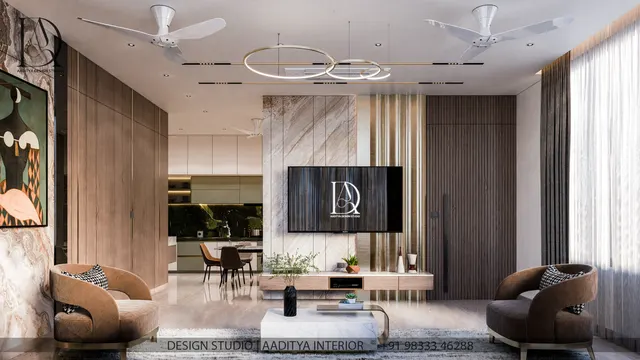
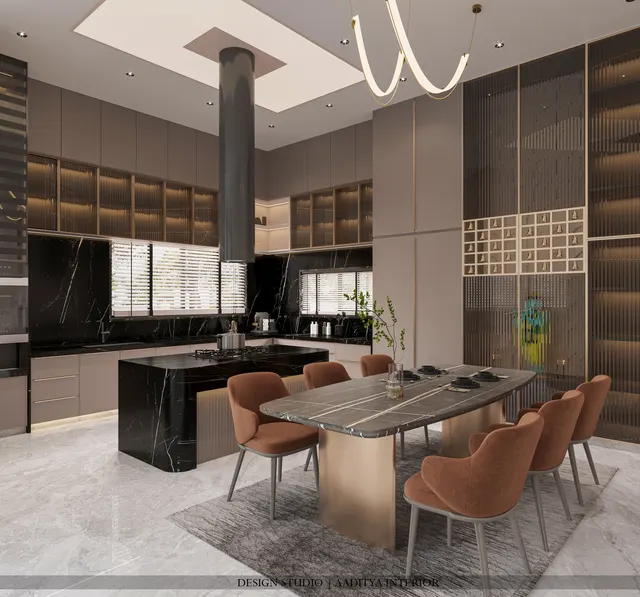
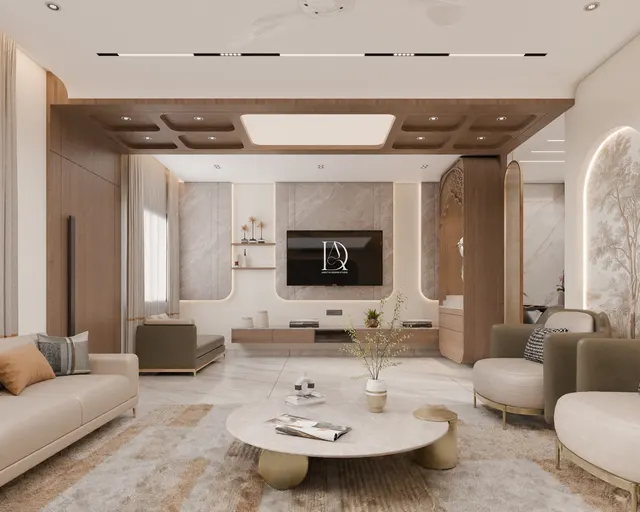
Every Indian home renovated in a hurry carries a date stamp. Walk into a flat finished in the late 2000s and the layered POP ceiling with a coloured LED strip tells you the year before anyone speaks. A home done a decade later announces itself with high-gloss acrylic, a grey feature wall and a wallpaper with metallic leaves. None of these choices was wrong at the time — they were simply chosen because everyone else was choosing them, and that is exactly why they aged together.
The problem is money. In India most families do a full interior once, perhaps twice, in the life of a home, and the expensive parts — false ceiling, flooring, kitchen carcass, wardrobes, wall panelling — are meant to last fifteen to twenty years. When a fashion is built into those permanent parts, the home starts to look dated long before anything has worn out, and changing it means breaking, not redecorating. A trend in a cushion costs a few hundred rupees to undo; a trend in a ceiling costs a full room to undo.
This article does not predict fashion for its own sake. It sets out a practical test for spotting a short-lived trend, names the looks that are most likely to feel tired by 2028 in Indian homes and why, and shows — with dimensions, sections and indicative costs — what to build instead so that the shell of the home stays calm while the styling can change every few years. These are design judgements drawn from practice, not survey statistics; the reasons behind each one are explained so readers can apply the same test to whatever comes next.
How trends move through Indian homes
Interior trends in India usually follow a recognisable path. A look appears first in hotels, restaurants, international design media and high-end show flats. Designers and early adopters pick it up. Then manufacturers make it cheap — a laminate, a PVC sheet, a ready panel — and within a year or two it is in every catalogue, every carpenter's sample book and every builder's sample flat. That saturation point is the moment a look stops signalling taste and starts signalling a date. The decline is not caused by the look becoming ugly; it is caused by it becoming everywhere.
What separates a lasting change from a fad is whether the idea solved a real problem. Modular kitchens arrived as a trend in Indian cities and stayed, because they solved storage, hygiene and maintenance. LED lighting stayed because it cut electricity bills. Vitrified tiles replaced mosaic in most new flats because they were faster to lay and easier to clean. In each case the look changed over the years — but the underlying idea did not fade, because it worked. By contrast, the coloured cove light, the mirror-finish wallpaper and the zig-zag POP ceiling solved nothing; they only looked new.
| Period (approximate) | Signature look in Indian homes | What faded | What stayed |
|---|---|---|---|
| 1990s | Wall-to-wall wooden panelling, laminated wall units, mosaic and marble floors | Dark panelled walls, heavy wall units | Built-in storage as an idea |
| 2000s | Layered POP ceilings, coloured cove LEDs, glass-and-steel showcases | Coloured lights, zig-zag ceilings, etched-glass everything | Gypsum ceilings with concealed services |
| Early 2010s | High-gloss lacquer and acrylic, metallic wallpaper, glossy tiles | Mirror-gloss on every surface, metallic prints | Modular kitchens, vitrified tiles |
| Late 2010s | Grey and white schemes, wooden-look tiles, chevron patterns | Grey-on-grey, chevron feature walls | Neutral bases with warm accents |
| Early 2020s | Fluted panels, arches, boucle, cane, black-and-gold trims, profile lights | Still in progress — the subject of this article | Likely: cane and natural textures used sparingly, warm lighting |
The five-question fad test
Before any finish goes into a permanent part of the home, it is worth asking five questions. They do not need a designer to answer them, and they work for trends that have not been invented yet. A look that fails three or more of them is a fad for the purposes of a fifteen-year interior — enjoy it, but keep it in the layer that is cheap to change.
| Question | Lasting change answers | Fad answers | Example |
|---|---|---|---|
| Does it solve a problem in an Indian home? | Yes — storage, cleaning, heat, light, cost | No — it only looks new | Soft-close hinges (problem solved) vs coloured cove LED (none) |
| Does it survive dust, humidity and daily cleaning? | Easy to wipe, hides marks | Grooves trap dust; gloss shows every fingerprint | Matte laminate vs high-gloss acrylic |
| Does it only work in a photograph? | Looks right from every angle, day and night | Needs one camera angle and staged light | A balanced lighting plan vs a single neon sign |
| What does it cost to undo? | Repaint, re-cover or swap | Break, re-plaster, re-lay | Cushions vs a POP ceiling |
| Is it suddenly everywhere at every budget? | Spread slowly over a decade | Appeared in every catalogue within a year or two | Fluted PVC sheets in every hardware shop |
The fourth question matters most in practice. A trend in a removable layer — a rug, a lamp, a fabric, a paint colour — costs little to follow and little to leave. The same trend built into a ceiling, a floor, a kitchen carcass or a full wall of panelling locks the home into that year. Aaditya Interior's working approach is simple: the shell of the home should be chosen for twenty years, and trends belong in the layer that can be changed in a weekend.
Eleven looks most likely to fade by 2028
The list below is a judgement, not a forecast based on sales data. Each look earns its place because it fails several of the five questions — usually because it has saturated, because it is hard to maintain in Indian dust and humidity, or because it is built into permanent parts of the home.
1. Fluted panels on every surface
Fluted MDF, WPC and PVC panels — narrow vertical grooves repeated across a surface — became the defining texture of the early 2020s. Used once, on a TV wall or a bed back, flutes add rhythm and catch light beautifully. The problem is repetition: fluted TV wall, fluted wardrobe, fluted kitchen island, fluted bar counter and fluted ceiling in the same flat. The grooves also collect dust, which in Indian cities means weekly brushing. The look will not vanish, but full-room fluting will read as early-2020s in the same way that full-room wooden panelling reads as 1990s.
2. Layered POP ceilings with linear profile lights everywhere
The multi-step POP ceiling, with two or three drops, cut-outs, and now grids of slim aluminium profile lights running in every direction, is the most expensive trend to undo. Each layer lowers the room: on a 2750 mm slab — the minimum habitable height under NBC 2016 Part 3 — a 500 mm deep layered border leaves just 2250 mm at the room edge, which makes a modest flat feel cramped. Grid patterns of profile lights also fix the furniture layout forever: once the light lines are cut into the ceiling, the sofa and bed cannot move. The lasting alternative is a single shallow perimeter cove for services and indirect light, a flat centre, and lighting that follows the furniture rather than a pattern.
3. High-gloss acrylic on every shutter
High-gloss acrylic shutters looked dramatic in showrooms and still do in a photograph. In a working Indian kitchen they show every fingerprint, every splash of oil and every fine scratch from a ring or a cleaning sponge, and the gloss draws attention to any slight waviness in a large panel. The market has already been moving towards matte, super-matte and soft-touch finishes, and anti-fingerprint matte laminates are now widely available. Gloss will remain useful as an accent — a single tall unit or an overhead row — but a full high-gloss kitchen and wardrobe set is likely to read as a 2010s choice.
4. Grey-on-grey and cold greige schemes
Grey floors, grey walls, grey sofa, grey curtains — the cool neutral scheme of the late 2010s is already giving way to warmer whites, beige, terracotta, olive and wood tones. Grey has a particular weakness in Indian homes: under the warm 2700–3000 K light most families prefer at night, cool greys turn muddy, and in strong daylight they can look flat. A neutral base is still the right idea; it is the cold, single-colour version that is fading.
5. Black-and-gold trims on everything
Thin black or gold metal profiles — on wardrobe shutters, around mirrors, inlaid in wall panels, as handles, as edges on marble tops — are attractive in moderation. When every surface carries a profile, the room looks busy and the trims become the most visible thing in it. Gold PVD finishes also show wear on high-touch surfaces over time. Expect the next phase to use one metal per room and far fewer lines.
6. Arches on every opening
The arch is one of the oldest forms in Indian architecture and will never go out of style as architecture. What will fade is the decorative arch applied to everything: arched mirrors, arched niches, arched wardrobe shutters, arched door frames cut into a rectangular RCC flat. Where an arch has a reason — a structural opening, a pooja niche, a heritage-style home — it lasts. Where it is a shape pasted onto a rectangle, it dates.
7. Open shelving in Indian kitchens
Open shelves replacing overhead cabinets looked light and airy in imported images. In an Indian kitchen, where tadka, deep frying and long cooking put oil and moisture into the air, open shelves collect a sticky film within weeks — even with a good chimney. Most families who try them either add shutters later or stop using them. Closed overhead cabinets with a lift-up or matte shutter are the practical answer; one short open shelf for daily-use jars, away from the hob, is the compromise.
8. Boucle and curves on every piece
Curved sofas, rounded armchairs and boucle upholstery softened rooms after years of hard-edged furniture, and some of that softness will stay. Boucle itself is a weak fabric for most Indian homes: its looped texture holds dust, snags on jewellery and pet claws, and is hard to clean in a humid, dusty climate. One curved piece in a room reads as considered; a fully rounded room in boucle reads as a moment in time.
9. Charcoal louvres, PVC fluted sheets and 3D wall panels
Ready-made PVC and WPC louvre sheets, often in charcoal or dark wood print, made a panelled look affordable and quick to install. That is precisely why they saturated: they are now used in budget shops, salons, offices and homes alike. Many of these sheets are glued directly to the wall, so removal can damage the plaster underneath. Where a panelled look is genuinely wanted, a real veneer or painted MDF detail on a single wall ages far better.
10. Glossy marble-print tiles everywhere
Large-format glazed vitrified tiles printed to look like Statuario or Calacatta marble, laid in high gloss through the whole flat — living, bedrooms and even balconies — are already common enough to signal the period. The print repeats are easy to spot across a large floor, and high gloss shows dust and footprints. The tile itself is a sound, durable product; the dated part is the loud print and the mirror finish. Matte or satin finishes and quieter, low-contrast patterns are the safer long-term choice.
11. The single Instagram corner
Neon signs, preserved-moss walls, swing chairs, statement wallpaper behind one sofa — elements chosen because they photograph well rather than because they serve daily life. They are not expensive mistakes on their own, but they date quickly and rarely suit the way a family actually uses a room. They belong in cafés and event spaces, or in the easily changed layer of a home.
| Look | Why it peaked | Why it is likely to fade | What to do instead |
|---|---|---|---|
| Fluted panels everywhere | Cheap ready panels, strong photographs | Saturation; dust in grooves | One fluted band per room; plain matte elsewhere |
| Layered POP + profile-light grids | Show-flat drama | Lowers rooms; locks the layout; costly to undo | Single 200–300 mm perimeter cove, flat centre |
| High-gloss acrylic everywhere | Showroom shine | Fingerprints, scratches, visible waviness | Matte or anti-fingerprint laminate; gloss as one accent |
| Grey-on-grey | Cool modern palette | Turns muddy under warm light | Warm white, beige, wood, one deep accent |
| Black/gold trims on every surface | Hotel-lobby look | Visual clutter; plating wear | One metal per room, few lines |
| Decorative arches | Soft, heritage feel | Pasted onto rectangular flats | Arches only where they have a reason |
| Open kitchen shelving | Imported images | Oil film in Indian cooking | Closed overheads; one short open shelf |
| Boucle and all-round curves | Soft-furniture moment | Holds dust, snags | One curved piece; tight-weave fabrics |
| PVC/WPC louvre and 3D sheets | Fast, cheap panelling | Everywhere at every budget; glued to walls | Real veneer or painted MDF on one wall |
| Glossy marble-print tiles | Luxury look at tile prices | Repeating prints, shows dust | Matte or satin, quiet patterns |
What a trend costs to put in — and to take out
The real cost of a trend is not its installed price but the price of removing it later. The table below uses indicative October 2026 rates already used across this blog for ceilings, finishes and wall treatments; removal costs are described qualitatively because they depend so heavily on site conditions. The pattern is clear: the cheapest trends to follow are those in paint, fabric and loose furniture, and the most expensive are those built into ceilings, floors and carcasses.
| Item | Indicative installed cost (Oct 2026) | What undoing it involves | Regret risk |
|---|---|---|---|
| Designer layered gypsum/POP ceiling | ₹80–180 per sq ft | Break down, re-do services, new ceiling, repaint the room | High |
| Plain gypsum ceiling with cove | ₹60–80 per sq ft | Usually nothing — repaint only | Low |
| Acrylic shutters | ₹900–1,500 per sq ft of shutter | Replace shutters; carcass can stay | Medium |
| PU paint shutters | ₹1,000–1,800 per sq ft of shutter | Re-paint possible in a new colour | Medium |
| Laminate shutters | ₹350–650 per sq ft of shutter | Re-laminate or replace shutters | Low–medium |
| Texture paint or wallpaper wall | ₹40–150+ per sq ft | Strip and repaint one wall | Low |
| PVC panel ceiling or wall | ₹50–90 per sq ft | Remove; wall plaster may need repair if glued | Medium |
| Cushions, throws, rugs, lamps | Small, per piece | Swap in an afternoon | Very low |
| Element | Typical service life (indicative) | Belongs in | Trend-safe? |
|---|---|---|---|
| Wiring, plumbing, waterproofing | 25 years and more | Shell | Never follow trends |
| Flooring (vitrified, stone, wood) | 20–25 years | Shell | Choose quiet and durable |
| Kitchen and wardrobe carcasses | 15–20 years | Shell | Choose by board grade, not looks |
| False ceiling | 15–20 years | Shell | Keep simple |
| Shutter finishes | 8–15 years | Between shell and layer | Moderate — can be replaced |
| Wall paint | 5–7 years between repaints | Layer | Yes — colour can follow fashion |
| Upholstery, curtains, rugs | 3–7 years | Layer | Yes |
| Décor, cushions, accessories | 1–5 years | Layer | Yes — this is where trends belong |
What is likely to last into the 2030s
The ideas most likely to last are those that answer real pressures on Indian homes: heat, smaller flat sizes, rising electricity costs, ageing parents living at home, and work done from home. They are not looks so much as principles, and each can be expressed in many styles.
- Warm, layered lighting — ambient, task and accent — on separate circuits, typically at 2700–3000 K in living areas and bedrooms, chosen for how a room is used rather than to draw patterns on the ceiling.
- Matte, low-maintenance surfaces that hide fingerprints and dust: matte laminates, honed or satin stone, matte tiles, washable paints.
- Natural and local materials used honestly: wood veneer, cane, terracotta, lime plaster, kota and other regional stones, handloom fabric — in measured amounts.
- Closed, well-planned storage sized to Indian life: deep utility storage, shoe storage at the entrance, pooja space, and lofts that can actually be reached.
- Climate-aware design: cross-ventilation, shading of west-facing glass, ceiling fans planned with lighting, and appliances chosen by BEE star rating.
- Flexible rooms: a study that becomes a guest room, a dining table that serves as a work desk, furniture that can move.
- Ageing-in-place details: grab-bar-ready bathroom walls, level thresholds, good night lighting along the path to the toilet.
- Lower-emission finishes: low-VOC paints and E1-class or better boards, which green-building rating systems such as IGBC and GRIHA already reward.
None of these will make a home look fashionable in a photograph. All of them will make it feel right in ten years. A useful way to think about the future is that trends will keep changing in the layer — colours, fabrics, shapes of lamps — while the shell moves slowly towards calmer, warmer, more practical and more climate-aware homes.
How to use a trend without regretting it
Trends are not the enemy. They keep design alive, and a home with nothing current in it can feel lifeless. The skill is in placing them. The rules below are those designers use to let a client enjoy what is current without paying for it twice.
- Put trends in the layer, not the shell: paint, fabric, loose furniture, lighting fixtures and accessories.
- Limit any strong trend to one surface per room — one fluted band, one arched mirror, one statement wallpaper.
- Keep the ceiling simple: a single perimeter cove and a flat centre at full slab height wherever possible.
- Choose finishes for maintenance first: in Indian dust and humidity, matte and wipeable beats glossy and grooved.
- Before approving a finish, ask what it would cost to remove — if the answer involves breaking, think twice.
- Avoid anything you see in every budget catalogue and every builder's sample flat at the same time.
- Spend permanent money on what you touch daily: hinges, channels, taps, switches, mattresses and chairs.
- Let one piece be personal rather than fashionable — a family heirloom, a local craft object or a piece of art.
Frequently asked questions
Is fluted panelling going out of style?
Fluting as a texture is likely to remain in use, but full rooms of fluted walls, shutters and counters are already saturated and are likely to feel dated by around 2028. One fluted band per room — behind a TV, a bed or a bar — with plain surfaces around it will age far better.
Is grey still in style for interiors?
Cool grey-on-grey schemes are fading in favour of warmer neutrals such as warm white, beige, wood tones, olive and terracotta. Grey still works as one element — a sofa fabric or a stone — within a warmer palette, especially in rooms lit at 2700–3000 K.
Which interior design style is timeless?
No style is completely timeless, but homes age well when they use simple ceilings, durable matte surfaces, natural materials in measured amounts, good storage and well-planned lighting. The calmer the permanent shell, the longer the home looks current.
Are open kitchen shelves practical in Indian homes?
Rarely as full replacements for overhead cabinets. Indian cooking puts oil and moisture into the air, so open shelves near the hob gather a sticky film quickly. A short open shelf placed away from the hob for daily jars works; the rest of the wall is better as closed overhead cabinets 300–350 mm deep.
How often should home interiors be updated?
As a broad guide, paint every five to seven years, soft furnishings every three to seven, and the permanent shell — kitchen, wardrobes, flooring, ceilings — every fifteen to twenty years or when it fails. Planning the home in a shell and a layer lets the look be refreshed without breaking anything.
Sources & standards
- Bureau of Indian Standards — National Building Code of India 2016, Part 3 (Development Control Rules and General Building Requirements: habitable room heights) and Part 8 (Building Services: lighting and ventilation)
- Bureau of Energy Efficiency (BEE) — Star labelling programme for appliances and Eco-Niwas Samhita (Energy Conservation Building Code for residential buildings)
- Indian Green Building Council (IGBC) and GRIHA — green rating systems that address low-VOC materials and indoor environmental quality
- Neufert, Architects' Data — kitchen and room planning dimensions
- Time-Saver Standards for Interior Design and Space Planning — kitchen and storage dimensions
- Price ranges: indicative October 2026 estimates — confirm locally before budgeting
- Trend assessments are the design judgement of the Aaditya Interior team based on practice, not survey or sales statistics