Ask for quotations for the same wardrobe from three firms and the finish line will probably differ in every one: a matte laminate in the first, a teak veneer with PU polish in the second, a high-gloss acrylic in the third, with a price gap of two or three times between them. The carcass, hardware and size may be identical; the finish alone changes the look, the cost, the cleaning routine and how the piece will age. Yet the decision is usually made in a few minutes in a showroom, by looking at a small sample under bright lights.
This blog already compares shutter finishes for kitchens and wardrobes — laminate, acrylic, PU paint and membrane — and has separate guides to natural and recon veneer, laminate types and laminate thickness. This article brings the three most common furniture finishes into one decision and goes deeper on what lies beneath the surface: how each finish is built up in layers, which board it needs, how its edges are treated, how it behaves in a humid Indian city, how it is repaired, and where each one belongs across a whole home — wardrobes, beds, TV units, dining tables, study desks and kitchens.
The short version is that none of the three is "best". Laminate is a hard, factory-finished plastic surface; veneer is a thin slice of real wood that takes its protection from the polish applied over it; acrylic is a glossy polymer face that gives depth and colour but is softer than laminate. Each is right somewhere, and a well-designed home often uses all three.
Three finishes, three very different materials
Decorative laminate — high-pressure laminate or HPL — is made by stacking layers of kraft paper soaked in phenolic resin under a printed decorative paper and a clear overlay soaked in melamine resin, then pressing the stack under heat and high pressure until it becomes a single hard sheet. In India the standard decorative face is about 1.0 mm thick, with 0.8 mm used on budget faces and inner liners and 1.25–1.5 mm on heavy-use tops; the performance tests for decorative laminates are set out in IS 2046. The surface is factory-finished and needs no polish. Its colour or wood grain is printed, which gives perfect consistency from shutter to shutter.
Veneer is a thin slice of real timber, commonly about 0.5–0.6 mm thick in the Indian market, peeled or sliced from a log and pressed onto a plywood or MDF core. Natural veneer keeps the grain, colour variation and figure of the species — teak, walnut, oak, ash and many others — while recon or reconstituted veneer is made from fast-growing timber that is dyed, glued into blocks and re-sliced to produce a regular, repeatable grain. Unlike laminate, veneer is not finished when it arrives: it must be sanded and polished on site or in a factory, usually with melamine or PU lacquer, and that polish is what protects the wood.
Acrylic in furniture usually means a thin acrylic (PMMA) facing, typically about 1–1.5 mm thick, often co-extruded with a coloured backing layer and bonded to MDF or HDHMR. Its clear top layer gives the depth of reflection that makes acrylic shutters look like glass. Acrylic is available in high gloss and, increasingly, in matte; gloss acrylic shows fine scratches and fingerprints more than laminate does, but light surface marks can often be polished out, which laminate cannot do. Because it is a different material from the board below, acrylic panels are always finished with a matching edge band and balanced on the back face.
Layer by layer: what sits under the surface
Every finished furniture panel is a sandwich. The face finish, the core board, the back face and the edge treatment must work together. A panel that has a hard finish on one side and nothing on the other absorbs and releases moisture unevenly and bows, especially on tall shutters in a humid city. That is why good factories apply a balancing layer — a liner laminate, a backer veneer, or a balancing laminate behind acrylic — to every panel, and edge-band every exposed edge. Fig. 1 shows typical build-ups for an 18 mm panel.
| Layer | Laminate panel | Veneer panel | Acrylic panel |
|---|---|---|---|
| Face thickness | 1.0 mm standard; 0.8 budget; 1.25–1.5 heavy-use tops | ≈ 0.5–0.6 mm leaf plus polish | ≈ 1–1.5 mm acrylic facing |
| Preferred core | BWR ply or HDHMR; BWP at sinks | BWR ply or MDF (smooth, stable) | HDHMR or MDF (flat, smooth) |
| Back face | 0.6–0.8 mm liner; same thickness as face on tall or gloss shutters | Backer veneer or laminate | Balancing laminate, often 0.8 mm |
| Edge | 0.8–2 mm PVC or ABS band, 2 mm on exposed edges | Matching veneer tape or 5–10 mm timber lipping, polished | Matching acrylic or ABS band, often with a gloss face |
| Finished on | Factory — ready to use | Polish after pressing, in factory or on site | Factory — protective film peeled after installation |
| Typical finished shutter thickness | ≈ 20 mm (18 + faces) | ≈ 19–20 mm | ≈ 20 mm |
| Pressing method | Cold or hot press with adhesive | Hot press; veneer glued and pressed | Factory press or pre-laminated board |
Edges: where finishes succeed or fail
In Indian homes the edge is usually the first part of a panel to fail. A raw or poorly sealed edge lets humid air and spilled water into the core; plywood edges swell slightly and lift the laminate, MDF edges swell more, and the finish starts to peel from the corner. The three finishes are edged differently. Laminate panels are edge-banded with PVC or ABS strips, ideally 2 mm thick on every visible edge and applied by an edge-banding machine with hot-melt glue; hand-glued thin strips are the cheapest and the first to peel. Veneer panels are edged with matching veneer tape on lighter pieces or with a solid timber lipping on table tops and shelves, which is then shaped and polished with the face; lipping is more durable and allows a softly rounded edge.
Acrylic panels need an edge band that matches both colour and gloss, which is why they are usually bought as complete systems from a single supplier. Machine-applied bands with a thin glue line are standard; newer zero-joint edges — fused by laser or hot air instead of a visible glue line — are increasingly offered by large factories and make the edge almost invisible. Fig. 2 compares the edge details.
How they perform in daily life
Performance differences show up in five places: scratches, heat, water, sunlight and fingerprints. Laminate is the toughest of the three on almost all of them. Its melamine overlay resists scratches and stains well, survives a warm plate, and does not fade in sun when it is a good branded product. Its weaknesses are that it cannot be repaired locally — a deep chip or a burn means relaminating the panel — and that cheap laminates or poor edges can delaminate in damp corners.
Veneer performs only as well as its polish. A good PU polish gives reasonable scratch and stain resistance, but it is still a coating a fraction of a millimetre thick over soft wood; hot vessels, water rings and sharp objects mark it more easily than laminate. Natural veneer also changes colour with light: many species darken or lighten over months and years, and a panel moved after a few years may show a paler shadow where something stood. In exchange, veneer can be sanded lightly and re-polished, so a well-made veneer piece can be renewed rather than replaced.
Acrylic sits in between. Its high-gloss face shows fine scratches and every fingerprint, which is why it is best on surfaces that are seen more than touched. It tolerates normal room heat well but should not sit next to a hob, a toaster or a lamp that heats it directly. Light scratches can often be reduced with a suitable plastic polish, following the maker's guidance. Matte acrylic is less reflective and shows fewer marks, but it has less of the depth that makes people choose acrylic in the first place.
| Property | Laminate (HPL) | Veneer (with PU polish) | Acrylic (gloss) |
|---|---|---|---|
| Look | Printed; huge colour and texture range; uniform | Real wood grain; each leaf different | Deep mirror gloss or soft matte; solid colours |
| Scratch resistance | Best of the three | Fair — depends on polish | Fair — fine scratches visible on gloss |
| Heat (warm plates, mugs) | Good | Fair — use coasters and mats | Good in normal use; keep away from direct heat sources |
| Water and steam | Good if edges are sealed | Fair — polish protects; edges and joints are weak points | Good on the face; edges must be sealed |
| Sunlight | Colourfast in good grades | Changes colour with time; can be uneven | Generally stable; check the maker's UV guidance |
| Fingerprints | Low on matte and textured; high on gloss | Low on matte polish | High on gloss; low on matte |
| Repair | Re-laminate the panel; chips can be filled | Sand and re-polish; damaged leaf is hard to patch | Light scratches can be polished; deep damage needs a new panel |
| Consistency between panels | Perfect | Natural variation; needs careful matching | Very consistent within one batch |
| Feel | Hard and slightly cool | Warm, natural, tactile | Smooth, glassy |
| Best reason to choose it | Durability and value | Warmth and authenticity | Gloss and colour depth |
Where each finish belongs in the home
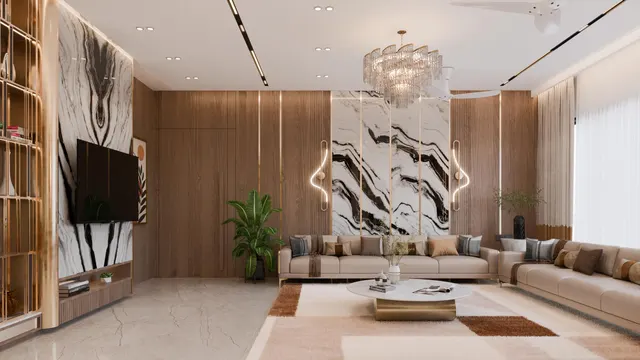
The best approach is not one finish for the whole home but the right finish for each surface. A simple test helps: how often will hands, water, heat and sharp objects touch this surface? Surfaces touched every hour — kitchen bases, study desks, children's furniture, dining table tops in daily use — need laminate's toughness or a protective top. Surfaces that are mostly seen — a TV wall, a headboard panel, a bar unit, the upper shutters of a wardrobe — can carry veneer's warmth or acrylic's gloss. Fig. 3 shows how a mixed approach works on one wall.
| Furniture or surface | First choice | Good alternative | Avoid or take care |
|---|---|---|---|
| Kitchen base shutters | Laminate (matte or suede) | Acrylic on upper shutters only | Veneer near the sink and hob |
| Kitchen upper shutters | Laminate or acrylic | Gloss acrylic for a bright, reflective look | Gloss next to the hob without a heat gap |
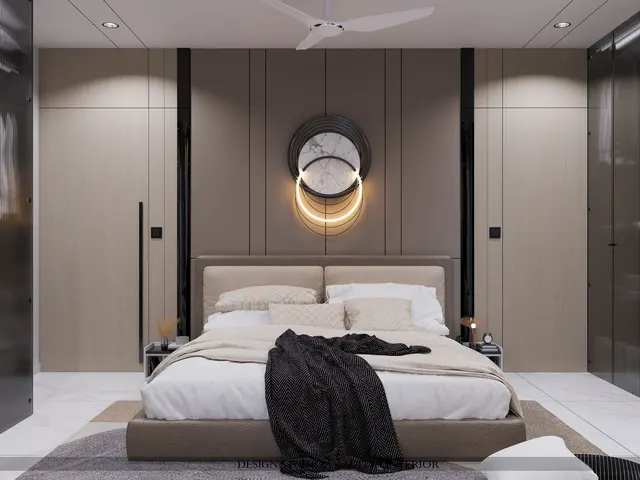
| Wardrobe shutters | Laminate, or acrylic in low-touch bedrooms | Veneer in a master bedroom | Gloss acrylic in a child's room |
| Bed and headboard | Veneer or upholstered headboard; laminate body | Laminate with wood grain | Gloss acrylic where elbows and heads rest |
| TV unit and feature wall | Veneer panel with laminate storage | Acrylic display shutters | One finish across the whole wall |
| Dining table top | Laminate or veneer with tough PU | Veneer with stone or glass top | Gloss acrylic on a daily-use top |
| Study desk and children's furniture | Laminate, 1.0–1.5 mm on the top | Matte acrylic on fronts | Veneer tops without a protective finish |
| Bathroom vanity | Laminate on BWP ply, all edges sealed | Acrylic fronts on BWP core | Veneer in direct splash zones |
| Pooja unit | Veneer or laminate wood grain | Acrylic back panel with backlight | Veneer near oil lamps without protection |
What each finish costs
Finish prices in India are usually quoted per square foot of finished shutter or panel, including the finish, edge banding and pressing, but not the carcass, hardware or installation. The bands used across this blog for October 2026 are about ₹350–650 per sq ft for laminate, ₹600–1,100 for natural veneer with polish, ₹900–1,500 for acrylic, and ₹1,000–1,800 for PU paint as a reference. Recon veneer usually sits between laminate and natural veneer. Fig. 4 applies these bands to the shutters of one wardrobe.
| Finish | Finished shutter rate (₹ per sq ft) | 54 sq ft wardrobe shutters (₹) | What moves the price |
|---|---|---|---|
| Laminate, 1.0 mm, machine edge band | ≈ 350–650 | ≈ 18,900–35,100 | Brand, texture, gloss, edge method |
| Recon veneer with PU polish | Between laminate and natural veneer — confirm locally | Confirm locally | Pattern, polish system |
| Natural veneer with melamine or PU polish | ≈ 600–1,100 | ≈ 32,400–59,400 | Species, book-matching, polish coats |
| Acrylic, gloss or matte | ≈ 900–1,500 | ≈ 48,600–81,000 | Brand, edge system, colour |
| PU paint (reference) | ≈ 1,000–1,800 | ≈ 54,000–97,200 | Coats, sanding and polishing |
| Membrane (reference) | ≈ 500–850 | ≈ 27,000–45,900 | Routed design, foil grade |
Across a whole home the difference adds up. In the Surat 3BHK cost guide on this blog, three wardrobes with about 160 sq ft of elevation are the main reason the premium band is two to three times the basic band. A family that wants the look of acrylic or veneer but has a mid-range budget can put the premium finish on the most visible faces — the master wardrobe, the TV wall, the kitchen upper shutters — and use laminate for the rest, which usually saves more than choosing a cheaper brand of the premium finish everywhere.
Humidity, sunlight and Indian conditions
Indian homes test finishes harder than the showroom does. In coastal and humid cities — Surat, Mumbai, Chennai, Kochi, Kolkata — boards take up moisture during the monsoon and release it in the dry months, and panels without balancing layers bow. Laminate and acrylic panels must be balanced on the back; veneer panels need a backer and a polish on both faces of doors. Edges must be sealed everywhere, including the cut-outs for sinks, hobs and hinges. BWR ply (IS 303) or HDHMR suits dry rooms, and BWP or marine ply (IS 710) belongs under every sink and vanity, whatever the face finish.
Sun is the second test. West-facing rooms in Indian cities receive strong afternoon sun, and natural veneer near a window will change colour unevenly, while cheap laminates may fade. Curtains or blinds, UV-filtering glass where windows are large, and colourfast laminate grades on sun-facing panels solve most of this. Kitchens add steam and heat: keep acrylic and veneer away from the immediate hob zone, and use laminate or a heat-resistant backsplash panel there.
Care, repair and refinishing
The three finishes are cleaned differently, and the wrong cleaner can damage them. Laminate tolerates most mild household cleaners and a damp cloth. Veneer polish is cleaned with a soft dry or slightly damp cloth and dried at once; strong solvents, abrasive pads and standing water damage it. Acrylic is cleaned with a soft microfibre cloth and mild soapy water; dry dusting with a rough cloth or kitchen tissue can leave fine scratches on gloss acrylic, and many solvents and alcohol-based cleaners can craze it, so the maker's care instructions should be followed.
| Task | Laminate | Veneer | Acrylic |
|---|---|---|---|
| Daily cleaning | Damp cloth, mild detergent | Soft dry or barely damp cloth; dry at once | Microfibre with mild soapy water; no dry rubbing |
| Avoid | Abrasive powders, scouring pads | Standing water, solvents, hot vessels without mats | Alcohol and solvent cleaners, rough cloths |
| Light scratch | Usually permanent; less visible on textured | Touch-up or local re-polish by a polisher | Often reducible with a suitable plastic polish |
| Chip or burn | Fill with coloured filler or re-laminate | Re-veneer the area; matching is difficult | Replace the panel |
| Fading over years | Rare in good grades | Expected; re-polishing evens it somewhat | Usually limited; depends on the product |
| Refinishing a 7 × 2 ft shutter (14 sq ft) | Re-laminate: ≈ ₹4,900–9,100 | Re-polish or re-veneer: ≈ ₹8,400–15,400 | New panel: ≈ ₹12,600–21,000 |
The refinishing figures above use the same per-sq-ft bands as the cost table and are consistent with this blog's laminate peeling and veneer maintenance guides. Hardware usually transfers from the old shutter to the new, but a new acrylic panel must come from the same colour and batch to match its neighbours, so it is worth asking the supplier to keep a spare panel or note the batch.
A short history of furniture finishes
Veneering is ancient. Craftsmen in ancient Egypt glued thin sheets of precious wood onto cheaper timber, and European cabinetmakers developed the art over centuries, using book-matched and marquetry veneers in their finest furniture. In India, solid teak, rosewood and sheesham dominated traditional furniture, and veneered plywood became common in urban homes in the twentieth century, as plywood mills spread and solid timber grew scarcer and more expensive.
High-pressure decorative laminate emerged in the early twentieth century, first as an electrical insulating material and later as a decorative surface for kitchens and furniture in the mid-century. Acrylic (PMMA) was commercialised in the 1930s and used for decades as a glazing material before thin acrylic facings for furniture became popular. In Indian homes, laminate became the default finish of the modular-furniture era from the 1990s and 2000s, and gloss acrylic shutters spread over the last decade or so with factory-made kitchens.
| Period | Finish development | What it meant for homes |
|---|---|---|
| Ancient times | Hand-cut veneers glued onto cheaper wood | Precious timber used sparingly |
| 17th–19th century | European veneered and inlaid furniture | Book-matching and marquetry as status symbols |
| Early 20th century | Plywood and high-pressure laminates developed | Stable panels; a hard, washable surface |
| 1930s | Acrylic (PMMA) commercialised | First used as glazing; furniture use came much later |
| 1990s–2000s, India | Laminate on plywood becomes the modular standard | Affordable, durable, factory-made furniture |
| 2010s–now | Acrylic, super-matte and textured laminates, recon veneers | More finishes; more care in matching them |
Where furniture finishes are heading
Three changes are under way. First, super-matte and anti-fingerprint surfaces — both in laminate and in acrylic and PET-type facings — are replacing high gloss in many kitchens and wardrobes, because they look calm and hide marks. Some of these surfaces claim thermal healing of micro-scratches; such claims should be checked against the maker's data rather than assumed. Second, textured laminates with synchronised grain, where the texture follows the printed wood grain, are closing the visual gap with veneer at a lower price. Third, low-emission panels and adhesives are increasingly requested, and finishes are being chosen with formaldehyde emission classes and responsible timber sourcing in mind, especially for children's rooms and bedrooms.
The best use of these new materials is still the old principle: choose the toughest finish for the surfaces touched most, the warmest for the surfaces seen most, and keep the number of finishes in one room to two or three so they read as a family rather than a sample board.
Rules for choosing between laminate, veneer and acrylic
- Choose by touch: laminate where hands, water and heat work hardest; veneer or acrylic where surfaces are mostly seen.
- Use 1.0 mm laminate for most faces and 1.25–1.5 mm on table and desk tops; balance every panel on the back.
- Specify veneer with its polish: name the species, natural or recon, and melamine or PU polish with the number of coats.
- Put acrylic on HDHMR or MDF with a matching edge system from the same supplier, and keep the film on until handover.
- Edge-band every exposed edge with machine-applied 2 mm PVC or ABS, or timber lipping on veneer tops.
- Use BWP plywood under sinks and vanities whatever the face finish; the core fails before the finish.
- Keep veneer and gloss acrylic out of direct sun or protect them with curtains and blinds.
- Limit a room to two or three finishes in one colour family, and approve samples under the room's own lighting.
- Ask for the cleaning instructions for each finish at handover, and keep a spare panel or batch number for acrylic.
Frequently asked questions
Which is better for a wardrobe — laminate, veneer or acrylic?
For most wardrobes, especially in children's and guest rooms, laminate is the best balance of durability and cost. Acrylic suits a master wardrobe where a glossy, reflective look is wanted and the shutters are handled with care. Veneer suits a warm, natural master bedroom. A common compromise is laminate on the carcass and lower shutters with veneer or acrylic on the upper or most visible ones.
Is veneer more expensive than laminate?
Yes. A finished natural veneer shutter typically costs about ₹600–1,100 per sq ft including polish, against about ₹350–650 for laminate (indicative October 2026). Veneer also needs more careful matching and occasional re-polishing over its life.
Does acrylic scratch easily?
Gloss acrylic shows fine scratches more easily than laminate, especially if it is wiped with a dry or rough cloth. Matte acrylic hides marks better. Light scratches can often be reduced with a suitable plastic polish, but deep damage needs a new panel.
Which finish is best for a humid city like Surat or Mumbai?
The finish matters less than the board and edges. Laminate on BWR ply or HDHMR, balanced on the back and edge-banded on every edge, is the most forgiving. Acrylic performs well with the same care. Veneer works if both faces are polished and edges are lipped or sealed, but should be kept away from sinks and damp walls. BWP plywood should be used under every sink.
Can laminate look like real wood?
Good textured laminates with synchronised grain look very close to real wood at normal viewing distance, and they are perfectly consistent between panels. Up close, veneer still has more depth and natural variation, and it feels warmer to the touch.
Sources & standards
- Bureau of Indian Standards — IS 2046, Decorative thermosetting synthetic resin bonded laminated sheets (specification and tests)
- Bureau of Indian Standards — IS 303 (plywood for general purposes), IS 710 (marine plywood) and IS 1328 (veneered decorative plywood)
- Bureau of Indian Standards — IS 12406 (medium density fibreboards for general purposes)
- Manufacturer technical datasheets for decorative laminates, acrylic facings and edge bands — standard thickness and care ranges, described generically
- Aaditya Interior guides — Laminate vs Acrylic vs PU Paint vs Membrane; Natural Veneer vs Recon Veneer vs Laminate; Laminate Thickness; Veneer Types; Laminate Peeling
- Price ranges: indicative October 2026 estimates — confirm locally before budgeting