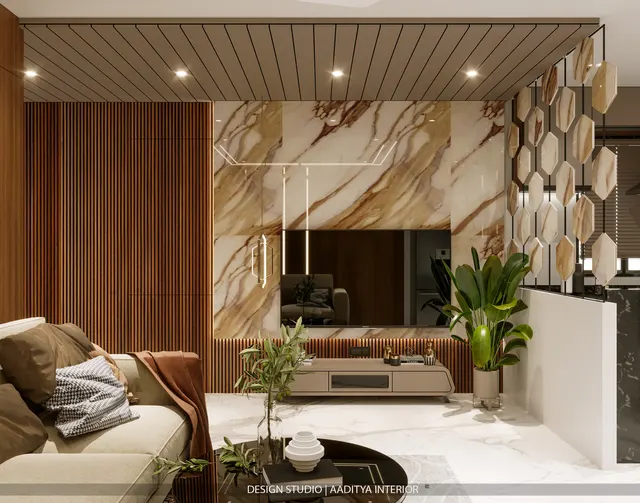
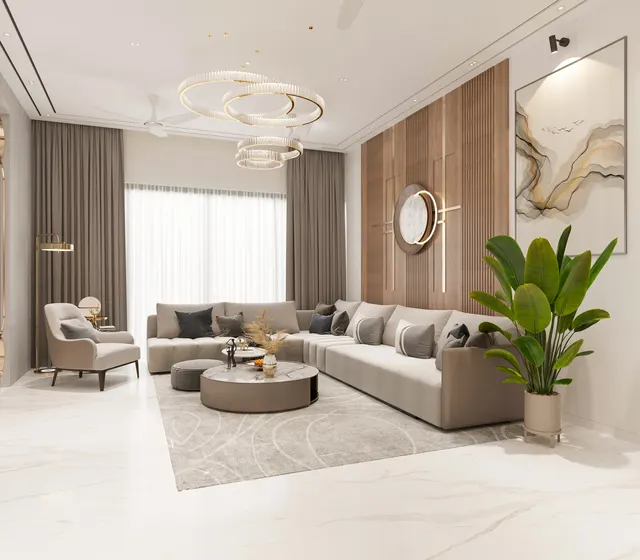
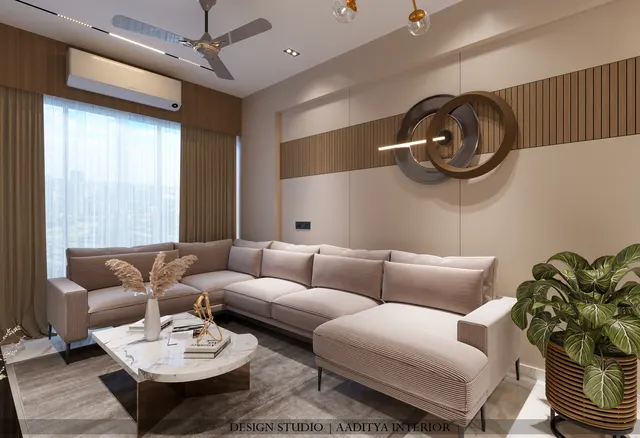
Louvre panels — walls and ceilings covered in vertical ribs or slats — have become one of the most requested finishes in Indian interiors. They appear behind televisions, beds and reception counters, on ceilings in cafés and on the shutters of wardrobes. Their appeal is easy to see: a rhythm of light and shadow that makes a plain wall look designed, at a price that can be lower than many people expect.
The trouble is that "louvre panel" covers very different materials. A hollow PVC strip, a charcoal composite panel, a solid WPC profile, a CNC-routed MDF board painted in PU, a wall of solid teak battens and an aluminium baffle can all be sold under the same name, at prices that differ by ten times or more. Each behaves differently with moisture, heat, sunlight, impact and cleaning, and each needs a different fixing. Many disappointments — panels that bow in a humid monsoon, joints that open in the first summer, a surface that cannot be repainted — come from choosing the look first and the material second.
This article compares the materials used for interior louvre panels in India: what each is made of, the profile sizes it is usually supplied in, how it is fixed, where it works and where it does not, and its indicative October 2026 installed cost. It builds on this blog's guides to charcoal panels and to fluted panels and keeps their rates, focusing here on choosing the material for the job.
From window shutters to wall panels: what a louvre is
Strictly, a louvre is a set of angled slats that let air through while blocking rain, sun or view — the slatted wooden shutters of colonial bungalows, the fixed concrete louvres on modernist facades, the ventilators above bathroom doors. In Indian interior trade language the word has drifted. A "louvre panel" today usually means a decorative wall or ceiling lining with raised vertical ribs separated by grooves — closer to what designers would call a fluted or slatted panel. The slats are no longer angled, and air does not pass through; the louvre has become a texture.
The history explains the look. Timber louvred shutters and doors were common in Indian bungalows and public buildings of the nineteenth and twentieth centuries because they let breeze in during hot weather while keeping out glare and rain. Modernist architects in India later used concrete fins and louvres on facades for the same climate reasons. The interior louvre panel borrows the vertical rhythm of those elements and turns it into a lining. Understanding this helps in one way: a louvre wall reads best when its ribs are vertical, evenly spaced and continuous, like the shutters it descends from.
| Term used in trade | What it usually means | Typical profile | Notes |
|---|---|---|---|
| Louvre panel | Wall or ceiling lining with raised ribs and grooves | Ribs 10–40 mm wide, grooves 5–20 mm | Often PVC, charcoal or WPC profiles |
| Fluted panel | Rounded (half-round) grooves cut into a board | Flutes 10–30 mm | Usually CNC-routed MDF, stone or glass |
| Slatted / batten wall | Separate solid strips fixed with gaps | Battens 20–60 mm wide, gaps 10–25 mm | Solid wood, MDF or aluminium |
| Ribbed panel | Square-edged ribs, similar to louvre | Ribs 10–30 mm | Name varies by supplier |
| Acoustic slat panel | Slats on a felt backing that absorbs sound | Slats about 25–30 mm, felt 9–12 mm | Veneer or laminate slats on PET felt |
| Baffle ceiling | Vertical metal or timber fins hung from a ceiling | Fins 50–150 mm deep | Common in offices, cafés, retail |
The seven materials compared
The materials below are listed roughly from cheapest to most expensive. The thickness and profile figures are typical of products widely sold in India and vary by manufacturer; the prices are indicative installed ranges per square foot of wall in October 2026, excluding GST, lighting and wall repair, and match the rates used in this blog's other panelling guides.
1. PVC hollow louvres and strips
Extruded PVC profiles, hollow inside, with a printed or plain surface. They are light, fully waterproof, very cheap and quick to install, which makes them the default in bathrooms, utility areas and budget ceilings. Their weaknesses are a thin, slightly plastic look up close, a hollow sound when tapped, and softening and movement near heat sources and in direct sun. Plain strips cost about ₹50–90 per sq ft installed.
2. Charcoal louvres
Sold widely as "charcoal panels", these are composite profiles — typically a PVC-based or WPC-type core with a decorative laminated or foil surface — in wood, stone, metallic and plain finishes. They are light, moisture-tolerant and quick to fix with adhesive or onto battens. Installed on a prepared wall, charcoal louvres cost about ₹150–320 per sq ft. They are the most popular budget louvre in Indian homes, but the surface film can be scratched or peel at cut edges if poorly finished, and long panels can bow in strong sun near large windows.
3. WPC louvres
Wood–plastic composite profiles are generally thicker, denser and more rigid than charcoal louvres, and tolerate moisture well. They hold screws, take clip systems and stay straighter over long lengths. WPC louvres cost about ₹250–500 per sq ft installed (₹300–500 for the denser, better-finished ranges). They suit kitchens, dining walls, semi-outdoor shaded areas and humid coastal cities, where MDF would be risky.
4. MDF and HDHMR louvres — laminate, membrane, veneer or PU
Here the ribs are routed into, or built up from, engineered board and then finished. Pre-laminated or laminated fluted boards cost about ₹350–850 per sq ft; membrane-pressed boards about ₹500–850; natural veneer about ₹600–1,100; and PU-painted MDF about ₹1,000–1,800, the range used for PU shutters on this blog. These give the crispest edges and the widest choice of colour and grain, and PU can be repainted. They must stay dry: MDF swells at exposed edges, and even HDHMR needs sealed edges near water. They are the right choice for bedrooms, living rooms, offices and hotel rooms.
5. Solid wood battens
Separate strips of teak, ash, oak, sal or other seasoned hardwood, fixed with gaps onto a dark backing. Solid wood gives the warmest, most natural result, ages well and can be refinished, but it moves with humidity, needs well-seasoned stock and a good polish system, and is expensive. Indicatively, solid timber louvre or batten work costs about ₹900–2,000 per sq ft, in line with the timber louvred shutter rates used elsewhere on this site, rising further for imported species.
6. Aluminium louvres and baffles
Extruded aluminium profiles, powder-coated or with a wood-grain transfer finish, used on ceilings, high walls and commercial interiors. They are dimensionally stable, non-combustible, moisture-proof and long-lived, and are often specified where fire and maintenance matter. Aluminium louvres cost about ₹550–1,200 per sq ft depending on profile depth and finish. Their limits are a more commercial feel and dents from impact at low level.
7. Acoustic slat panels
Veneer, laminate or melamine-faced MDF slats fixed onto a recycled PET felt backing. The felt between the slats absorbs a useful part of mid- and high-frequency sound, which makes these panels popular in home theatres, conference rooms and echoing living rooms with hard floors. They are priced in the veneer band and above — indicatively about ₹700–1,500 per sq ft installed — and work best when a sizeable part of the wall is covered, not a narrow strip.
| Material | Typical thickness | Moisture tolerance | Finish options | Indicative installed cost (₹/sq ft, Oct 2026) | Best for | Avoid |
|---|---|---|---|---|---|---|
| PVC hollow strips | 8–10 mm | Waterproof | Printed, plain | ₹50–90 | Bathrooms, utility, budget ceilings | Feature walls seen up close; heat |
| Charcoal louvres | 8–12 mm overall | Good | Wood, stone, metallic, plain films | ₹150–320 | Budget feature walls, bedrooms, rentals | Direct sun, careless cut edges |
| WPC louvres | 12–25 mm overall | Very good | Wood grain, plain, paintable ranges | ₹250–500 | Kitchens, dining, humid cities, shaded semi-outdoor | Fine, delicate profiles |
| Laminate / membrane MDF or HDHMR | 12–18 mm | Poor (MDF) to fair (HDHMR) | Laminate, membrane | ₹350–850 | Bedrooms, living rooms, offices | Wet walls, bathrooms |
| Veneer MDF or HDHMR | 12–18 mm | Poor to fair | Natural veneer, polished | ₹600–1,100 | Premium homes, hotel rooms | Wet or sunlit walls |
| PU-painted MDF | 12–18 mm | Poor | Any colour, matt to gloss | ₹1,000–1,800 | Feature walls, premium interiors | Kitchens near the hob, bathrooms |
| Solid wood battens | 20–40 mm | Fair (moves) | Oil, PU, melamine polish | ₹900–2,000 | Statement walls, reception counters | Unseasoned timber; AC-dried rooms without acclimatisation |
| Aluminium louvres / baffles | Fins 50–150 deep | Excellent | Powder coat, wood-grain transfer | ₹550–1,200 | Ceilings, commercial interiors, high walls | Low-level walls that get kicked |
| Acoustic slats on felt | ≈ 21–25 mm overall | Poor to fair | Veneer, laminate, melamine | ₹700–1,500 | Home theatres, meeting rooms | Wet areas; tiny patches |
Profile size, pitch and how a louvre wall reads
Three dimensions decide how a louvre wall looks: the rib width, the groove width and the depth between them. Narrow ribs at a tight pitch — say 10–15 mm ribs with 5–10 mm grooves — read as a fine texture, almost like corduroy, and suit small rooms and furniture fronts. Wider ribs of 25–40 mm with 15–20 mm grooves read as distinct stripes and suit large walls and reception areas. Depth controls the shadow: 5–8 mm reads softly under diffused light, while 15–25 mm gives strong lines, especially with a grazing light from a cove or a wall-washer above.
Viewing distance matters. A pattern that looks rich at arm's length can blur into a flat grey at 5 m; a pattern scaled for a hotel lobby looks crude in a small bedroom. As a working rule, fine profiles suit walls seen from 1–3 m, medium profiles 2–5 m and bold profiles beyond that. Lengths matter too: most profiles are supplied in lengths of roughly 2.4–3 m, so a full-height wall in a 3 m room may need a joint. Plan it at a consistent height — at a skirting, a ledge or above door height — rather than scattering joints across the wall.
| Profile scale | Rib / groove (typical) | Rib depth | Reads best from | Typical use |
|---|---|---|---|---|
| Fine | 10–15 mm / 5–10 mm | 5–8 mm | 1–3 m | Wardrobe shutters, bed backs, small rooms |
| Medium | 20–30 mm / 10–15 mm | 8–15 mm | 2–5 m | TV walls, living rooms, cafés |
| Bold | 30–40 mm / 15–25 mm | 15–25 mm | 4 m and beyond | Reception walls, lobbies, double-height walls |
| Separate battens | 20–60 mm battens / 10–25 mm gaps | 20–40 mm | 2–8 m | Statement walls, screens, ceilings |
| Baffles | Fins 20–40 mm thick | 50–150 mm deep | Seen from below | Ceilings in offices, retail, restaurants |
How louvre panels are fixed
Fixing is where cheap installations fail. There are four common methods. Adhesive fixing — panel adhesive or silicone applied straight to a smooth, dry, sound wall — is fast and suits light PVC and charcoal profiles, but it telegraphs every bump in the plaster and makes later removal destructive. Batten fixing — timber, WPC or aluminium battens screwed to the wall at about 400–600 mm centres, with the panels screwed or nailed into them — creates a flat plane over an uneven wall, leaves a cavity for wiring and is the standard for WPC, MDF and solid wood. Clip systems hide the fixings and allow panels to be removed. Framed systems — aluminium sub-frames or hangers — are used for baffle ceilings and large commercial walls.
| Fixing method | Suits | Advantages | Limits |
|---|---|---|---|
| Adhesive direct to wall | PVC strips, light charcoal louvres | Fast, thin, cheap | Shows wall unevenness; removal damages wall |
| Battens (timber, WPC or aluminium) | WPC, MDF, solid wood, heavier charcoal | Flat plane, wiring cavity, screw fixing | Adds 30–50 mm build-up |
| Concealed clips | Many WPC and aluminium systems | Invisible fixing; panels removable | Needs the matching system and accurate battens |
| Backing board + adhesive and pins | Routed MDF, acoustic slats | Very flat finish, factory-made modules | Heavier; needs secure fixing of the backing |
| Hanging frame / carrier | Aluminium baffles, timber baffles | Fast for large ceilings; services above stay accessible | Commercial look; needs ceiling coordination |
Whatever the method, the wall must be dry. A louvre wall fixed over plaster that is still curing, or over a wall with rising damp or a leaking pipe, traps moisture, and even moisture-tolerant WPC battens cannot stop the wall behind from growing mould. Check moisture with a meter before fixing, fix waterproofing first in wet areas, and allow a small gap — about 3–5 mm — at ends and at the ceiling for expansion, covered by a trim or shadow gap. On external walls and walls that get afternoon sun, allow for heat movement in PVC and composite profiles, which expand more with temperature than wood or aluminium.
Choosing the material room by room
The quickest way to choose is to start with the room's moisture, heat and wear, then the finish quality needed, and only then the budget. A bathroom ceiling and a living-room TV wall should rarely get the same material. The matrix below reflects how designers commonly match louvre materials to Indian rooms.
| Room or surface | First choice | Also works | Avoid |
|---|---|---|---|
| Living-room TV wall | Laminate or PU fluted MDF; WPC louvres for budget | Veneer, charcoal louvres, solid wood | PVC strips on a feature wall |
| Bed back wall | Charcoal or WPC louvres; laminate or veneer MDF | Acoustic slats, upholstered centre with louvre sides | Hard edges at pillow height without a ledge |
| Kitchen and dining | WPC louvres | HDHMR with sealed edges away from the sink | MDF beside sink or hob |
| Bathroom walls and ceiling | PVC strips (ceiling); WPC away from direct spray | Aluminium baffles in large washrooms | MDF, veneer, solid wood |
| Home theatre or study | Acoustic slats on felt | Veneer battens with absorbent backing | Hard glossy panels on every wall |
| Office reception and cabins | Veneer or laminate MDF, solid wood behind counters | Aluminium baffles on ceilings | PVC strips at reception |
| Café or retail ceiling | Aluminium or timber baffles | WPC louvres | Heavy MDF ceilings without a frame |
| Semi-outdoor, shaded verandah | WPC louvres or aluminium | Treated hardwood with exterior finish | MDF, charcoal panels in direct sun |
A worked comparison: one TV wall, four materials
A typical living-room TV wall of about 10 × 9 ft, or about 90 sq ft, shows how much the material choice moves the budget. Using the indicative October 2026 installed rates above, and excluding the TV unit, lighting and GST, the louvre lining alone costs roughly as follows.
| Material | Rate (₹ per sq ft) | Area | Indicative lining cost |
|---|---|---|---|
| Charcoal louvres | ₹150–320 | 90 sq ft | ≈ ₹13,500–28,800 |
| WPC louvres | ₹300–500 | 90 sq ft | ≈ ₹27,000–45,000 |
| Laminate fluted MDF | ₹350–850 | 90 sq ft | ≈ ₹31,500–76,500 |
| PU-painted fluted MDF | ₹1,000–1,800 | 90 sq ft | ≈ ₹90,000–1,62,000 |
In round figures, the same wall costs about ₹14,000–29,000 in charcoal louvres, ₹27,000–45,000 in WPC and ₹90,000–1,62,000 in PU-painted MDF — the same comparison used in this blog's charcoal and fluted panel guides. A practical middle path, often used by Aaditya Interior, is to put the expensive material only where it is seen most: a 4 ft wide PU or veneer centre panel behind the TV (about 36 sq ft) with charcoal or WPC louvres on the remaining 54 sq ft, giving a premium look for a fraction of the all-PU price.
Working it through: the centre panel of about 36 sq ft at ₹600–1,800 costs about ₹21,600–64,800, and the side panels of about 54 sq ft at ₹150–500 cost about ₹8,100–27,000, for a total of roughly ₹29,700–91,800 depending on which materials are paired. Pairing veneer at ₹600–1,100 with WPC at ₹300–500 gives about ₹37,800–66,600 — well below the all-PU figure, and visually most of the way there because the eye goes to the centre.
Durability, safety and maintenance
Fire behaviour deserves attention in commercial interiors and escape routes. Plastics-based panels — PVC, charcoal and many WPC products — are combustible and produce smoke when they burn; wood and MDF are combustible too. In offices, hotels, hospitals, malls and other public buildings, the fire safety requirements of the National Building Code of India 2016, Part 4, and the local fire authority apply to interior linings, especially in corridors, staircases and exit routes. Ask suppliers for fire test classifications where relevant, keep combustible linings out of escape routes unless the fire consultant approves them, and prefer aluminium or fire-rated boards there.
Day-to-day care is simple but material-specific. Dust ribs weekly with a soft brush or a vacuum brush attachment, because grooves collect dust faster than flat walls. Wipe PVC, charcoal, WPC and laminate with a damp microfibre cloth and mild soap; avoid solvents that can dull printed films. Wipe PU and veneer with a dry or barely damp cloth. Solid wood benefits from re-oiling or polishing every few years, and PU surfaces can be touched up or repainted by a skilled painter. Keep all panels away from direct heat — the back of a hob, a halogen lamp, a geyser — and from long hours of direct sun through unshaded glass.
| Material | Expected life indoors (typical) | Main failure mode | Repairability |
|---|---|---|---|
| PVC strips | Long if dry and shaded | Warping near heat; cracked thin faces | Replace strip |
| Charcoal louvres | Long with good installation | Film peeling at edges; bowing in sun | Replace panel; edges need trims |
| WPC louvres | Long; good in humidity | Movement in strong heat; colour change in sun | Replace profile |
| Laminate / membrane MDF | Long in dry rooms | Edge swelling from water | Panel replacement |
| Veneer MDF | Long in dry rooms | Scratches, UV fading | Can be re-polished |
| PU-painted MDF | Long in dry rooms | Chips at edges | Touch-up or repaint |
| Solid wood | Very long if seasoned | Gaps or cupping from humidity swings | Sand and refinish |
| Aluminium | Very long | Dents at low level | Replace fin |
Where louvre materials are going
Several directions are visible. Composite profiles are becoming thicker and better finished, narrowing the gap between budget WPC and mid-range MDF. Factory-finished modular systems with concealed clips are replacing site-cut work, which improves joints and makes panels removable for wiring changes. Acoustic slats are moving from studios into ordinary homes as hard floors and open plans make rooms echo. And there is growing interest in lower-emission boards and recyclable or recycled-content products, reflected in green building rating systems such as IGBC and GRIHA, which encourage low-VOC finishes and responsible materials. Whatever changes, the basic choice stays the same: match the material to the room's moisture, heat and wear first, and to the look second.
Rules for specifying louvre panels
- Choose the material from the room's moisture, heat and wear before choosing the look.
- Use PVC, WPC or aluminium in wet and humid zones; keep MDF, veneer and PU in dry rooms only.
- Fix WPC, MDF and solid wood on battens at about 400–600 mm centres over a dry, sound wall.
- Plan any horizontal joint at a consistent line — skirting, ledge or door head — not at random.
- Leave 3–5 mm expansion gaps at ends and edges, covered by trims or a shadow gap.
- Scale the profile to viewing distance: fine ribs for 1–3 m, bold ribs for 4 m and beyond.
- Light louvres with a grazing cove or wall-washer, not flat front light.
- In commercial buildings and escape routes, follow NBC 2016 Part 4 and the fire officer's requirements for linings.
- Ask for the exact product, thickness and finish in writing — 'louvre panel' alone is not a specification.
Frequently asked questions
Which is better, WPC louvre or charcoal louvre?
WPC louvres are generally thicker, more rigid, better at holding screws and more tolerant of humidity, and they cost more — about ₹250–500 per sq ft installed against ₹150–320 for charcoal louvres. Charcoal louvres are lighter, cheaper and offer more surface designs. For kitchens, dining walls and humid coastal cities, WPC is the safer choice; for bedroom feature walls on a budget, charcoal louvres work well.
Can louvre panels be used in bathrooms?
PVC strips and many WPC profiles can, provided the wall behind is waterproofed and the panels are kept out of direct shower spray where possible. MDF, veneer and solid wood should not be used in bathrooms.
Do louvre panels need battens?
Light PVC and charcoal profiles are often fixed directly with adhesive on smooth, sound walls. WPC, MDF and solid wood are best fixed on battens at about 400–600 mm centres, which gives a flat surface, a cavity for wiring and screw fixing that does not rely on glue alone.
Are louvre panels good for sound?
Ordinary louvre panels on a solid backing do little for acoustics. Acoustic slat panels, with slats on an absorbent felt backing, reduce echo noticeably when a sizeable area is covered, which is why they are used in home theatres and meeting rooms.
How long do louvre panels last?
Indoors and away from water, heat and direct sun, well-installed louvre panels of any of these materials can last many years. Failures usually come from moisture behind MDF, heat or sun on plastics-based panels, or poor fixing, rather than from age alone.
Sources & standards
- National Building Code of India 2016, Part 4 (Fire and Life Safety) — interior finishes and surface spread of flame in escape routes
- Bureau of Indian Standards — IS 12406 (medium density fibreboard), IS 303 (plywood for general purposes), IS 1708 (methods of testing small clear specimens of timber)
- Bureau of Indian Standards — IS 401 (code of practice for preservation of timber)
- IGBC Green Interiors rating system and GRIHA — low-emission materials and finishes
- Time-Saver Standards for Interior Design and Space Planning — wall finishes and acoustic treatment
- Manufacturer standard ranges for PVC, charcoal, WPC, MDF, aluminium and acoustic slat panels, described generically
- Price ranges: indicative October 2026 estimates — confirm locally before budgeting