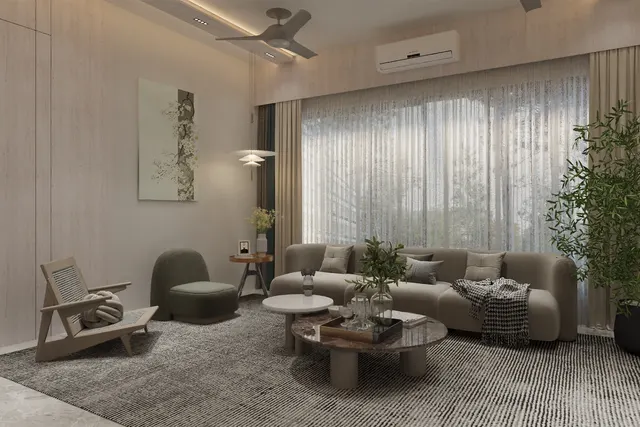
Anyone who has moved into a freshly painted flat knows the smell: sharp, sweet and heavy, strongest in closed bedrooms and lingering in wardrobes for weeks. Most people accept it as a sign of a new home. In fact, much of that smell is volatile organic compounds — VOCs — evaporating from paints, enamels, wood polishes, adhesives and new furniture boards into the air the family breathes. In a typical Indian renovation, where walls, doors, grills, wardrobes, false ceilings and modular furniture are all finished within a few weeks and then the flat is locked up, those emissions concentrate in exactly the rooms where people sleep.
The good news is that this is one of the easiest indoor-air problems to reduce. Paint technology has moved a long way from solvent-heavy oil paints; most branded interior wall emulsions sold in India today are water-based, and many manufacturers now publish VOC figures and carry eco-labels. The difficulty is that labels are confusing — low-VOC, zero-VOC, odour-free, green, eco — and that the wall paint is often not the main source. Solvent-based enamels on grills and doors, thinners, PU wood lacquers, adhesives and particle boards can matter just as much.
This article explains what VOCs are, where they come from in an Indian home, how to read the numbers and certifications on a paint can, what low-VOC finishes cost compared with ordinary ones, and how to schedule painting and ventilation so that a family moves into a home that smells of nothing at all.
What VOCs are and why they matter
Volatile organic compounds are carbon-based chemicals that evaporate easily at room temperature. In coatings they act mainly as solvents and coalescing agents: they keep the paint liquid in the can, help it flow and level on the wall, and then evaporate as the film dries. Common examples in building products include mineral turpentine and other hydrocarbon thinners, xylene and toluene in some enamels and lacquers, glycol ethers in some water-based products, and formaldehyde, which can be released from some resin-bonded wood panels and adhesives.
Indoors, these compounds can reach concentrations well above outdoor levels, especially in the first days after application and in rooms with poor ventilation. Health agencies such as the World Health Organization and national environmental bodies associate exposure to elevated VOC levels with eye, nose and throat irritation, headaches, nausea and dizziness, and some individual compounds carry longer-term concerns — formaldehyde, for instance, is classified by the International Agency for Research on Cancer as carcinogenic to humans. Children, elderly people, pregnant women and people with asthma or other respiratory conditions are generally advised to avoid freshly painted rooms. None of this is a reason to panic about painting; it is a reason to choose lower-emission products and to ventilate properly.
VOCs also matter outdoors. Released into the atmosphere, they react with nitrogen oxides in sunlight to form ground-level ozone, one of the components of urban smog. That is why many countries regulate the VOC content of paints at the national level, and why green building rating systems reward low-VOC materials.
Where VOCs come from in an Indian renovation
When people think of VOCs they think of wall paint, but in a modern Indian interior project the wall emulsion is usually one of the lower emitters, because it is water-based. The larger sources are often the products applied in smaller quantities but with much higher solvent content: oil-based enamels on window grills, safety doors and railings; thinners used to dilute them and to clean brushes; solvent-based PU, NC or melamine lacquers sprayed on veneer wardrobes and doors; contact adhesives used for laminates; and resin-bonded panels such as some plywoods, MDF and particle boards. The table below lists the usual suspects and the lower-emission alternative for each.
| Source in the home | Why it emits | Relative VOC load | Lower-emission alternative |
|---|---|---|---|
| Interior wall emulsion | Water-based; small amounts of coalescents and additives | Low to moderate | Emulsion with published low g/L figure or eco-label |
| Oil-based (synthetic) enamel on grills, doors | Solvent-borne alkyd; thinned with turpentine | High | Water-based enamel or powder-coated metal from the factory |
| Thinner and brush cleaning | Pure solvent | High | Water-cleanable products; keep thinner out of living spaces |
| Solvent PU / NC / melamine wood lacquer | High solvent content; often sprayed on site | High | Water-based PU, or factory-finished shutters |
| Contact adhesive for laminates | Solvent-based rubber adhesives | Moderate to high | Low-solvent or water-based adhesives; press-laminated boards |
| Plywood, MDF, particle board | Formaldehyde-based resins can off-gas | Low to high by grade | Boards declared to low-emission classes (E1 or better); edge-band all faces |
| Wall putty and primer | Mostly water-based | Low | Use the maker's matched water-based primer |
| Floor sealers, epoxy, grout sealers | Some are solvent-based | Moderate to high | Water-based sealers; ventilate during curing |
This is why Aaditya Interior's site sequence matters as much as the product choice. If solvent lacquers are sprayed inside a flat whose wall paint has just been finished, the fresh paint film and soft furnishings absorb some of the vapour and release it slowly afterwards. Wherever possible, wood finishing should be done in a workshop or with factory-finished shutters, and solvent work on site should be completed early, with the flat fully ventilated, before the final wall coat goes on.
Reading the numbers: grams per litre, low-VOC and zero-VOC
The VOC content of a paint is normally stated in grams per litre (g/L) of ready-to-use product. That figure is the most useful single number a homeowner can ask for, because labels such as low-VOC or eco-friendly have no single legal definition in India. Commonly used market thresholds, drawn from international certification schemes, treat a wall paint below about 50 g/L as low-VOC and below about 5 g/L as zero-VOC or near-zero. For reference, the European Union's paints directive (2004/42/EC) caps matt interior wall and ceiling paints at 30 g/L and glossy interior wall paints at 100 g/L, while solvent-borne trim enamels are allowed considerably more. Conventional solvent enamels and lacquers typically run into several hundred grams per litre.
Three cautions help when reading labels. First, a figure for the base paint may not include the colourants added at the dealer's tinting machine; some colourants contain glycols and add to the total, so deep shades can carry more VOC than whites and pastels. Second, odour is not the same as VOC: some low-odour products mask smell, while some compounds with little smell still count as VOCs. Third, a paint's VOC content is what is in the can; emission is what comes out into the room over time. Some certification schemes test emissions in a chamber over days or weeks, which is a more direct measure of indoor-air impact than content alone.
Certifications and standards worth knowing in India
India does not yet have one universal VOC label for all paints, but several schemes and rules are useful. The Bureau of Indian Standards publishes product standards for paints such as IS 15489 for plastic emulsion paint, which define performance requirements; India's Ecomark scheme, administered with BIS, covers environmentally preferable products including surface coatings. The CII–Godrej GreenPro ecolabel certifies building products, including many paints, against environmental criteria. Green building rating systems — IGBC (Indian Green Building Council) and GRIHA — award credits for low-emitting paints, adhesives and sealants in certified projects, which is why many manufacturers publish VOC figures. Lead is regulated separately: the Regulation of Lead Contents in Household and Decorative Paints Rules, 2016 limit lead in household paints to 90 parts per million. Internationally, labels such as Green Seal, the EU Ecolabel and emission certifications such as GREENGUARD are seen on some imported and export-oriented products.
| Label or rule | What it tells you | What it does not tell you | How to use it |
|---|---|---|---|
| Declared VOC in g/L (technical data sheet) | Solvent content of the ready-to-use product | Emission rate over time; tint additions unless stated | Compare products of the same type |
| Low-VOC / zero-VOC claim on can | Maker's own positioning | No single Indian legal definition | Ask for the g/L figure behind the claim |
| Ecomark (BIS) | Meets environmental criteria for the product class | Exact VOC figure | A useful screen where available |
| GreenPro (CII) | Third-party environmental certification of the product | Room emission levels in your home | Shortlist products for green-rated projects |
| IGBC / GRIHA credit compliance | Product meets the rating system's VOC limit | Anything outside that credit | Useful for offices and certified homes |
| Lead rules 2016 (≤ 90 ppm) | Lead content limit for household paints | VOC content | Buy branded, labelled paint from proper dealers |
| Emission certification (chamber-tested) | Measured emissions after set days | Performance or durability | Best indicator for bedrooms, nurseries, clinics |
A healthier paint system, layer by layer
A wall finish is a system, not one coat: wall putty, primer and two or more finish coats. Choosing a low-VOC top coat but a solvent-based primer, or thinning a water-based paint with turpentine on site, defeats the purpose. The figure below shows a typical interior system over cement plaster with the lower-emission choice for each layer, and the drying time that should pass before the next one.
What low-VOC choices cost
For walls, the cost difference is smaller than many homeowners expect, because most premium emulsions are already water-based and many already sit in or near the low-VOC band. The bigger cost decisions are on wood finishes and metalwork, where switching from solvent to water-based products or factory finishes can add to the cost of those items. The table uses the rate bands used across this blog — economy emulsion ₹12–18 and premium emulsion ₹20–30 per sq ft of paintable area, all-in with putty, primer and two coats — and adds an indicative band for certified low-VOC or air-quality-focused premium emulsions.
| Item | Conventional choice | Lower-emission choice | Indicative cost (Oct 2026) | Comment |
|---|---|---|---|---|
| Interior walls | Economy emulsion | Premium emulsion with published low g/L | ₹12–18 → ₹20–30 per sq ft all-in | Best value step for bedrooms |
| Interior walls, sensitive rooms | Premium emulsion | Certified low-VOC / air-quality emulsion | About ₹22–35 per sq ft all-in | Nurseries, elders' rooms, clinics |
| Grills, railings, safety doors | Solvent enamel, brushed on site | Water-based enamel or factory powder coat | Similar to modestly higher per item | Powder coating also lasts longer |
| Veneer wardrobes and doors | Solvent PU or melamine sprayed on site | Water-based PU or factory-finished shutters | Often a modest premium on polish cost | Move spraying off site if possible |
| Laminate bonding | Solvent contact adhesive | Low-solvent adhesive or pre-laminated boards | Small difference per sheet | Big gain in closed wardrobes |
| Carcass boards | Unspecified grade | Boards declared E1 or better, fully edge-banded | Within normal plywood bands | Seal all cut edges |
For a 3BHK of about 1,000 sq ft of carpet area, the paintable wall and ceiling area is commonly around three times the carpet area, so roughly 3,000 sq ft. Moving from economy emulsion to a premium low-VOC emulsion on that area adds roughly ₹24,000–36,000 at the bands above; upgrading only the bedrooms costs a fraction of that. Against the total cost of an interior project, this is one of the cheapest health decisions available.
A painting and ventilation schedule that clears the air
Even the best product emits most of its VOC load in the first hours and days after application, as the film dries and cures. Emissions then fall away over the following weeks. The single most effective step after choosing the right product is therefore ventilation: lots of fresh air while the work is done and for several days afterwards, before the family sleeps in the rooms.
| Stage | Timing | What to do | Why |
|---|---|---|---|
| Before painting | 1–2 weeks before | Finish solvent work (enamels, wood lacquers) first; fully air the flat | Stops vapour soaking into new paint and fabrics |
| During each coat | Every coat | Windows open, fans on, no thinner used for wall paint | Most VOC leaves as the film dries |
| After final coat | Day 0–3 | Continuous cross-ventilation; exhausts on; rooms unoccupied at night | Peak emission period |
| Settling period | Day 3–7 | Ventilate daily for several hours; keep wardrobes open | Emissions fall but continue |
| Furniture and soft goods | After day 3–7 | Bring in mattresses, curtains and rugs after the main airing | Fabrics absorb and re-release VOCs |
| Move-in | About 1–2 weeks after final coat | Keep airing daily for the first weeks | Lower residual emissions; new furniture still off-gasses |
| Sensitive occupants | As advised by their doctor | Stay away during work and the first days | Infants, elderly, asthma and pregnancy |
Offices, clinics and schools
In commercial projects the arithmetic is different. Offices, clinics, schools and hotels are usually occupied soon after handover, often with air-conditioning running on mostly recirculated air and limited openable windows. That makes product choice more important than in a home, where windows can be thrown open for a week. For these projects, designers commonly specify low-VOC or certified paints for every interior surface, water-based or factory-applied finishes for all joinery, low-emission adhesives for carpets and vinyl floors, and a flush-out period in which the mechanical system runs on maximum fresh air before occupation. Green building rating systems describe such flush-out procedures in their indoor-air credits, and they are good practice even where a project is not seeking a rating.
Hotels add one more consideration: rooms are refurbished floor by floor while the rest of the building remains open. Guests in adjoining rooms and corridors can be affected by solvent vapour, so the specification should favour water-based products, sealed-off work zones, temporary extraction and painting schedules that allow airing before a room returns to inventory. The same logic applies to occupied homes where only one or two rooms are being repainted while the family lives in the rest.
Paint is one part of indoor air
A healthy-air plan should not stop at the paint can. In Indian cities, indoor air is shaped by outdoor particulate pollution entering through windows, smoke and fumes from cooking, incense and mosquito coils, moisture and mould in poorly ventilated bathrooms, and carbon dioxide building up in closed, air-conditioned bedrooms at night. Low-VOC finishes reduce one important source during and after a renovation; good kitchen extraction, bathroom exhaust fans, trickle ventilation or openable fanlights in bedrooms, and control of damp do the rest. National Building Code of India 2016, Part 8, sets out the principles of natural and mechanical ventilation that underpin these decisions.
Where healthy coatings are heading
The direction is clear even if the pace varies. Manufacturers are reformulating towards lower VOC content and publishing figures; some now sell interior emulsions marketed for their ability to reduce odours or certain pollutants after application, or with anti-microbial additives, though such claims should be judged by the test data behind them. Mineral finishes — lime and silicate paints — are returning for their breathability and low solvent content. Water-based technologies have improved enough to replace solvent enamels and PU lacquers in most interior uses. In parallel, low-cost indoor air-quality monitors that read particulate matter, carbon dioxide and total VOCs have become common, letting homeowners see the effect of ventilation for themselves; their VOC readings are approximate and best used to compare before and after, rather than as precise measurements.
For designers, healthy indoor air is becoming part of the specification rather than an afterthought — in offices aiming for IGBC or GRIHA ratings, in hospitals and clinics, in schools and in homes for young families. Over the next few years, Aaditya Interior expects the default specification for bedrooms and children's rooms to shift to certified low-emission paints, factory-finished wood and low-emission boards, with ventilation planned into the site sequence.
Rules for low-VOC painting
- Ask for the declared VOC figure in g/L from the technical data sheet, not just a low-VOC claim on the can.
- Keep the whole system water-based: putty, primer and finish coats from the same maker's matched range.
- Never thin water-based paints with turpentine; use clean water as specified.
- Replace site-applied solvent enamels and lacquers with water-based or factory finishes wherever possible.
- Finish all solvent work first, air the flat, then apply the final wall coats.
- Specify low-emission boards (E1 or better) and edge-band every cut face, including inside wardrobes.
- Ventilate continuously during and for at least 3–7 days after painting; do not sleep in freshly painted rooms for the first nights.
- Bring mattresses, curtains and rugs in only after the main airing period.
Frequently asked questions
How long after painting is it safe to sleep in a room?
With water-based low-VOC paint and good cross-ventilation, many households wait at least two to three nights, and longer where solvent enamels or lacquers were used. Infants, elderly people, pregnant women and people with asthma should stay away longer, as advised by their doctor. The smell fading is a reasonable sign, but ventilation should continue for a week or more.
Is zero-VOC paint really zero?
Usually not literally. Zero-VOC normally means the content is below a very low threshold, commonly about 5 g/L, as defined by a particular certification. Colourants added during tinting can raise the figure. Ask for the declared value and whether it includes tinting.
Are all water-based paints low-VOC?
Water-based paints are far lower in VOCs than solvent-based ones, but they still contain small amounts of co-solvents and additives, and figures vary between products. Compare the declared g/L values rather than assuming.
Do air purifiers remove paint fumes?
Standard HEPA purifiers capture particles, not gases. Units with substantial activated-carbon filters can absorb some VOCs, but they are not a substitute for opening windows. Fresh-air ventilation remains the most effective way to clear paint fumes.
Is the smell from new furniture also VOC?
Often, yes. Resin-bonded boards, adhesives and solvent lacquers can off-gas for weeks. Choosing low-emission boards, edge-banding all faces, using water-based finishes and keeping wardrobes open and ventilated in the first weeks all help.
Sources & standards
- World Health Organization — WHO Guidelines for Indoor Air Quality: Selected Pollutants (2010)
- International Agency for Research on Cancer (IARC) — Monographs classification of formaldehyde
- European Union — Directive 2004/42/EC on VOC emissions from decorative paints and varnishes
- Ministry of Environment, Forest and Climate Change, India — Regulation of Lead Contents in Household and Decorative Paints Rules, 2016
- Bureau of Indian Standards — IS 15489 (plastic emulsion paint); Ecomark scheme for surface coatings
- CII–Godrej GBC GreenPro ecolabel; IGBC Green Homes and GRIHA rating systems — low-emitting materials credits
- National Building Code of India 2016 — Part 8 (Building Services: lighting and natural ventilation)
- Price ranges: indicative October 2026 estimates — confirm locally before budgeting