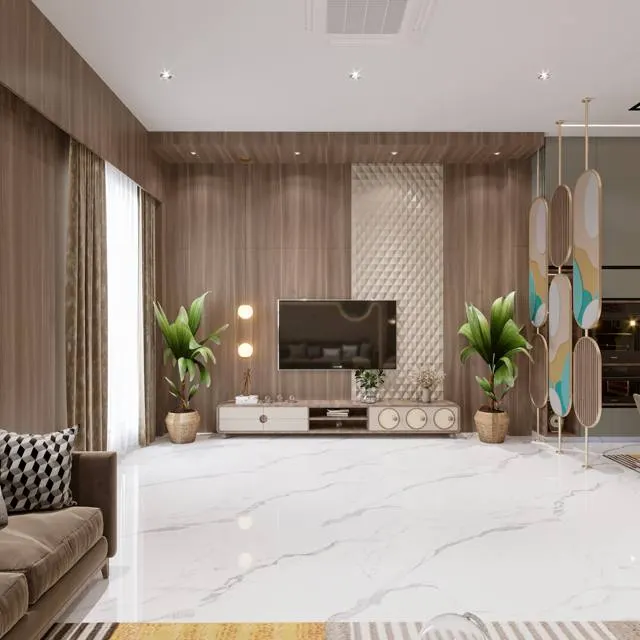
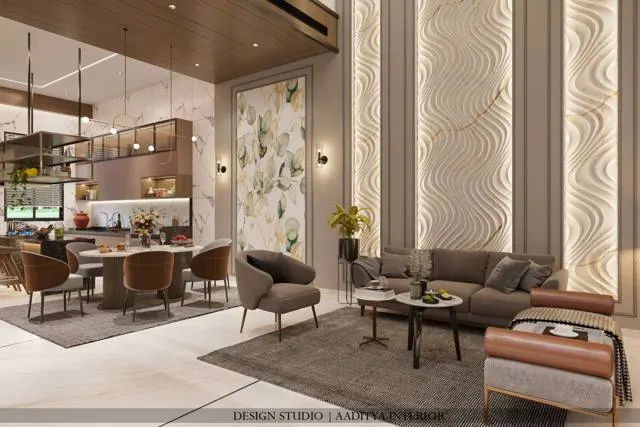
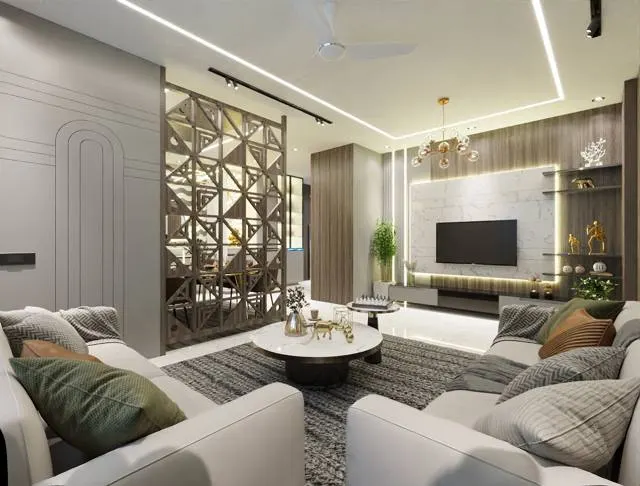
Every interior budget conversation eventually reaches the same question: what exactly is the difference between a ₹2,000 per sq ft home and a ₹5,000 per sq ft one? Both have a kitchen, wardrobes, a false ceiling and lights. Both may use some of the same brand names. In photographs the gap can look smaller than the price. Yet families who have lived in both kinds of home can feel the difference at once — in how a drawer closes, how a stone wall meets the ceiling, how evenly a room is lit, how quiet the air-conditioning is, and how the home looks after five monsoons rather than five weeks.
Luxury is also where budgets drift furthest. A client asks for an imported marble floor without knowing the wastage on a book-matched slab; a designer specifies a fabric-wrapped wall without saying who makes it; an Italian sofa is ordered without anyone mentioning the lead time and the duty. By the end, the luxury premium has been paid, but much of it has gone into rework, delays and items nobody budgeted. In Indian cities, where many high-end homes are large apartments and penthouses finished within tight possession timelines, these surprises are the rule rather than the exception.
This guide explains what actually changes at the top end of the interior market, using the same per-square-foot bands and rates as the other cost guides on this site, including the 4BHK and penthouse guide. It sets out the luxury band, the seven things that make it more expensive, a line-item budget for a 3,000 sq ft luxury home, lead times and process, and the places where the premium earns its money and where it does not. All prices are indicative October 2026 ranges and must be confirmed locally before budgeting.
Where luxury begins: the bands, side by side
Interior costs on this site are always expressed per square foot of carpet area, the usable floor inside the walls, and never per square foot of super built-up area. On that basis, the bands used across the cost guides are basic at ₹800–1,200, mid-range at ₹1,200–2,000 and premium at ₹2,000–3,500 or more per sq ft, with most complete homes landing at ₹1,400–1,800. Above about ₹3,500 a home moves into bespoke territory, where every line must be validated individually. This article calls that territory luxury and, for planning, uses a band of roughly ₹3,500–6,000 per sq ft, recognising that homes led by imported furniture, rare stones or extensive automation go well beyond it.
| Band (per sq ft of carpet) | Typical rate | 3,000 sq ft home (indicative) | What typically defines it |
|---|---|---|---|
| Basic | ₹800–1,200 | ₹24–36 lakh | BWR ply and laminate, standard hardware, selective plain ceilings, economy emulsion |
| Mid-range | ₹1,200–2,000 | ₹36–60 lakh | BWR/HDHMR, laminate or membrane, soft-close branded hardware, cove ceilings |
| Premium | ₹2,000–3,500 | ₹60 lakh–₹1.05 crore | BWP where needed, acrylic or PU, premium hardware, designer ceilings, layered lighting |
| Luxury / bespoke | ₹3,500–6,000+ | ₹1.05–1.8 crore+ | Natural stone and veneer, flush detailing, architectural lighting, bespoke and imported furniture |
| Not in the rate | Quoted separately | Varies widely | HVAC equipment, automation hardware, appliances, art, terrace landscaping, GST |
Two warnings go with this table. First, the bands overlap at their edges: a well-planned premium home with a few luxury moments — a stone foyer, a veneer master bedroom, a feature light — can look and feel more luxurious than a home spread thinly at a higher rate. Second, a luxury rate is not a quality guarantee. A ₹5,000 per sq ft figure that is not backed by drawings, samples and named specifications is just a high number.
How luxury interiors were made then, and how they are made now
Indian luxury has always meant craft and material. The havelis of Rajasthan and Gujarat were finished with carved wood, painted walls, stone jaalis and lime plasters polished to a sheen; princely households in the nineteenth century ordered European chandeliers, mirrors and furniture to sit beside local craftsmanship. In the 1930s, Bombay's Art Deco apartment buildings along Marine Drive and around the Oval — now part of the UNESCO World Heritage property of Victorian Gothic and Art Deco Ensembles of Mumbai — brought terrazzo floors, chrome, etched glass and built-in furniture into the city flat. Luxury, in each era, was something made by hand to fit one place.
Economic liberalisation in the 1990s opened Indian homes to imported marble, European fittings and international brands, and for a while luxury meant simply imported. Today the picture is more mature. High-end Indian projects combine imported items with very high-quality local craft — Indian stone, Indian joinery workshops that build to millimetre tolerances, Indian textile and metal artisans — and luxury is increasingly defined by precision, comfort and services rather than by labels. That shift matters for budgets: much of what a luxury rate buys today is invisible in a photograph, and it has to be specified to be delivered.
Seven things that change at the top end
The luxury premium is not one upgrade. It is the sum of seven separate shifts, each with its own cost. Families who understand them can choose which ones they want, rather than paying for all of them by default.
1. Design depth and documentation
A mid-range home can be built from a layout, a few elevations and a material board. A luxury home needs a full drawing set: reflected ceiling plans coordinated with air-conditioning and lighting, joinery shop drawings, stone layout drawings showing every slab and vein, lighting circuits and scenes, electrical and data layouts, bathroom details, and a finish schedule naming every product. Specialists join the team — lighting, AV and automation, HVAC, acoustics, sometimes landscape and art consultants. Design fees, commonly charged at about 8–12 per cent of project cost under the percentage model, sit at the upper end or above it, and consultant fees are additional. This is money well spent: most rework on high-end sites comes from things nobody drew.
2. Materials: from boards to natural surfaces
The second shift is from manufactured finishes to natural and crafted ones: natural stone on floors and walls, book-matched veneer panelling, solid-wood details, leather and fabric wall panels, brass, bronze and PVD-finished metal, hand-applied lime and mineral plasters. These materials are beautiful, but they bring wastage, skilled labour, sealing and maintenance. A laminate shutter at ₹350–650 per sq ft becomes a natural-veneer shutter at ₹600–1,100, a PU shutter at ₹1,000–1,800, or a bespoke lacquered or metal-clad shutter above that. A vitrified floor at ₹60–120 per sq ft of material plus ₹25–40 laying becomes imported marble or engineered wood priced by variety and grade.
3. Precision and craftsmanship
Precision is the least visible and most important luxury upgrade. Mid-range joinery tolerates shutter gaps that wander between 2 and 4 mm and joints hidden by trims. Luxury joinery is built to consistent shadow gaps, often 3 mm held evenly along every edge; panels align across rooms; doors, wall panels and wardrobes share one datum line; corners are mitred rather than lipped; skirtings are recessed or flush; and stone joints line up with joinery. This needs better machines, better installers, more site time and, above all, accurate site measurement after plastering and before production.
4. Hardware and mechanisms
In mid-range homes, a branded soft-close upgrade of ₹5,000–15,000 per wardrobe is the hardware decision. At the top end, hardware becomes a design element in its own right: push-to-open or servo-assisted drawers for handle-less kitchens, lift systems on every overhead unit, full-extension drawers with high load ratings, pocket and pivot doors, concealed hinges on flush wall panels, motorised curtain tracks, sensor-switched internal lighting, and handles in solid brass, leather or bronze. Each item is small; across a large home the hardware line can rival the cost of the carcasses.
5. Services: air, light, sound, water and control
A large share of the luxury premium now goes into services. Ducted or VRF air-conditioning with linear diffusers, hidden in a deeper ceiling void; architectural lighting with trimless downlights, high colour rendering and dimming by scene; acoustic insulation in partitions and under floors; water treatment and pressure pumps for rain showers; centralised controls for lighting, curtains, climate and security. These systems are quoted by specialist contractors and are usually kept out of the interior per-square-foot rate — but they shape the interior, because they set ceiling depths, wall cavities and switch positions, and they must be designed before carpentry begins.
6. Furniture, soft furnishings and art
In a mid-range home, loose furniture and curtains are often a fifth or less of the budget. In a luxury home they can approach a third, and imported sofas, dining tables, rugs and lighting can single-handedly double a room's cost. Imported pieces bring freight, insurance, customs duty and clearance charges on top of the catalogue price, and lead times that commonly run to several months. Bespoke Indian furniture made by a skilled workshop can match or beat imported quality at a lower landed cost, but it too needs drawings, prototypes and approval of finishes.
7. Process: samples, mock-ups and supervision
Finally, luxury changes the process. Stone is selected slab by slab at the yard, photographed and numbered; veneer is chosen from a single flitch; a sample panel or a full-size mock-up of a wardrobe or a bathroom wall is built and approved before production; lighting is tested on site at night before the ceiling is closed. A dedicated project manager coordinates a dozen trades. This costs time and money — and it is precisely what prevents the expensive mistakes that make luxury sites overrun.
| Element | Mid-range specification | Luxury specification | Indicative cost shift (Oct 2026) |
|---|---|---|---|
| Kitchen and wardrobe shutters | Laminate ₹350–650 or membrane ₹500–850 per sq ft | Veneer ₹600–1,100, PU ₹1,000–1,800, bespoke lacquer or metal above | Two to four times the laminate rate |
| Wardrobes (per sq ft elevation) | ₹1,200–2,200 | ₹3,500 and above for bespoke, lit, handle-less systems | Often double the mid-range rate |
| Flooring | Vitrified ₹60–120 + laying ₹25–40 per sq ft | Imported marble or engineered wood, priced by variety and grade | Wide range — get slab- or batch-specific quotes |
| Wall finishes | Premium emulsion ₹20–30 per sq ft painted area | Veneer, fabric, leather or stone panelling; lime and mineral plasters | Panel work priced per sq ft all-in — verify locally |
| Ceilings | Gypsum ₹60–80; designer cove ₹80–180 per sq ft | Coordinated ceilings with linear diffusers, trimless lights, curtain pockets | Upper end of designer rates plus specialist work |
| Lighting | Cove LED ₹150–300 per running ft; panels ₹400–1,200 each | Architectural downlights, track, scene control, high colour rendering | Per-fitting cost several times higher |
| Hardware | Soft-close upgrade ₹5,000–15,000 per wardrobe | Push-to-open, lift systems, servo drawers, pivot doors, solid metal handles | Can rival the carcass cost |
| Countertops | Basic quartz ₹250–425 per sq ft | Premium quartz ₹550–1,000+, natural stone or sintered surfaces | Two to three times basic quartz |
Stone at the top end: why a marble wall costs what it does
Natural stone is the single item that most often breaks luxury budgets, because its cost is not just the price per square foot of the slab. A book-matched wall — where consecutive slabs from the same block are opened like the pages of a book so the veins mirror each other — uses slabs in sequence. If one slab cracks or has a flaw in the wrong place, the pattern breaks and the next pair must be used, wasting material. Slabs are cut to fit the wall rather than the other way round, so offcuts accumulate. Wastage on ordinary stone flooring is often around 10 per cent; on carefully matched walls and floors it commonly runs from 15 to 30 per cent or more, depending on the stone and the pattern.
Then come the hidden costs: transport and handling of heavy slabs, fixing with mechanical anchors or specialist adhesive on walls, edge mitring, epoxy filling of natural fissures, grinding and polishing after laying, and sealing. Marble is calcium carbonate and is etched by acids — lemon, vinegar, some cleaners — so kitchen and bar tops in marble need sealing, care and acceptance of patina. Many luxury clients now choose marble for walls, floors and vanities, and quartz or sintered stone for working kitchen tops, which keeps the look while protecting the surface that is used hardest.
A line-item budget for a 3,000 sq ft luxury home
The table below builds a complete luxury interior for a 3,000 sq ft carpet-area apartment — four bedrooms, five bathrooms, a family lounge, a study and a bar or entertainment zone — using rates consistent with the other guides and luxury ranges where the item moves beyond them. Where a figure is a judgement rather than a listed rate it is marked indicative. Air-conditioning and automation are shown separately, because they are normally contracted separately.
| Line item (3,000 sq ft, luxury) | Basis | Indicative cost (Oct 2026) | Notes |
|---|---|---|---|
| Modular kitchen with premium hardware | Kitchen and pantry, quartz or sintered top | ₹8–15 lakh | Appliances excluded; handle-less systems and lift units included |
| Wardrobes and dressing | ≈ 300 sq ft of elevation | ₹10.5–15 lakh | ≈ ₹3,500–5,000 per sq ft elevation, lit interiors |
| Other joinery | TV, bar, pooja, foyer, study, panelling | ₹12–20 lakh | Veneer and lacquer finishes; indicative |
| Stone and flooring | ≈ 2,600 sq ft incl. wastage, polishing | ₹15–28 lakh | Imported marble or engineered wood — slab-specific quotes |
| Ceilings and wall finishes | Coordinated ceilings, veneer or fabric walls | ₹8–14 lakh | Indicative — depends on panel areas |
| Lighting and controls | Architectural fittings, drivers, dimming | ₹6–12 lakh | Excludes decorative chandeliers |
| Bathrooms (5) | Stone, premium sanitaryware and fittings | ₹12–20 lakh | Waterproofing and concealed systems included |
| Loose furniture, rugs, curtains, art | All rooms | ₹25–40 lakh | Widest band; imported pieces push it higher |
| Design, project management, contingency | Full project | ₹12–20 lakh | Fees plus 5–8 % contingency |
| SUBTOTAL — interior | 3,000 sq ft carpet | ≈ ₹1.08–1.84 crore | ≈ ₹3,600–6,100 per sq ft — the luxury band |
| HVAC (ducted / VRF) and automation | Specialist contractors | ₹12–22 lakh | Quoted separately; indicative — verify locally |
Two observations come out of this table. First, the share of the budget taken by kitchens and wardrobes shrinks at the top end even though their cost per square foot of elevation roughly doubles or triples; the categories whose share grows are stone, loose furniture and services. Second, the line that protects the whole budget is the smallest: design, project management and contingency. Cutting it to fund a more expensive sofa is the most common and most costly false economy at the top end.
Time, lead times and approvals
Luxury interiors take longer, and the extra time is mostly in decisions and procurement rather than in site work. Stone must be selected, reserved and shipped; veneer flitches and fabrics must be approved from physical samples; imported furniture is made to order; mock-ups must be built and signed off. A mid-range 4BHK typically takes four to six months from design approval to handover; a luxury home of similar size commonly takes eight to twelve months, and longer when the furniture is imported or the services are complex. The table shows typical lead times to plan around; they vary by supplier and season and should be confirmed at order.
| Item | Typical lead time (indicative) | What must happen first | Risk if late |
|---|---|---|---|
| Imported marble, selected slabs | 4–10 weeks after selection | Yard visit, slab numbering, dry-lay approval | Flooring and walls stall; joinery waits |
| Natural veneer from one flitch | 3–6 weeks | Physical sample and flitch approval | Mismatched panels if a second batch is used |
| Bespoke Indian furniture | 8–14 weeks | Shop drawings, prototype or finish sample | Rooms finished but unusable |
| Imported furniture and lighting | Often 3–5 months including shipping and clearance | Order confirmation, advance, finish approvals | Handover with empty rooms |
| VRF / ducted air-conditioning | 4–8 weeks for equipment | Heat-load design, ceiling coordination | Ceilings cannot be closed |
| Automation and AV | 4–8 weeks | Scene design, conduit and back-box positions | Rewiring after plaster |
| Motorised curtains and blinds | 3–6 weeks | Pocket sizes, power points, fabric approval | Pockets built to the wrong size |
Where the luxury premium pays — and where it does not
Aaditya Interior's advice to clients at the top end is to spend first on what is used every day and what cannot be changed later, then on what defines the first impression, and only then on what is fashionable. Concealed services, waterproofing, acoustic separation, electrical capacity and hardware fall into the first group: they are invisible, permanent and expensive to fix. The foyer, the living and dining space and the master suite fall into the second: they carry the impression of the whole home. Statement furniture, art and decorative lighting fall into the third: they matter, but they can be bought over time.
| Upgrade | Pays back? | Why |
|---|---|---|
| Precise joinery with consistent shadow gaps | Yes | Seen and touched daily; impossible to retrofit |
| Architectural lighting with dimming scenes | Yes | Changes how every material looks, day and night |
| Ducted or VRF air-conditioning designed with the ceiling | Yes | Comfort, quiet and clean ceilings for decades |
| Acoustic insulation between bedrooms and to the corridor | Yes | Privacy in large households; hard to add later |
| Book-matched stone in the foyer or living room | Usually | High impact in one place; avoid spreading it thinly |
| Marble kitchen working top | Rarely | Etches and stains; quartz or sintered stone works harder |
| Imported loose furniture throughout | Selectively | Buy statement pieces; bespoke Indian pieces can match quality elsewhere |
| Elaborate ceiling designs in bedrooms | Rarely | A clean ceiling with good light usually looks more luxurious |
Luxury is often confused with quantity — more stone, more panelling, more lights. The best high-end interiors are frequently restrained: fewer materials, chosen carefully and detailed precisely, with generous space left plain. A restrained palette also ages better and keeps maintenance manageable, which matters when the house staff and service contractors must care for natural stone, veneer and complex systems for years.
Where the top end is heading
Three shifts are already visible in high-end Indian projects. The first is wellness: families ask about air quality, filtration, humidity, acoustic comfort and circadian lighting as often as they ask about finishes, and the services budget is growing accordingly. The second is provenance and longevity: natural, repairable materials — solid wood, lime plaster, stone, metal that patinates — are preferred over high-gloss finishes that look tired within a few years, and Indian craft is being specified with pride rather than as a cheaper alternative to imports. The third is integration: lighting, climate, curtains and security are increasingly controlled as one system, which means the interior designer, the electrical engineer and the automation integrator must work from one set of drawings from the first week. None of these lowers the cost, but each raises the value of what the cost buys.
Rules for a luxury interior budget
- Quote and compare on carpet area, room by room — and treat any rate above ₹3,500 per sq ft as a list of items to validate, not a number to negotiate.
- Pay for full documentation: reflected ceiling plans, joinery shop drawings, stone layouts and a finish schedule naming every product.
- Keep HVAC, automation, appliances, art and terrace works as separate lines with their own quotes.
- Select stone at the yard, number the slabs, approve a dry-lay photograph and order a spare pair for matched walls.
- Build and approve a sample panel or mock-up for every repeated luxury detail before production.
- Freeze services — ceiling void, diffuser lines, light positions, switch locations — before any carpentry is produced.
- Order long-lead items as soon as the design is approved, and write the lead times into the programme.
- Hold a 5–8 % contingency and the final 5–10 % of payments until the snag list is closed.
Frequently asked questions
What is the cost of luxury interior design per sq ft in India?
Indicatively, luxury interiors start around ₹3,500 per sq ft of carpet area and commonly run to ₹6,000 or more, depending on stone, furniture and the extent of bespoke work. Air-conditioning, automation, appliances, art and GST are usually extra. Below ₹3,500, the premium band of ₹2,000–3,500 already includes acrylic or PU finishes, premium hardware and layered lighting.
Why are luxury interiors so expensive?
Because the cost is spread across many invisible items: fuller design documentation and consultants, natural materials with high wastage, precise workmanship and longer installation, premium hardware, integrated services, bespoke or imported furniture, and a slower process with samples and mock-ups. Each adds a moderate amount; together they multiply the mid-range rate two to three times.
Is Italian marble worth it for a luxury home?
For floors and feature walls in living spaces and bathrooms, it can be — it gives depth and character no manufactured surface fully matches. It needs careful selection, wastage allowance, professional laying, polishing and sealing, and it etches with acids, so it is a poor choice for working kitchen tops. Many luxury homes combine marble on floors and walls with quartz or sintered stone in the kitchen.
How long does a luxury interior project take?
A luxury apartment of 3,000 sq ft or so commonly takes eight to twelve months from design approval to handover, longer if furniture is imported or services are complex. Most of the time goes into approvals and procurement, so early decisions shorten the programme more than extra site labour does.
How can a home look luxurious on a premium rather than a luxury budget?
Concentrate the luxury materials in the foyer, living room and master suite; choose a restrained palette; invest in precise joinery and good lighting throughout; and keep secondary rooms simple. A premium-band home with a few well-detailed luxury moments often looks better than a luxury-rate home spread thinly.
Sources & standards
- UNESCO World Heritage Centre — Victorian Gothic and Art Deco Ensembles of Mumbai (inscribed 2018): official description
- National Building Code of India 2016, Part 3 (Development Control Rules) — habitable room heights; Part 8 (Building Services) — lighting, air-conditioning and electrical installations
- IS 3646 (Part 1):1992 — Code of practice for interior illumination
- Bureau of Energy Efficiency — Eco-Niwas Samhita (Energy Conservation Building Code for residential buildings)
- IGBC Green Homes and GRIHA rating systems — indoor environmental quality and materials guidance
- Companion cost guides on this site — interior cost per sq ft, 4BHK and penthouse cost, shutter finishes, designer fees (same October 2026 rate bands)
- Price ranges: indicative October 2026 estimates — confirm locally before budgeting