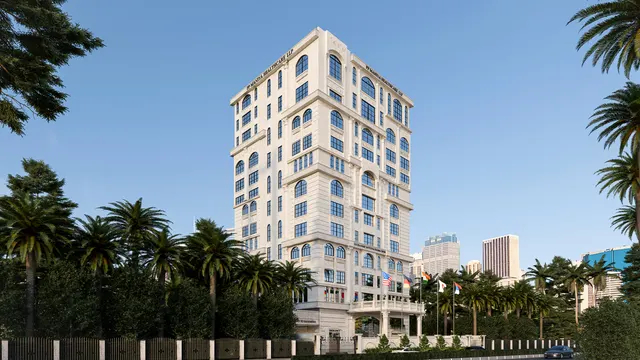
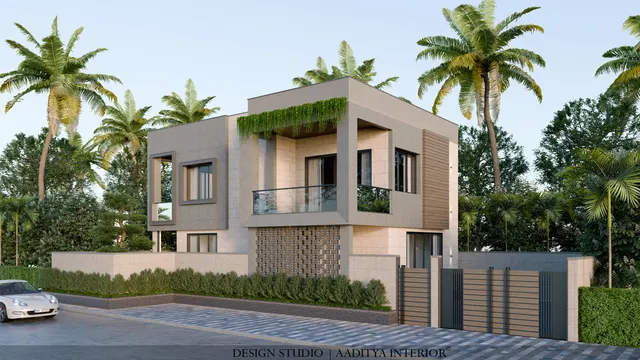
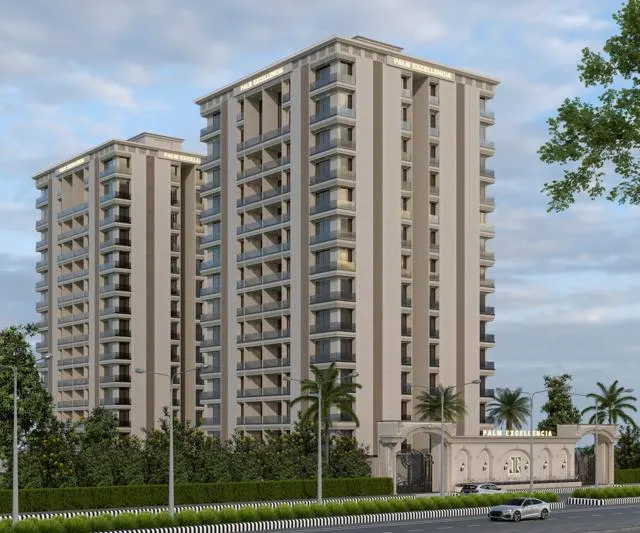
In most Indian homes the outdoor lighting is decided in the last week of the project. An electrician fixes a couple of floodlights on the parapet, a tube light over the gate and a few cheap garden spikes, and the family switches everything on for the housewarming. By the next monsoon, half the garden lights have filled with water, the floodlights glare into the neighbour's bedroom, the stone cladding that cost lakhs looks flat and grey at night, and the electricity bill shows a new line nobody planned for. The facade that looked wonderful in the 3D render looks nothing like it after dark.
Outdoor lighting is harder than indoor lighting because the conditions are harsher and the mistakes are more visible. Fittings must survive 40-degree summers, horizontal monsoon rain, dust, insects, salt air in coastal cities and the occasional car tyre. The light itself has no ceiling or walls to bounce off, so every fitting's position and beam angle matter. And the result is seen by the whole street. A well-lit facade makes a bungalow, a showroom or a hotel look considered; a badly lit one makes even good architecture look cheap.
This guide covers the full picture for homes, bungalows and small commercial buildings: the lighting techniques and the dimensions that make them work, how much light each outdoor area actually needs, the IP and IK ratings and materials that survive Indian weather, colour temperature, wiring and controls, a dimensioned layout for a bungalow garden, and indicative October 2026 costs.
From diyas to LED: a short history of lighting the outside
Lighting the outside of a building is an old Indian habit. Rows of oil diyas along parapets, steps and courtyard edges are still how homes are lit for Diwali, and temple festivals have long used lamp towers (deepastambhas) and lamp-lined walls to make architecture glow at night. What these traditions understood instinctively is that small, warm, low points of light following the lines of a building look magical, while a single bright source looks like a searchlight. Modern designers are often trying to recreate exactly that effect with LEDs.
Electric outdoor lighting arrived first as street lighting and then, in the twentieth century, as floodlighting of monuments, public buildings and stadiums using large incandescent, halogen, mercury vapour and sodium lamps. These sources were hot, inefficient, short-lived and difficult to aim precisely, so facades were typically lit by a few powerful floods from a distance — flat, orange or bluish, and full of glare. The arrival of LED fittings changed almost everything. LEDs are small enough to hide in a plinth, a sill or the ground; their optics give precise beams from very narrow to very wide; they last many thousands of hours; and they use a fraction of the energy. The challenge has shifted from getting enough light to using it with restraint.
The six facade lighting techniques
Almost every successful facade scheme is built from a handful of techniques, each suited to a particular surface. Choosing the technique for each element of the elevation — a stone wall, a column, a canopy, a tree — before choosing any fitting is the single most important step. Fig. 1 shows the six techniques with the distances that make them work.
Grazing
Grazing places a narrow-beam fitting very close to the wall — typically 150–300 mm away — so that light skims the surface at a steep angle. Every projection casts a shadow, so texture is dramatised: split-face stone, exposed brick, fluted panels and rough plaster come alive. The same effect exposes every bulge and patch in a poorly plastered wall, so grazing should be reserved for surfaces that are meant to be textured. Linear grazers mounted in a recess at the foot of a stone wall, or at the head of the wall shining down, are the standard detail.
Washing
Washing pulls the fitting back — typically 600–1500 mm, roughly a quarter to a third of the wall height for floor-mounted fittings — and uses a wider beam so that light falls evenly across the surface. It flattens texture and makes a smooth wall glow uniformly, which suits painted plaster, light stone and large blank surfaces. Uneven washing, with bright scallops at the bottom and dark patches at the top, is the most common facade fault; it is fixed by using asymmetric wall-wash optics, closer spacing, or fittings at both top and bottom of a tall wall.
Uplighting, downlighting, silhouette and outline
Uplighting from in-ground or spike-mounted fittings picks out columns, pilasters, trees and sculptural elements. A narrow beam (about 10–25 degrees) on a column or a tall palm, a wider beam (about 30–60 degrees) under a spreading tree canopy. Downlighting from wall lights, soffit downlights or canopy fittings is the most practical technique: it lights the ground where people walk and the wall below, and it causes the least glare and light pollution. Silhouetting lights the wall behind an object, so a sculpture, a jaali or a palm reads as a dark shape against a glowing background. Outline lighting traces a parapet, cornice or canopy edge with a continuous line from a linear profile or neon flex; used sparingly on one or two lines, it gives a crisp night silhouette, but outlining every edge makes a building look like a wedding venue.
| Technique | Best for | Typical fitting and beam | Typical position | Common mistake |
|---|---|---|---|---|
| Grazing | Split-face stone, brick, fluting, textured plaster | Linear grazer or narrow spot, 10–20° | 150–300 mm from wall, at base or head | Grazing a badly plastered wall — every patch shows |
| Washing | Smooth plaster, painted walls, light stone | Wall-washer, 40–60° or asymmetric | 600–1500 mm back, or from the head | Bright scallops at the base, dark top |
| Uplighting | Columns, pilasters, trees, palms | In-ground or spike spot, 10–60° | Close to base of the element | Unshielded beam into the sky and passers-by |
| Downlighting | Entrances, porches, verandahs, paths | Wall light, soffit downlight | 2100–2700 mm high on the wall | Bare lamps visible — glare at eye level |
| Silhouette | Jaali screens, sculpture, palms | Washer on the wall behind | Behind the object | Lighting the object from the front as well |
| Outline / linear | Parapets, cornices, canopy edges | Linear profile or neon flex, IP65–IP67 | Along one or two key lines | Outlining every edge |
| Window glow | Whole elevation at night | Interior lighting near the glass | Inside, 0–1000 mm from glass | Ignoring the inside — dark windows look dead |
How much light outdoor areas need
Outdoors, the eye adapts to darkness, so much less light is needed than indoors. A room may need 150–300 lux; a garden path is comfortable at 5–20 lux. The most common outdoor mistake in India is not too little light but far too much, from floodlights intended for factory yards. Too much light makes the surroundings look darker by contrast, creates glare, attracts insects and spills into neighbouring plots. The ranges below are typical design values for residential and small commercial settings, drawn from common international practice for outdoor lighting; they are guidance, not a code requirement, and should be adjusted for surroundings — a bungalow on a dark lane needs less than a showroom on a bright main road.
| Area | Typical horizontal illuminance | Notes |
|---|---|---|
| Garden path, lawn edge | 5–10 lux | Low bollards or step lights; avoid glare at eye level |
| Driveway and parking | 10–30 lux | Enough to see a step, a pet or a vehicle edge |
| External steps and level changes | 20–50 lux on treads | Light every tread or the nosing line; safety-critical |
| Gate and main entrance | 50–100 lux | Faces should be readable on CCTV and by the person inside |
| Porch, verandah, sit-out | 30–100 lux, dimmable | Warm light; wall or soffit fittings |
| Facade, light material, dark surroundings | ≈ 20–50 lux on the wall | Bungalows in residential lanes |
| Facade, medium surroundings | ≈ 50–100 lux on the wall | Suburban roads, small commercial |
| Facade, bright urban surroundings | ≈ 100–200 lux on the wall | Main roads, retail frontages; darker materials need more |
Two refinements matter more than the numbers. First, contrast: a facade does not need to be evenly bright. A scheme where the entrance, one stone wall and two columns are lit, and the rest falls into soft shade, reads better than a uniformly floodlit box. Designers commonly aim for a clear hierarchy, with the brightest feature roughly three to five times brighter than its surroundings. Second, reflectance: white plaster reflects most of the light falling on it, dark grey granite very little, so a dark stone facade needs several times the illuminance of a white one to look equally bright.
IP, IK and materials: fittings that survive Indian weather
Every outdoor fitting carries an IP (ingress protection) rating, defined in IEC 60529 and its Indian adoption. The first digit, from 0 to 6, describes protection against solids and dust; the second, from 0 to 8, describes protection against water. A '6' as the first digit means dust-tight. For water, '4' means splashing from any direction, '5' water jets, '6' powerful water jets, '7' temporary immersion and '8' continuous immersion under conditions the manufacturer states. In practice, almost nothing outdoors in India should be below IP65, because monsoon rain is driven sideways by wind and garden sprinklers and hosepipes do the rest.
The IK rating, defined in IEC 62262, describes resistance to mechanical impact on a scale from IK00 to IK10. Bollards, low wall lights and in-ground fittings within reach of people, cricket balls, garden tools and vehicles should be IK08 or better; in-ground fittings in a driveway also need a stated drive-over load rating. In-ground fittings have one more specification that is easy to miss: the temperature of the glass. Where children may walk barefoot, choose fittings designed for a low surface temperature.
| Fitting | Minimum rating | Typical wattage | Indicative price per fitting (October 2026) | Where it fails |
|---|---|---|---|---|
| Wall up-down light | IP65 | 2 × 3–6 W | ₹1,200–4,500 (decorative up to ₹10,000+) | Cheap gaskets; water through the cable entry |
| Outdoor wall or ceiling fitting (budget) | IP65 | 6–15 W | ₹400–1,200 | Plastic diffusers yellow in UV within a few years |
| Bollard, 600–1000 mm high | IP65, IK08 | 5–12 W | ₹2,500–9,000 | Base corrosion where water stands |
| Spike spot (garden) | IP65–IP67 | 3–12 W | ₹1,200–3,500 | Knocked out of aim by gardeners |
| In-ground uplight | IP67 (IP68 if flood-prone), IK08–IK10 | 5–18 W | ₹2,500–8,000 | No drainage bed; fills with water |
| Step or brick light | IP65–IP67 | 1–3 W | ₹800–3,000 | Recessed too deep; glare to the eye |
| Linear grazer / washer, per metre | IP66–IP67 | 10–25 W/m | ₹2,000–5,000 per metre | Bad end-caps; dirty lens in dust |
| LED neon flex or strip, installed | IP65–IP67 | 8–14 W/m | ₹150–300 (strip) to ₹300–600 (neon flex) per running ft | Ordinary indoor strip used outside |
| Underwater pool or fountain light | IP68 | 6–18 W, low voltage | ₹4,000–15,000 | Mains voltage used in water — never acceptable |
Material matters as much as the rating. Die-cast aluminium with a good marine-grade powder coat is the standard body; in coastal cities such as Mumbai, Surat, Chennai or Kochi, salt air attacks cheap coatings within a year or two, and grade 316 stainless steel, bronze or brass bodies, or aluminium with a proper pre-treatment and powder coat, are worth the extra cost. Glass lenses age better than polycarbonate under strong UV. Gaskets should be silicone, and cable glands should match the cable diameter; many failures come not from the fitting but from water tracking down the cable into it.
Colour temperature and colour rendering outdoors
Colour temperature sets the mood of a facade more than any other choice. Warm white of 2700–3000 K flatters sandstone, beige and cream stone, wood, brick, terracotta and most Indian residential facades, and it matches the warm interior light seen through the windows. Neutral white of 3500–4000 K suits concrete, grey stone, metal cladding and glass, and gives a crisper, more commercial look. Cool daylight of 5700–6500 K, which is what most budget floodlights produce, makes stone look grey, skin look pale and gardens look like car parks; it is best avoided on homes.
Plants are the exception that proves the rule. Green foliage often looks richer under neutral white around 4000 K, because warm light lacks some of the blue-green energy that leaves reflect. Many designers therefore use 3000 K on the building and 3000–4000 K on trees, keeping the two within one step of each other so the scene does not look patchy. Colour rendering matters too: a CRI of 80 or more is the minimum for general outdoor use, and 90 or more is worth specifying on feature stone, wood and entrance areas, where people and materials are seen close up. Coloured RGB lighting is best kept for festivals and occasional scenes through a controller, not as the everyday look.
| Facade material | Suggested colour temperature | Preferred technique | Note |
|---|---|---|---|
| Sandstone, beige limestone, travertine | 2700–3000 K | Grazing for texture, washing for smooth | Warm light brings out the honey tones |
| Brick and terracotta | 2700–3000 K | Grazing | Avoid cool light — brick looks brown-grey |
| White or cream plaster | 3000 K | Washing, downlighting | Grazing exposes patchy plaster |
| Grey granite, slate, concrete | 3000–4000 K | Grazing or washing | Dark stone needs more light for the same effect |
| Wood cladding and louvres | 2700–3000 K | Grazing, backlighting | High CRI (90+) shows the grain |
| Glass and metal cladding | 3500–4000 K | Light the frame or the interior, not the glass | Glass reflects the fitting, not the light |
| Trees and palms | 3000–4000 K | Uplighting, moonlighting from above | Keep within one step of the facade's colour |
Wiring, controls and safety
Outdoor lighting combines water, soil, people and mains electricity, so its wiring deserves more care than any indoor circuit. Outdoor lights should run on their own circuits, separate from indoor lighting, protected by a residual current device of 30 mA sensitivity (an RCCB or RCBO) so that a leakage fault trips the supply before it can harm anyone. Wiring practice in India follows IS 732, the code of practice for electrical wiring installations, and National Building Code of India 2016, Part 8, Section 2, on electrical and allied installations; a licensed electrical contractor should do and certify the work.
Buried cable should be armoured, or run in rigid conduit, laid in a trench on a sand bed with a warning tape or tiles above it, and routed along paths and boundaries where future digging is least likely; a depth of roughly 600–750 mm is common practice for low-voltage cable, in line with the guidance in IS 1255. Every joint outdoors should be in an IP68 junction box or a gel-filled connector, never taped. Drivers for LED fittings should be placed in dry, ventilated, accessible boxes — not buried in soil or sealed in a planter. For gardens, low-voltage systems running at 12 or 24 V from a transformer in a dry location are safer around soil, water features and children; anything in or near a pool or fountain must be low voltage and IP68.
Controls make the difference between a scheme that is enjoyed and one that is switched off. An astronomical timer or a photocell switches the lights on at dusk without anyone remembering. A two-stage schedule — full scene from dusk to about 10–11 pm, then only security and path lights until dawn — cuts energy and light pollution substantially. Motion sensors suit side passages, service yards and the area around a back door. In homes with automation, the outdoor circuits can be grouped into scenes such as everyday, festival and away; but even a simple timer on each circuit is better than a bank of manual switches.
Light pollution is a real issue in dense Indian neighbourhoods. Glare into a neighbour's bedroom is the most common complaint about facade lighting, and it is nearly always avoidable by aiming fittings at the building rather than outwards, choosing shielded optics and glare cowls, and keeping uplighting confined to the surface it is meant to light. The International Commission on Illumination's guidance on obtrusive light (CIE 150) gives limits for spill light, glare and upward light by environmental zone; India now has a designated dark-sky reserve at Hanle in Ladakh, and awareness of night-sky protection is growing. Bright upward floods that light the sky more than the building are wasteful wherever they are.
A worked layout for a bungalow
Fig. 4 shows a complete outdoor scheme for a typical bungalow front on a plot about 15 m wide, with a 6 m front setback, a driveway, a pedestrian path, a stone-clad feature wall, two columns at the porch, a tree and a gate. The aim is a calm, layered scene: the stone wall grazed, the columns uplit, the porch downlit, the path and steps lit low, and the gate lit for faces and CCTV — with nothing aimed at the street.
The schedule shows how modest a good scheme can be. About 16–18 fittings with a combined load of roughly 120–180 W light the whole front of the house. Run for six hours every night, 150 W uses about 0.9 kWh a day, or roughly 27 kWh a month — at a typical residential tariff of ₹6–9 per unit, that is roughly ₹160–250 a month. With the two-stage schedule, where only path and security lights stay on after 11 pm, it is less. A single 200 W floodlight on the parapet, by comparison, uses more energy than the whole designed scheme and lights it worse.
Scaling up: commercial facades, signage and hotels
Shops, showrooms, offices and hotels use the same techniques at larger scale, with three additions. First, brand: the facade lighting must work with the signage, not compete with it, and the sign is usually the brightest element. Second, maintenance: fittings on a four-storey facade need access, so they are placed where a ladder, a boom lift or a cradle can reach them, and long-life drivers are chosen. Third, regulation: municipal signage and advertising rules, and in some cities heritage-precinct rules, restrict brightness, animation and colour; they should be checked before the design is fixed. Media facades with programmable RGB pixels are spectacular on malls and hotels but costly to maintain, and on most buildings a restrained static scheme with one controllable accent ages better.
In hospitality projects — the kind of resort and hotel work Aaditya Interior's team has done in India and abroad — outdoor lighting is designed as a sequence: arrival at the gate, the drive, the porte-cochère, the lobby glimpsed through glass, the pool and the landscape beyond. Each stage is slightly brighter or darker than the one before, guiding guests without signs. The same idea scales down to a home: the gate, the path and the door should be the brightest points of the journey, with the garden and facade glowing softly around them.
Budgets and where lighting is heading
| Scheme | What it includes | Typical fittings | Indicative cost, fittings + installation (October 2026) |
|---|---|---|---|
| Basic | Gate lights, porch light, a few path lights, budget IP65 fittings | 6–10 | ₹40,000–1,00,000 |
| Designed residential | As Fig. 4: grazer, uplights, bollards, steps, gate, timer, RCCB | 15–25 | ₹1.5–4 lakh |
| Premium bungalow or villa | Full facade, landscape, water feature, scenes and automation | 30–60+ | ₹5–12 lakh and above |
| Small showroom frontage | Signage-integrated facade, canopy downlights, linear accents | 10–25 | ₹1.5–5 lakh, excluding sign |
| Low-rise hotel or resort facade | Facade, landscape, pool, arrival sequence, DALI/DMX control | Project-specific | Lighting design fee plus fittings; budget per project |
These ranges cover fittings, drivers, junction boxes and installation, and exclude civil trenching through finished hardscape, the main electrical work and any automation system beyond simple timers. The biggest variable is fitting quality: an architectural-grade in-ground uplight with a good optic, a glass lens, a stainless or marine-grade body and a long warranty can cost three to four times a market-grade lookalike, and it usually lasts far longer. Spending more on fewer, better fittings is nearly always the better trade.
Looking ahead, outdoor lighting is becoming quieter and smarter. Tunable-white and dimmable fittings allow one scheme to shift from warm and soft on ordinary evenings to brighter for events. Wireless controls allow scenes and schedules to be changed from a phone without new wiring. Solar-powered garden lights are improving but still deliver modest output and short run times after cloudy monsoon days, so they suit accents rather than safety lighting. And growing awareness of light pollution and its effects on sleep, insects and birds is pushing designers towards shielded, warm, lower-intensity schemes — which happen to look better too.
Rules for outdoor and facade lighting
- Choose a technique for each surface first — graze texture, wash smooth walls, uplight columns and trees, downlight entrances and paths.
- Light less, not more: paths 5–10 lux, steps 20–50 lux, entrances 50–100 lux; leave some of the facade in soft shade.
- Use 2700–3000 K on homes, 3000–4000 K on trees and modern grey or glass facades, and avoid 6500 K floodlights.
- Specify IP65 minimum outdoors, IP67 for in-ground and IP68 in water, and IK08 or better within reach of people and tools.
- In coastal cities, pay for marine-grade powder coat, 316 stainless or bronze bodies, glass lenses and silicone gaskets.
- Put outdoor lights on separate circuits behind a 30 mA RCCB, with armoured or conduit cable at about 600–750 mm depth and IP68 joints.
- Use 12/24 V systems in planting beds and only low-voltage IP68 fittings in pools and fountains.
- Switch with an astronomical timer or photocell and run a two-stage schedule after about 11 pm.
- Aim every fitting at the building or the ground — never at the street, the sky or a neighbour's window.
Frequently asked questions
Which IP rating is best for outdoor lights in India?
IP65 is the practical minimum for any exposed outdoor fitting, because monsoon rain is driven by wind from every direction. Use IP66 or IP67 for linear facade fittings on exposed walls, IP67 for in-ground uplights (IP68 if the area can flood) and IP68 for anything in a pool or fountain. IP44 is acceptable only under a deep, covered porch.
Which colour light is best for a house elevation?
Warm white of 2700–3000 K suits most Indian homes, especially stone, brick, wood and cream or white plaster. Neutral white of 3500–4000 K suits grey stone, concrete, metal and glass. Avoid cool daylight floodlights of 5700–6500 K on homes — they make stone look grey and flat.
How far apart should garden bollard lights be?
It depends on their output and height. Low-output bollards of 600–800 mm height are commonly spaced about 1500–2000 mm apart on a short path; brighter ones of 900–1000 mm can be spaced 3000–4000 mm apart. The aim is overlapping pools of light without dark gaps, not uniform brightness.
How do I stop facade lights from glaring into neighbours' homes?
Aim every fitting at the building or the ground, use narrow beams and glare cowls on uplights, keep wall lights to downward or up-down distributions, and avoid floodlights mounted on parapets pointing outwards. Switching feature lights off after about 11 pm also helps.
Are solar garden lights good enough?
For small decorative accents, yes. For path and step safety lighting, wired fittings are more reliable, because solar lights give modest output and can run short after cloudy monsoon days. A hybrid approach — wired safety lighting, solar accents — works well.
Sources & standards
- IEC 60529 and its Indian adoption, IS/IEC 60529 — Degrees of protection provided by enclosures (IP code)
- IEC 62262 — Degrees of protection provided by enclosures against external mechanical impacts (IK code)
- Bureau of Indian Standards — National Building Code of India 2016, Part 8 (Building Services), Section 1 (Lighting and Natural Ventilation) and Section 2 (Electrical and Allied Installations)
- Bureau of Indian Standards — IS 732, Code of practice for electrical wiring installations; IS 1255, Code of practice for installation and maintenance of power cables
- International Commission on Illumination (CIE) — CIE 150, Guide on the limitation of the effects of obtrusive light from outdoor lighting installations
- Bureau of Energy Efficiency — guidance on LED lighting efficiency and energy conservation
- Manufacturer catalogues for architectural outdoor fittings — typical IP, IK, beam-angle and wattage ranges, described generically
- Price ranges: indicative October 2026 estimates — confirm locally before budgeting