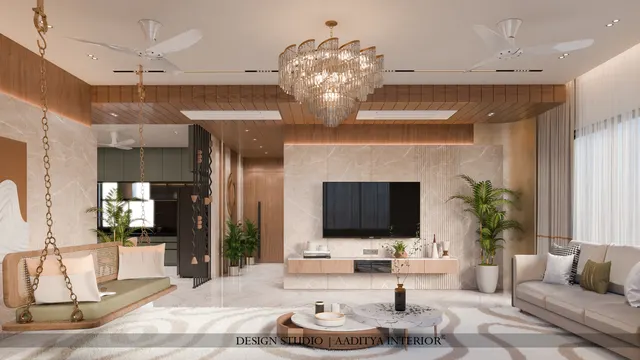
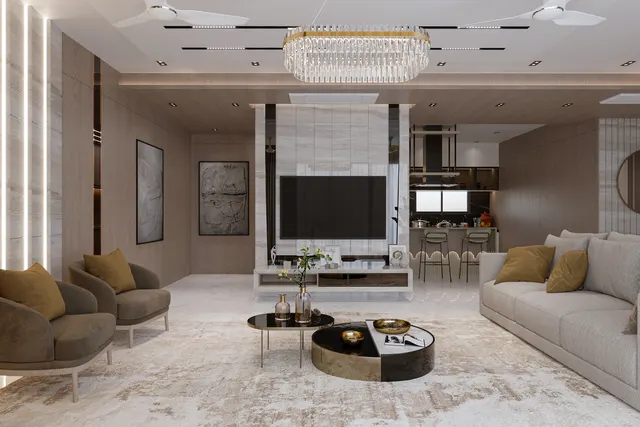
Solid surface is the countertop material most people in India have touched without knowing its name. It is the seamless white reception desk in a hospital, the curved bathroom vanity with a basin that grows out of the top, the long island in a show flat with no visible joint from end to end. Corian is the brand that made the material famous — so famous that "Corian" is often used for any solid surface, the way "Sunmica" is used for any laminate. But there are several brands and two main chemistries, and the differences matter for price, heat resistance and how well the material can be shaped.
It is also one of the most misunderstood materials in Indian kitchens. Families who choose it for its looks are sometimes disappointed when a hot kadhai leaves a mark or when a cheap sheet scratches easily. Others reject it as "plastic" without realising that it is the only common countertop that can be repaired almost invisibly after twenty years. This article goes beyond this blog's three-way comparison of Corian, quartz and granite: it explains what solid surface is made of, sheet sizes and fabrication, the details that make a seamless counter work, heat and care rules for Indian cooking, prices, and the alternatives — quartz, sintered stone, compact laminate, nano white, granite and stainless steel — with where each one belongs.
What solid surface is
Solid surface is a cast sheet made of a resin binder filled with a fine mineral — usually alumina trihydrate, a white powder derived from bauxite — plus pigments and sometimes decorative particles. The resin is either acrylic (PMMA, the same family as acrylic sheet) or polyester, or a blend of the two. The material is the same colour and composition all the way through, it has no pores, and it is soft enough to be cut, routed and sanded with woodworking tools. Those four properties — homogeneous, non-porous, workable and repairable — define it.
DuPont developed Corian in the 1960s, and it became the reference product for the category. Other well-known international brands include LG Hi-Macs, Staron and Krion, and a number of Indian manufacturers and importers now offer solid surface sheets at a range of prices. Brands differ in resin type, colour range, translucency, thermoforming behaviour and warranty, and above all in whether the installer is trained and certified by the manufacturer. A brand's seamless joint and warranty are only as good as the fabricator who makes the joint.
| Type | Resin | Thermoforming (bending with heat) | Typical character | Relative cost |
|---|---|---|---|---|
| 100 % acrylic solid surface | PMMA acrylic | Very good — tight curves possible | Tough, colour stays even when heated, best repairability | Highest |
| Modified acrylic / blended | Acrylic plus other resins | Good, within limits | Balance of cost and performance | Mid |
| Polyester solid surface | Unsaturated polyester | Limited — gentle curves only | Harder, can be more brittle; colours may whiten when heated | Lower |
| Cultured marble (cast basins and tops) | Polyester with stone filler and gelcoat | Cast in moulds, not bent | Glossy gelcoat surface; repairs show | Low to mid |
| Translucent solid surface | Usually acrylic | Good | Glows when backlit; used for feature walls and bars | Premium |
Sheets, thicknesses and fabrication
Solid surface for countertops is most commonly supplied as 12 mm sheets about 760 mm wide and roughly 3.6–3.7 m long; thinner sheets of about 6 mm are used for wall cladding and shower walls, and some brands offer other thicknesses and wider sheets. Because a kitchen counter is usually 600–650 mm deep, one 760 mm sheet covers the depth with enough left over for a built-up front edge strip. Unlike quartz or granite, which are delivered as finished slabs and cut to shape, solid surface is fabricated: the sheet is cut, routed and glued into a three-dimensional object in a workshop, then brought to site in the largest pieces that can be carried in, and joined on site.
Fig. 1 shows why solid surface counters look thicker than they are. The 12 mm sheet is laid on a frame of support strips, and the front edge is built up by bonding strips of the same sheet underneath to create a visible edge of about 25–40 mm — 38 mm is a common choice. Because the adhesive is colour-matched and the joint is sanded flush, the edge looks like a solid block. The same technique creates coved upstands, waterfall ends and integrated sinks, which is where solid surface does something no slab material can.
| Element | Typical dimension (mm) | Note |
|---|---|---|
| Sheet thickness, counters | 12 | Thinner sheets (≈ 6) for walls and showers |
| Sheet size (typical) | ≈ 760 wide × 3600–3700 long | Varies by brand; wider sheets exist |
| Visible front edge | 25–40 (built up) | 38 is common; thicker looks heavier |
| Counter depth | 600–650 | One sheet width covers it |
| Coved upstand height | 75–100 | Cove radius per fabricator, often 10–25 |
| Support strips or frame | At ≤ 600 centres | Follow the brand's fabrication manual |
| Unsupported overhang | ≈ 150 or less without brackets | Larger overhangs need corbels or a sub-frame |
| Gap to walls | A few mm, hidden by the upstand | Allows thermal movement |
The seamless kitchen counter, detailed
A solid surface kitchen counter is a fabricated assembly, and its success depends on details that are invisible once it is installed. The counter rests on a support frame — continuous plywood strips or a full deck — so the 12 mm sheet never spans far unsupported. Joints are glued with the manufacturer's matching adhesive, clamped, and sanded flush; a certified fabricator positions them away from the corners of sink and hob cut-outs, where stress concentrates. The upstand is bonded with a coved inside corner so there is no crevice for grease and water. And the sink is either undermounted and bonded from below or, best of all, formed from the same material so the bowl and the counter are one piece.
Two Indian-kitchen cautions go with Fig. 2. First, the sink: an integrated solid surface bowl is beautiful and hygienic, but repeated boiling water poured straight from a pot, and heavy iron vessels dropped into it, are its harshest test. Many families choose a stainless steel sink undermounted below the solid surface counter, which keeps the seamless top while putting the hardest work into steel. Second, the hob: solid surface is a thermoplastic, and its manufacturers publish specific hob cut-out details — rounded inside corners, heat-reflective aluminium tape along the cut edges, reinforcement blocks under the corners and minimum clearances from the burners. These must be followed exactly; a hob cut-out made with square corners and no heat protection is the most common cause of cracks.
Bathroom vanities and integrated basins
Bathrooms are where solid surface is at its best. A vanity top with an integral basin has no rim, no silicone line between bowl and counter and nothing to blacken with mould; the whole top can be wiped in one movement. The material is warm to the touch, quiet when a bottle is set down, and resistant to the water, soap and toothpaste that a bathroom throws at it. In hotels, hospitals and clinics it is often chosen precisely because seamless, non-porous surfaces are easier to keep clean. The dimensions follow the same rules as any vanity: the basin rim at about 800–850 mm for an integrated or undercounter basin, a top 450–550 mm deep, and about 760 mm of clear floor in front.
Beyond vanities, solid surface works for shower walls and niches in 6 mm sheets with bonded, coved corners; for window sills that must resist condensation; for bar tops and reception desks, where curves and backlighting are wanted; and for clinic and nursery counters, where hygiene and soft edges matter. Translucent grades glow when lit from behind, which makes them popular for bar fronts and feature panels — though the backlight must be designed so that heat from the LEDs does not build up behind the sheet.
Heat, stains and scratches with Indian cooking
Solid surface behaves very differently from stone under heat. It tolerates boiling water and normal warm vessels, but a hot tawa, kadhai or pressure cooker taken straight from a high flame and set down on the counter can scorch, discolour or crack it. A trivet or a steel plate beside the hob is not optional. Stains are less of a worry: because the material is non-porous, turmeric, oil and tea sit on the surface rather than soaking in, and stubborn marks can be removed with a mild abrasive cleaner or a scouring pad on a matt finish. Scratches are the price of its softness — knives, steel vessels dragged across the top and gritty dust leave fine marks — but they can be sanded out.
| Situation | Solid surface | Quartz | Granite | What to do |
|---|---|---|---|---|
| Hot kadhai or tawa set down from the flame | Can scorch or crack | Resin can mark or crack | Usually unharmed | Always use a trivet on solid surface and quartz |
| Turmeric, oil, tea left overnight | Wipes off; sands out if needed | Wipes off | Can stain if unsealed | Wipe the same day; seal granite periodically |
| Knife cuts and dragged vessels | Scratches; sand out | Highly resistant | Highly resistant | Use a chopping board on all of them |
| Boiling water at the sink | Generally fine; avoid repeated shock in one spot | Fine; edges dislike thermal shock | Fine | Run cold water while draining hot pots |
| Dropped heavy vessel | May dent or crack; repairable | May chip; hard to repair | May chip | Choose a steel sink for heavy pots |
| Strong solvents, paint strippers, oven cleaners | Can damage the surface | Can damage the resin | Acids etch some stones | Follow the maker's care guide |
The repair story is solid surface's great advantage. Fine scratches on a matt finish disappear with a fine abrasive pad and a little cleaner, worked in circles. Deeper scratches, burns and stains can be sanded out by a fabricator, and even a crack or a chip can usually be cut out and replaced with a patch of the same sheet, bonded and polished so that it is barely visible. After ten or fifteen years, a whole counter can be resurfaced to look new. No slab material can do this. Gloss finishes look striking in a showroom but show every scratch in a working kitchen; a matt or satin finish is far more forgiving.
What solid surface costs in 2026
Solid surface is priced in two ways, and quotations mix them up. The sheet material itself is commonly listed at about ₹250–1,000 per sq ft depending on brand, type and thickness. A fabricated, installed countertop — with built-up edges, upstands, joints, cut-outs, polishing and installation — costs considerably more, typically ₹900–2,000 or more per sq ft of top for branded acrylic, which is the range used across this blog's guides for clinical and commercial counters. Integrated sinks and basins, thermoformed curves and translucent backlit panels are priced on top. All figures are indicative October 2026 ranges excluding GST.
| Countertop | Indicative cost (Oct 2026) | 40 sq ft kitchen counter | Notes |
|---|---|---|---|
| Branded acrylic solid surface, fabricated and installed | ₹900–2,000+ per sq ft of top | ≈ ₹36,000–80,000 | Sinks, curves and integral basins extra |
| Solid surface sheet (material only) | ₹250–1,000 per sq ft by brand and thickness | Not a finished price | Fabrication is the larger share |
| Basic quartz, 20 mm | ₹250–425 per sq ft | ≈ ₹10,000–17,000 | The value engineered-stone option |
| Designer quartz | ₹400–600 per sq ft | ≈ ₹16,000–24,000 | Veined and patterned |
| Premium quartz | ₹550–1,000+ per sq ft | ≈ ₹22,000–40,000 | Large-format and premium brands |
| Granite | ₹100–350+ per sq ft (common blacks ₹110–180) | ≈ ₹4,000–14,000 | Widest range; exotics climb steeply |
| Sintered stone | ≈ two to three times basic quartz | Get slab-specific quotes | Thin, heat-tolerant, specialist cutting |
| Compact laminate, 12–13 mm | ≈ ₹200–400 per sq ft material | Fabrication extra | Very water-resistant; dark core edge |
For a vanity top of 1200 × 550 mm (about 7 sq ft), branded solid surface works out to roughly ₹6,300–14,000 for the top itself, with an integral basin quoted separately by the fabricator. That is where its price premium is easiest to justify: the area is small, and the seamless basin saves the cost and maintenance of a separate basin and its silicone joint. On a full kitchen, the premium over quartz is larger — often ₹25,000–55,000 on a 40 sq ft counter — and is worth paying only if seamless joints, curves, an integrated sink or long-term repairability matter to the family.
The alternatives, and where each one belongs
Solid surface is one of several good countertop materials, and none is best everywhere. The right choice follows the abuse the surface will take. A busy Indian kitchen with high-flame cooking and heavy vessels is a different brief from a powder-room vanity, a reception desk or a hospital nurse station.
| Material | Strengths | Weaknesses | Best place in an Indian home |
|---|---|---|---|
| Solid surface (Corian type) | Seamless joints, integrated sinks, curves, repairable | Heat-sensitive, scratches, premium price | Vanities, islands, bar tops, clinics, curved desks |
| Quartz (engineered stone) | Best stain resistance, very hard, no sealing | Resin dislikes direct heat; visible joints; chips hard to repair | Most kitchens; vanities |
| Granite | Heat-tolerant, hard, economical | Needs sealing; visible joints; pattern varies | High-flame cooking zones, outdoor kitchens, budget kitchens |
| Sintered stone / large porcelain slab | Very heat- and scratch-resistant, thin, UV-stable | Brittle at edges and corners; specialist fabrication | Premium kitchens, islands, outdoor counters, wall cladding |
| Compact laminate (HPL) | Water-resistant, impact-tolerant, economical | Visible dark core edge; heat marks; limited thickness look | Utilities, labs, washrooms, kids' areas |
| Nano white (crystallised glass) | Very white, glossy, non-porous | Brittle; repairs difficult; prices vary widely | Feature counters where pure white is wanted |
| Stainless steel 304 | Heat-proof, hygienic, integral sinks possible | Scratches and dents; industrial look | Heavy-use cooking zones, utility counters |
Many good kitchens combine materials. A common Aaditya Interior recommendation for families who love the seamless look is to use granite or sintered stone on the cooking run, where hot vessels land, and solid surface or quartz on the island or the preparation counter, where the seamless edge and soft feel are enjoyed most. In bathrooms, solid surface vanities with integral basins are often the best-value premium choice in the house.
Where solid surface is heading
The material is changing in three directions. First, appearance: newer sheets imitate marble veining that runs through the thickness, so that edges and cut-outs no longer show a plain core. Second, performance: some brands have improved heat and stain resistance and introduced matt textures that hide scratches better. Third, sustainability: manufacturers increasingly publish recycled-content figures, low-emission certifications and take-back programmes for offcuts, and the long, repairable life of a solid surface top is itself an environmental argument. Competition from sintered stone and porcelain slabs is pushing solid surface out of high-heat kitchens and towards the places where its unique abilities — seamless joints, curves, integration and repair — matter most.
Rules for specifying solid surface
- Ask for the resin type (100 % acrylic, blended or polyester) and the exact brand and colour in writing.
- Use a fabricator trained by the sheet manufacturer; the seamless joint and the warranty depend on it.
- Specify a 12 mm sheet on a support frame at ≤ 600 mm centres, with a 25–40 mm built-up front edge.
- Follow the maker's hob cut-out detail exactly: rounded corners, reinforcing blocks, heat tape and clearances.
- Keep joints well away from cut-out corners, and approve the joint layout before cutting.
- Put a trivet or steel plate beside the hob and never set hot vessels straight on the counter.
- Choose matt or satin finishes for kitchens; keep gloss for low-use surfaces.
- Consider a steel sink under a solid surface counter for heavy Indian cooking; use integral basins in bathrooms.
- Compare quotes on the fabricated price per sq ft of top, with edges, upstands and cut-outs listed separately.
Frequently asked questions
Is Corian good for Indian kitchens?
It can be, if the family accepts its limits. Corian and other solid surfaces resist stains and can be repaired, but hot vessels from a high flame can scorch or crack them. Use trivets, follow the maker's hob cut-out rules, and consider granite or steel on the cooking run with solid surface on the island or preparation counter.
Which is better, Corian or quartz?
Quartz is harder, more scratch- and stain-resistant and usually cheaper; Corian gives invisible joints, curves, integrated sinks and repairability. For a typical kitchen, quartz is the practical default; for vanities, islands and curved or seamless designs, solid surface is often better.
What is the price of Corian per sq ft in India?
Sheet material for solid surface is commonly listed at about ₹250–1,000 per sq ft by brand and thickness, while a fabricated, installed branded acrylic countertop typically costs about ₹900–2,000 or more per sq ft of top, before integrated sinks, curves and GST (indicative October 2026). Always compare fabricated prices, not sheet prices.
Can scratches on solid surface be removed?
Yes. Fine scratches on a matt finish can be removed at home with a fine abrasive pad and a mild cleaner; deeper scratches, burns and stains can be sanded out by the fabricator, and damaged sections can be cut out and patched with the same material.
Is solid surface the same as acrylic or cultured marble?
Not exactly. Acrylic solid surface uses acrylic resin with a mineral filler throughout its thickness. Polyester solid surfaces use a different resin. Cultured marble is a cast polyester product with a glossy gelcoat surface; it is cheaper but cannot be repaired invisibly once the gelcoat is damaged.
How thick is a solid surface countertop?
The sheet is usually 12 mm thick, laid on a support frame, with the front edge built up to about 25–40 mm by bonding strips underneath. Thinner sheets of about 6 mm are used on walls and in showers.
Sources & standards
- Manufacturer technical literature for acrylic solid surface (fabrication manuals, care and maintenance guides, hob and sink installation instructions) — described generically
- Bureau of Indian Standards — IS 303 (plywood for general purposes) and IS 710 (marine plywood) for support frames and substrates
- Bureau of Indian Standards — IS 2046 (decorative thermosetting synthetic resin bonded laminated sheets) for high-pressure and compact laminates
- Neufert, Architects' Data — kitchen and bathroom counter heights and depths
- Time-Saver Standards for Interior Design and Space Planning — vanity and counter dimensions
- Aaditya Interior guides — Corian vs Quartz vs Granite: Solid Surface Compared; Quartz Countertops: Brands, Sizes and Care; Vanity Counter Height and Depth
- Price ranges: indicative October 2026 estimates — confirm locally before budgeting